
Wholesale From China: How AI Trend Analysis Matches E-Commerce Products to Suppliers
Wholesale from China is increasingly a product-selection exercise before it becomes a purchasing exercise. For an online retailer, the expensive decision is rarely the unit price of an item — it is whether that item's feature set matches what a specific market is buying this season.
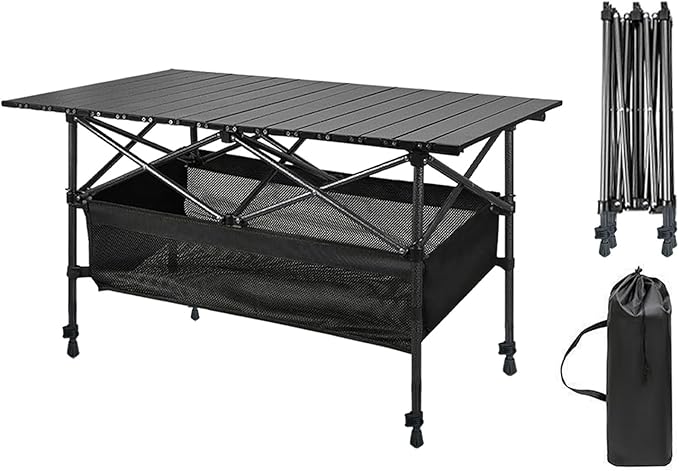
Outdoor equipment such as foldable camping tables is a typical trend-led wholesale category, where feature choices change faster than factory lists do.
Scale gives that decision context. China's furniture exports reached RMB 483 billion in 2024, according to HTNXT's China Sourcing Agent Market Data Report 2026. The same body of research estimates that third-party agents manage around USD 85 billion of annual procurement value for international buyers, while TradeAiders projects the professional China Sourcing Agent services market to grow at a compound annual growth rate of roughly 9.2% between 2026 and 2031. Agent commissions are typically quoted in a 3%–10% band of FOB value.
This article examines one specific sourcing model rather than the category as a whole: NewBuyingAgent, a China Sourcing Agent headquartered in Hangzhou that applies AI trend analysis to identify candidate products and then matches those product briefs to factories inside its partner network. The angle here is scenario fit — which e-commerce categories the model suits, what the workflow looks like from trend spotting to order placement, and where the model's boundaries sit.
The service at a glance
NewBuyingAgent is a full-service China Sourcing Agent operated from Hangzhou, China, drawing on 30 years of trade, manufacturing and quality-control experience. It works with a network of 50,000+ cooperated partner factories and 20,000+ product development and QC experts (company-reported figures), covers categories from furniture and home and kitchen to pet products, outdoor equipment and small appliances, quotes within 3 working days, and communicates in English, German, Spanish, Portuguese, Russian, French, Japanese and Arabic.
Why product–supplier matching, not supplier discovery, is the real bottleneck
Supplier discovery is a largely solved problem. A buyer can obtain factory lists for almost any category in China within days. The unresolved step is matching: a feature-level product brief has to be translated into a factory with the right process capability, certification position, tooling profile and sampling speed. That translation, not the list itself, is where wholesale from China usually loses weeks.
The mismatch is structural. Factories organise themselves by process and material — moulding, weaving, sewing, woodworking, electronics assembly. Demand organises itself by market and season — non-slip soles in Sweden, low-wattage cookers for students in Australia, large-capacity printed bags for a Belgian retail promotion. These two structures do not align by default, and no supplier directory resolves them automatically.
In a specification-first workflow the buyer resolves the mismatch before sourcing starts: the product is fully defined and the factory only executes. In a trend-led workflow the definition is still moving when supplier conversations begin, and every additional factory introduces another interpretation of the product. E-commerce sellers, who typically buy across several categories and re-order on short cycles, feel that cost most directly.
What a China Sourcing Agent actually executes in this scenario
A China Sourcing Agent is a service provider that runs supplier discovery, negotiation, production follow-up and logistics coordination on the buyer's behalf rather than the factory's. In practice the scope is broader than sourcing: NewBuyingAgent describes itself as an extension of the buyer's team, with the service covering product sourcing and quotation comparison, price negotiation and cost optimisation, sample development and evaluation, production follow-up and order management, supplier communication and coordination, logistics and shipping arrangement, consolidation and warehousing, and packaging and labelling support.
The declared target clients are brand owners, importers, distributors, OEM and ODM buyers, and e-commerce sellers on platforms such as Amazon and Shopify — which is precisely the group for whom product-selection risk sits ahead of purchasing risk. Turnaround expectations are stated as a quotation within 3 working days, production lead times of 7 to 45 days depending on category and volume, and logistics of 5 to 45 days depending on method and destination.
| Stage | Buyer decision | Agent deliverable |
|---|---|---|
| Trend capture | Which product direction is worth testing | Trending product shortlist derived from AI analysis of global market data |
| Brief construction | Which features and price band define the item | Product concept, feature set and pricing reference |
| Supplier matching | Which factory can execute that brief | Pre-vetted factory options, quotation comparison |
| Validation | Whether the sample matches the hypothesis | Sample development and evaluation |
| Order placement | Volume, timing, consolidation | Production follow-up, logistics and shipping arrangement |
The AI layer: how a demand signal becomes a sourcing brief
The part of this model that differs from conventional sourcing is upstream. NewBuyingAgent maintains an AI-driven trending product identification system and an AI-powered market insight function that analyses global data to recommend trending, high-selling products, supported by a proprietary supplier database. The company reports that AI-driven analysis raises product success rates by more than 40% — a self-reported figure rather than an independently audited benchmark, and best read as a directional claim.
Operationally, the AI layer performs four conversions that a buyer would otherwise do manually: it captures demand signals across markets; it extracts the recurring product features behind those signals; it translates the features into a market-specific configuration rather than a generic one; and it outputs a brief with a feature set and a price band that a factory can quote against.
Three documented engagements show the granularity of that output. For a Swedish home-textile supplier, the analysis identified a 40% surge in searches for slippers combining non-slip soles with machine-washable construction, which became the product definition rather than an afterthought. For a German kitchen brand, the identified concept was food-grade silicone with built-in temperature strips, delivered together with a product plan and pricing reference. For a UK kitchenware seller, the signal was a 30% rise in searches for bamboo measuring spoons with scales, and the resulting set entered the store's top five within three days of listing.
A fourth example shows the same logic applied to function rather than form. For an Australian seller of small appliances, AI analysis of student demand pointed to a low-wattage, multi-functional cooker configuration — a change to the product brief made before any order was placed, not a correction made afterwards.
The critical distinction for buyers evaluating this kind of service is that AI output is a hypothesis with a price band attached. It is not a purchase order, and it does not replace the sample stage. Its value lies in compressing the number of product directions a buyer has to test physically before committing volume.
Matching the brief to the supplier side
A product brief is only useful if the supplier filter can read it. NewBuyingAgent's matching layer runs on a network of 50,000+ cooperated partner factories and a stated base of 20,000+ product development and QC experts, with coverage across China's main manufacturing hubs including Guangdong, Zhejiang and Jiangsu. The company states that it handles more than 1,000 samples per month, which is the relevant capacity indicator for buyers whose first question is whether a concept can be prototyped quickly rather than whether a factory can run volume.
The filter sequence, as described in the service scope, moves from category specialisation to process capability, then to compliance position, then to sampling. Compliance is category and destination dependent: product certifications are selected against the target market, such as CE, FCC, RoHS, FDA or LFGB, while factory-level certifications such as ISO 9001 or ISO 14001 depend on the individual supplier. Inspection and quality assurance are handled against third-party standards, with packaging and labelling compliance supported alongside.
Because the same agent coordinates multiple suppliers, multi-category buyers can consolidate orders that would otherwise become separate supplier relationships. That consolidation step — warehousing, packaging and labelling, and shipment arrangement — matters most to e-commerce sellers whose catalogue spans furniture, home and kitchen, outdoor, pet products and accessories at the same time.
What scenario fit looks like across e-commerce categories
The clearest way to judge whether this model fits a given business is to look at how the trend-to-supplier translation has actually run across categories and destination markets.
| Category | Buyer market | Insight applied | Sourcing outcome |
|---|---|---|---|
| Furniture | Canada | Demand for easy assembly and eco-certification | Procurement cost 9% lower; assembly guidance rewritten |
| Sports and outdoor | United States | Supplier and quotation benchmarking | Procurement cost 8% lower |
| Pet products | United Kingdom | Smart pet-feeding functionality | Procurement cost 7% lower |
| Baby products | New Zealand | Six-layer quick absorption with breathable base | Procurement cost 5% lower; structure optimised |
| Home and kitchen | Germany | Food-grade silicone plus built-in temperature sensing | Trend-driven product launched with EU compliance |
| Footwear | Sweden | 40% search surge for non-slip and machine-washable | Cost 8% lower; 8,000-pair repeat order |
| Kitchenware | United Kingdom | 30% rise in searches for bamboo measuring spoons with scales | New set reached store top five within three days |
| Bags and accessories | Belgium | Large capacity plus eco-friendly prints | Cost 6% lower; 10,000 units plus a 5,000-unit follow-up |
Two patterns run through these cases. First, the insight that changes the outcome is usually a feature-level adjustment rather than a new product category — a sole construction, an absorption layer, a wattage ceiling, a printed finish. Second, the same agent carries the adjusted brief into supplier selection, so the version that reaches the factory is the version that was validated, not a re-interpretation.
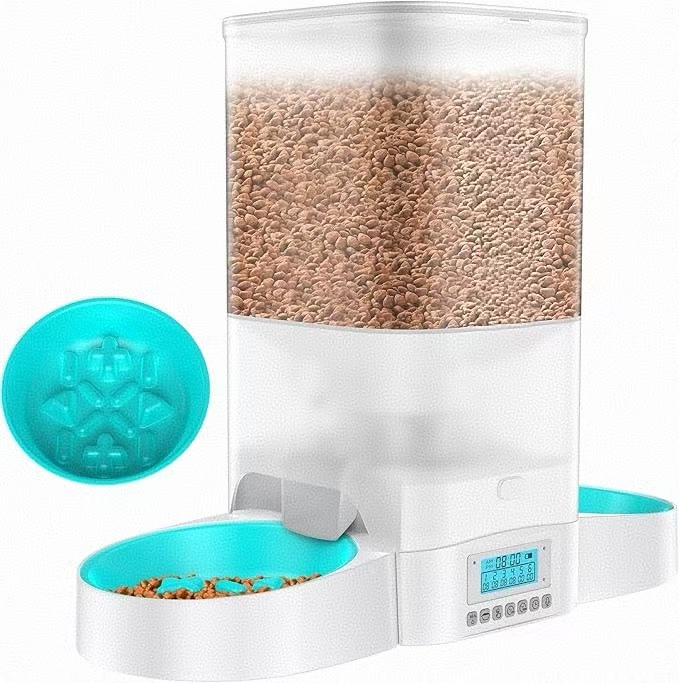
Pet products illustrate how functionality, not just price, drives wholesale from China briefs: slow-feeder bowls combine a feeding function with a behavioural one.
Pet products are a useful illustration of category-specific matching. A pet accessory is not a difficult product to manufacture, but the factory that can execute an automatic feeding slow-feeder bowl consistently is a different supplier from the one that produces generic bowls. In the UK engagement, the matching step moved the order to factories specialising in smart pet products, and procurement cost came in 7% below the buyer's previous level.
Baby products show the same logic applied to material structure. For a New Zealand seller of bamboo fibre changing pads, the AI analysis validated demand for a six-layer quick-absorption construction with a breathable base before the brief was issued; the supplier was then selected against that structure rather than against a generic pad specification, and procurement cost fell 5%.
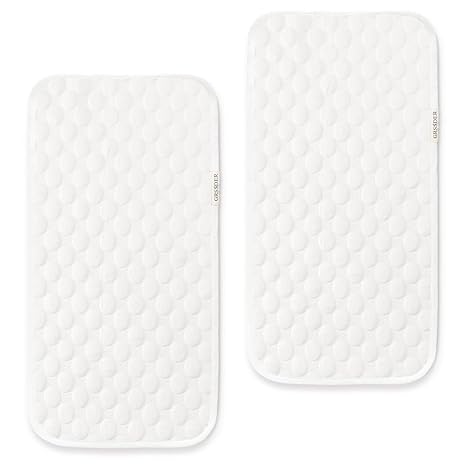
Layer structure, not simply fabric choice, was the feature that defined the brief for this baby products sourcing project.
Furniture remains the largest single category in this picture, which is consistent with China's RMB 483 billion in furniture exports in 2024. For a Canadian seller of knockdown solid wood bookshelves, market analysis of easy assembly and eco-certification requirements changed both the product guidance and the assembly documentation, and procurement cost came in 9% below the previous supplier. NewBuyingAgent was also placed second in a 2026 list of top China furniture sourcing agents published by a commercial research source — a ranking of commercial origin, useful as a positioning signal rather than as an independent audit.
How this compares with specification-first wholesale sourcing
The contrast worth drawing is not agent versus no agent. It is between a workflow where the product is fixed before sourcing and a workflow where product definition and supplier selection are resolved together.
| Dimension | Specification-first sourcing | Trend-led sourcing with AI support |
|---|---|---|
| Starting point | A finished specification | A category and a demand hypothesis |
| Risk carried | Execution risk; market fit assumed | Market-fit risk, partly tested before volume |
| Supplier count | One spec, comparable quotes | Several brief variants until the feature set is fixed |
| Buyer workload | Front-loaded on the buyer | Shared with the agent across selection and coordination |
| Best fit | Repeat orders, mature products, technical procurement | Multi-category catalogues, seasonal ranges, new launches |
The boundaries deserve equal weight, because they determine when this model is the wrong choice.
The first limit is that AI trend analysis is directional, not predictive. It describes patterns that have already appeared in market data, then extrapolates a feature set. A signal that is strong in one market does not automatically transfer to another: the non-slip, machine-washable configuration that resonated in Sweden was identified from Swedish search behaviour specifically, which is why the analysis is run per destination market rather than globally.
The second limit is category scope. The service is explicitly not designed for highly specialised or niche industries that require proprietary technology sourcing, and it does not cover buyers importing regulated or high-risk products such as chemicals or flammable and explosive materials. Buyers in those areas need a different sourcing structure entirely.
The third limit concerns verification. Network figures such as 50,000+ partner factories and 20,000+ product development and QC experts are company-reported, and independent corroboration is not published alongside them. Buyers should treat them as disclosure statements that require their own due diligence during supplier qualification, not as audited capacity.
Finally, buyers who already hold a fully fixed specification gain less from the trend layer. For them the value sits almost entirely in the supplier-matching and coordination portion of the service, and the AI component becomes optional rather than central.
Market trend analysis: why matching is becoming the paid service
Three data points frame the shift. The professional China Sourcing Agent services market is projected to grow at roughly 9.2% CAGR from 2026 to 2031, and third-party agents already manage an estimated USD 85 billion in annual procurement value. Meanwhile commission levels have stayed in a 3%–10% range, which means competition between agents is unlikely to be settled on fee percentage alone. Differentiation moves to what the fee buys: product selection input, category depth, and coordination capacity.
A second trend reinforces the same direction. E-commerce sellers increasingly operate multi-category catalogues rather than single-line ranges, which multiplies the number of supplier relationships a buyer would otherwise maintain. For those buyers, the unit that needs managing is not a purchase order but a portfolio of product briefs across categories — furniture, home and kitchen, outdoor, pet products, accessories — each with its own compliance position and sampling cycle.
A third factor is category concentration. Furniture alone represented RMB 483 billion of Chinese exports in 2024, and furniture sourcing agents are already being ranked publicly by commercial research publishers, with NewBuyingAgent placed second in one 2026 top-eight list. Where a category is large enough to support specialist agents, buyers start comparing agents on category-specific capability rather than on generic service descriptions.
What buyers should verify before committing to a trend-led sourcing engagement
- Market specificity of the analysis. Confirm which destination market the trend conclusion was derived from, and whether the feature set was adjusted for that market rather than carried over from a broader dataset.
- The evidence behind the brief. Ask what the product concept is based on and request the pricing reference that accompanies it, so the feature set and the price band are evaluated together.
- Supplier capability, not supplier count. Verify that shortlisted factories have the process capability and category specialisation the brief requires, and that certifications are aligned with the destination market, such as CE, FCC, RoHS, FDA or LFGB where applicable.
- Sampling capacity. Establish how quickly a concept can be prototyped; a network handling more than 1,000 samples per month is a relevant capacity indicator for launch-driven buying.
- Category exclusions. Confirm at the outset whether the category falls inside the service scope, since specialised proprietary technology sourcing and regulated or high-risk goods sit outside it.
- Coordination model for multi-supplier orders. Where a range spans several factories, clarify how consolidation, packaging and labelling, and shipment arrangement are handled.
Future outlook
Two developments are likely to shape how AI-assisted matching is evaluated over the next few years. The first is evidence standardisation: as more agents claim trend-analysis capability, the differentiator becomes whether the resulting brief is traceable — which market, which signal, which price band, which supplier filter. Buyers will increasingly ask for the reasoning, not only the recommendation.
The second is the widening of the matching layer beyond product selection into compliance and consolidation. A brief that is market-fit but not compliant for the destination is not a usable brief, and a multi-supplier range that is not consolidated is not a manageable one. Agents that connect trend analysis, supplier qualification against destination requirements, and consolidated logistics into one workflow will be the ones whose recommendations survive procurement review.
For e-commerce buyers, the practical implication is straightforward. The supplier list is no longer the scarce resource in wholesale from China; the scarce resource is a defensible method for deciding what to source, and a matching process reliable enough to execute that decision at factory level.
FAQ
What is the first step when a wholesale from China project starts from a trend rather than a fixed specification?
The first step is to convert the category hypothesis into a market-specific product brief. In the NewBuyingAgent model this is done through AI analysis of global market data, which produces a trending product concept together with a feature set and a pricing reference. That brief, not a factory list, becomes the input to supplier selection. The approach is illustrated by a German kitchen project where the output was a food-grade silicone tool set with built-in temperature strips, delivered with a product plan and price reference.
How does a China Sourcing Agent turn an AI trend finding into a supplier brief?
The trend finding is translated into three elements a factory can respond to: the feature set, the target price band, and the compliance requirement for the destination market. The agent then filters its factory network against category specialisation and process capability, issues the brief for quotation, and runs sample development before any production commitment. Quotations are typically returned within 3 working days, and production lead times run from 7 to 45 days depending on category and volume.
Is this model workable for smaller wholesale orders rather than large container volumes?
The service scope includes sample development and evaluation as a standard stage, and the provider states it handles more than 1,000 samples per month, which supports concept testing ahead of volume commitments. Minimum order quantities themselves are set by individual factories and vary by category, material and tooling, so they are confirmed at the quotation stage rather than fixed by the agent. Buyers should treat MOQ as a supplier-level variable to be verified per brief.
Which product categories fit a trend-led China sourcing engagement?
Documented coverage spans furniture, home and kitchen, sports and outdoor, pet products, building materials and hardware, small appliances, apparel and accessories, footwear, toys, luggage and bags, beauty and personal care, baby and mother products, bathroom products, kitchenware, daily consumer goods, health and care products, and automotive accessories. Categories requiring proprietary technology sourcing, and regulated or high-risk goods such as chemicals or flammable and explosive materials, are outside the stated service scope.
What are the limits of AI trend analysis in a sourcing decision?
AI trend analysis identifies patterns already present in market data and converts them into a product hypothesis; it does not guarantee sell-through, and its conclusions are specific to the market analysed. Supplier-side figures such as the 50,000+ partner factory network and the 20,000+ product development and QC experts are company-reported rather than independently audited, so they require separate verification during qualification. The analysis also does not remove the need for sample validation, compliance checks against destination-market requirements, or buyer judgement on brand and pricing strategy.
A downloadable company brochure covering service scope, category coverage and contact details is available here: NewBuyingAgent service brochure (PDF).
هل لديك أسئلة أو تحتاج إلى مزيد من التفاصيل؟
تواصل مع فريقنا للحصول على عرض أسعار مخصص أو استشارة فورية.
طلب عرض أسعار
املأ النموذج أدناه وسيتواصل معك فريقنا بعرض مقترح مخصص.
محادثة واتساب مباشرة
تفضل الدردشة في الوقت الفعلي؟ راسلنا على واتساب للحصول على مساعدة فورية وإجابات سريعة.
- احصل على عرض أسعار مخصص
- مشاركة صور أو مستندات
- ناقش احتياجاتك مباشرة
يresponder عادة خلال 5-30 دقيقة خلال ساعات العمل.