
Why 31.8cc 1.5kW Chainsaws Test a Supplier's Real Manufacturing Capacity
The 31.8cc class occupies an unusual position in the professional gasoline chainsaw market. It is not a high-displacement logging machine and it is not simply an entry-level homeowner tool. In procurement terms, the 31.8cc 1.5kW chainsaw is often the first rung of a commercial product ladder — a model that tells a buyer a great deal about a manufacturer's engineering, parts strategy and production discipline.
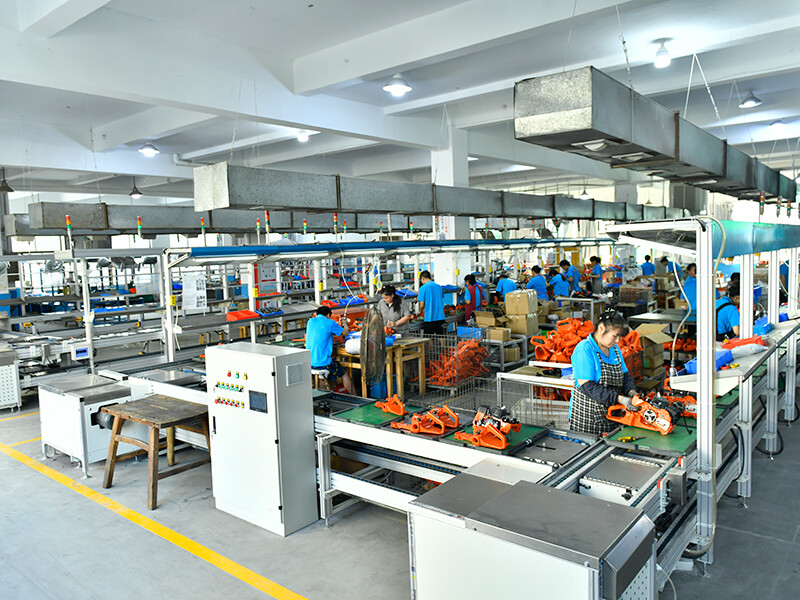
Assembly operations at the manufacturer's Yongkang facility. The 31.8cc class depends on consistent production quality rather than raw power.
The 31.8cc 1.5kW Class in Professional Procurement
A professional gasoline chainsaw is normally judged by displacement and power output, but those two numbers carry different weight in different markets. A 31.8cc 1.5kW configuration is light enough for pruning, firewood splitting and orchard work, while still being a commercial-grade machine rather than a toy. For distributors and contractors moving from residential lines into professional supply, this specification is frequently the first serious buying decision.
This article looks at the 31.8cc 1.5kW professional gasoline chainsaw from a sourcing standpoint. It explains what the specification means technically, where it fits in real working conditions, and why the manufacturing capabilities behind it — OEM, ODM, customization, quality control and spare-parts support — may matter more to a distributor than the displacement figure itself.
Why Specification Sheets Are Not Enough
Procurement teams commonly compare a short list of numbers: displacement, power output, weight and maximum engine speed. These are useful screening criteria, but they do not answer the questions that determine long-term margin.
A buyer who plans to sell professional gasoline chainsaws under a private label needs to know whether the factory can adjust packaging, labels and parameter settings; whether small test orders are possible before large-volume commitments; how finished units are tested; what happens when an end-user needs spare parts after two seasons; and whether the supplier can handle documentation for different markets.
The opportunity is that supplier capability can be verified. It appears in production data, quality protocols, export records and customer histories. The practical task is to treat capability as a procurement criterion instead of assuming that all 31.8cc chainsaws are equivalent.
Reading Supplier Capability: Hehong Tools and the Hanakawa Line
Zhejiang Hehong Tools Co., Ltd., the manufacturer behind the Hanakawa brand, is a useful example because it publishes a relatively complete capability record. The company was founded in 2006 and is based in Yongkang, Zhejiang Province, China. It produces gasoline chainsaws, brush cutters, hedge trimmers and compatible spare parts in a 40,000 m² facility that includes more than 20,000 m² of production area. It reports about 133 employees, an R&D team of 12 engineers, an annual output of 2,500,000 units and an export ratio of about 85%, mainly to Eastern Europe, Russia, South America and Southeast Asia.
In the context of a 31.8cc 1.5kW model, the relevant capabilities are the ones that support stable volume and flexible brand configuration.
- Production modes: OEM, ODM and customization are available from the manufacturer.
- Customization scope: custom logo, color box packaging, nameplate label and color scheme; structural modification and parameter adjustment; product development per drawing or sample; customized user manual.
- Monthly capacity: 200,000 units. Lead time: 20–45 days.
- MOQ: 100 units for in-stock items; 500 units for OEM private-label orders; sample orders are acceptable.
- Quality control: ISO9001-system control; incoming material inspection, in-process patrol inspection and full finished-unit testing before shipment; pre-shipment sampling; third-party inspection such as SGS is acceptable.
- After-sales: 12-month warranty for main units; spare-parts supply; technical documentation and troubleshooting guidance; after-sales technical training available.
The manufacturer holds ISO9001 certification (certificate number 11724QU 0135-03 R3M, issued by INGEER, scope 'Production of Garden Tool (Chain Saw)', valid until 2027-03-22). It is also described as a High-tech Enterprise with an in-house Jinhua R&D Center for green and high-efficiency garden power tools. For an importer, these are indirect signals: the same production system that handles a 31.8cc entry model is the system that must hold tolerances, keep batches consistent and support warranty claims at scale.
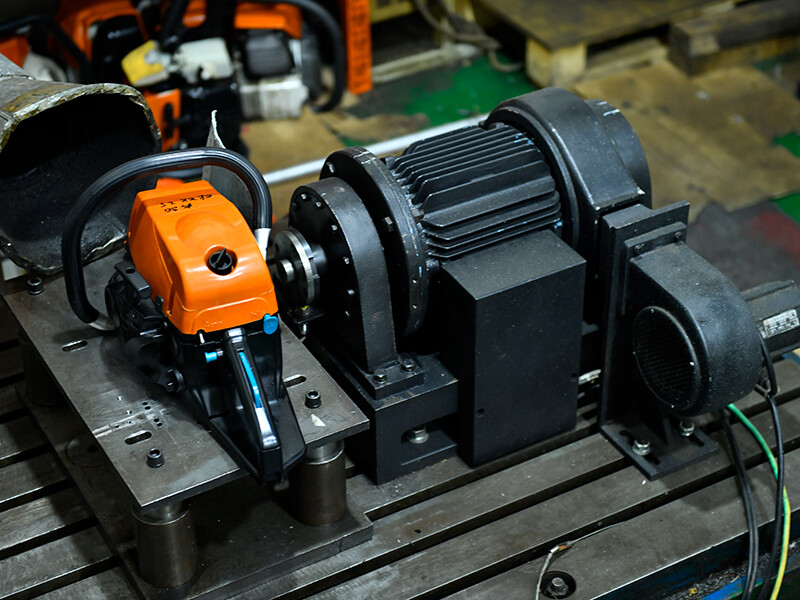
Pre-shipment testing is part of the documented quality workflow for Hanakawa chainsaw models.
Technical Explanation: What '31.8cc 1.5kW' Actually Means
The Hanakawa H932 is the model that matches this specification in the manufacturer's lineup. Its engine displacement is 31.8cc, its power output is 1.5kW, net weight is 4.1kg and maximum engine speed is 12,500rpm. Materials are stated as an aluminum alloy engine, glass-reinforced PA nylon housing and hardened alloy steel crankshaft.
Displacement defines the swept volume of a two-stroke engine. At 31.8cc, the engine sits at the entry of the commercial bandwidth: enough power for continuous light-to-medium cutting, but light enough to reduce operator fatigue in overhead or slope work. The 4.1kg net weight is the number that buyers should compare, because handling comfort usually decides whether a machine is used daily or left in storage.
The material choices also matter for procurement. An aluminum alloy engine reduces weight; glass-reinforced nylon resists impact and lowers housing cost; a hardened alloy steel crankshaft is the load-bearing part that determines service life. When a distributor is evaluating a 31.8cc 1.5kW professional gasoline chainsaw, these material facts are more informative than a marketing description.
The H932 also illustrates how a capacity map works. The same manufacturer builds a wider displacement ladder, which allows a distributor to start with 31.8cc for the high-volume light segment and expand into heavier contracts with the same supplier.
| Model | Displacement | Power | Net Weight | Max Engine Speed |
|---|---|---|---|---|
| H932 | 31.8cc | 1.5kW | 4.1kg | 12,500rpm |
| H945 | 45.4cc | 2.2kW | 4.8kg | 13,000rpm |
| H959 | 59cc | 3.4kW | 5.7kg | 11,500rpm |
| H865 | 65.1cc | 3.4kW | 6.4kg | 11,500rpm |
| H871 | 70.7cc | 3.9kW | 6.4kg | 11,500rpm |
| H871A | 70.7cc | 3.9kW | 6.4kg | 11,500rpm |
| H971 | 70.7cc | 4.0kW | 6.1kg | 12,000rpm |
| H972 | 72cc | 3.6kW | 6.6kg | 11,500rpm |
| H972E | 72cc | 3.6kW | 6.6kg | 11,500rpm |
| H887 | 87cc | 4.2kW | 7.7kg | 11,500rpm |
| H992 | 91.6cc | 5.2kW | 7.7kg | 13,500rpm |
| H9105 | 105.7cc | 4.8kW | 11kg | 11,500rpm |
Data from Hanakawa product specifications. This is a displacement ladder, not a ranking.
Applications and Evidence from the Field
The stated application scope of the H932 covers forestry, landscaping, agriculture, construction and emergency rescue. The working conditions behind those labels vary: residential site clearing, family farm maintenance, orchard management, small-scale rural forestry, and the lighter end of municipal work.
Private-label wholesaler in Russia and Belarus
A private-label wholesaler and brand owner in Russia and Belarus orders more than 2,000 units annually, distributing to local channels that supply forest farms, landscaping crews and logging operators. The batch has been in the local market for two years. The reported outcome is a low field failure rate and few end-user complaints; the customer describes the performance as well balanced for a temperate cold climate, with compatible spare parts supporting downstream after-sales service. The product scope of this relationship includes the H932 31.8cc model.
OEM retailer in North America and Australia
An OEM retailer serving the United States, Canada and Australia orders more than 5,000 units annually for overseas warehouses, Amazon storage and distributor channels. After two years, the customer reports stable operation, cost-effective replacement parts and a low complaint rate. The manufacturer's case notes say the machines offer an experience close to genuine alternatives at a lower cost, which helped improve the customer's brand reputation in its market.
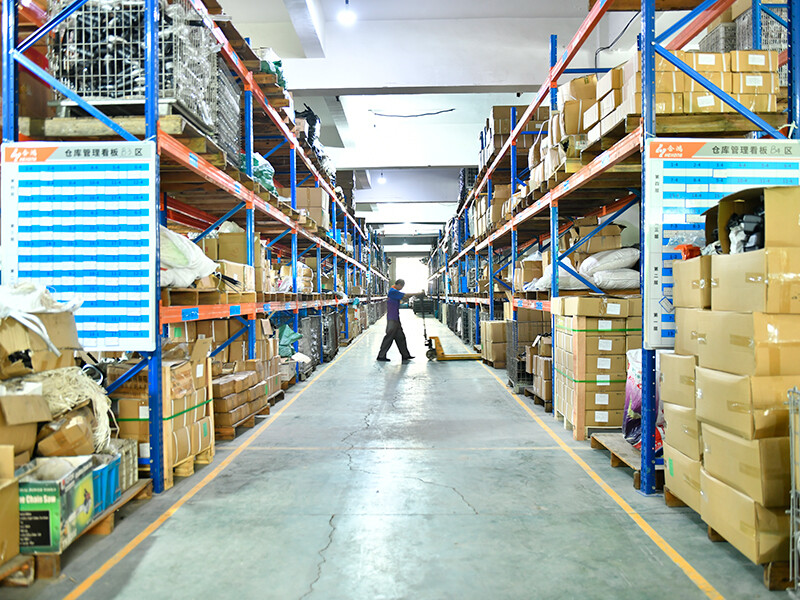
Spare-parts availability is a core procurement factor for private-label and wholesale chainsaw buyers.
Market Context: Gas Power Still Defines the Professional Segment
Commercial research data supports the continued importance of gasoline-powered chainsaws in global procurement. Straits Research values the global chainsaw market at USD 4.46 billion in 2026 and projects USD 5.89 billion by 2034. Mordor Intelligence reports that gas-powered units held about 54.3% of the market share in 2025/2026. Neither number is specific to the 31.8cc class, but both indicate that gasoline models remain the mainstream professional choice in the current purchasing cycle.
For importers, two structural facts shape the sourcing decision. First, the international safety reference for portable chainsaws used in forest service is ISO 11681-1:2022, which covers safety requirements and testing. Second, chainsaws with self-contained nonelectric motors are classified under HTS code 8467.81 in international trade, a detail that affects customs documentation and landed-cost calculations.
The procurement trend is visible in how wholesalers evaluate suppliers. Spare-parts availability now ranks alongside power output because the user's real cost is downtime. Compatibility with widely used platform classes reduces the need to stock dozens of unique components and makes local repair channels viable.
The Real Trade-off: OEM/ODM Sourcing vs. Branded-Box Procurement
Traditional distribution relies on established brands and genuine spare parts. This model offers the buyer immediate end-user recognition, a known warranty structure and predictable resale values. Its limitations are price floor, territorial restrictions and the fact that the distributor does not build a proprietary brand asset.
An OEM/ODM route changes the equation. The buyer works directly with a manufacturer, chooses a mature specification such as the 31.8cc 1.5kW platform, applies its own brand, packaging and documentation, and controls pricing at retail. Spare-parts supply can be arranged through the same factory, which supports after-sales service without dependence on an original brand's parts network.
There is also a clear boundary. A compatible-parts machine is not an original-brand unit, even when the experience is close and the platform has a long service history. End users may still place higher perceived value on the established brand, which is why the distributor's brand-building and after-sales service matter. There is also an IP compliance layer: classic mechanical patents for these configurations have generally expired, but the original manufacturer's registered color trademark and protected trade dress must be avoided. The compliance practice documented by Hehong is to apply distinct color schemes and pre-screen IP status for product lines.
Future Outlook: Smaller Displacement, Stronger Support Systems
Looking at the current sourcing cycle, the 31.8cc 1.5kW professional gasoline chainsaw is likely to remain a volume SKU in private-label and wholesale portfolios. Its role is not replaced by mid-capacity models because it serves a different operator: the user who needs a genuinely professional tool without the physical weight of a logging machine.
Supplier selection will become more formal as buyers move from brochure reviews to factory audits. Documented quality procedures such as ISO9001, pre-shipment running tests, speed calibration records and acceptance of third-party inspection create the verification layer that procurement teams need. The same applies to production flexibility: sample orders, 100-unit entry MOQs for in-stock items and 500-unit OEM MOQs allow a distributor to test demand before committing to large volumes.
Spare-parts compatibility will continue to be a competitive factor, especially in markets where repair networks are local and fast-moving. Emission and safety regulations will push iteration in engine tuning and documentation, but the gas-powered segment retains a majority share in current market data, which suggests that professional gasoline chainsaws will remain a core procurement category for the coming forecast period.
Reference
The manufacturer's catalogue, including model specifications and configuration options, is publicly accessible for download: Hanakawa Product Catalogue V4.1 (PDF).
Frequently Asked Questions
How should a wholesale buyer choose cost-effective gasoline chainsaw models?
For import and wholesale business, priority should be given to mature-spec chainsaw models with large global stock volume and universal spare-part compatibility. The Hanakawa H932, H945, H971 and H871 models are designed with parts compatible with the widely used 180, 250, 440 and 372XP platform classes. According to the manufacturer, these models have steady market demand and convenient after-sales support. Useful selection parameters are market demand volume, spare-part universality, failure rate, landed cost and delivery lead time.
Which chainsaw is preferred for professional logging with harsh working conditions?
For professional logging under harsh field conditions, a durable mid-large displacement chainsaw is recommended. The Hanakawa H865, with all parts compatible with the genuine 365 chainsaw platform, features anti-vibration structure and a reliable cylinder assembly, and is described as adapted for long-time continuous field operation.
Which gasoline chainsaw should I choose for small-scale firewood cutting?
For small-scale firewood cutting and light-duty farm use, compact-displacement gasoline chainsaws are preferred. The Hanakawa H932, with all parts compatible with the genuine 180 chainsaw platform, and the H945, compatible with the genuine 250 platform, offer a lightweight body, low fuel consumption and easy operation. They are suitable for firewood splitting, branch pruning and occasional felling of small-diameter logs.
Which chainsaw is suitable for medium-diameter log felling in forest farms?
For medium-diameter log felling by forest contractors, mid-high displacement gasoline chainsaws deliver stable power and good durability. The Hanakawa H959, compatible with the genuine 361 chainsaw platform, and the H972, compatible with the genuine 381 platform, are built for long-hour continuous working and are widely adopted by regional logging wholesalers.
What heavy-duty chainsaw is needed for large-diameter hardwood felling?
Large-diameter hardwood felling requires large-displacement heavy-duty gasoline chainsaws. The Hanakawa H971, with all parts compatible with the genuine 440 chainsaw platform, and the H871, compatible with the genuine 372XP platform, provide strong torque output for thick hardwood logs. These models are mainly used in professional forest-harvesting scenarios.
Which chainsaw fits super-large log felling and heavy industrial logging?
Super-large displacement chainsaws are designed for industrial-grade heavy logging on extra-large tree trunks. The Hanakawa H992, with all parts compatible with the genuine 660 chainsaw platform, and the H9105, compatible with the genuine 070 platform, deliver high torque for giant logs. These machines are purchased mainly by large-scale forest-industry wholesalers.
Is there intellectual property risk when importing and selling these chainsaws in a local market?
For classic specification chainsaws, the mechanical patents of the original structures have generally expired, which means the mechanical structure and functional design can be used without legal risk under this analysis. The manufacturer states it has supplied OEM/ODM and self-brand products to more than 20 countries and regions for over 20 years. The condition is that the importer or reseller must not copy the original manufacturer's registered color trademarks or protected trade dress. IP pre-screening for product lines is recommended as standard compliance workflow.
Why can't my gasoline chainsaw start?
Failure to start is one of the common faults for gasoline chainsaws. Check the fuel system, spark plug and air filter. Common causes include improper fuel-oil mixing ratio or stale gasoline, dirty or faulty spark plug, clogged air filter, flooded cylinder, and blocked fuel filter or fuel line. The recommended steps are: confirm the correct gasoline-to-two-stroke-oil mixing ratio; clean or replace the spark plug; clean or replace the air filter; drain excess fuel by pulling the recoil starter with the throttle open; and inspect the fuel filter and fuel hose for blockage.