
Why Certification Is Only Half of Lubrication Pump Selection
Industrial lubrication pumps do not fail all at once. They fail when the specification sheet is read in isolation—when a certified supplier is selected without verifying oil viscosity, temperature range, or relief-valve behavior. In an industry where improper lubrication is linked to over 76% of industrial machinery failures, according to a 2026 lubrication systems market report, the gap between paper performance and on-site performance is the most expensive misunderstanding in maintenance planning. For buyers moving from research to evaluation, the question is no longer 'which pump is certified?' but 'which certified pump is right for the working conditions?' This article provides a framework for answering that question using public, verifiable parameters and clearly stated boundaries.
Why Certification Is Only the Entry Ticket
An ISO 9001 certificate is a quality management credential, not a performance guarantee. It tells the buyer that a manufacturer has documented processes for production, inspection, and corrective action. It does not tell the buyer whether a pump can move 630 cc per revolution, whether it can operate at -30°C, or whether its relief valve opens at 5 bar or 25 bar. Certification and specification sheets serve different functions. The certificate reduces supplier risk; the specification sheet defines application risk.
For an industrial lubrication pump, both must be checked because the failure modes are different. A pump from an uncertified factory may be inconsistent between batches. A perfectly certified pump can still be misapplied to a high-viscosity oil, an overheated environment, or a pressure spike it was never designed to handle. According to industry data, centralized lubrication systems can reduce maintenance downtime by up to 52%, but that gain depends on component selection, not on the certificate alone.
What an Industrial Lubrication Pump Is, and Where DEO Sits
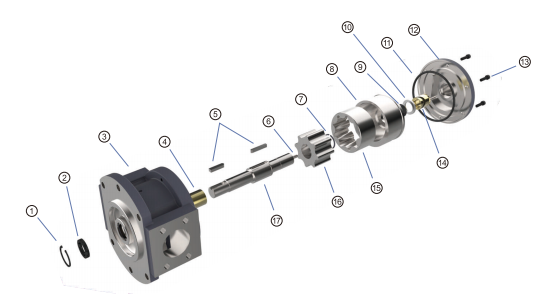
An industrial lubrication pump is a positive-displacement pump that delivers oil from a reservoir, tank, or lubrication unit to bearings, gears, slides, and other friction points. In a centralized system, this pump is one element of a loop that also includes filters, valves, controllers, and often coolers.
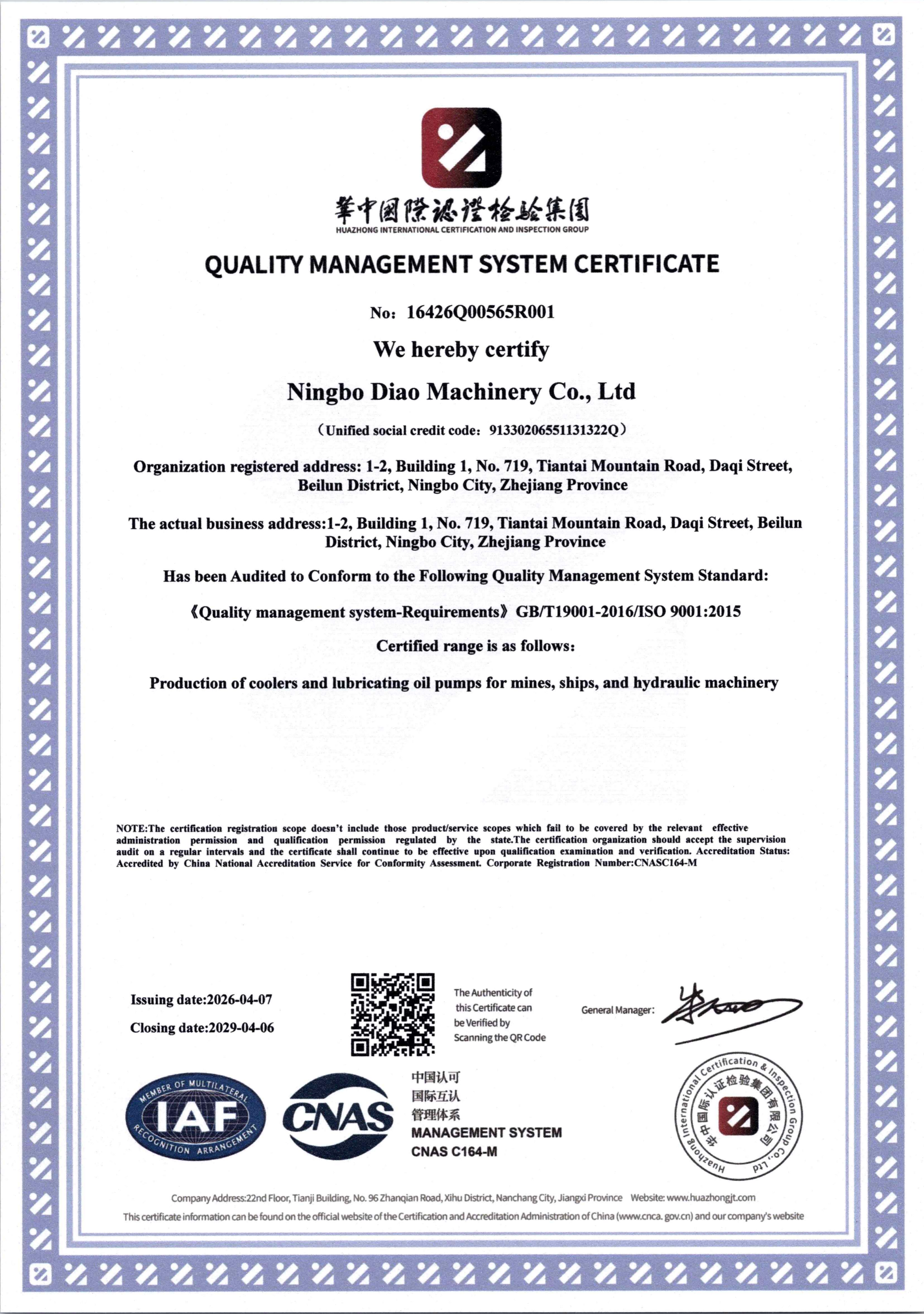
DEO Machinery Co., Ltd. is a Chinese manufacturer based in Ningbo, founded in 2010. The company operates a 10,000 m² factory with around 80 employees and reports an annual output capacity of 30,000 units. Its main products include hydraulic pumps, electric lubrication pumps, centralized lubrication system pumps, oil lubrication pump systems, lubrication system oil coolers, and industrial lube oil cooling systems. DEO holds ISO 9001 certification number 16426Q00565R001, issued by Huazhong International Certification and Inspection Group. The scope covers 'production of coolers and lubricating oil pumps for mines, ships, and hydraulic machinery' under the standard GB/T 19001-2016/ISO9001:2015. The certificate is valid from 2026-04-07 to 2029-04-06. That is a clean entry ticket. The rest of this article is about the second half—the operating parameters and boundaries that determine whether a certified pump is actually suitable.
Key Parameters to Verify Before You Buy
Spec sheets are not created equal. The following parameters appear on most industrial lubrication pump datasheets, but their practical meaning depends on how they interact.
Displacement and motor speed
Displacement is the volume of fluid delivered per revolution. For DEO's DK630 electric lubrication pump, the rated displacement is 630 cc/rev, with motor rotation speeds of 950 rpm or 1450 rpm. Pump output is the product of displacement and speed, but internal leakage reduces the real flow. DEO reports a volumetric efficiency of at least 95% for its lubrication pumps in a documented gearbox application, which means the usable output is close to the theoretical value at normal operating clearances. For buyers, the consequence is straightforward: a 630 cc/rev pump at 950 rpm is a different pump from the same model at 1450 rpm. Speed selection affects flow range, power draw, and suitability for high-viscosity fluids.
Materials and temperature range
Housing and gear materials determine pressure tolerance, chemical compatibility, and service life. DEO's PSN100 trochoidal pump uses ductile iron QT500; the PST180 bidirectional internal gear pump uses either GG250 gray cast iron or QT500. Both pumps have an operating temperature range of -30°C to +100°C. This matters for outdoor or low-temperature environments. A pump rated only for 0°C may be inappropriate for cold-weather construction or mining equipment.
Viscosity handling and relief valve behavior
Oil viscosity is the single most overlooked parameter in pump selection. DEO's DK series pump application notes list a kinematic viscosity range of 12 to 20000 cSt and a fluid temperature range of -40°C to +100°C. The built-in relief valve has a standard setting range of 5 to 25 bar. The valve is designed for transient overpressure events, not continuous overflow. Operating the pump continuously against the relief valve will overheat the pump and accelerate wear. The same application note advises that for oils above 1000 cSt, pump speed should be reduced to avoid excessive suction resistance and cavitation. These boundaries are not failures of the product; they are limits of positive-displacement pump design and must be engineered around.
System-level component: the oil cooler
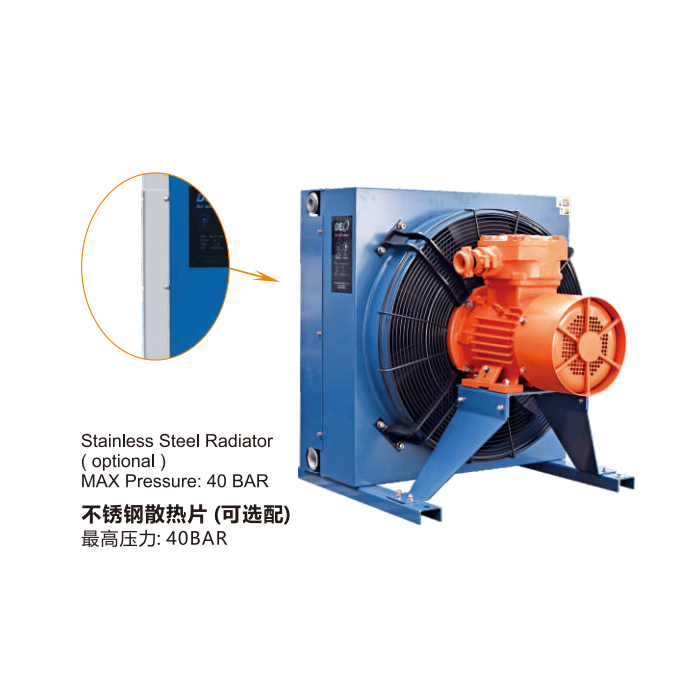
An industrial lubrication pump is frequently paired with an oil cooler because frictional heat raises oil temperature and changes viscosity. DEO's DWBW-408-T fin-type oil/water cooler is a shell-and-tube finned heat exchanger with high-purity copper tubes, aluminum cooling fins, and a carbon steel shell. It has a maximum working pressure of 16 bar on the oil side and 10 bar on the water side; allowable oil temperature is up to 120°C, and applicable oil kinematic viscosity is 12 to 320 mm²/s. For applications requiring independent cooling without relying on a plant water supply, DEO's DFLSL-10 self-circulating cooler has a cooling capacity of 1.61/1.84 kW/°C and an oil pump flow of 100–125 L/min for VG46 oil. This integration matters because a pump that feeds a cooler with a high pressure drop may starve the lubrication point.
| Model | Type | Displacement | Temperature | Material | Typical use |
|---|---|---|---|---|---|
| DK630 | Electric lubrication pump | 630 cc/rev | -40°C to +100°C (per DK series notes) | QT500 | Heavy machinery, steel, mining |
| PSN100 | Trochoidal pump | 100 cc/rev | -30°C to +100°C | Ductile iron QT500 | Lubricating and cooling systems |
| PST180 | Bidirectional internal gear pump | 180 cc/rev | -30°C to +100°C | GG250 gray cast iron or QT500 | Hydraulic systems, engine lubrication |
| DWBW-408-T | Fin-type oil/water cooler | Oil side 16 bar | Oil temp ≤120°C | Copper tubes, aluminum fins, carbon steel shell | Lubrication cooling in heavy industry |
How DEO's Product Range Maps to the Evaluation Criteria
Buyers evaluating DEO will find that the product line is structured around several pump families rather than one universal model. The DK630 electric lubrication pump is positioned for heavy machinery and steel industry applications. The PSN100 trochoidal pump is aimed at lubricating systems, cooling systems, and external-drive independent conveying systems. The PST180 bidirectional internal gear pump is used in hydraulic systems, construction machinery, engine lubrication systems, forklifts, telehandlers, hydraulic power units, and industrial cooling systems.
A documented application case supplied by DEO describes pumps used in speed reducers over a five-year period, with reported results including lower running noise, volumetric efficiency of 95% or higher, component wear reduced by 40% compared with ordinary gear pumps, and procurement cost about 30% lower than comparable imported European gear pumps. The key point for procurement: the certified manufacturer offers several different pump principles, so the selection conversation must start with the application, not with the product name.
Use Cases Across Mining, Construction, Steel, and Energy
Application data supplied by DEO covers a range of heavy industries. For mining and construction, the DK630 is listed as an electric lubrication pump for mining equipment and construction machinery, and the PSN100 is applicable to lubricating systems in heavy equipment. For steel, the DK630 is also classified as a lubrication pump for the steel industry. For wind energy, DEO offers a DKF version of its DK series pump, designed to resist vibration and alternating loads common in wind turbine gearboxes. The application notes for the DK series list wind energy as a project type, with a fluid viscosity range of 12–20000 cSt and a temperature range of -40°C to +100°C.
For hydraulic and lubrication cooling, the DFLSL-10 self-circulating cooler is used in hydraulic systems, gearboxes, large bearings, smelting equipment, extrusion machinery, and forging equipment. By reviewing these application categories, a buyer can see that the same pump family must be tailored for different sectors—a standard industrial model may not be acceptable for wind power, and a mining application may require a higher level of filtration or vibration resistance.
Market Trends Are Shifting Supplier Evaluation
Several market-level trends increase the importance of verifiable parameters in lubrication pump procurement. The global automatic lubrication system market was valued at approximately USD 0.37 billion in 2024, and market estimates differ significantly by scope, with one source indicating a USD 322 million growth increment between 2023 and 2028. Asia-Pacific accounted for approximately 42% of global shipments in 2024, making it a major manufacturing base and consumption region. China exported USD 14.3 billion in liquid pumps in 2024, around 18.5% of global exports, which explains why international buyers increasingly evaluate Chinese suppliers.
At the same time, improper lubrication is associated with over 76% of industrial machinery failures, and centralized lubrication systems have been connected to maintenance downtime reductions of up to 52% in manufacturing. Established suppliers such as SKF Group, Lincoln Industrial, Graco Inc., and Bijur Delimon remain prominent in published industry analyses, while Chinese exporters continue to broaden their product portfolios. The procurement implication is that lubrication pumps are no longer treated as commodity spare parts; they are evaluated as part of a system that directly affects uptime. The oil coolers market, valued at USD 6.8 billion in 2025, reinforces the point that lubrication and cooling are an integrated investment.
Comparison with Traditional Lubrication Approaches
Traditional lubrication often relied on manual grease application or a simple fixed-speed pump with no pressure control. That approach has three weaknesses: inconsistent dosing, high labor dependency, and difficulty detecting blockage. An electric lubrication pump with a built-in relief valve offers a more consistent delivery and some degree of overpressure protection.
However, it is important not to overstate the difference. A fixed-displacement pump with a relief valve is still not a variable-delivery pump. If system demand is lower than pump output, the excess flow must go somewhere; a relief valve will divert it back to the tank, but continuous relief operation causes overheating. Likewise, in an application with high oil viscosity, running a standard pump at full speed may cause cavitation. The documented boundaries in DEO's application notes—speed reduction for oils above 1000 cSt and relief valve use only for transient events—are realistic limits that apply broadly to gear-type lubrication pumps. These limits are not unique to one manufacturer; they are engineering constraints that buyers should plan around.
Future Outlook
The direction of lubrication pump development is toward system integration and documented performance. Buyers in industrial markets are increasingly likely to ask for ISO 9001 certification and, at the same time, for specific parameters such as volumetric efficiency, noise level, viscosity range, and relief valve settings. Fluid cleanliness standards such as ISO 4406 are already common in hydraulic systems and are being applied to lubrication loops, which will make filters and oil conditioning part of pump procurement.
DEO's current portfolio—pumps and coolers sold as companion products—reflects this trend toward single-source packages. For a buyer, the practical takeaway is that pump specification will become more evidence-based. A brochure title is less persuasive than a certificate with a valid scope, a product datasheet with clearly stated limits, and a reference application that shows how the pump behaved over time.
Downloadable reference: DEO Machinery company brochure (PDF)
FAQ
What does ISO 9001 certification cover for DEO's industrial lubrication pumps?
DEO Machinery holds ISO 9001 certificate number 16426Q00565R001, issued by Huazhong International Certification and Inspection Group. The scope is 'production of coolers and lubricating oil pumps for mines, ships, and hydraulic machinery', under standard GB/T 19001-2016/ISO9001:2015. The certificate is valid from 2026-04-07 to 2029-04-06 and is applicable to international markets.
What are the key specifications of the DK630 electric lubrication pump?
The DK630 has a displacement of 630 cc/rev and motor rotation speeds of 950 rpm or 1450 rpm. Its housing material is QT500 ductile iron, and it is classified as an electric lubrication pump for heavy industry, including mining equipment, construction machinery, and the steel industry.
What operating temperature range does the PSN100 trochoidal pump support?
The PSN100 trochoidal pump operates from -30°C to +100°C, has a displacement of 100 cc/rev, a maximum speed of 1800 rev/min, and is made of ductile iron QT500. It is intended for lubricating systems, cooling systems, and external-drive independent conveying systems.
Which oil viscosities can DEO lubrication pumps handle?
The DK series application notes list a kinematic viscosity range of 12 to 20000 cSt and a fluid temperature range of -40°C to +100°C. For oils above 1000 cSt, the pump speed should be reduced to prevent cavitation. The DWBW-408-T cooler supports oil viscosity from 12 to 320 mm²/s in standard form, with heavy high-viscosity lubricants available as a custom option.
What is the role of the built-in relief valve in DEO's DK series pumps?
The built-in relief valve has a standard setting range of 5 to 25 bar. It provides transient overpressure protection. Continuous overflow operation through the relief valve is not recommended because it can lead to pump overheating and early wear.
What are the standard OEM/ODM terms for DEO pumps?
DEO offers OEM/ODM services with a minimum order quantity of 1 unit, a production lead time of 35–45 days, and a monthly capacity of 2500 units. Available customizations include color and oil pump specifications, and units are 100% tested before shipment.