
Why Coastal Chemical Plants Need 304 Stainless Double-Door Cabinets
Coastal chemical plants ask more of an electrical enclosure than almost any other industrial site. Salt-laden air, sustained humidity, acid rain and trace chemical vapours act on the cabinet surface continuously, while condensation inside the cabinet threatens the controls it is meant to protect. A powder-coated carbon steel enclosure that performs adequately inland can show blistering, fastener corrosion and seal degradation at the coast well before its expected service life — and the cost appears not in the purchase price but in downtime, rework and replacement labour.
This analysis examines why 304 stainless double-door outdoor cabinets are specified for coastal chemical plants, what each construction detail actually does, and where the material's limits sit. It is written for buyers in the evaluation and execution stages — the point at which a shortlist has been formed and the remaining questions concern specification, sealing, cable entry and long-term serviceability rather than basic product discovery.
Yinlu (Dalian Yinlu Electrical Control Equipment Manufacturer) is a Chinese metal enclosure manufacturer based in Dalian, Liaoning Province, producing sheet metal fabrication, electrical control cabinets and custom stainless steel outdoor enclosures for industrial buyers. Its Stainless Steel Double-Door Outdoor Cabinet is engineered for highly corrosive and harsh outdoor environments and is used in communication base stations, energy storage power stations, chemical plants and coastal projects.
Why Coastal Chemical Plants Face a Corrosion Problem
Corrosion in a coastal chemical plant is not a single mechanism but several acting at once. Understanding them is the first step in specifying an outdoor electrical enclosure that will still be serviceable in its tenth year.
- Chloride exposure. Sea air carries chloride ions that deposit on every exposed surface. Chlorides are aggressive toward many metals and can initiate pitting where the passive layer is broken or where water stands.
- Humidity and condensation cycles. Day–night temperature swings draw moisture into cabinets and deposit it on cooler internal components. A cabinet that keeps rain out can still fail if it traps condensation inside.
- Acid rain and chemical vapours. Chemical plants add process vapours and acidic fallout to the coastal load, which accelerates surface degradation on coated substrates.
- UV and thermal ageing. Long-term sun exposure degrades organic coatings and some elastomers, reducing both appearance and sealing performance.
- Mechanical wear at service points. Doors, hinges, locks and cable entries are opened and disturbed during maintenance. Every intervention is a chance to compromise a seal.
The practical result is that corrosion rarely appears first on a large flat panel. It appears at fasteners, hinges, cut edges, cable entries and door seals — the places where material, finish and design detail meet. That is why a coastal specification cannot be solved by choosing a thicker sheet alone; the door hardware, gasket material and cable-entry method carry equal weight.
What a 304 Stainless Double-Door Outdoor Cabinet Is
A 304 stainless double-door outdoor cabinet is a floor-mounted electrical enclosure built from 304-grade stainless steel, fitted with two door leaves, a stainless handle lock and an EPDM sealing strip, and intended for long-term outdoor installation where corrosion resistance matters. The category sits between a standard powder-coated carbon steel enclosure and a fully marine-grade 316 cabinet: it offers a meaningful corrosion step-up at a lower cost than 316 while remaining unsuitable for the most aggressive chloride or acid environments.
Yinlu's Stainless Steel Double-Door Outdoor Cabinet is the reference platform for this discussion. Its published configuration is summarised below.
| Specification area | Configuration |
|---|---|
| Material | Stainless steel; 304 as the standard grade, 316 available for higher-chloride or acidic duty |
| Plate thickness | 1.5 mm |
| Surface treatment | Brushed finish |
| Protection grade | IP65 |
| Installation | Floor-mounted |
| Door structure | Double-door design, stainless steel handle lock with keys, EPDM sealing strip, reliable grounding bonding between door and cabinet body |
| Internal configuration | Compatible with 19-inch rack, shelves and mounting plates; suitable for communication equipment, energy storage batteries, PLC and frequency converters; internal grounding bar included |
| Cable entry / exit | Pre-drilled knockout holes at the bottom and back, configurable with stainless steel waterproof cable glands |
| Weather resistance | UV-resistant, anti-ageing and acid-rain-proof; suitable for long-term outdoor exposure to sunlight, rain and snow |
| Ambient temperature | −20 °C to +60 °C; extendable to −40 °C to +80 °C for the 316 grade version |
| Relative humidity | ≤95% (non-condensing; heater or dehumidifier can be added for condensing environments) |
| Typical industries | Communication base stations, energy storage power stations, chemical industry, coastal projects |
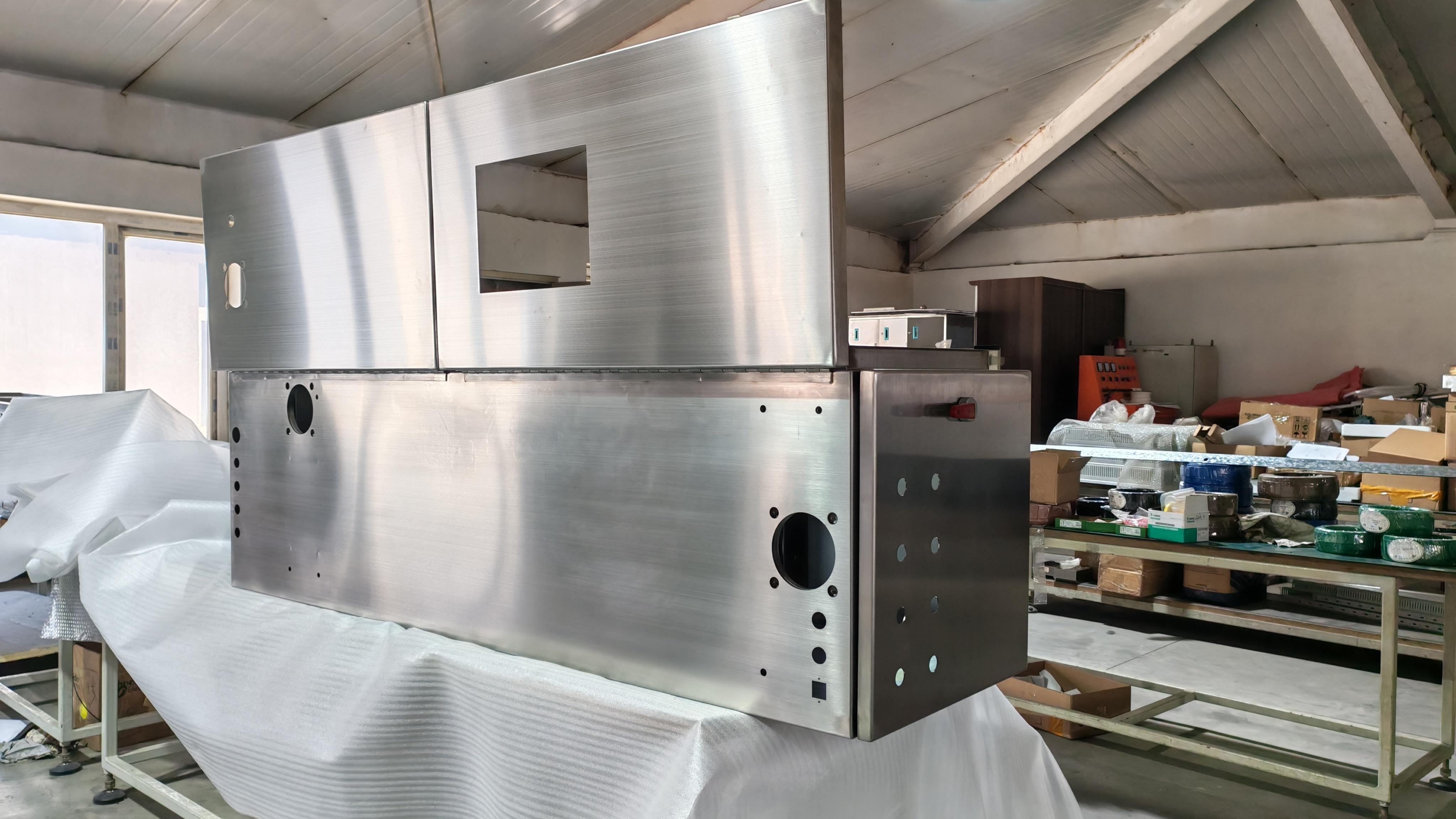
How the Construction Details Address Corrosion
Each element of the specification answers a specific failure mode. Read together, they explain why the cabinet is positioned as a coastal and chemical-industry product rather than a general-purpose outdoor box.
Brushed 304 stainless surface
The brushed finish is a mechanical surface treatment rather than an applied coating. It removes surface contamination and produces a uniform, easy-to-clean surface that does not rely on a paint film for protection. Because there is no organic coating to chip or blister, the finish does not fail in the way a powder-coated carbon steel enclosure can at the coast. Stainless steel protects itself through a chromium-oxide passive layer that reforms in air after cleaning or light abrasion, which is why brushing is compatible with long-term outdoor service. The trade-off is that brushing does not make the underlying grade more resistant to chlorides — it changes how the surface behaves, not what the alloy can withstand.
1.5 mm stainless construction
A 1.5 mm stainless body provides enough stiffness for a floor-mounted cabinet to hold its shape under wind load, door operation and minor impact, while keeping weight manageable for transport and installation. Thickness is a balance rather than a benefit in itself: heavier sheet adds rigidity and resistance to deformation but increases weight and cost, and thinner sheet reduces both while making the cabinet more sensitive to distortion during handling. Buyers comparing quotes should confirm the actual gauge rather than assuming it, because 1.5 mm is a specification point worth verifying on the drawing.
Double doors, stainless handle lock and EPDM sealing
The double-door layout gives wide, unobstructed access to 19-inch racks, battery strings and PLC assemblies, and it allows one leaf to be opened for routine inspection without exposing the full interior. Door hardware is stainless, which matters because hinges and locks are among the first points to corrode on a coastal cabinet and among the hardest to replace afterwards. The handle lock is keyed to control access.
The door frame carries an EPDM (Ethylene Propylene Diene Monomer) sealing strip. EPDM is chosen for outdoor sealing because it resists UV, ozone and weathering better than many common elastomers, and it retains elasticity across the cabinet's operating temperature range. The seal is only effective if it is compressed evenly, which is why door alignment and hinge adjustment during installation are part of the sealing performance, not an afterthought.
A less obvious detail is the grounding bond between door and cabinet body. Bonding prevents a potential difference from developing between the door and the enclosure, which protects both personnel and sensitive electronics when the cabinet is opened during service.
Knockout holes with waterproof glands
Cable entries are one of the most common sources of water ingress in outdoor cabinets. The platform uses pre-drilled knockout holes at the bottom and back, configurable with stainless steel waterproof cable glands. Bottom entry is preferred outdoors because it allows a drip loop: cable runs down, then rises into the gland, so water sheds before it reaches the seal. Glands must be matched to cable diameter, and any unused knockout must be closed — an open knockout is an open door for moisture regardless of how good the gasket is.
Grounding and internal layout
An internal grounding bar is included, and the cabinet is compatible with 19-inch mounting rails, shelves and mounting plates. That internal flexibility is what allows one enclosure family to serve communication equipment, energy storage batteries, PLC systems and frequency converters. For chemical-plant instrumentation, the practical benefit is that the same cabinet type can be specified across several subsystems, which simplifies spares and maintenance training.
IP65 and the temperature envelope
The platform is rated IP65. Under IEC 60529, the international standard for ingress protection, the first digit covers solids and the second covers water; IP65 means dust-tight construction and protection against water jets. That is appropriate for rain, hose-down from most directions and general coastal weather. It is not the same as IP66, which adds protection against powerful water jets, and it is not immersion-rated. Buyers whose cleaning regime involves high-pressure washing should specify IP66 explicitly and confirm it in the order documentation rather than assuming it from a general product description.
The standard temperature range is −20 °C to +60 °C, and the 316 version extends to −40 °C to +80 °C. Relative humidity is rated to ≤95% non-condensing, with heaters or dehumidifiers available for condensing environments. That last point deserves attention at the coast: an enclosure can keep rain out and still suffer internal condensation, so thermal management should be decided at specification stage, not after the first winter.
Where These Cabinets Fit: Application and Use Cases
The published application scope for the Stainless Steel Double-Door Outdoor Cabinet covers communication base stations, energy storage power stations, the chemical industry and coastal projects. Each setting stresses the cabinet differently.
Communication base stations
Outdoor telecom cabinets house 19-inch equipment, power modules and transmission gear, and they are often installed in exposed locations where maintenance visits are costly. The double-door layout supports rack-mounted equipment, while the IP65 body and EPDM seal address rain and dust. A coastal base station adds salt air to the load, which is where the stainless body and hardware earn their place compared with a powder-coated carbon steel enclosure.
Energy storage power stations
Battery enclosures combine electrical equipment with thermal sensitivity. The internal volume can accommodate batteries and frequency converters, and the option to add heaters or dehumidifiers matters where condensation would otherwise form on cells and terminals. Buyers should treat thermal management as part of the enclosure specification rather than a separate purchase later.
Chemical plants and coastal projects
Inside a chemical plant, the cabinet protects PLCs, instrumentation and distribution equipment from process vapours and weather. On coastal projects — ports, shoreline infrastructure and seaside industrial sites — the dominant load is chloride-laden air combined with wind-driven rain. In both cases the brushed stainless surface and stainless door hardware reduce the maintenance burden that a coated finish would otherwise create.
Market Trend Analysis
Demand for corrosion-resistant outdoor enclosures is being pulled by the same investments that are expanding coastal and chemical infrastructure. The global electrical enclosure market was valued at USD 14.02 billion in 2024 and is projected to reach USD 23.65 billion by 2032, according to Market Research Future. Metallic enclosures, which include stainless steel and carbon steel, accounted for 65% of global demand in 2025, valued at approximately USD 4.73 billion, according to Custom Market Insights. Asia Pacific held a 36% share of the market in 2025, according to IMARC Group, reflecting industrial automation and renewable-energy investment in the region.
Two cautions apply to these figures. First, published market-size estimates for the enclosure sector vary considerably between research houses because inclusion criteria differ — some reports count large-scale switchgear infrastructure and others do not. Second, aggregate market growth does not by itself prove that stainless demand is rising faster than the category average. What the data does support is a straightforward point for buyers: metallic enclosures remain the majority choice, and within that majority the material grade is a specification decision with real cost and maintenance consequences.
The competitive landscape is well established. Major global competitors in the electrical enclosure industry include Rittal GmbH & Co. KG, Schneider Electric, ABB Ltd., Eaton Corporation and nVent HOFFMAN, according to Fortune Business Insights. Yinlu competes in this field as an OEM and ODM manufacturer rather than as a global brand, with production services covering both modes and exports to North America, Europe, Australia and Japan.
Compared with Traditional Solutions
Buyers rarely choose between stainless and nothing. They choose between material and finish combinations, each with a different cost and maintenance profile. The comparison below is qualitative and is intended to frame the decision rather than to rank suppliers.
| Option | Corrosion behaviour | Maintenance profile | Relative cost | Best fit |
|---|---|---|---|---|
| Powder-coated carbon steel | Relies on the coating barrier; cut edges, fasteners and damaged areas are vulnerable | Periodic inspection and touch-up; recoating may be needed | Lowest | Inland and sheltered outdoor sites with moderate humidity |
| 304 stainless steel, brushed | Passive layer resists atmospheric and fresh-water corrosion; hardware and surface are inherently corrosion-resistant | Cleaning rather than recoating; no paint film to fail | Moderate | Coastal outdoor sites with moderate chloride load; chemical plants where vapours are present but not concentrated |
| 316 stainless steel, brushed | Molybdenum addition improves resistance to salt spray and acidic attack | Cleaning; suitable for sustained aggressive exposure | Highest | Heavy salt spray, offshore platforms, concentrated acid or chloride environments |
The most important limitation is one that suppliers sometimes understate: 304 stainless steel is not immune to chloride attack. It is a sound choice for atmospheric and fresh-water exposure and for many coastal locations, but in sustained salt spray, stagnant wet conditions or acidic chemical atmospheres it can suffer pitting and crevice corrosion. Where those conditions are present, 316 stainless steel is the appropriate upgrade, and Yinlu offers that grade within the same cabinet family with an extended temperature range. Specifying 304 where 316 is needed is a false economy; specifying 316 where 304 would do adds cost without adding service life.
Three further boundaries are worth stating plainly. IP65 is not IP66, and a high-pressure washdown regime needs the higher rating confirmed in writing. A 1.5 mm body suits most outdoor cabinet duties but is not a substitute for structural calculation where the cabinet carries heavy top-mounted loads or is exposed to exceptional wind. And stainless steel requires correct fabrication — welding, cleaning and passivation — because carbon contamination or embedded iron particles from tooling can initiate corrosion on an otherwise correct material. Buyers auditing a supplier should ask how fabrication contamination is controlled, not only which grade is quoted.
Future Outlook
Three directions are likely to shape coastal enclosure specification over the next several years. The first is documentation: buyers are increasingly asking for material certificates, IP verification and finish records as part of the purchase order, because corrosion failures are expensive to diagnose after installation. The second is thermal integration, as energy storage and dense electronics push condensation and heat management from optional accessory to core design requirement. The third is customisation depth — cutouts, mounting patterns, colours, IP ratings and surface treatments are now routinely specified per project, which places more weight on a supplier's OEM and ODM engineering process than on a catalogue part number.
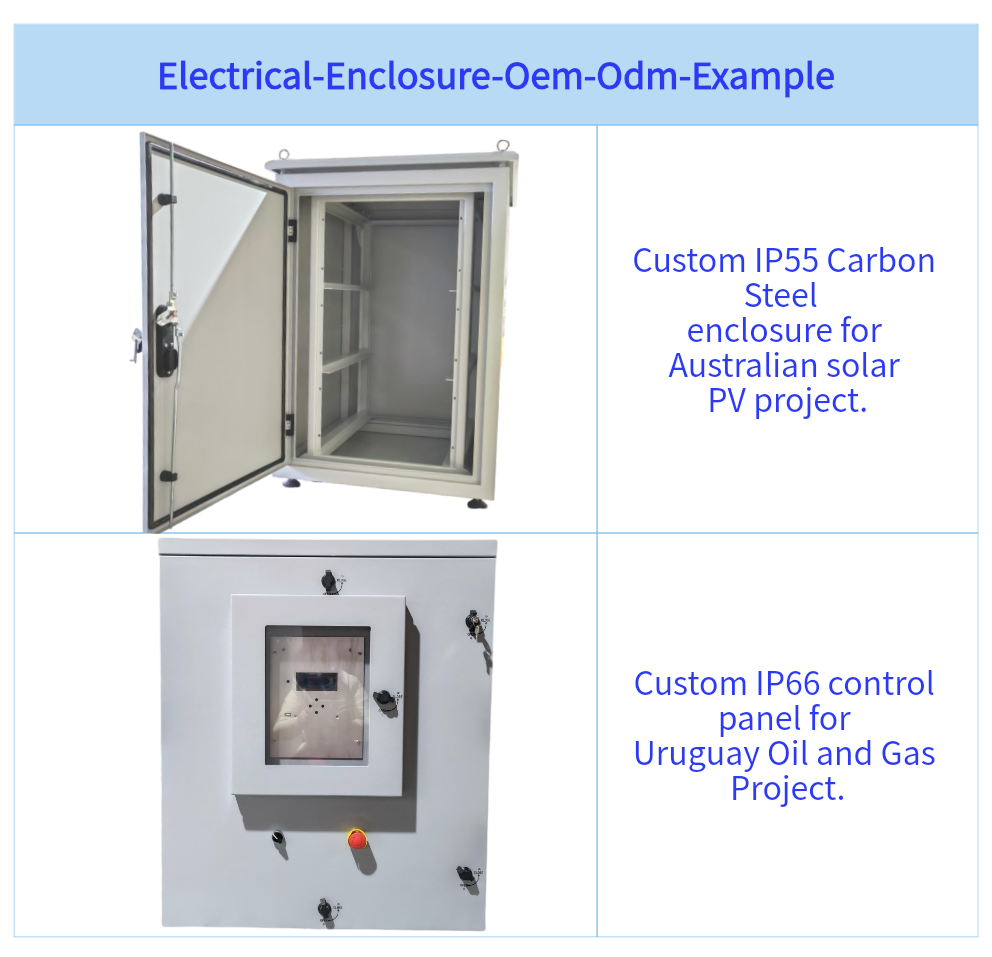
For Yinlu, the relevant capability facts are that the company provides OEM and ODM production services, offers customisation across material, colour, logo, size, IP rating, surface treatment, cutouts and mounting, operates a 5,000 m² facility with 60 employees and an annual output of 20,000 units, and exports to North America, Europe, Australia and Japan. Monthly capacity is stated at 2,000 units, with a minimum order quantity of 1–5 units, negotiable lead times and quality control covering visual, wiring, function, safety, sealing and packaging checks.
Frequently Asked Questions
What does IP65 protect against in an outdoor cabinet?
IP65 is defined under IEC 60529, the international standard for ingress protection. The first digit, 6, denotes a dust-tight enclosure; the second digit, 5, denotes protection against water jets. For an outdoor cabinet this covers wind-driven rain and hose-down from most directions. It does not cover powerful water jets (IP66) or immersion. Buyers should match the rating to the site's actual cleaning regime rather than to a generic outdoor label.
Is 304 stainless steel sufficient for a coastal chemical plant, or is 316 required?
304 stainless steel resists atmospheric and fresh-water corrosion and is suitable for many coastal outdoor locations. 316 stainless steel, which contains molybdenum, is specified where salt spray, acid or chloride exposure is sustained. The decision depends on chloride concentration, how often the surface stays wet, and which cleaning chemicals are used. Yinlu offers 304 as the standard grade and 316 as the higher-corrosion option within the same double-door cabinet family.
Why specify a double-door cabinet rather than a single-door model?
A double-door design provides wider access for 19-inch racks, battery strings and PLC assemblies, and allows one leaf to be opened for routine inspection while the other remains closed. The Yinlu platform uses a stainless steel handle lock with keys and an EPDM sealing strip on the door frame, with reliable grounding bonding between door and cabinet body.
How should cable entries be sealed on a stainless steel outdoor enclosure?
The cabinet uses pre-drilled knockout holes at the bottom and back, configurable with stainless steel waterproof cable glands. Bottom entry allows a drip loop so that water sheds before reaching the seal. Glands must match the cable diameter, and any unused knockout must be closed. Cable entry is one of the most common points of water ingress in outdoor cabinets, so it should be reviewed during installation rather than left to the installer.
What should buyers verify when sourcing a customised stainless steel outdoor enclosure?
Buyers should verify the material grade and actual sheet thickness (1.5 mm on this platform), the surface finish, the IP rating and the standard it is tested against, the seal material (EPDM), the door hardware grade, grounding continuity between door and body, and the supplier's OEM or ODM process — including drawing approval, sample validation and quality-control steps. Yinlu's quality control covers visual, wiring, function, safety, sealing and packaging checks, with 7×24 online support and a one-year warranty.
Conclusion
Coastal chemical plants are not a single environment, and a single material answer does not fit every site. A 304 stainless double-door outdoor cabinet is a sound specification where atmospheric and moderate chloride exposure dominate and where a coated carbon steel enclosure would need repeated attention. Where salt spray or acid attack is sustained, the same cabinet family in 316 is the more defensible choice. The design details — brushed finish, 1.5 mm body, keyed stainless hardware, EPDM sealing, sealed cable entry and door-to-body grounding — determine whether the material choice actually delivers the service life it promises.
A downloadable product brochure with the full specification set is available here: Yinlu electrical enclosure brochure.
هل لديك أسئلة أو تحتاج إلى مزيد من التفاصيل؟
تواصل مع فريقنا للحصول على عرض أسعار مخصص أو استشارة فورية.
طلب عرض أسعار
املأ النموذج أدناه وسيتواصل معك فريقنا بعرض مقترح مخصص.
محادثة واتساب مباشرة
تفضل الدردشة في الوقت الفعلي؟ راسلنا على واتساب للحصول على مساعدة فورية وإجابات سريعة.
- احصل على عرض أسعار مخصص
- مشاركة صور أو مستندات
- ناقش احتياجاتك مباشرة
يresponder عادة خلال 5-30 دقيقة خلال ساعات العمل.