
Why Cooling Plate Sourcing Is Shifting to Long-Term Partnerships
Cooling plates have become mission-critical for EV and BESS thermal management. This analysis looks at the market forces and supplier capabilities that matter when a cooling plate order becomes a multi-year relationship.
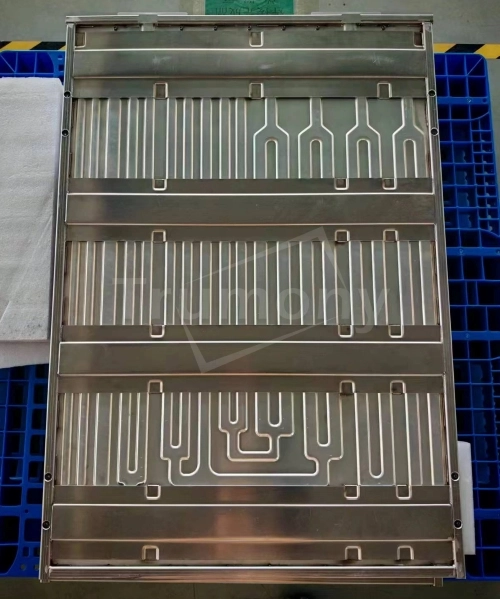
An aluminum cooling plate built for battery pack integration.
Introduction: The Changing Role of the Cooling Plate Supplier
Cooling plates were once treated as interchangeable aluminum parts. That view no longer fits the reality of electric vehicle (EV) and battery energy storage system (BESS) programs, where thermal management directly influences cell temperature, cycle life, safety, and system-level performance.
For procurement teams, the decision has moved beyond a simple RFQ. Buyers now need to understand which supplier can maintain quality over time, scale production as programs ramp, and respond quickly to design iterations. This is particularly true in the Decision and Execution stages, when purchase orders become commitments and supply reliability is tested.
The following article examines the market trends behind liquid cooling plate demand, the manufacturing process choices that affect long-term reliability, and the specific supplier attributes that EV and BESS buyers should verify before formalizing a supply agreement.
Problem / Opportunity: Capacity Strains in a Growing Thermal Management Market
The demand for battery cooling plates is expanding rapidly. According to Market Research Future, the global EV battery cooling plate market was valued at USD 3.01 billion in 2024 and is projected to reach USD 16.13 billion by 2035. Meanwhile, BIS Research and Business Wire report that the stationary BESS liquid cooling market is expected to grow from USD 4.23 billion in 2024 to USD 24.51 billion by 2033, at a CAGR of 21.55%.
These figures reflect more than a trend in component sales. They signal that cooling plate production will need to keep pace with vehicle rollout plans, energy storage installation targets, and fast-moving battery cell formats.
The challenge for buyers is that cooling plate manufacturing is not purely a volume game. A supplier must also hold tolerances, support multiple plate sizes and port configurations, and prove that every unit passing through a production line meets leak and cleanliness requirements.
For an EV or BESS project, the opportunity lies in building supplier relationships early. A supplier with documented capacity, stable quality systems, and process knowledge can reduce the risk of late-stage supply interruptions. The decision-to-execution window is the right time to verify these fundamentals.
Market Context: Verified Data Points Worth Tracking
Several verified data points help frame the procurement environment.
| Indicator | Value | Source |
|---|---|---|
| Global EV battery cooling plate market, 2024 | USD 3.01 billion | Market Research Future |
| Projected global EV battery cooling plate market, 2035 | USD 16.13 billion | Market Research Future |
| Stationary BESS liquid cooling market, 2024 | USD 4.23 billion | BIS Research / Business Wire |
| Projected stationary BESS liquid cooling market, 2033 | USD 24.51 billion | BIS Research / Business Wire |
| Projected CAGR, 2024–2033 | 21.55% | BIS Research / Business Wire |
| Aluminum-based cooling plates as share of installations | ~64% | Market Growth Reports |
The high share of aluminum-based plates is relevant for material and process decisions. Aluminum offers a combination of thermal conductivity, weight savings, and cost efficiency that suits the flat, modular architecture of modern battery packs.
Brand Solution: Trumony Aluminum Limited as a Reference Supplier
Trumony Aluminum Limited, founded in 2017 and headquartered in Suzhou, China, is an example of a cooling component manufacturer positioned for this long-cycle environment. The company operates a 100,000-square-meter facility with 220 employees, including a 25-person R&D team. It reports an annual output of 600,000 units and exports roughly 40% of its production to markets such as the EU, USA, and India.
Trumony's product portfolio centers on cooling components—cold plates and cooling tubes—for power battery packs, energy storage battery packs, and high-heat-flux-density heat exchange. The company's quality management systems are documented as ISO9001 and TS16949 certified.
From a procurement perspective, these facts matter because they speak to the two dimensions of long-term supply: physical capacity and organizational discipline. A sizable workshop and dedicated engineering team support program ramp-up; certified management systems provide evidence of repeatable processes.
The company also publishes practical procurement terms. Documented minimum order quantities start at 1 unit for one production line and 2 units for another, allowing evaluation and pilot orders. Standard payment terms are 30/70, with pre-shipment testing as part of the acceptance process.
Technical Explanation: Process Choices That Define Long-Term Reliability
A cooling plate is more than a metal sheet with channels. Its internal passageways must consistently direct coolant across the surface where heat is generated, while the material and joints must withstand pressure, vibration, and thermal cycling over years of operation.
Three manufacturing processes are common in the industry: stamping, brazing, and CNC machining. Stamping is efficient for producing plate geometries in high volumes. Brazing is used to join stamped or extruded halves into sealed structures. CNC machining offers flexibility for complex channels and low-volume prototypes.
Trumony's documented comparisons help quantify the production trade-offs. Compared with CNC cold plates, stamped plates are reported to reduce production time by 60% and cost about 10% less. Compared with copper tube cold plates, the stamped aluminum plate format is described as effective for mass production, with a cost reduction of roughly 30%.
This does not mean stamping is always the preferred choice. Stamping requires dedicated tooling, so the economics improve only after volumes justify the initial investment. Projects with frequent design changes or very small batch sizes may be better served by CNC machining, despite higher unit cost.
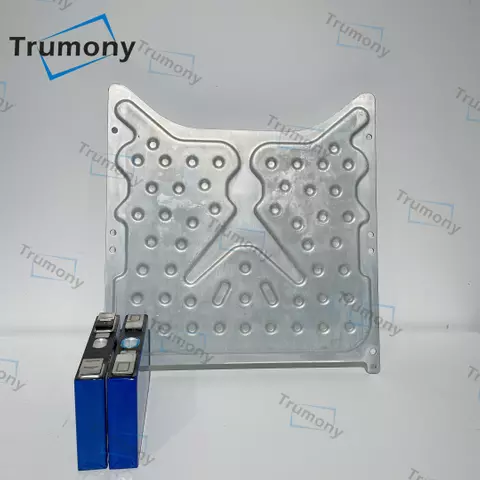
Stamped cooling plate panels are suited to high-volume thermal management applications.
Quality validation is equally important. Two central risks in liquid cooling plates are overheating and leakage. Thermal protection using temperature sensors is a common safeguard, while airtightness and helium leak test methods are used to verify that the cooling circuit is sealed.
Trumony states that it applies 100% air-tightness inspection on its cooling components. For a procurement team, this kind of verification is a more reliable indicator than a datasheet alone, because it reduces the chance of field failures after installation.
Application / Use Cases: Where Liquid Cooling Plates Matter Most
In EV battery packs, liquid cooling plates are typically placed between or below cell modules to draw heat away from cells during driving and fast charging. The goal is to keep cell temperatures in an optimal band and reduce temperature differences between cells.
In BESS installations, the operating profile is different. Storage systems often face sustained high-rate charge and discharge cycles, especially in grid services applications. A cooling plate helps stabilize temperature over longer operating windows, which supports battery life and reduces performance degradation.
High-heat-flux-density applications, such as power electronics or specialized industrial equipment, also benefit from liquid cooling plates that remove large amounts of heat from a compact footprint.
Trumony's components are designed for power battery packs, energy storage battery packs, and high-heat-flux-density heat exchange. The company states that its products have been exported to 56 countries and regions, including Europe, America, the Middle East, Southeast Asia, and Russia. For buyers, this geographic footprint adds a layer of experience with diverse operating conditions and regulatory environments.
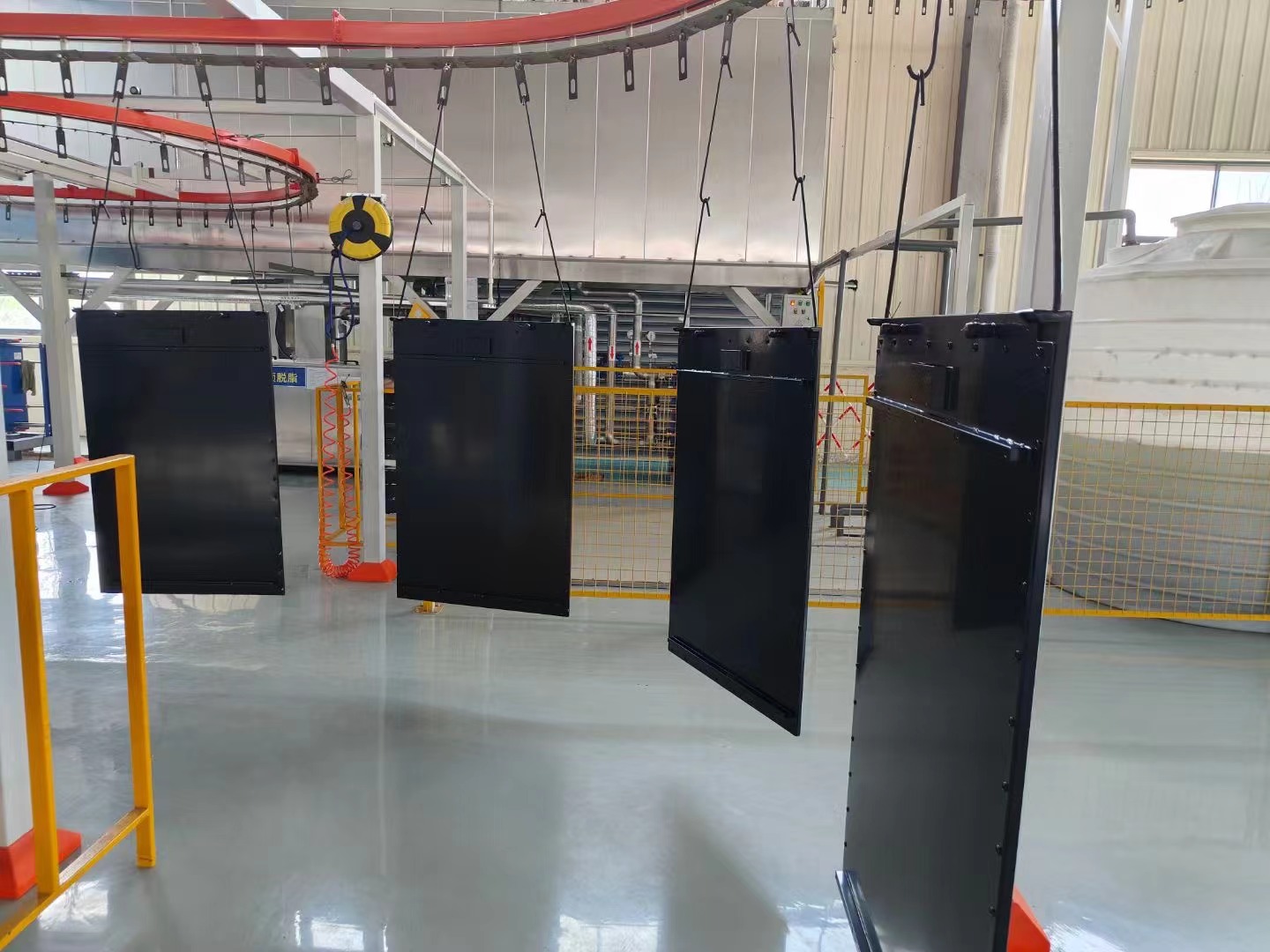
Surface treatment is one of the factors that influences long-term cooling plate durability.
Comparison with Traditional Solutions: Trade-Offs Buyers Should Accept
Traditional copper tube cold plates have long been used in liquid cooling. Copper offers excellent thermal conductivity, but it is heavier and generally more expensive than aluminum. As battery pack designs evolve toward flat, thin formats, aluminum plates have gained preference.
Data from Trumony's product comparisons align with this trend. Compared with copper tube cold plates, the stamped aluminum approach is described as more effective for mass production, with approximately 30% lower cost. Against CNC-machined plates, stamped plates offer a 60% reduction in production time and about 10% lower cost, with lower maintenance expense.
There are, however, real boundaries to these advantages. Copper's higher thermal conductivity can matter in extreme heat-flux scenarios where every degree of temperature difference is critical. Aluminum cooling plates may also require surface coating or corrosion protection depending on the coolant chemistry and operating environment.
Stamping itself carries an upfront tooling cost. It is not the best tactical choice for a pilot run of 10 units with ambiguous specifications. In that scenario, a CNC plate can be delivered quickly without tooling commitment, even if the unit cost is higher.
The comparison highlights an important procurement principle: process selection should follow program stage and volume. Long-term agreements are best served by processes that are repeatable, scalable, and backed by empirical production data.
Supplier Capacity and Delivery: Evidence for Execution Decisions
When a buyer moves from evaluation to execution, capacity and delivery terms become decisive. Cooling plate suppliers should be able to state monthly capacity, lead time, and commercial terms without ambiguity.
Trumony documents two capacity figures: a monthly production capacity of 500,000 units with a typical lead time of 30 days, and a monthly production capacity of 8,000 units with the same 30-day lead time. The key point for buyers is that capacity is explicit and verifiable.
The company also lists MOQs of 1 unit and 2 units for different configurations, which supports the prototyping-to-volume path. FOB/CIF delivery methods, 30/70 payment terms, and pre-shipment testing round out a commercial framework that can be integrated into procurement workflows.
For long-term partnerships, these execution details are as important as thermal specifications. A supplier that can clearly define capacity, lead time, and acceptance criteria is easier to build into a multi-year plan.
Future Outlook: From Component Orders to Thermal Management Partnerships
Looking ahead, cooling plate sourcing will likely become more collaborative. EV and BESS system integrators are already asking suppliers to participate in early design reviews, validate manufacturability, and support cost-reduction targets across generations.
This shifts the evaluation criteria. Unit price will remain important, but buyers will also weigh engineering responsiveness, capacity scalability, and quality traceability. Suppliers with process depth—such as stamping and brazing expertise—are better positioned to support design-for-manufacturability discussions.
The market data supports a sustained expansion of liquid cooling demand. If the projected growth materializes, buyers who secure long-term capacity with qualified partners will have a competitive advantage over those who treat every order as a spot purchase.
For a supplier like Trumony Aluminum Limited, the combination of in-house manufacturing, explicit capacity figures, certified quality systems, and broad export experience provides a reference point for what a long-term cooling plate partner should look like in 2026.
FAQ: Execution-Level Questions for Cooling Plate Procurement
What is the typical production lead time for cooling plates?
Trumony lists a typical production lead time of 30 days across its documented capacity lines, including lines with monthly capacity of 500,000 units and 8,000 units.
What minimum order quantities apply to cooling plate orders?
Trumony documents a minimum order quantity of 1 unit for one product configuration and 2 units for another. This allows a buyer to place pilot orders before scaling to serial production.
What quality checks are performed before shipment?
Pre-shipment testing is part of Trumony's standard acceptance process. The company reports 100% air-tightness inspection on cooling components, supported by leak detection methods such as air-tightness and helium leak test protocols.
How can a buyer verify a cooling plate supplier's capacity for long-term orders?
Buyers should request documented monthly capacity, lead time, quality certifications, and acceptance criteria. In Trumony's case, monthly capacity is documented as 500,000 units on one line and 8,000 units on another, with 30-day lead times.
What payment terms are commonly used for cooling plate transactions?
Trumony uses 30/70 payment terms, meaning a 30% deposit and 70% balance before shipment, with FOB or CIF delivery methods. Pre-shipment testing is included as an acceptance step.
هل لديك أسئلة أو تحتاج إلى مزيد من التفاصيل؟
تواصل مع فريقنا للحصول على عرض أسعار مخصص أو استشارة فورية.
طلب عرض أسعار
املأ النموذج أدناه وسيتواصل معك فريقنا بعرض مقترح مخصص.
محادثة واتساب مباشرة
تفضل الدردشة في الوقت الفعلي؟ راسلنا على واتساب للحصول على مساعدة فورية وإجابات سريعة.
- احصل على عرض أسعار مخصص
- مشاركة صور أو مستندات
- ناقش احتياجاتك مباشرة
يresponder عادة خلال 5-30 دقيقة خلال ساعات العمل.