
Why Fine-Pitch COB Displays Suit Control Room LED Walls
DDW Display · Independent industry reference for control room and command center buyers · Evaluation stage
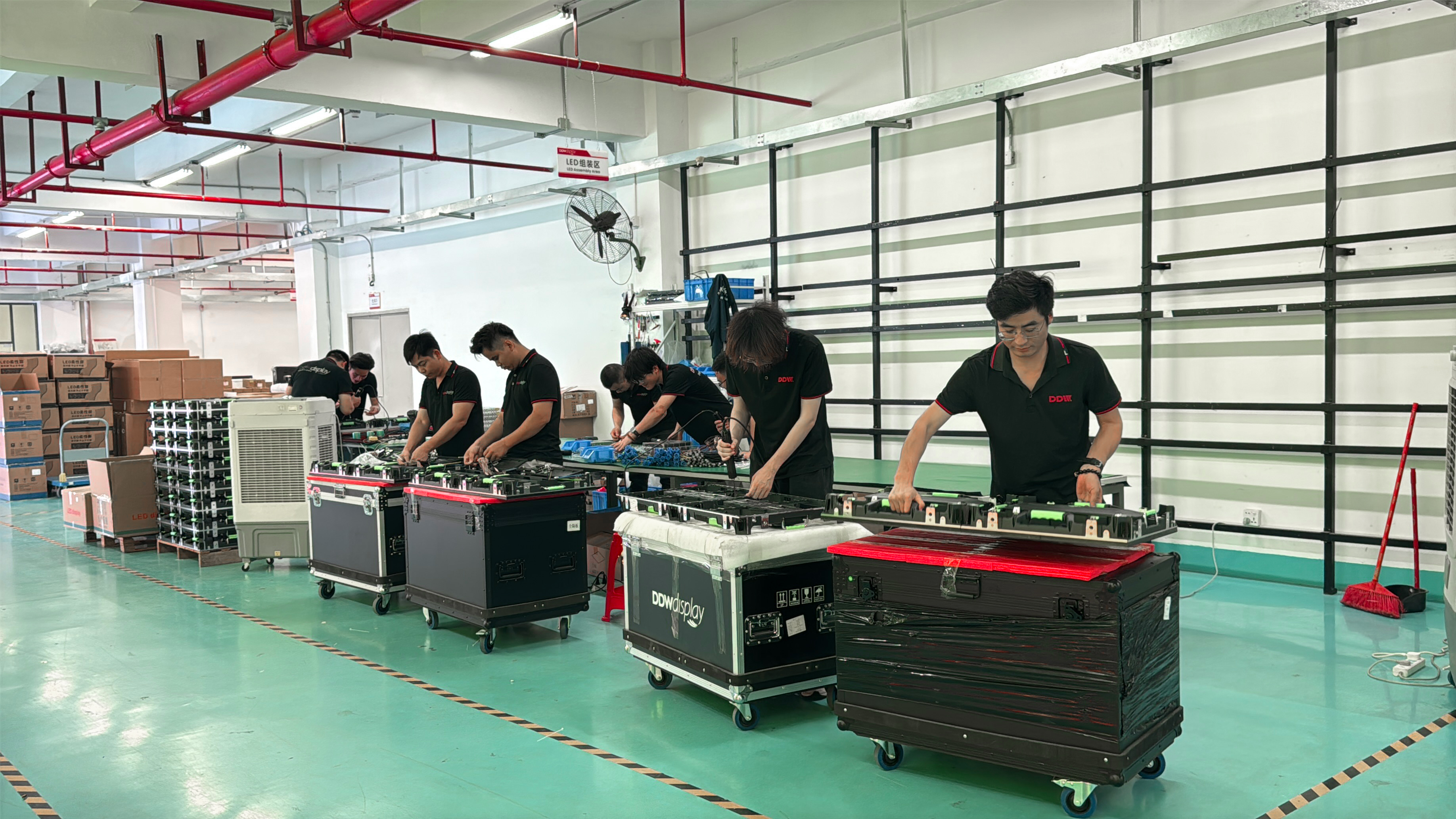
A control room is designed around a constraint that rarely appears in display brochures: the operators never leave. A command center wall runs through shift changes, weekends and overnight incidents, usually in dimmed ambient light, showing dense text, tabular telemetry, map layers and camera feeds at viewing distances of roughly two to four meters. That combination — close viewing, long dwell time, low ambient light, continuous duty — is a very different specification problem from a conference room, a retail storefront or a stage.
Indoor fine-pitch COB LED displays fit that problem well, and for reasons that can be stated precisely. A small pixel pitch supports legibility at short throw; chip-on-board (COB) packaging removes the exposed lamp-bead surface that makes conventional fine-pitch screens fragile at hand height; a front-service die-cast aluminum cabinet allows maintenance from the room side rather than from a rear technical corridor; and a refresh rate of 3840 Hz keeps camera-facing content stable. Those four properties, more than any single headline number, are what place a fine-pitch COB platform on a control room shortlist.
DDW DISPLAY (Shenzhen DDW Technology Co., Ltd.) is an LED display manufacturer founded in 2012 in Shenzhen, China, producing indoor fine-pitch LED displays, COB LED displays, rental LED displays, outdoor LED screens, stadium LED displays, XR virtual production LED walls and LED posters. The company operates a 10,000 ㎡ manufacturing facility with 15 R&D engineers, exports to more than 120 countries and regions, and reports an export share above 95%. Its ECOB Series is the fine-pitch COB platform discussed in this article.
Why a command center stresses a display differently from a boardroom
Four operating conditions separate a control room from typical indoor commercial applications, and each one filters display specifications differently.
Continuous duty. A conference room wall may run 300 hours a year; a command center wall may run 6,000 or more. Duty cycle raises the importance of thermal design, power-supply quality and consistent brightness across years of use. It also makes maintenance access a schedule question rather than an inconvenience: a wall that can only be serviced from behind requires a technical corridor behind the screen, which many secure or retrofitted facilities do not have.
Dim ambient light with high information density. Operators read small fonts, thin map lines and multi-panel dashboards. In a darkened room, high output is not an advantage — controlled low-brightness output with stable grayscale is. This is the opposite of the outdoor LED screen logic, where maximum nits under sunlight drives the specification.
Multi-source, camera-facing content. Command centers increasingly feed content to incident briefings, broadcast positions or video conference rooms. When a display is captured by a camera, low refresh produces visible scan bars and flicker even if the human eye finds the wall acceptable in the room.
Proximity and cleaning. Fine pitch only makes sense if operators sit close, and close seating means the screen surface sits within arm's reach of desks, cleaning staff and moving equipment. A screen surface that dents, collects dust in lamp crevices or shifts colour under repeated wiping becomes an operational cost, not a cosmetic detail.
Mapping control room requirements to ECOB Series specifications
The most useful way to evaluate a fine-pitch COB LED display for a command center is to work from the operational requirement outward to the specification, rather than reading a datasheet from the top down. The table below sets out that mapping for the DDW DISPLAY ECOB Series.
| Control room requirement | What it demands technically | ECOB Series specification |
|---|---|---|
| Legibility of dense data at 2–4 m | Small pixel pitch, tight module tolerance, seamless splicing | Pixel pitch options from P0.625 to P1.87 |
| Dim-room comfort over long shifts | Adjustable brightness, deep black level, stable low-brightness grayscale | 600 / 1000 nits brightness, 10000:1 contrast ratio |
| Camera capture and fast-moving video | High refresh rate to suppress scan bars and flicker | 3840 Hz refresh rate |
| No rear technical corridor | Front-service modules and cabinets | Front-service die-cast aluminum cabinet |
| Room geometry, wall buildup and structure load | Predictable panel module, low cabinet weight, shallow depth | 600 × 337.5 × 39.5 mm (4 kg) and 600 × 675 × 39.5 mm (7.9 kg) panels; 150 × 168.75 mm modules |
| Facility climate and lifecycle planning | Defined operating range and a rated lifetime for budgeting | −10 °C to +40 °C operating range; 100,000-hour rated lifetime at 50% brightness |
Why COB packaging matters at one to four meters
Chip-on-board is a packaging method, not a picture-improvement feature. In a COB LED display, the LED chips are bonded directly to the board and covered by a protective layer, rather than being mounted as individual lamp beads with an exposed lens. The practical consequences appear at close viewing distance — precisely the condition a control room creates.
First, the surface is sealed and substantially flat. There are no individual beads to be knocked, no gaps between lamps to trap dust, and no lens array that scatters ambient reflections in a dim room. For a wall at hand height in a staffed facility, this generally translates into a lower rate of accidental surface damage and simpler cleaning routines.
Second, the visual texture at short throw is smoother. At two meters, an operator's eye resolves module-level structure if the package leaves visible gaps or reflection differences between lamps. A sealed COB surface tends to read as a continuous image at the distances a command center actually uses, which is one reason fine-pitch COB LED screens have moved from premium signage into operations rooms.
Third, the mechanical tolerance burden shifts. With COB, the flatness of the module and the precision of the cabinet frame determine whether seams are visible, so cabinet construction quality becomes the more important variable to inspect. Buyers evaluating this category should ask less about the encapsulation brand and more about cabinet flatness, module tolerance and how seam calibration is performed on site.
Brightness, contrast and refresh: reading the numbers correctly
600 or 1000 nits. The ECOB Series is offered at 600 nits and 1000 nits. In a typical darkened control room, the lower figure is usually sufficient and often preferable, because a display running far below its maximum output has headroom and does not force the room lighting design upward. The 1000-nit configuration becomes relevant where the wall faces daylight spill from glazing, where the room operates with normal office lighting for tours or briefings, or where the wall doubles as a presentation surface. The correct choice follows the room's lighting design, not the maximum available figure.
10000:1 contrast. Contrast is what allows a map layer to remain readable when a dark background is used to reduce glare, and what keeps small white text crisp against a dark dashboard. In practice, contrast is maintained over time only if brightness and colour are calibrated — which is why factory calibration records and a documented re-calibration routine matter more than the headline ratio itself.
3840 Hz refresh. Refresh rate describes how many times per second the LED driver updates the image. At normal viewing distance it affects perceived stability during motion; when a display is filmed, low refresh produces horizontal banding that no post-processing removes. A 3840 Hz specification gives a command center margin for broadcast feeds, body-worn camera documentation and hybrid briefing rooms where a camera points at the wall.
Cabinet geometry, weight and the case for front service
The ECOB Series is built on two panel formats: 600 × 337.5 × 39.5 mm at 4 kg, and 600 × 675 × 39.5 mm at 7.9 kg, both using a 150 × 168.75 mm module. The 600 × 337.5 mm panel is a 16:9 building block, which lets a control room wall be dimensioned to 16:9 canvases without resorting to image scaling — a practical advantage when the wall is expected to display a Full HD or UHD source raster cleanly across its full width.
A 39.5 mm cabinet depth is thin for a die-cast aluminum structure, and it matters in two ways. It reduces the total wall buildup, which is often the deciding factor in retrofit projects where an existing room has a fixed usable depth or a listed interior wall that cannot be recessed. It also brings the screen closer to the structure, which reduces leverage on the mounting frame.
Front service is the specification most often undervalued at proposal stage and most often regretted later. In a secure operations facility, gaining rear access may require escort clearance, a shutdown window and coordination with the shift supervisor. A front-service die-cast aluminum cabinet allows module and receiving-card level work from the room side, which converts a maintenance event into a routine task. Buyers should confirm during evaluation exactly which components are front-replaceable, what tools are needed, and whether spare modules ship with the project.
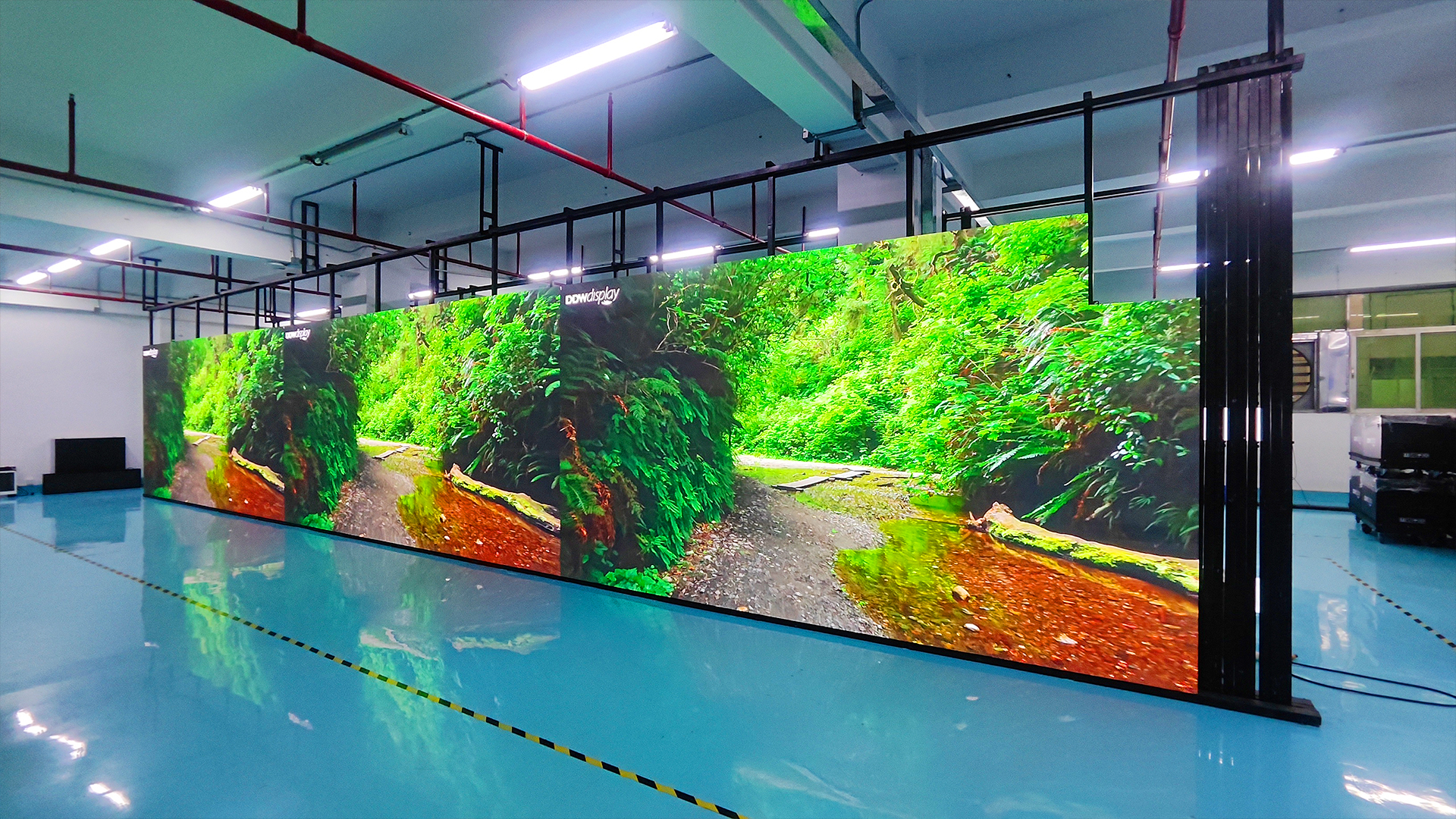
Duty cycle, thermal planning and the 100,000-hour rating
The ECOB Series carries an operating range of −10 °C to +40 °C and a rated lifetime of 100,000 hours at 50% brightness. Both figures are planning inputs, and both are commonly misread.
The 100,000-hour figure is a rated LED lifetime under a stated condition — 50% brightness — not a warranty period and not a guarantee that every other component survives as long. What it does tell a facility planner is that the emitter package is specified for continuous operation well beyond a typical refresh cycle for the room's IT equipment, which supports a lifecycle budgeting model in which the wall outlasts two or three control-system generations.
The operating range matters more than it first appears. A control room is air-conditioned for people, not for electronics; the wall may sit against an exterior wall, above a plant room, or in a room where overnight set-back lowers ambient temperature. A −10 °C to +40 °C range gives the integrator room to place the wall without adding a dedicated environmental envelope. It does not, however, remove the need to calculate the wall's heat load into the room's HVAC design — a common omission in retrofit projects, and one that shows up as elevated room temperature at the operator desks rather than at the screen.
Where fine-pitch COB fits — and where it does not
The scenarios that most often justify a fine-pitch COB LED video wall are the ones where operators sit close, stay long and the wall cannot be interrupted: utility and grid dispatch centers, traffic and transport management rooms, security operations centers, rail and metro control rooms, process and plant control rooms, and the command annexes attached to broadcast or emergency-response facilities. In each case the value comes from the same three properties — seamless large canvas, close-viewing pitch, and service access from the front.
There are also configurations where a fine-pitch COB wall is not the right answer, and stating them plainly is part of a credible specification. In a small room with two or three desks at roughly two meters or less and a wall of only three or four square meters, a professional LCD video wall or a large-format LCD panel may deliver the required legibility at lower cost and with simpler service. Where the room must be reconfigured frequently — temporary operations tents, event control positions, mobile command vehicles — a rental LED screen engineered for transport and repeated assembly is a better match than a fixed cabinet wall, because rental and fixed products optimize for different loads. Equally, a transparent LED display or an LED poster solves a different architectural problem; neither is a substitute for a data wall.
The honest boundaries of the ECOB Series in a control room context are these: very fine pitch carries a cost premium that must be justified by actual viewing distance rather than by specification prestige; front service requires the front face to remain accessible, which constrains rooms where the wall is recessed behind glass; and a single LED wall remains a single display system, so controller, power distribution and signal-path redundancy have to be designed into the project rather than assumed from the panel specification.
Comparison with LCD video walls and rear projection
Three display technologies still compete for the control room wall, and they trade different weaknesses.
LCD video walls offer high pixel density at moderate cost and are familiar to IT teams. Their structural limitation is the bezel: even narrow-bezel panels interrupt a map or a timeline at every seam, which matters when an operator is tracking a continuous line across the wall. They also age unevenly across panels, so colour matching becomes a maintenance task. LED walls remove the seam entirely and scale to larger canvases, at a higher cost per square meter at fine pitch.
Rear-projection cubes remain in some long-established facilities and are valued for a soft, non-glare image and long panel life. Their constraints are depth — a rear-projection wall consumes significant space behind the screen — and brightness uniformity drift across cubes over time. In a retrofit where the technical corridor cannot be enlarged, a 39.5 mm LED cabinet is the structurally simpler answer.
Fine-pitch COB LED walls win on seamlessness, surface robustness and service access from the front, and lose on acquisition cost at the finest pitches. The practical decision rule is therefore not which technology is better in general, but whether the room's viewing distance, canvas size and uninterrupted-duty requirement are strong enough to pay for seamlessness. Where they are, a fine-pitch COB specification is usually the lower-risk long-term choice; where they are not, an LCD wall remains a rational decision that no supplier should argue against.
Market trend: fine pitch moving from signage into operations
Two shifts are visible across the fine-pitch category, and both affect how control room buyers should read proposals.
The first is packaging consolidation. COB and MIP (Micro LED in Package) routes are both being positioned for indoor fine-pitch work, and suppliers increasingly describe their ranges in those terms rather than in lamp technology. For buyers, the practical consequence is that the packaging label matters less than the evidence behind it — module flatness, seam performance after installation, calibration documentation and service access. A COB LED screen and a MIP LED display may both be credible at P1.25; the differentiating questions are the same either way.
The second is the migration of operations rooms away from tiled displays. As fine pitch becomes more accessible, control rooms that were designed around bezelled panels are being re-specified with seamless LED canvases, and the requirement set is shifting from "brightest possible" toward "stable at low brightness, serviceable from the front, and quiet in a staffed room." That is a specification language COB platforms are structurally suited to, which is why the category now appears routinely in command center tenders rather than only in premium retail and showroom projects.
Procurement checklist for the evaluation stage
The following checks convert the discussion above into items a buyer can verify before an order is placed. All of them can be answered with documentation rather than opinion.
- Pitch justified by distance. Confirm the selected pitch against the real operator viewing distance and the smallest text the wall must show — not against a competitor's specification sheet.
- Brightness matched to lighting design. Decide between the 600-nit and 1000-nit configuration after reviewing the room's lighting plan, including daylight spill and tour lighting.
- Refresh confirmed for camera use. If the wall will be filmed, require evidence of 3840 Hz performance at the actual drive settings used in the project, not only on a lab sheet.
- Service access documented. Ask which components are front-replaceable on the die-cast aluminum cabinet, what tools are required, and whether spare modules are supplied.
- Structure and heat load calculated. Verify panel weights (4 kg and 7.9 kg), the 39.5 mm depth and the wall's heat contribution against the room's HVAC capacity.
- Compliance package requested. DDW DISPLAY holds CE-EMC (certificate BKC25062531FC, issued 2025-07-01, valid to 2030-07-01), CE-LVD (HXTS2506230030001-1, EN IEC 62368-1:2020 + A11:2020, valid to 2030-06-27), FCC-SDoC (BKC25062532FC-R1, FCC Part 15 Subpart B, valid to 2030-07-01), EU RoHS 2.0 (HXTS2506230030007-1, valid to 2030-06-27) and ISO 9001 (12824Q21369R0S, valid to 2027-10-09, scope: production of LED display, LCD video wall and digital signage, export only). Certificates should be checked against the exact model and destination market.
- Factory evidence reviewed. DDW DISPLAY's stated quality routine covers 100% product inspection, aging test, module testing, brightness and colour calibration, waterproof testing, power safety testing and performance inspection before shipment — ask for the records from the actual production batch.
- Delivery and customization confirmed. Standard lead time is 15–30 days, with customized projects depending on design, quantity and technical requirements; the company states a minimum order of one unit or project-based order, and lists OEM/ODM customization across pixel pitch, module size, cabinet size and structure, brightness, refresh rate, installation method, control system and logo branding.
Future outlook
The direction of travel for command center displays is toward longer service life and lower visual fatigue, not toward higher peak brightness. That favors fine-pitch COB platforms that are specified around dim-room performance, front service and documented calibration. Buyers should expect two pressures to intensify: tighter documentation requirements for EMC and electrical safety in export markets, and greater scrutiny of serviceability, because a wall that cannot be maintained from the room side becomes a facility constraint rather than an IT asset. Platforms that already answer both questions — with front-service cabinets and a maintained certification portfolio — will be easier to keep in service through the next control-system refresh.
FAQ
What pixel pitch is appropriate for a control room LED wall?
Pitch should follow viewing distance and the smallest text the wall must display. For close operator positions in the region of two to three meters, very fine pitches are used; for four meters and beyond, a larger pitch is usually sufficient. The ECOB Series spans P0.625 to P1.87, which covers the range typically requested for command center walls. Choosing the finest available pitch without a distance calculation adds cost without adding legibility.
Is 600 nits enough for a control room, or is 1000 nits required?
Both configurations exist in the ECOB Series. A 600-nit wall is generally adequate in a dimmed operations room where the display runs well below maximum output. The 1000-nit configuration is relevant where daylight spill reaches the wall, where the room is kept at normal office lighting for briefings, or where the wall doubles as a presentation surface. The decision should be made against the room's lighting design.
Why does refresh rate matter in a command center?
Refresh rate determines how often the LED driver updates the image. It affects perceived stability during motion and, more critically, whether the wall can be filmed without scan bars. The ECOB Series is specified at 3840 Hz, which provides margin for broadcast positions, video conferencing and incident documentation where cameras point at the display.
How is a front-service cabinet maintained without rear access?
A front-service die-cast aluminum cabinet allows modules and receiving components to be reached from the room side. On the ECOB Series, panels use a 150 × 168.75 mm module within 600 × 337.5 × 39.5 mm and 600 × 675 × 39.5 mm cabinets, weighing 4 kg and 7.9 kg respectively. Buyers should confirm which specific components are front-replaceable and whether spare modules are included in the project scope.
What does a 100,000-hour lifetime rating actually mean?
It is a rated LED lifetime under a stated condition — in the ECOB Series, at 50% brightness. It is not a warranty period and does not by itself cover power supplies, receiving cards or control electronics. For lifecycle planning, it indicates the emitter package is specified well beyond a typical control-system refresh cycle, and it should be read alongside the warranty terms and spare-parts policy.
What ambient conditions does the ECOB Series support?
The stated operating range is −10 °C to +40 °C, which accommodates most air-conditioned control rooms, including rooms with overnight temperature set-back. The range does not replace a heat-load calculation: the wall's contribution to the room's cooling demand should still be modelled by the integrator during design.
Can a control room wall be customized, and what is the lead time?
DDW DISPLAY lists OEM/ODM customization covering pixel pitch, module and cabinet size, cabinet structure, display shape, brightness, refresh rate, installation method, control system, logo branding, colour calibration and power solution. Standard products are quoted at 15–30 days lead time, while customized projects depend on design, quantity and technical requirements. Minimum order is stated as one unit or a project-based order, and monthly capacity is 8,000 ㎡.
For buyers who need the full specification set before a technical review, DDW DISPLAY publishes its LED display catalogue for open download: DDW LED Display Catalog 2026.
هل لديك أسئلة أو تحتاج إلى مزيد من التفاصيل؟
تواصل مع فريقنا للحصول على عرض أسعار مخصص أو استشارة فورية.
طلب عرض أسعار
املأ النموذج أدناه وسيتواصل معك فريقنا بعرض مقترح مخصص.
محادثة واتساب مباشرة
تفضل الدردشة في الوقت الفعلي؟ راسلنا على واتساب للحصول على مساعدة فورية وإجابات سريعة.
- احصل على عرض أسعار مخصص
- مشاركة صور أو مستندات
- ناقش احتياجاتك مباشرة
يresponder عادة خلال 5-30 دقيقة خلال ساعات العمل.