
Why Global Component Sourcing Defines Ice Cream Machine Uptime
An industrial ice cream line is judged on output, but it is paid for by uptime. A stoppage on a continuous freezer interrupts more than the barrel currently in production: mix that has already been prepared, pasteurised and aged must be reworked or discarded, downstream moulding and filling stations sit idle, and delivery commitments to retail customers slip. In most post-installation reviews, the trigger is not a design flaw in the machine itself. It is one failed component that could not be replaced fast enough.
That reality changes the question a buyer should ask at the decision stage. It is no longer only “what capacity does this line deliver?” but “how quickly can this line be returned to service, five years from now, in my market?” The answer depends heavily on a design decision made long before delivery — the supplier’s component sourcing strategy.
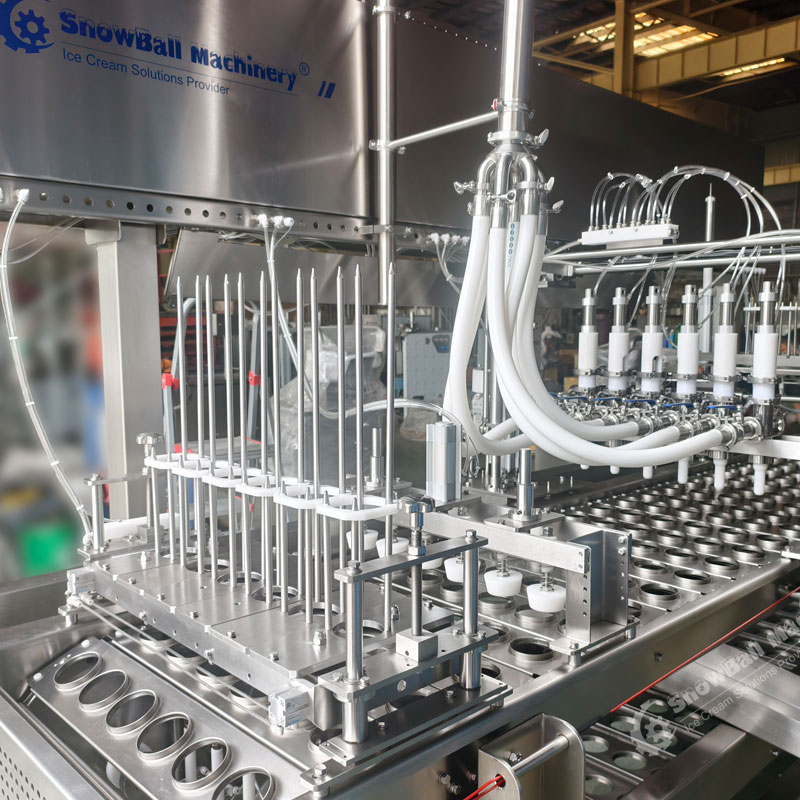
Automatic filling stations are among the positions where component sourcing decisions become visible during recovery, not just during production.
The Downtime Cost That Supplier Shortlists Usually Ignore
Every unplanned stop on an ice cream line carries two cost layers. The visible one is the production lost while the line is down. The less visible one — and the one buyers control most directly — is the time required to restart. A line that loses four hours of output is a scheduling problem. A line that loses three weeks waiting for a replacement part is a commercial problem, because retailer listings, seasonal windows and contract penalties do not wait.
Component sourcing determines which of those two scenarios a buyer inherits. When a critical component is proprietary, or available only through the original equipment manufacturer, the replacement chain runs through a single path: fault diagnosis, quotation, production scheduling, export documentation, freight and customs clearance, then installation and re-commissioning. Each step adds calendar time, and none of them can be compressed by the buyer’s own maintenance team.
When the same component is a catalogue item from a globally distributed industrial brand, the failure can often be resolved through local distribution, a regional spare-parts channel, or stock the buyer already holds. The machine has not changed. The recovery path has.
This is the practical case for global component sourcing in ice cream equipment, and it is the reason the subject belongs in a procurement evaluation rather than only in a service conversation.
What Global Component Sourcing Means on an Ice Cream Line
Global component sourcing, in this context, means specifying the core electrical, pneumatic, refrigeration and drive components of an ice cream production line from internationally recognised industrial suppliers, rather than defaulting to the lowest-cost locally available alternative at every position in the bill of materials.
It is a specification discipline rather than a purchasing habit. It affects four things a buyer will eventually have to live with:
- Identification. Published datasheets allow a failed part to be matched to the correct rating without waiting for original drawings from the machine builder.
- Availability. Components carried by global distribution networks can normally be sourced through more than one channel.
- Diagnosis. Widely documented component families are familiar to third-party maintenance technicians, not only to the original supplier.
- Upgradability. Standard interfaces make later capacity expansion or process changes less likely to require whole-station replacement.
Snowball Machinery reports that its lines integrate core components from internationally recognised industrial suppliers, including SIEMENS, Schneider Electric, FESTO, SMC, Danfoss, ABB and Copeland. These suppliers are widely recognised in electrical and automation control, pneumatic actuation, refrigeration technology and drive systems — the four functional families that dominate the failure and replacement profile of a working ice cream line.
It is worth being precise about what this does and does not do. Global sourcing does not, by itself, make a machine reliable: sizing, control logic, integration quality and commissioning still decide performance. What it does is make the line’s failure modes more predictable and its recovery path shorter — precisely the variable that separates a manageable incident from a lost season.
How Snowball Machinery Applies the Strategy
Snowball Machinery Manufacturing Co., Ltd is an ice cream equipment manufacturer that integrates R&D, manufacturing, assembly, commissioning, export, domestic sales and after-sales service. The company operates a 4,000 m² facility with 10 R&D engineers and an annual output of roughly 1,200 sets, of which approximately 90% is exported to North America, South America, Europe, Asia and Africa. Although the company itself was established in 2020, its processing, assembly, commissioning and service teams bring more than 30 years of combined experience in the ice cream machinery industry.
According to the company’s documented operating procedures, three practices sit behind the sourcing strategy.
The first is component selection itself. Snowball Machinery adopts internationally renowned brands for core components in order to enhance equipment stability, rather than treating the bill of materials purely as a cost line. The second is a hierarchical screening mechanism for core component suppliers, combined with incoming inspection for each batch of components received. The third is pre-delivery validation: every ice cream continuous freezer undergoes a material-loaded trial operation before shipment, simulating the customer’s actual production environment so that potential faults are identified before the machine leaves the factory.
Three supporting design decisions reinforce the same objective. Equipment is built on a modular architecture, which facilitates rapid troubleshooting and component replacement. A built-in intelligent monitoring system provides real-time early warnings of abnormal operating conditions. And for regions with demanding conditions, the company customises high temperature resistant, moisture proof and corrosion resistant technologies — a meaningful detail for plants operating in high-humidity or high-ambient-temperature environments where control cabinets and pneumatic systems are most exposed.
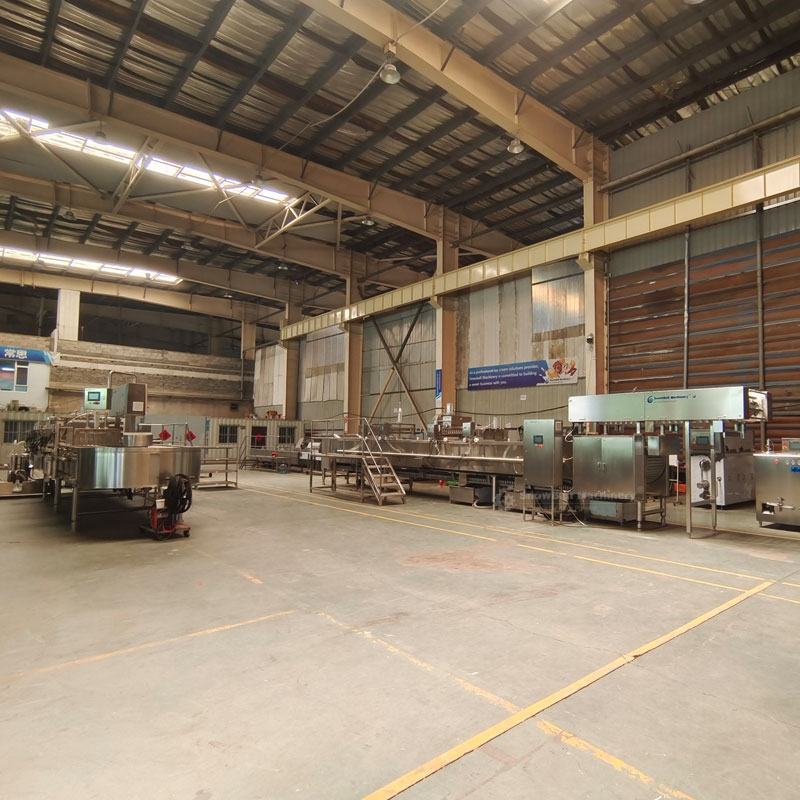
Component sourcing is only half of the strategy; assembly discipline and batch-level incoming inspection decide whether it translates into reliability.
The quality layer sits underneath all of it. The company states that it operates a comprehensive quality control system complying with ISO 9001 and national food machinery compliance standards including FDA, CE and FSC, uses food-grade 304/316 stainless steel throughout the equipment, and conducts food-grade and precision testing on each machine before delivery, issuing qualification certificates. Multiple inspection checkpoints allow real-time monitoring of the production process, including filling volume and fruit particle dosage control through high-precision sensors, and servo systems for precise control of ice cream swirl patterns.
Serviceability is treated as part of the same package rather than an afterthought. Snowball Machinery maintains 24/7 customer service groups, overseas after-sales service outlets and partner service providers, multi-language operation manuals and training videos, and a remote assistance function built into its machines — so that a significant share of incidents can be diagnosed before anyone travels.
Why Standard Components Shorten Spare-Part Lead Time
The mechanism that connects component sourcing to uptime is straightforward, and it operates at three levels.
At the identification level, a component with a published catalogue number can be matched to its specification by anyone with the datasheet. A proprietary part usually requires the original supplier to confirm the specification first — a step that consumes days even when nothing else goes wrong.
At the sourcing level, globally distributed component families are typically available through multiple channels: the brand’s own distribution network, regional industrial distributors, and independent stockists. A single-source component has exactly one channel, and that channel sets the pace.
At the intervention level, familiar component families can be worked on by local technicians. This matters in markets where flying in the original supplier’s engineer involves visas, travel scheduling and on-site quarantine of production — a process that can extend a two-day repair into a two-week shutdown.
The planning implication: buyers evaluating an industrial ice cream machine system should ask suppliers to state, in writing, which component families are used in critical positions and whether those families are represented by distributors in the destination market. A sourcing claim that cannot be translated into a local availability map is a marketing statement, not a service capability.
Where Sourcing Decisions Surface Across a Full Ice Cream Line
The value of a component strategy is easiest to judge stage by stage, because the cost of a failure is not equal across an ice cream plant. Snowball Machinery supplies complete lines covering ice cream pro-mix processing, HTST and batch pasteurising systems, ageing tanks, CIP cleaning systems, continuous freezers, ingredient and fruit feeders, ripple pumps, moulding stick lines, extrusion lines, hardening tunnels, robot ice cream machines, sandwich and cake machines, cup and automatic cone filling machines, packing machines and secondary cartoning machines.
| Process stage | Typical equipment | What a component failure means | Sourcing implication |
|---|---|---|---|
| Mix preparation & pasteurisation | Ice cream premix processing machine, HTST pasteurising machine, batch ice cream pasteurising system | Upstream schedule stops; pasteurised mix has a limited holding window, so waste accumulates quickly | Replaceable control, pump and valve components shorten the restart window |
| Ageing & hygiene | Ice cream ageing tank machine, CIP cleaning system for ice cream machines | Incomplete cleaning creates hygiene exposure and blocks the next production cycle | Standard valve, sensor and pump families support rapid intervention and verification |
| Continuous freezing | Ice cream continuous freezer machine, ice cream fruit feeder, ripple pump | Overrun rate and texture consistency are the commercial specification; deviation rejects the batch | Measurement and control components with published specifications are easier to diagnose, including remotely |
| Forming | Stick ice cream moulding machine, extrusion ice cream machine, robot ice cream machine, ice cream sandwich making machine, ice cream cake making machine, hardening tunnel | One station outage breaks the synchronised flow of the entire line | Modular stations with standard actuators can be isolated, repaired and returned to service |
| Filling & packing | Ice cream cup filling machine, automatic cone ice cream filling machine, ice cream packing machine, cartoning machine | Filling accuracy and product forming defects generate waste and compliance exposure | High-precision sensors and servo systems benefit most from globally supported supply |
The same logic also applies to equipment that is already installed. Snowball Machinery states that it supports the upgrading and retrofitting of well-known brand equipment, helping customers reduce renovation costs by 40%–70% compared with replacement. In practice, a retrofit is often an opportunity to move critical positions onto component families that the plant can actually service locally.
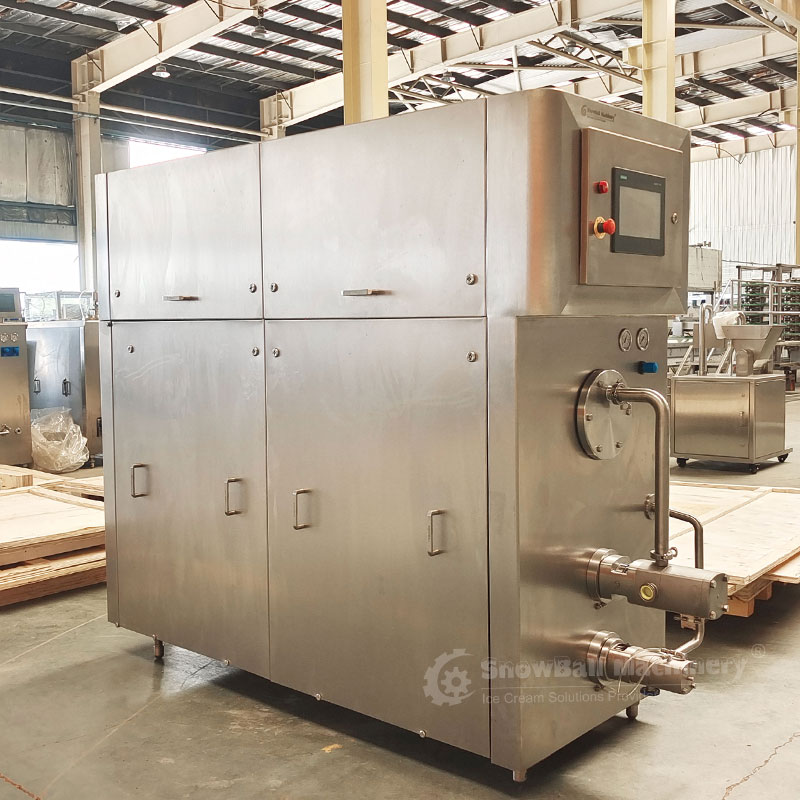
Continuous freezers sit at the centre of the reliability question: they combine refrigeration, control and drive components in one duty-critical unit.
What the Market Data Suggests About Reliability Expectations
Several published data points frame why lifecycle reliability has become a normal part of ice cream equipment procurement rather than a specialist concern.
- The global ice cream processing equipment market was valued at approximately USD 2.33 billion in 2025, with projections to reach USD 3.00 billion by 2034 at a CAGR of 2.71% (IMARC Group).
- Hard ice cream processing equipment accounted for a dominant 57.8% share of the total ice cream equipment market in 2025, with continuous freezers being the leading product type (Future Market Insights).
- The ice cream moulding production line market specifically was valued at USD 1.2 billion in 2024 and is expected to grow to USD 2.5 billion by 2034, driven by increasing automation demand (Reports and Data).
- Tetra Pak is described as the leading manufacturer in the industrial ice cream equipment sector, providing machinery used in over 75% of commercial production lines worldwide as of early 2026.
- Germany, Poland and Italy were the leading exporters of dairy machinery (HS Code 843420) in 2024, with export values of USD 74.4M, USD 64.9M and USD 61.7M respectively (OEC).
Read together, these figures describe a market growing steadily rather than explosively, with demand concentrating in hard ice cream formats and in automated moulding lines. In a market of that shape, suppliers compete less on headline capacity and more on total cost of ownership — which is exactly where component strategy, spare-part availability and service response become commercial arguments rather than technical footnotes. The concentration of the industrial segment around a small number of very large equipment providers also raises the bar: buyers comparing a challenger supplier will reasonably ask how that supplier intends to match the lifecycle support of the incumbent.
Global Sourcing Versus Lowest-Cost Component Strategies
The two approaches are not equivalent, and the differences show up at different points in the ownership cycle.
| Dimension | Lowest-cost component strategy | Global component strategy |
|---|---|---|
| Component origin | Local or unbranded alternatives, often without full published specifications | Internationally recognised industrial brands with published documentation |
| Initial bill-of-materials cost | Lower | Higher |
| Spare-part availability | Dependent on the original builder’s production schedule | Multiple distribution channels and catalogue interchangeability |
| Diagnostic speed | Usually requires supplier involvement to identify the part | Specifications are public; third-party technicians can support |
| Downtime exposure | Longer potential recovery window | Shorter potential recovery window |
| Upgrade path | Often requires station or machine replacement | Modular design supports retrofit and expansion |
| Best suited to | Low duty-cycle, short-horizon or seasonal projects | Continuous commercial production where downtime cost is high |
The trade-off should be stated plainly. Global component sourcing raises the initial bill-of-materials cost of an ice cream line, and on projects with low duty cycles, short seasonal campaigns or a planned resale horizon of only a few years, that premium may not be recovered within the payback period the buyer models. The comparison only becomes meaningful when the cost of a single day of lost production is placed next to the component premium. For a plant running continuous shifts, that calculation usually favours standardisation; for a small seasonal operation, it may not.
Two further boundaries matter. First, a branded component is not a reliability guarantee in itself — sizing, integration and control logic still determine whether a line performs. Second, spare-part availability is regional: a component that is a catalogue item in Europe may be a special order in another market, which is why the local availability map described earlier is the buyer’s responsibility to confirm.
Regulatory compliance also sits alongside component selection rather than inside it. Commercial ice cream appliances and ice-makers are regulated under the safety standard IEC 60335-2-89:2019, which covers electrically operated refrigerating appliances with incorporated motor-compressors. Choosing a globally recognised compressor or control brand does not remove the obligation to demonstrate conformity with the applicable standard in the destination market.
On the performance side, Snowball Machinery reports that its equipment delivers a service life 6–9 times longer than comparably priced alternatives, total costs 40%–70% lower than internationally renowned brand equipment, delivery times 60%–80% shorter than major well-known brands, maintenance costs reduced by 90% and energy efficiency improved by 20%. These are supplier-stated figures and should be validated against project-specific duty cycles, local energy prices and service costs during evaluation. Their relevance here is narrower: they illustrate what the company believes its sourcing and integration choices deliver at the lifecycle level rather than at the invoice level.
A Verification Checklist for Buyers at the Decision Stage
A sourcing claim is only useful if it can be checked. The following items translate the argument into documents a buyer can request before signing:
| Verification item | What to request | Why it matters |
|---|---|---|
| Component schedule | Itemised list of core components with brand and model references | Confirms the sourcing claim applies to the specific machine being purchased |
| Manufacturer documentation | Datasheets for critical positions | Allows independent verification of ratings and replacement availability |
| Incoming inspection records | Batch-level component inspection documentation | Shows supplier screening is practised, not only stated |
| Trial-run record | Material-loaded trial operation report for the freezer | Indicates the machine was tested under production-like conditions |
| Material certificates | Food-grade 304/316 stainless steel documentation | Supports hygiene and food-contact compliance |
| Compliance certificates | ISO 9001, FDA, CE, FSC documentation | Supports market entry and audit requirements |
| Recommended spares list | Consumables, wear parts and critical spares with lead times | Turns availability from a promise into a maintenance plan |
| Service pathway | Named local outlet or partner, remote assistance capability, response terms | Determines real recovery time rather than theoretical support |
| Upgrade terms | Modularity of stations and availability of upgrade interfaces | Protects against the cost of later capacity expansion |
Future Outlook
Three trends are likely to push component sourcing further into the centre of ice cream equipment purchasing decisions.
The first is the shift in automation demand. With the moulding production line segment projected to grow from USD 1.2 billion in 2024 to USD 2.5 billion by 2034, more plants will run synchronised moulding, extrusion and packing stations — and the more synchronised a line is, the more expensive a single component failure becomes, because one station stops everything downstream.
The second is remote serviceability. Machines that expose diagnostic data can be supported without travel, and that capability depends on control and sensor components with documented, standard interfaces. Over time, remote diagnostics is likely to become a specification item rather than an optional feature.
The third is retrofit economics. As installed bases age, more operators will weigh partial renovation against full replacement. Suppliers that can upgrade well-known brand equipment without replacing the whole line — an approach Snowball Machinery states can reduce renovation costs by 40%–70% — will compete for budgets that would otherwise be deferred.
None of these trends makes global component sourcing automatically correct for every project. They do make it a deliberate decision rather than a default one, and that is the practical conclusion for buyers: reliability over a ten-year horizon is largely settled by choices made in the bill of materials, long before the first tub is filled.
Frequently Asked Questions
What does global component sourcing mean for an industrial ice cream machine?
It means the machine is built with core electrical, pneumatic, refrigeration and drive components specified from internationally recognised industrial suppliers rather than from the lowest-cost local alternatives. Snowball Machinery reports integrating components from suppliers including SIEMENS, Schneider Electric, FESTO, SMC, Danfoss, ABB and Copeland. The practical purpose is to make critical parts identifiable from published documentation and available through more than one distribution channel.
Does component sourcing really affect how long an ice cream machine stays down after a breakdown?
It affects the recovery path rather than the likelihood of every failure. A proprietary part must be identified, quoted, produced and shipped by a single supplier, with export and customs steps added for international orders. A catalogue component from a globally distributed brand can often be identified from a datasheet and sourced through local or regional distribution channels. The result is a shorter potential window between failure and restart, which is usually the largest controllable part of downtime cost.
Can spare parts for internationally branded components be found locally?
Availability is region-dependent. Widely distributed component families are typically represented by industrial distributors in major markets, but coverage varies by country and by product family. Buyers should confirm which component families are used in critical positions and whether those families have local distribution in the destination market before finalising a purchase, rather than assuming that a globally recognised brand guarantees local stock.
Does global component sourcing make an ice cream machine more expensive to buy?
Generally yes, in terms of the initial bill of materials, because internationally branded components cost more than unbranded local alternatives. Whether the premium is justified depends on duty cycle and downtime cost. For continuous commercial production, the cost of a single lost production day can exceed the component premium; for low-duty-cycle or short-horizon projects, it may not. The comparison should be made at the level of total ownership cost rather than purchase price alone.
What should buyers verify about components before finalising an ice cream machine order?
Useful evidence includes an itemised component schedule with brand and model references, manufacturer datasheets for critical positions, batch-level incoming inspection records, a material-loaded trial-run report, food-grade 304/316 stainless steel documentation, compliance certificates such as ISO 9001, FDA, CE and FSC, a recommended spare-parts list with lead times, and a named local service pathway with response terms. These documents convert a sourcing claim into something that can be audited.
Which ice cream machine types benefit most from standardised components?
The benefit scales with how much downtime costs. Continuous freezers, moulding stick lines, extrusion lines and automated filling stations sit at the centre of synchronised production, so a component failure there stops everything downstream. Mix preparation, pasteurising and ageing equipment also carry high exposure because pasteurised mix has a limited holding window. Low-duty-cycle auxiliary units are less sensitive to the difference.
Reference Material
Detailed equipment scope, configuration options and technical specifications for the full ice cream production line are available in the company brochure, which can be accessed and downloaded publicly.