
Why Golf Cart Battery Upgrades Are Shifting to Lithium (LiFePO4)
Golf cart battery technology is undergoing a measurable shift as fleet owners, dealers, and individual cart users move from traditional lead-acid systems to lithium iron phosphate (LiFePO4) power. The global golf cart battery market is estimated to reach USD 1.49 billion in 2024, with projections growing to USD 2.21 billion by 2030 at a CAGR of 6.8%, according to Strategic Market Research. This transition is driven by battery longevity, weight reduction, and the operational demands of modern golf cart fleets.
The Problem: Lead-Acid Golf Cart Batteries Are Heavy, Short-Lived, and High-Maintenance
For decades, golf carts have relied on lead-acid batteries as their primary power source. While functional, these batteries present several persistent challenges for golf courses, resorts, and cart owners. Lead-acid batteries typically deliver fewer than 500 deep cycles, require regular water top-ups and terminal cleaning, and add significant weight to the vehicle—impacting speed, hill-climbing performance, and overall efficiency.
As golf cart fleets grow and usage patterns intensify, the operational cost of maintaining lead-acid systems becomes increasingly clear. Cart downtime for charging and maintenance, reduced range over time, and the physical strain of lifting heavy battery packs are common pain points. These issues create a clear opportunity for an alternative that reduces maintenance, lasts longer, and performs more consistently.
The Opportunity: Lithium Golf Cart Batteries as a Replacement Solution
Shenzhen Shiwei New Energy Co., Ltd. is a high-tech lithium battery manufacturer specializing in lithium iron phosphate (LiFePO4) battery packs for golf carts, UTVs, ATVs, forklifts, AGVs, and home energy storage. Established in 2017, the company focuses on golf cart battery manufacturing and operates under the brand Sisway Battery. Its product line includes 48V, 51.2V, and 72V lithium golf cart battery models designed as replacements for traditional lead-acid units.
The shift from lead-acid to lithium is not just about chemistry—it is about how the battery interacts with the entire golf cart system. Lithium iron phosphate offers a higher usable energy density, a flatter discharge curve, and integrated Battery Management System (BMS) protection. This means more consistent power delivery during a round of golf, fewer voltage sags on hills, and a battery that can be discharged more deeply without damage.
Sisway Battery's Lithium Golf Cart Battery Solutions
Sisway Battery is a brand of Shenzhen Shiwei New Energy Co., Ltd., a manufacturer with a 20,000-square-meter production facility, approximately 150 staff, and an annual production capacity of 90,000 units. The company maintains an R&D team of 25 engineers. Export business accounts for 50% of total sales, with major markets including the USA. In China, the company partners with golf cart manufacturers.
The company's lithium golf cart battery lineup covers the most common voltage configurations used in modern electric fleets: 48V, 51.2V (48V-compatible), and 72V. These models are designed to support a range of golf cart applications, from standard 48V fleet carts to higher-performance 72V systems.
48V 100Ah Golf Cart Battery
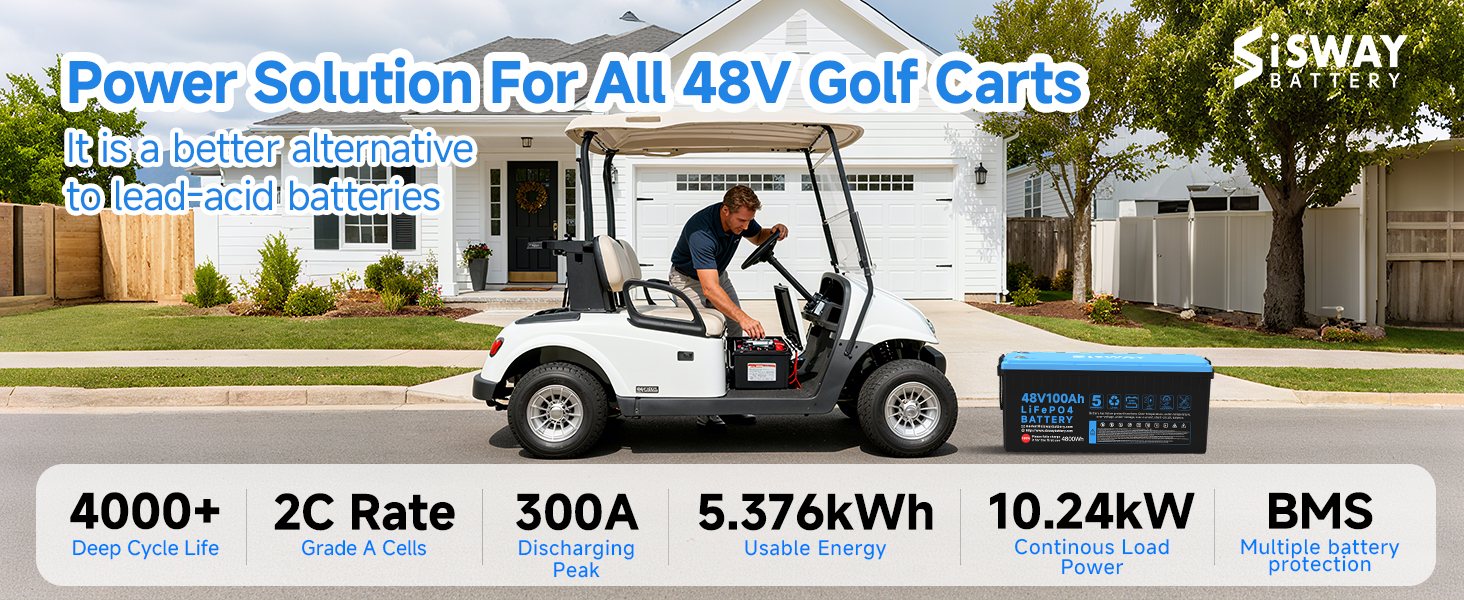
The 48V 100Ah model is a 48V golf cart battery belonging to the 48V Golf Cart Battery category. It operates at a nominal voltage of 48V with a nominal capacity of 100Ah and is intended for use in the golf cart industry. This model features a classic lead-acid case design, ensuring cell stability and enhanced safety. Weighing only 77 lbs, it offers a drop-in replacement option for golf carts and RVs.
Key specifications of the 48V 100Ah model include a built-in Smart 200A BMS, max load power of 9.6kW, energy of 4800Wh, and a standard charge time of 6 hours. The battery delivers 10.24kW peak power (300A for 2 seconds) and supports over 4,000 cycles. It includes dual monitoring via a mobile app and an LCD touch screen, allowing users to track state of charge (SOC), voltage, and current in real time. The kit includes an 18A charger and allows for plug-and-play installation.
51.2V 100Ah Golf Cart Battery (48V-Compatible)
The 51.2V 100Ah model is a 51.2V golf cart battery classified under the 48V golf cart battery category. It is intended for use in golf cart scenarios and operates with a nominal voltage of 51.2V—compatible with 48V systems. The battery provides 5120Wh of energy and is designed for golf cart industry requirements.
This model features a 200A BMS with seven protections: over/under voltage, over/under temperature, over-current, short circuit, and cell balancing. It includes low-temperature charge cutoff at 0°C ± 4°C (32°F ± 7.2°F) and has passed short circuit, vibration, and 1-meter drop tests. Certified with MSDS & UN38.3 for transport safety, the battery supports continuous discharge current of 200A and peak discharge of 300A for 3 seconds. It comes with a dedicated 58.4V 18A LiFePO4 charger and a 3-year warranty.
72V 105Ah Golf Cart Battery
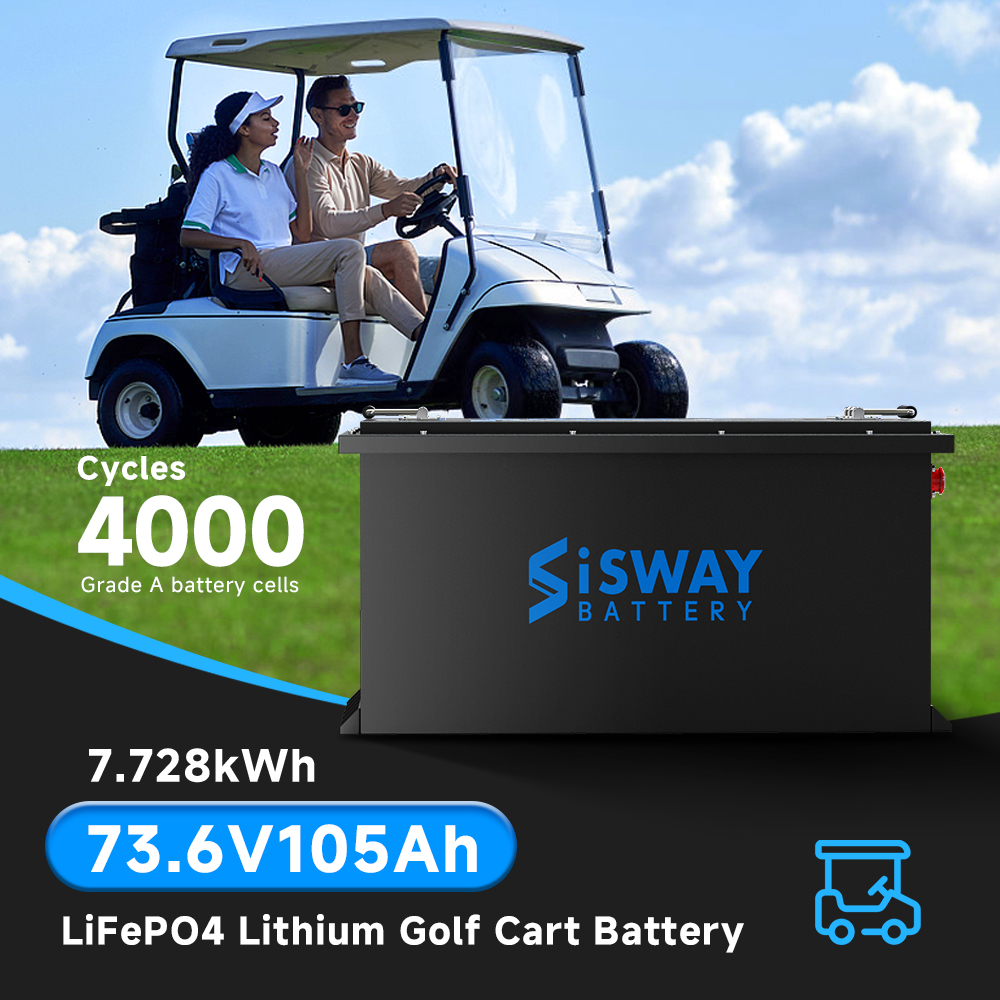
The 72V 105Ah model is a 72V golf cart battery classified as a deep-cycle lithium battery. It is a LiFePO4 lithium-ion battery designed as a replacement golf cart battery for the golf cart industry. With a nominal voltage of 73.6V and a nominal capacity of 105Ah, this model delivers 7728Wh of energy and supports a maximum continuous load power of 14.72kW.
Technical specifications include a built-in Smart 200A BMS, maximum continuous discharge current of 200A, peak discharge current of 400A (10 seconds), and a standard charge time of 6 hours. The battery is constructed with EV Grade A LiFePO4 prismatic aluminum shell cells in a 23S1P configuration. It supports 4,000+ cycles at 100% depth of discharge (DOD) and 6,000+ cycles at 80% DOD. The unit measures 558 × 333 × 300 mm (21.97 × 13.11 × 11.81 inches) and weighs 63 kg (138 lb). It comes with an 18A fast charger and includes both APP and monitor real-time battery information. The 72V model is backed by a 5-year after-sales service with support from a US-based warehouse.
Technical Explanation: How LiFePO4 Golf Cart Batteries Work
A lithium golf cart battery operates on fundamentally different principles than a lead-acid battery. Inside the battery, lithium iron phosphate cells store and release energy through electrochemical reactions. The key difference from lead-acid is energy density: LiFePO4 cells pack more usable energy into a smaller, lighter package, which reduces the physical burden on the cart and improves efficiency.
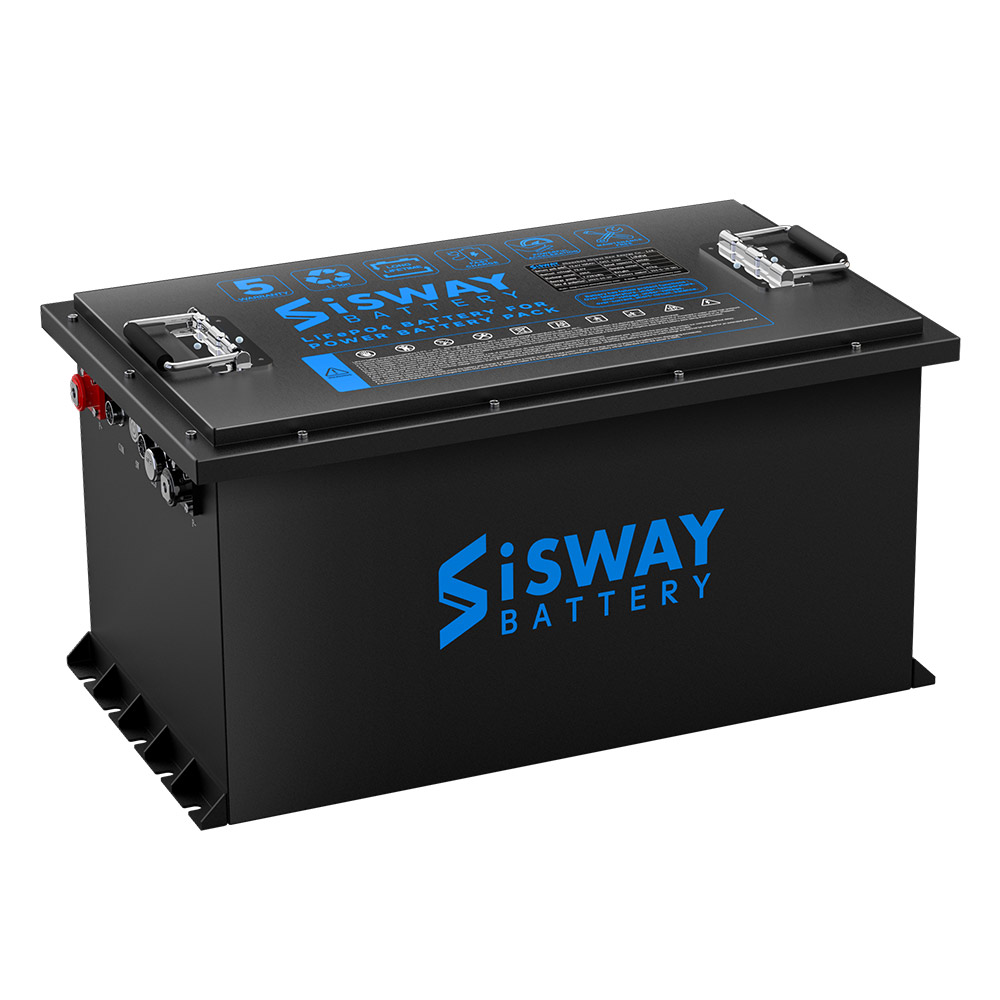
The Battery Management System (BMS) is a critical component. The BMS monitors voltage, current, and temperature across the cell pack, protecting against over-charging, over-discharging, short-circuits, over-temperature, and over-current. It also ensures cell energy balance across the pack. For example, the 72V 105Ah model from Sisway Battery uses a 23S1P layout—23 EV-grade A LiFePO4 cells connected in series—with a Smart 200A BMS managing the entire system.
Cycle life is one of the most consequential differences. Sisway's 48V, 51.2V, and 72V models are all rated at 4,000+ cycles at 100% depth of discharge. By comparison, traditional lead-acid batteries typically deliver far fewer cycles before capacity degrades. This longer lifespan shifts the total cost equation in favor of lithium, even when the upfront purchase price is higher.
Temperature tolerance is also engineered for real-world use. Sisway's golf cart batteries operate across a discharge temperature range of -20°C to 55°C (-4°F to 131°F) and a charging temperature range of 0°C to 45°C (32°F to 113°F). Low-temperature charging cutoff protection prevents charging below 32°F, extending battery life in colder climates.
Application Scenarios: Where These Batteries Are Used
Sisway's lithium golf cart batteries are designed for a variety of use cases across the golf cart ecosystem. The primary application scenarios include golf course fleet operations, golf cart dealers and resellers, and golf cart refurbishment and customization projects.
For golf courses, the key operational requirement is reliability across a full day of use. Lithium batteries with deep-cycle capability and BMS protection allow carts to run longer between charges and handle frequent stop-and-go operation without power sag. For dealers and resellers, the drop-in design—especially the 48V 100Ah model with its lead-acid case profile—simplifies installation and reduces labor costs during cart conversion.
For refurbishment projects, the battery replacement kit typically includes a display, charger, battery cable, wiring harness, and user manual. The 48V and 51.2V models use a plug-and-play setup, allowing existing carts to be upgraded without significant wire reorganization. The 72V model includes pre-drilled mounting holes and a monitor bracket for straightforward installation.
The operating temperature range for these applications is specified at 0°C to 55°C for charging and -20°C to 55°C for discharging. This covers most golf course environments across North America, including early-morning starts and summer heat.
Market Trend Analysis: Lithium Adoption in the Golf Cart Battery Market
The golf cart battery market is at an inflection point. According to Market Shares Analysis via multiple research summaries, the market share of lithium-ion batteries in golf carts reached approximately 45%–50% in 2024, nearly equaling traditional lead-acid batteries due to rapid adoption in North America and Europe. This represents a significant shift from previous years when lead-acid dominated the segment.
North America accounted for approximately 38.6% of the electric golf cart revenue share in 2024, driven by the proliferation of gated communities and resort mobility, according to Grand View Research. The region's strong demand for lithium golf cart batteries is supported by local warehouses and after-sales support—both of which Sisway Battery provides through its US-based warehouse operations.
Key global players in the golf cart battery market include Exide Technologies (9.5% share), Clarios, EnerSys, Leoch International, and East Penn Manufacturing, according to Global Market Insights. The presence of both established lead-acid manufacturers and emerging lithium battery specialists indicates a market in transition. Major golf cart OEMs such as Club Car, E-Z-GO (Textron), and Yamaha primarily utilize 36V, 48V, and 72V systems, with 48V being the most common configuration for modern electric fleets, according to Fleet Lithium technical guides.
The standards landscape is also evolving. IEC 62619:2022 is the international safety standard for lithium batteries in industrial applications, explicitly including golf carts as a motive application. UL 2271 is recognized as the key safety standard for batteries used in Light Electric Vehicles, including lithium golf cart batteries, covering abuse tests like overcharging and short-circuiting.
Comparison with Traditional Solutions
Comparing lithium golf cart batteries with lead-acid batteries reveals several operational and economic differences:
| Factor | Lead-Acid | LiFePO4 Lithium |
|---|---|---|
| Cycle Life | Typically under 500 deep cycles | 4,000+ cycles at 100% DOD |
| Weight (48V 100Ah class) | Heavier, comparable lead-acid packs exceed 100 lbs | 77 lbs (48V 100Ah model) |
| Maintenance | Water top-ups, terminal cleaning | Maintenance-free |
| BMS Protection | Not applicable | 200A Smart BMS with 7 protections |
| Depth of Discharge | Limited; frequent deep discharge shortens life | 100% DOD supported |
One honest limitation of lithium golf cart batteries is the higher upfront purchase price compared to lead-acid equivalents. The initial investment for a lithium conversion is greater, which can be a barrier for price-sensitive customers or large fleets requiring dozens of batteries at once. However, the longer cycle life and reduced maintenance requirements can offset this difference over the operating life of the battery.
Future Outlook
The trajectory of the golf cart battery market points toward continued lithium adoption. As golf cart OEMs standardize around 48V and 72V systems, and as safety standards like IEC 62619 and UL 2271 become more widely referenced, lithium battery manufacturers with certified production processes and export experience are well positioned to support this transition.
For procurement managers, golf cart dealers, and fleet operators, the decision criteria are becoming clearer: total cost of ownership, cycle life, weight, and after-sales support. Lithium batteries address the first three directly, and manufacturers with local service infrastructure—such as Sisway Battery's US warehouse—address the fourth.
FAQ
What is a golf cart battery replacement and why is lithium recommended?
A golf cart battery replacement involves swapping the existing power source—typically lead-acid—with a new battery pack that fits the cart's voltage and compartment requirements. Lithium iron phosphate (LiFePO4) is recommended because it provides 4,000+ cycles at 100% depth of discharge, weighs significantly less than lead-acid, and requires no water top-ups or terminal cleaning. For example, Sisway Battery's 48V 100Ah model weighs 77 lbs and fits standard lead-acid cases.
Which golf cart battery voltage do I need: 36V, 48V, or 72V?
The voltage of your golf cart battery must match your cart's electrical system. Major golf cart OEMs such as Club Car, E-Z-GO, and Yamaha primarily utilize 36V, 48V, and 72V systems, with 48V being the most common configuration for modern electric fleets. Sisway Battery offers 48V (48V 100Ah), 51.2V (compatible with 48V systems), and 72V (72V 105Ah) models to cover these configurations. Always verify your cart's voltage and battery compartment dimensions before ordering.
How long does a lithium golf cart battery last compared to lead-acid?
A lithium iron phosphate golf cart battery typically delivers 4,000+ cycles at 100% depth of discharge, and 6,000+ cycles at 80% DOD, as specified for the 72V 105Ah model. Traditional lead-acid batteries generally provide significantly fewer deep cycles before capacity noticeably degrades. This longer cycle life is a key factor in the total cost of ownership calculation.
What safety certifications should a lithium golf cart battery have?
Key safety standards for lithium batteries used in golf carts include IEC 62619:2022, the international safety standard for lithium batteries in industrial applications (explicitly including golf carts as a motive application), and UL 2271, the standard for batteries used in Light Electric Vehicles covering abuse tests like overcharging and short-circuiting. Sisway Battery's 51.2V 100Ah model holds MSDS and UN38.3 certifications for transport safety, and the company states it holds over 100 global certifications including CE, UL, UN38.3, and MSDS.
What is a BMS and why does it matter in a golf cart battery?
A Battery Management System (BMS) is an electronic system that monitors and protects the battery pack. In a golf cart battery, the BMS protects against over-charging, over-discharging, short-circuits, over-temperature, and over-current, while also ensuring cell energy balance. Sisway Battery's 48V, 51.2V, and 72V models feature a 200A Smart BMS. The 51.2V 100Ah model specifically includes seven protections: over/under voltage, over/under temperature, over-current, short circuit, and cell balancing.
Can a 48V golf cart use a 51.2V battery?
Yes. A 51.2V battery is designed to be compatible with 48V systems. The 51.2V 100Ah model from Sisway Battery has a nominal voltage of 51.2V and is classified under the 48V golf cart battery category. It is designed for 48V (58.4V charge voltage) golf carts. However, you should verify your battery compartment dimensions, which for this model are 625 × 505 × 360 mm (24.61 × 19.88 × 14.17 inches).
How long does it take to charge a lithium golf cart battery?
Charging time depends on the battery's energy capacity and the charger's output. The 48V 100Ah model has a standard charge time of approximately 6 hours with its included 18A charger. The 72V 105Ah model comes with an 18A fast charger capable of charging from 0–100% in 5–6 hours, or from 60% to 100% in approximately 3 hours.
What is the operating temperature range for lithium golf cart batteries?
The discharge temperature range for Sisway's lithium golf cart batteries is -20°C to 55°C (-4°F to 131°F), and the charging temperature range is 0°C to 45°C (32°F to 113°F). The 72V 105Ah model includes low-temperature cut-off protection that prevents charging below 32°F and resumes charging automatically at 41°F, and cuts off discharging at temperatures lower than -4°F.
Are lithium golf cart batteries safe for daily fleet use?
Lithium golf cart batteries are designed for daily deep-cycle use. The 48V 100Ah model is built to support over 4,000 cycles with its 200A BMS providing protection against over-charge, over-discharge, short-circuit, over-temperature, and over-current. The 51.2V model has passed short-circuit, vibration, and 1-meter drop tests. The BMS actively manages cell balance and temperature, making the battery suitable for daily golf cart operation in fleet settings.
About the Manufacturer
Shenzhen Shiwei New Energy Co., Ltd., established in 2017, is a lithium battery manufacturer specializing in lithium iron phosphate (LiFePO4) battery packs. The company's manufacturing facility in Shenzhen covers 20,000 square meters, employs approximately 150 staff including an R&D team of 25 engineers, and has an annual production capacity of 90,000 units. Export business accounts for 50% of total sales, with the USA as a major market. The company is among the Chinese manufacturers exporting to dozens of countries worldwide and partners with golf cart manufacturers in China.
For more information, download the Sisway Battery company brochure: Download the company brochure (PDF)
Contact:
Sisway Battery (Shenzhen Shiwei New Energy Co., Ltd.)
Email: inquiry@siswaybattery.com
Tel/WhatsApp: +86 137 1478 6322
Website: www.siswaybattery.com
Address: No.11 Tianyang 5th Road, Songgang Street, Bao'an District, Shenzhen, China