
Why Long-Term Claw Machine Supplier Partnerships Matter
Procuring a claw machine is often described as a one-time purchasing event: choose a game, confirm the voltage, and arrange freight. For venue operators with a growth plan, that view is incomplete. The real procurement test begins after delivery, when machines need spare parts, technical support, service response, and a path to scale the floor mix. This article examines why equipment buyers should evaluate claw machine suppliers as long-term partners rather than as one-off vendors.
Industry Introduction: Why the First Shipment Is Only the Beginning
The global claw machine business is no longer limited to small mall corners. Research estimates place the global claw machine market at about USD 2.8 billion in 2025, with projections exceeding USD 5.1 billion by 2032-2034. Asia Pacific has the largest regional share at 42.7%, while amusement markets in Europe, North America, the Middle East, Africa, South America, and Southeast Asia continue to absorb commercial machines. The commercial claw machine, often listed as an arcade claw machine or coin operated claw machine, operates in malls, family entertainment centers, game centers, and amusement parks.
Because demand is broad and fragmented, buyers can choose from many factories, trading companies, and regional distributors. The challenge is not finding a manufacturer; it is identifying a supplier that remains useful in the second and third year of operation. For decision-stage buyers, the conversation shifts from identifying a machine model to evaluating which supplier ecosystem can support this fleet over the life of the business.
Problem and Opportunity: Transactional Buying vs. Continuous Operations
Long-term procurement problems tend to emerge after the first container is opened. A single cabinet may arrive with a damaged door switch. A second unit develops an intermittent payment error. A venue wants to add another claw machine to match seasonal traffic, but the original supplier no longer responds.
These scenarios represent the main risk categories in cross-border amusement equipment purchases: product quality risk, delivery delay risk, after-sales service risk, and payment security risk. They are rarely solved by a low purchase price. For commercial use, downtime translates directly into lost revenue. A prize claw machine sitting idle in a mall corridor does not attract players, and a long wait for spare parts can create a poor guest experience.
The opportunity is to buy from a supplier whose processes reduce these risks: multi-step inspection before shipment, clear delivery scheduling, a dedicated after-sales team, and access to spare parts. For operators, these elements are the difference between managing a location and managing a constant stream of equipment failures.
Brand Solution: EPARK's Long-Term Supplier Model
Guangzhou EPARK Electronic Technology Co., Ltd., commonly known as EPARK, is an entertainment equipment manufacturer and service provider based in Panyu, Guangzhou. The company designs and produces claw machines, air hockey tables, basketball machines, boxing machines, VR simulators, racing arcade machines, shooting games, ticket redemption machines, kids game machines, and indoor playground equipment for arcade operators and entertainment venues.
For buyers evaluating production capacity, EPARK operates roughly 25,000 square meters of factory and showroom space, employs about 150 staff, and has an R&D team of 20 engineers. Annual output is stated at 8,000 to 10,000 units, with about 80% exported to the European Union, the United States, the Middle East, Africa, South America, and Southeast Asia. These figures help confirm that EPARK is a manufacturing operation with in-house production capability.
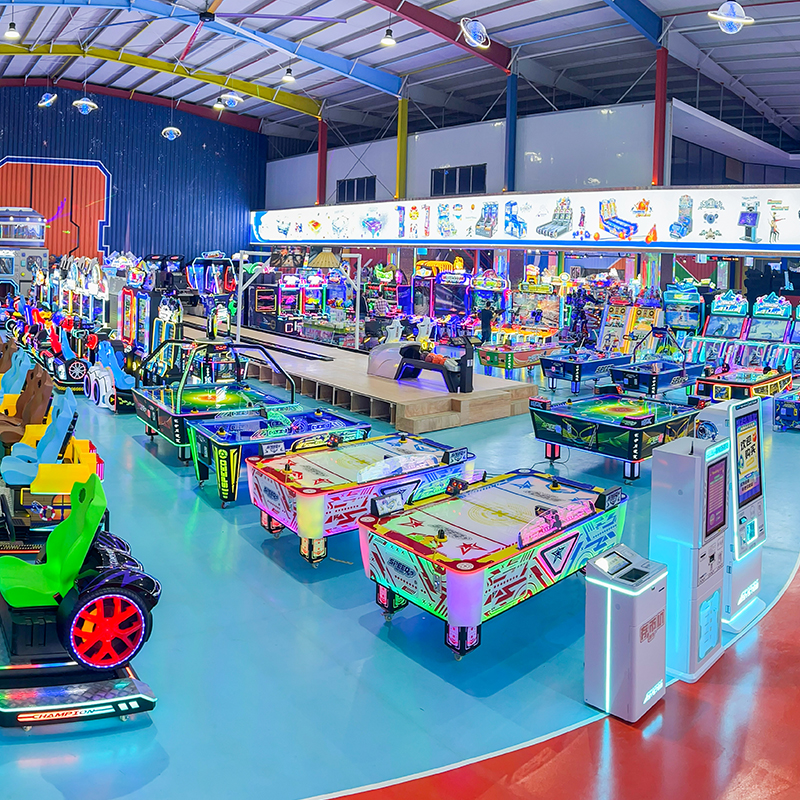
Core claw machine hardware
The company's core claw machine model is the EP-G001, a single-player coin operated claw machine. It combines a metal cabinet, tempered glass, a claw system, and an electronic control system. Its prize display system and LED-lit transparent cabinet are designed to attract attention. Power consumption is listed at 120-200W, voltage can be configured for 110V or 220V, and the claw strength is adjustable. The payment system supports coin, bill, card, and QR methods, which simplifies integration into modern game center operations. The EP-G001 carries CE certification and is intended for shopping malls, arcade centers, family entertainment centers, and amusement parks.
Procurement terms that reduce friction
On the buyer side, commercial terms are a useful indicator of a supplier's willingness to work with small and scaling operators. EPARK's stated MOQ is one unit for specific product orders and can range from one to five units for different product lines. Standard payment is a 30% deposit with 70% balance before shipment by T/T. Buyers can choose FOB, CIF, or EXW. All machines are tested before shipment, and technical support is part of the service model.
Risk controls built into production
EPARK describes its risk-control process as covering incoming material inspection, production testing, and a strict QC process with multi-step inspection before shipment. This level of control matters when a buyer is responsible for installing machines across multiple locations and cannot afford to rework units after arrival.
Technical Explanation: What Makes a Claw Machine Deployable at Scale
The technical choices in a claw machine determine whether it can be serviced by local technicians and remain profitable in a fleet. The first factor is the cabinet. A strong metal frame resists movement, tampering, and the wear of constant opening and closing. A tempered glass panel gives customers a clear view of prizes and also protects the internal mechanism.
The second factor is the claw system itself. Adjustable claw strength is a practical requirement for commercial use. Operators need the ability to set win rates in a way that balances player satisfaction and prize cost. If this function is buried in inaccessible firmware, the supplier must provide remote programming support.
The third factor is payment integration. A coin operated claw machine may be a minimum requirement, but busy venues also need bill acceptors, card readers, and QR code payment. EPARK's EP-G001 supports all four input methods, which reduces the need for coin handling and allows operators to adjust to local payment habits.
EPARK's own engineering comparison with standard arcade game machines lists stronger cabinet structure, stable performance, and customizable design as the main differences. The company claims a 30% longer lifespan and a 20% higher player attraction rate for its machines. These are manufacturer-level claims, not third-party measurements, and actual performance will vary based on usage intensity, site selection, and maintenance quality. Still, they give procurement teams a starting point for requesting validation data.
Compliance is another long-term variable. In many jurisdictions, arcade machines installed for public use must demonstrate electrical safety. The EP-G001 is marketed as CE certified. For European placements, buyers often need documentation aligned with IEC 60335-2-82, which specifically covers the safety of amusement machines and personal service machines for public use. Long-term importers should ask suppliers to provide certification copies and confirm voltage compatibility before the order.
Application and Use Cases: Where Long-Term Supply Relationships Pay Off
Different venues use claw machines in different configurations. The most common is the single-player cabinet, which is compact enough for a shopping mall corridor or a restaurant waiting area. Here, low power draw, LED lighting, and multiple payment methods are important. A well-placed plush toy claw machine can become a self-service attraction between other activities.
High-traffic game centers and family entertainment centers often need double or multi-player formations. A double claw machine lets two visitors play simultaneously and shortens queue time; a four-player claw machine can serve as a centerpiece in larger zones. EPARK's product catalog images include double-player and four-player claw machine formats, in addition to themed clip models such as Super Clip and Cute Cat lines. The exact availability of a given cabinet should be confirmed with the supplier, but the range suggests that operators can combine standard units with themed prize machines.
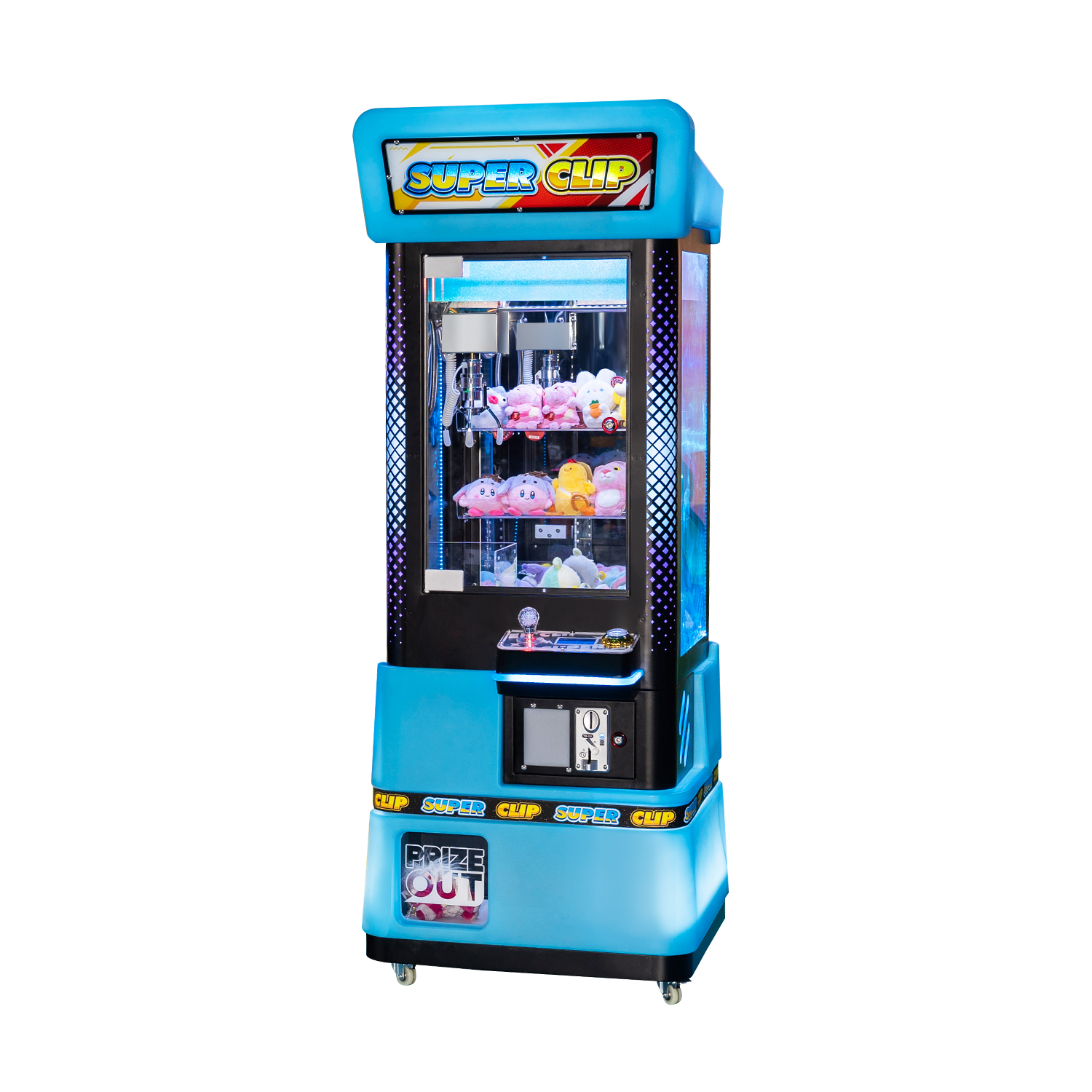
Redemption-based venues may treat claw machines as one element of a larger ecosystem. A supplier relationship can allow operators to swap prize claw machines for air hockey, basketball challenge, or VR experiences in the same space without qualifying a new vendor. EPARK's multi-category portfolio supports this type of floor evolution. Customization also plays a role: EPARK lists free project solutions and customizable design as part of its offering. For an operator opening a branded family entertainment center or a theme-specific zone, the ability to adapt cabinet design to colors and theme can be more practical than buying standard import stock.
When planning for growth, buyers should treat the first unit not as an isolated purchase but as a test of the supplier's service speed. Does the supplier respond to technical questions? Are spare parts available? Can the seller dispatch replacement doors, motherboards, or claws? These questions will determine whether the next ten units come from the same source.
Market Trend Analysis: Scale, Compliance, and Partner Value
The verified market figures support a long-term view of the category. The global claw machine market was valued at roughly USD 2.66-2.8 billion in 2024-2025 and is expected to surpass USD 5.1 billion by 2032-2034. The largest product segment in 2025 was the middle-type claw machine, holding about 44.2% of the market; this type generally fits the mall and family entertainment center installation schemes described above. Asia Pacific's 42.7% share in 2025 points to a strong local manufacturing base, and the Panyu district of Guangzhou is widely cited in industry literature as a global hub for claw machine production.
Compliance is becoming a more visible criterion. Standards such as IEC 60335-2-82 are used in the international safety assessment of amusement machines, and buyers are starting to include technical documentation requests at the RFQ stage rather than after shipment. The result is that suppliers with documented CE certification and production control gain an advantage in long-term contracts.
Finally, return expectations affect how buyers think about equipment cost. Industry commentary suggests a typical commercial claw machine placed in a reasonable traffic location can pay back its investment within 12-24 months, depending on foot traffic and operational efficiency. If recovery takes a year or more, a small difference in machine reliability or after-sales response directly changes the business case. That is why a slightly higher purchase price can be justified if the supplier reduces downtime and supports a longer service life.
Comparison with Traditional Solutions: One-Time Purchase vs. Supplier Partnership
Traditional sourcing for claw machines often follows a simple transaction: an importer or venue owner finds a listing, receives a quotation, and places a purchase order. The comparison below summarizes how this differs from a long-term supplier relationship.
| Criteria | One-Time Transactional Sourcing | Long-Term Supplier Partnership |
|---|---|---|
| Order scope | Single machine or single container | Fleet expansion, spare parts, and future model refresh |
| Quality control | Depends on the final inspection arranged by the buyer | Factory states incoming material inspection, production testing, and multi-step pre-shipment QC |
| Service response | Limited to the warranty window | Dedicated after-sales team and spare parts support built into the operating model |
| Customization | Usually fixed stock model | Project solutions and customizable cabinet design available |
| Commercial flexibility | Deposit and balance may change between orders | Stated terms such as MOQ from one unit, 30/70 payment, FOB/CIF/EXW delivery |
| Knowledge accumulation | Supplier does not need to understand venue performance | Both sides can track failure patterns, prize strategies, and future demand |
Limitations also need to be acknowledged. A long-term partnership cannot compensate for a poorly selected site. If a venue lacks foot traffic or the prize strategy does not fit the local audience, even a well-built claw machine will not perform. In addition, a manufacturer based in Guangdong cannot provide immediate on-site service in every country. Buyers shipping to distant markets should compare EPARK's remote technical support and spare parts process against the lead time of a local agent, especially for single-unit emergency replacements.
Future Outlook
The next stage of claw machine procurement will likely be shaped by operational rather than purely aesthetic factors. As the market grows, more operators will standardize around machines that can be serviced remotely, repaired with available spare parts, and integrated with modern payment networks. Manufacturers that maintain a broad product catalog, an in-house engineering team, and clear support infrastructure are better positioned to build repeat-buyer relationships.
For buyers, the practical takeaway is that supplier selection should happen before a full fleet deployment. A small pilot order can validate cabinet quality, payment behavior, and support responsiveness. Once that evidence exists, the decision to scale with the same supplier becomes a lower-risk choice than searching for the lowest quote on every additional machine.
FAQ
What makes a claw machine supplier suitable for long-term partnerships?
A suitable supplier should have documented production capacity, in-house quality control, spare parts availability, after-sales service, clear commercial terms, and product range that can match future floor changes. Buyers should verify these points before the first order.
What are EPARK's payment and delivery terms for commercial claw machines?
EPARK's standard payment is 30% deposit and 70% balance before shipment by T/T. Delivery methods include FOB, CIF, and EXW. The order quantity can start from one unit for certain product lines. All machines receive 100% testing before shipment.
Can a buyer place a small pilot order before committing to a fleet?
Yes. EPARK lists MOQs of one unit or one set for different products, with flexible minimums between one and five units depending on the product line. A test order allows the buyer to evaluate quality and support responsiveness in a real operating environment.
What type of after-sales support does EPARK provide?
EPARK states that it has a dedicated after-sales team and spare parts support. The production process includes incoming material inspection and multi-step pre-shipment QC. Technical support is part of the stated service model for buyers who cannot walk into a local service center.
Which claw machine configurations can be used when expanding a venue?
Single-player claw machines are useful for corridors and small spaces. Double-player and four-player cabinets support higher traffic in arcade centers and family entertainment centers. Themed plush or prize clip machines add visual novelty. EPARK's catalog images include double-player, four-player, and themed clip machines such as Super Clip and Cute Cat.
What safety standards should buyers check for claw machines in public venues?
CE certification is commonly cited in EPARK product specifications. For European public use, buyers should also verify that the machine complies with the relevant electrical safety framework, including IEC 60335-2-82, which specifically covers amusement machines and personal service machines used by the public.
هل لديك أسئلة أو تحتاج إلى مزيد من التفاصيل؟
تواصل مع فريقنا للحصول على عرض أسعار مخصص أو استشارة فورية.
طلب عرض أسعار
املأ النموذج أدناه وسيتواصل معك فريقنا بعرض مقترح مخصص.
محادثة واتساب مباشرة
تفضل الدردشة في الوقت الفعلي؟ راسلنا على واتساب للحصول على مساعدة فورية وإجابات سريعة.
- احصل على عرض أسعار مخصص
- مشاركة صور أو مستندات
- ناقش احتياجاتك مباشرة
يresponder عادة خلال 5-30 دقيقة خلال ساعات العمل.