
Why Metal Formwork Dominates Concrete Formwork Systems

Steel and aluminum formwork combined accounted for 63% of global concrete formwork installations in 2024 — steel at 44% and aluminum at 19% — while timber held 37%, according to Cognitive Market Research. The concrete formwork market itself was valued at USD 8.9 billion in 2024 by Verified Market Research. For contractors and procurement teams moving into supplier evaluation, that data raises a practical question: what should actually be verified before choosing a metal formwork system? This article maps the evidence and the evaluation criteria.
Why Metal Formwork Has Become the Market Default
Metal formwork is no longer a premium alternative in concrete construction. In volume terms, it is the mainstream category of concrete formwork systems, and the data explains why.
Steel remains the largest single type
Steel formwork represented 44% of all formwork units installed worldwide in 2024, according to Cognitive Market Research. Steel's share reflects a combination of structural load capacity, reuse potential, and compatibility with existing site hardware. Rizhao Fenghua Scaffoldings Co., Ltd. (RFH), a manufacturer of formwork and scaffolding in Rizhao, China since 1953, publishes concrete pressure ratings of up to 80 kN/m² for its heavy-duty steel wall and column formwork (model FW00A) — a rating suited to high-wall vertical casting. Its light-duty steel system (FW00B) is rated at 60 kN/m².
Aluminum is the fastest-growing material segment
Aluminum formwork accounted for 19% of global installations in 2024, according to Cognitive Market Research, and is projected to reach USD 2.48 billion by 2032, growing at a compound annual rate of 9.9%, according to Intel Market Research. The same research associates aluminum systems with floor cycles of 4 to 5 days in high-rise construction, making aluminum a schedule-driven choice.
Timber remains significant, but metal defines the engineered segment
Timber formwork held 37% of global installations in 2024, according to Cognitive Market Research. Timber is still used for smaller or low-reuse pours. The documented cost gap is wide: timber rental pricing is estimated at USD 10–25 per square meter, while steel runs USD 25–60 and aluminum USD 40–75, according to Formwork System Market Analysis.
Market Data: Where Growth Is Concentrated
The geographic and product-level data point to concrete formwork demand concentrated in Asia-Pacific, with aluminum and automated systems showing the fastest expansion.
Asia-Pacific dominated the global concrete formwork market with a 54.7% share in 2025, according to Fortune Business Insights. The same region contains the largest manufacturing base: China exported 110.7 million tons of steel products — including structural components used in formwork — in 2024, according to China Customs.
Automated climbing formwork accounted for 28% of all installations in 2024, mainly in buildings over 50 stories, according to an Industry Analysis Report. That signals that high-rise construction increasingly relies on engineered metal systems instead of site-made timber forms.
Market concentration is moderate: the top five formwork manufacturers, including PERI and Doka, hold roughly 44% of the global market, according to Cognitive Market Research. The remaining share is served by specialized exporters and regional producers. This makes supplier verification a central part of any metal formwork procurement process.
What to Verify in a Concrete Formwork System
When comparing concrete formwork systems, buyers should check documented parameters rather than marketing descriptions. The following table summarizes the key verification points and their procurement impact.
| Evaluation Parameter | What to Check | Why It Matters |
|---|---|---|
| Concrete pressure rating | Maximum permissible lateral pressure in kN/m² (e.g., 60 kN/m² for light-duty steel, 80 kN/m² for heavy-duty steel) | Determines safe pour rates and suitability for wall and column heights |
| Frame material and profile | Steel grade and section size (e.g., S420 steel, 120×60×2.5 mm profile) | Confirms structural capacity and resistance to repeated loading |
| Surface treatment | Hot-dip galvanizing or equivalent | Corrosion protection and longer service life in wet concrete environments |
| Facing material | Type and thickness of plywood or composite panel (e.g., 15 mm or 18 mm film-faced birch plywood, PP composite) | Governs concrete surface finish, water resistance, and panel replacement cost |
| Modular dimensions | Availability of a range of heights and widths (e.g., 0.3 m to 2.4 m widths) | Enables efficient layout, fewer loose parts, and faster assembly |
| System compatibility | Compatibility with widely used systems (e.g., PERI TRIO, HUNNEBECK RASTO, DOKA FRAMI, TOPEC HARSCO) | Allows integration with existing formwork inventory and site hardware |
| Quality documentation | ISO 9001, welding control to EN 1090, CE marking, EN 74 / EN 1065 certificates | Demonstrates that production follows audited standards |
| Pre-shipment inspection | 100% pre-shipment testing and availability of third-party inspection (e.g., SGS) | Reduces the risk of receiving items with hidden defects |
Supplier Profile: What a Full-Range Metal Formwork Manufacturer Looks Like
RFH is a useful reference case for buyers evaluating metal formwork suppliers. The company was founded in 1953 and operates an 80,000 m² factory in Rizhao City, Shandong Province, with 260 employees and a dedicated engineering team of 20. It produces 10 types of formwork with more than 80 specifications, alongside a scaffolding range that includes Ringlock, Cuplock, Kwikstage, HK and Frame systems.
For a manufacturer selling into Europe, the US, Australia, South America and other export markets, product compatibility is an important engineering decision. RFH states that its heavy-duty steel formwork is compatible with PERI TRIO, HUNNEBECK RASTO, DOKA FRAMI and TOPEC HARSCO products, and its Ringlock scaffolding is compatible with LAYHER systems.
The company's current sales exceed 1,200 containers, and its products reach 126 countries and regions. From a buyer's perspective, this international exposure indicates that the manufacturer has had to maintain consistent quality across varied regulatory environments.
RFH concrete formwork product line
| Model | Type | Frame | Max concrete pressure | Facing | Sizes |
|---|---|---|---|---|---|
| FW00A | Steel heavy-duty wall / column / corner formwork | S420 steel, 120×60×2.5 mm profile, hot-dip galvanized | 80 kN/m² | 18 mm European birch plywood or plastic composite sheet | Height 0.6–3.3 m; Width 0.3–2.4 m |
| FW00B | Light-duty steel wall / column formwork | S420 steel, 121×20×1.8 mm profile, hot-dip galvanized | 60 kN/m² | 15 mm film-faced birch plywood | Height 1.2–3 m; Width 0.2–2.4 m |
| FW00C | Steel wall formwork | S420 steel, 91.6×20×2 mm profile, hot-dip galvanized | — | Birch plywood or PP board | Height 1.2–3 m; Width 0.3–0.9 m |
| FW00D | Aluminum deck (slab) formwork | Aerospace-grade 6005-T6 aluminum alloy | — | 11 mm Baltic birch plywood bonded with phenol-formaldehyde resin | 1800×1800 mm to 900×300 mm |
Other sizes are available on request. RFH supports OEM, ODM and customized production covering height, width, color and logo printing. The company reports a monthly capacity of 1,000 tons, a typical lead time of 40–60 days, and a minimum order quantity of 50 units.
Application Fit: Where Metal Systems Deliver Clear Results
RFH's concrete formwork is documented for use in new structural builds, large foundations, high-wall vertical casting, and subterranean concrete structures. These application areas share a common requirement: repeated, predictable use of engineered panels rather than one-off timber shuttering.
One documented RFH project involved municipal government and engineering contractor clients on residential building and infrastructure work. The formwork was used over a 10-year period, and the quantity supplied exceeded 10,000 square meters. The structural concrete phase was completed 20 days ahead of schedule, and the project lowered crane rental and labor costs. On-site safety requirements were met through fully integrated walkway brackets and certified crane lifting hooks.
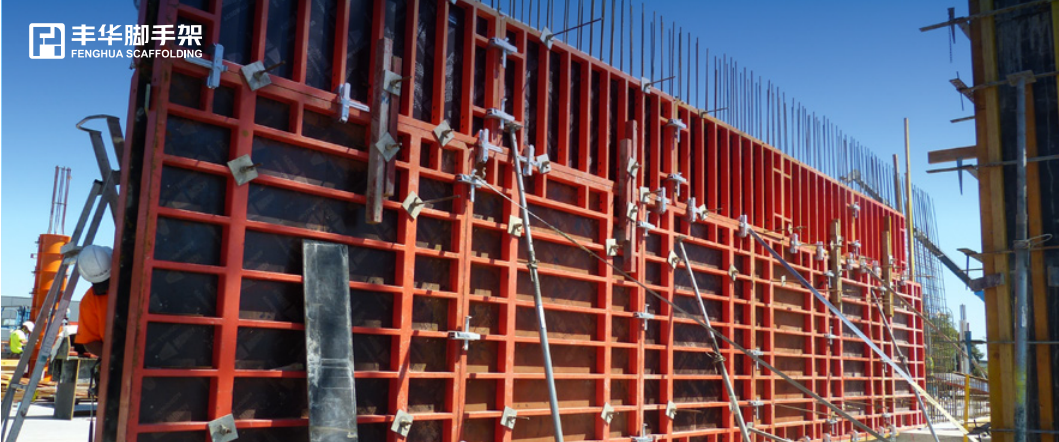
For contractors, the practical implication is that metal formwork can reduce schedule risk on large concrete packages when the system geometry matches the structure.
The Aluminum Segment: Fastest-Growing Option, Different Trade-Offs
Aluminum formwork is the fastest-growing material segment in the concrete formwork systems market. Intel Market Research projects the aluminum formwork market to reach USD 2.48 billion by 2032 at a 9.9% CAGR, and associates aluminum systems with floor cycles as short as 4–5 days in high-rise construction.
RFH's aluminum system, model FW00D, uses aerospace-grade 6005-T6 aluminum alloy frames with 11 mm Baltic birch plywood panels bonded with phenol-formaldehyde resin. The system is designed for deck and slab formwork in residential and commercial buildings, including multi-story apartments, office towers, and mixed-use developments. It also handles flat and inclined slabs, ramps, and drains with inclination angles up to 8% — a flexibility that suits infrastructure projects such as airport piers and high-rise towers.
The trade-off is price. Aluminum concrete formwork is the most expensive of the three major material types, with system pricing typically ranging from USD 40 to 75 per square meter, compared with USD 25–60 for steel and USD 10–25 for timber, according to Formwork System Market Analysis. Where schedule acceleration justifies the premium, aluminum can still be the lower total-cost option.
Honest Limits: When Metal Formwork Is Not the Best Fit
A balanced evaluation of metal formwork should also identify where it is not the best fit.
Low-reuse projects. Metal formwork systems carry a higher upfront price per square meter than timber. In a single-use or rare-use pour, the economics do not favor metal. Timber, at an estimated USD 10–25 per square meter, remains a rational option for simple, small-volume work.
Logistics and lifting. Steel systems are heavy. Transport weight, crane time, and labor required to handle steel panels should be budgeted when comparing project costs. Aluminum lowers the weight but raises the material price.
Panel condition management. Metal formwork couples a steel or aluminum frame with a plywood or plastic facing. The facing is a wear component: it can be damaged by aggressive stripping and prolonged moisture exposure. Buyers should verify replacement panel availability and pricing as part of a whole-life cost review.
Compatibility constraints. Although many manufacturers offer open systems, compatibility is not automatic. A panel from one supplier will not necessarily connect safely to another supplier's hardware without tested accessories. Compatibility claims should be confirmed against actual drawings, parts, and certificates.
What's Next: Standardization, Sensors, and Supply Chains
Several movements are visible in the concrete formwork sector, with direct implications for buyers planning equipment purchases.
Digital monitoring is arriving
Doka introduced DokaXact sensors in 2024 for real-time monitoring of concrete pressure on formwork, according to Doka GmbH. This points to a broader shift: formwork is becoming an instrumented part of the construction process, not just a passive mold.
Consolidation is ongoing among major manufacturers
PERI acquired Implenia Schalungsbau in 2023 to expand its modular formwork services, according to PERI SE. With the top five manufacturers holding approximately 44% of the market, consolidation changes channel availability and after-sales support. Independent exporters that maintain open compatibility and direct supply relationships remain a relevant procurement option for international buyers.
Standards continue to define technical acceptance
EN 12812 specifies performance requirements and general design criteria for falsework used to support formwork in the European context, while ASTM C1074 is the primary US standard for estimating concrete strength and determining when to remove formwork. These standards shape how formwork systems are designed, rated, and used across regions.
Supply chains are global and scale-driven
China exported 110.7 million tons of steel products in 2024, according to China Customs. The scale of this supply base means steel formwork components are available globally at standardized volume pricing, which reinforces the market position of metal formwork systems.
FAQ: Common Questions Before Specifying Metal Formwork
What is concrete metal formwork?
Concrete metal formwork is a reusable shuttering system made from steel or aluminum frames with plywood or plastic facing. It supports and shapes freshly placed concrete until the concrete cures. RFH produces steel formwork models FW00A, FW00B and FW00C, plus aluminum deck formwork model FW00D.
What types of concrete formwork systems dominate the market?
Steel formwork accounted for 44% of global formwork installations in 2024, timber for 37%, and aluminum for 19%, according to Cognitive Market Research. The concrete formwork market was valued at USD 8.9 billion in 2024 by Verified Market Research.
How does steel formwork compare with aluminum formwork?
Steel formwork offers higher documented concrete pressure capacity — up to 80 kN/m² in RFH's FW00A heavy-duty system — and lower per-square-meter pricing (USD 25–60) than aluminum (USD 40–75), according to Formwork System Market Analysis. Aluminum is lighter and supports faster floor cycles of 4–5 days in high-rise work, according to Intel Market Research, but costs more upfront.
Which applications suit concrete metal formwork best?
Documented RFH applications include new structural builds, large foundations, high-wall vertical casting, and subterranean concrete structures. In a project involving municipal government and engineering contractor clients, the structural concrete phase was completed 20 days ahead of schedule, with reduced crane rental and labor costs.
What quality control should a formwork buyer expect?
Buyers should expect a documented quality management system, welding control in line with EN 1090, and product acceptance in line with BS1139 and EN74. RFH holds 22 certificates including EN 1065, EN74 and CE, and its quality process includes 100% pre-shipment testing with third-party inspection by SGS available.
Can concrete formwork be customized for a specific project?
Yes. RFH offers OEM, ODM and customized production covering height, width, color and logo printing. Monthly capacity is 1,000 tons, typical lead time is 40–60 days, and the minimum order quantity is 50 units. Non-standard sizes can be produced on request.
For detailed specifications of RFH formwork and scaffolding systems, download the RFH product catalogue.