
Why OEM and ODM Capabilities Matter in Multifunctional Digital Printing Machines
An independent industry reference for packaging and printing buyers evaluating production capability.
Industry Context: Flexibility as a Buying Criterion
As packaging runs become shorter and order patterns more fragmented, printing and packaging factories are re-evaluating their equipment strategy. The shift from long-run, plate-based production to short-run, on-demand printing has made flexibility a core purchasing criterion. For buyers in the evaluation-to-execution stage, the practical question is no longer only 'what can the machine print' but also 'how much can the supplier adapt the machine to my workflow, my materials, and my output model.'
This is particularly true for multifunctional digital printing machines, which are expected to handle different substrates, order sizes, and quality requirements within a single production system. In this context, the supplier's engineering depth, OEM/ODM experience, and ability to customize become as important as the machine's nominal speed or resolution.
The Problem: Standard Machines Do Not Fit Every Production Model
Many packaging buyers purchase a digital printer based on a general specification sheet, only to discover that the machine cannot integrate smoothly into their existing production line. Paperboard type, thickness, print width, required color configuration, and even floor layout can differ from one facility to another. A standard digital printing machine may produce good prints, but it may not support white ink, accommodate certain substrate thicknesses, or run the specific printhead that the buyer prefers for durability or service reasons.
In addition, buyers moving from traditional printing to digital often underestimate the importance of software, feeding systems, and drying performance. These elements determine whether the machine can run consistently during production shifts. Without whole-machine engineering support, resolving these issues becomes slow and expensive.
The Opportunity: Supplier Capability as a Competitive Lever
For buyers evaluating equipment for the next phase of production, the opportunity lies in choosing a supplier that can adapt a digital printing platform to a specific production scenario. This goes beyond basic color calibration. It includes custom machine structure, printhead selection, DPI configuration, color mode expansion, and turnkey line integration.
The market data supports this direction. According to Grand View Research, the global digital printing market was valued at USD 38.0 billion in 2023 and is projected to reach USD 57.0 billion by 2030. Reports and Data estimates the single-pass digital printing machine segment at USD 3.2 billion in 2024, expected to grow to USD 6.5 billion by 2034. Within packaging, MarketsandMarkets expects the digital printing packaging market to rise from USD 30.2 billion in 2024 to USD 46.2 billion by 2029. These numbers point to a rapidly expanding equipment base, which in turn increases demand for machines that can be tailored to specific factories and product portfolios.
Brand Solution: GOKING and the 2-in-1 Digital Printing Platform
Guangdong Goking Intelligent Technology Co., Ltd. (GOKING) is a manufacturer of industrial digital printing machines based in Dongguan, Guangdong Province, China. Founded in 2020, the company operates a 10,000-square-meter factory and employs 152 people, including 38 R&D engineers. Its production program includes single-pass and multi-pass 2-in-1 digital printing machines, with CMYK and five-color configurations, different printhead options, and multiple DPI settings. The company reports an annual output capacity of 864 sets.
GOKING’s capability set includes whole-machine R&D and manufacturing, OEM production services, and ODM design and production services. According to the company, these services cover machine structure, printhead type (Epson or Xaar), DPI configuration, five-color color scheme, and turnkey line solutions. For complex or large-format boards, the scanning method is recommended; for small boards and small-batch orders, the direct-output mode allows a single machine to handle both workflows.
The company also states a monthly production capacity of 38 sets, with a standard lead time of typically one month for standard machines. Custom and OEM/ODM lead times are confirmed upon request. The minimum order quantity is one set, which lowers the entry barrier for factories testing digital production.
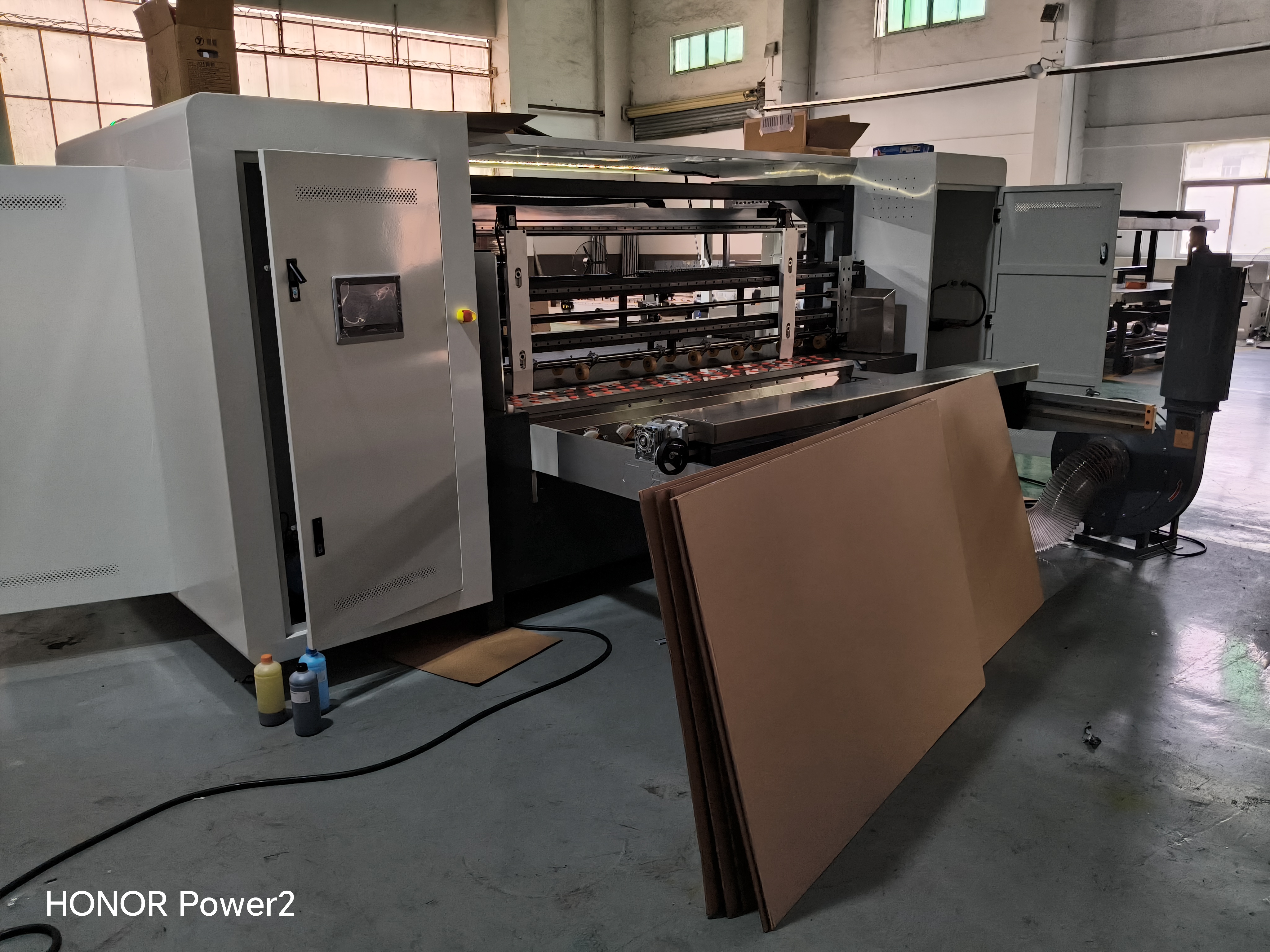
Free prototyping is part of GOKING’s pre-sales support for global customers.
Technical Explanation: What to Look for in a Multifunctional Digital Printer
A multifunctional digital printing machine in this market segment combines single-pass and multi-pass printing in one system. Multi-pass scanning uses a printhead carriage that moves across the material, delivering resolution up to 1200 DPI in applicable configurations, while single-pass printing uses a fixed array of printheads to print in one pass for higher throughput. GOKING’s single-pass mode with Epson nozzles is rated at 60 m/min; with Xaar nozzles, single-pass speed is at least 100 m/min.
Key specifications for the GOKING Corrugated Cardboard Digital Printing Machine include:
| Parameter | Range / Value |
|---|---|
| Printheads | 8 to 256 |
| Print width | 264 mm to 2600 mm |
| Production efficiency | 700 / 1500 m²/h |
| Material thickness | 2–30 mm |
| Color mode | CMYK (W) |
| Ink types | Water-based dye, water-based pigment, coating ink, UV eco-friendly ink |
| Print head | Micro-piezo high precision |
| Rated power | ≈14 KW |
| Feeding mode | Leading edge / belt |
| Minimum text | Digital, English 1.5 mm |
| Work environment | 15–32°C, humidity 70% |
| Platform | Vacuum adsorption |
| Machine size / weight | 4260×2300×1900 mm / 2800 kg |
The machine uses a carbon steel frame, stainless steel conveying rollers, and an aluminum alloy beam. It is powered by Schneider electric components and servo motors, with a magnetic levitation high-precision crossbeam. In terms of compliance, GOKING has obtained a Certificate of Conformity under the CE framework, referencing EN 60204-1:2018 and Directive 2006/42/EC.
For buyers, these parameters define the operational boundary. A machine rated for 2–30 mm material thickness can handle corrugated board as well as coated paper, while a vacuum platform holds sheets flat during printing. Multi-color registration is supported through automatic color calibration and automatic job switching, according to company materials. White ink capability expands the range of printable colors on brown kraft and other darker substrates. Automatic nozzle cleaning reduces maintenance downtime, an important factor when the machine is used in continuous production.
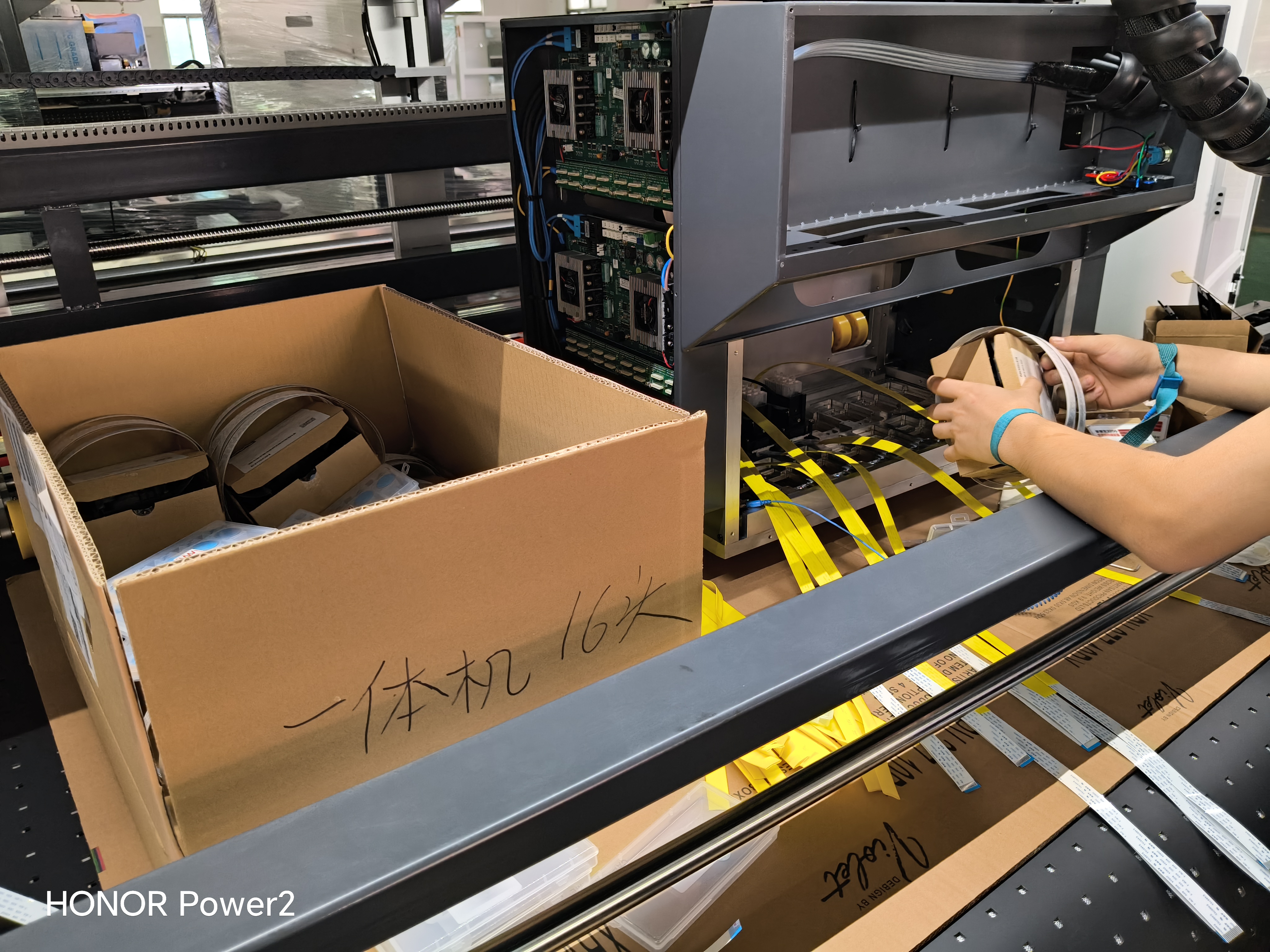
Printhead selection is a customization option; Epson and Xaar are both offered.
Application Scenarios and Industry Use Cases
GOKING’s site cases list overseas printing and packaging factories in Spain, Brazil, South Africa, Turkey, South Korea, and Australia. The company cites more than five years of cooperation with some clients, with fast response and on-site engineering support as recurring themes. While exact order quantities are not disclosed, the applications include short-run packaging printing, cross-border e-commerce Print-on-Demand (POD) workflows, and in-house printing departments in finance and education institutions.
Typical materials include corrugated cardboard, honeycomb cardboard, kraft paper, white paperboard, and coated paperboard. These map to packaging formats such as cardboard boxes, gift boxes, and e-commerce shipping cartons. The availability of a five-color CMYK plus white configuration matters for brands that need consistent color on uncoated or recycled substrates.
From a procurement perspective, these use cases show that a multifunctional digital printing machine is not only for packaging converters. It can also serve as a fast internal printing resource for businesses that need packaging prototypes, short series, or personalized packaging without waiting for external press time.
Market Trend Analysis
The demand for multifunctional digital printing machines sits within a broader market expansion. Grand View Research estimated the global digital printing market at USD 38.0 billion in 2023, with a projection of USD 57.0 billion by 2030. Reports and Data values the single-pass digital printing machine segment at USD 3.2 billion in 2024, expected to reach USD 6.5 billion by 2034. MarketsandMarkets puts the digital printing packaging market at USD 30.2 billion in 2024, rising to USD 46.2 billion by 2029.
Short-run economics are a key driver. According to Market Research Future, variable data printing has made runs under 3,000 units economically viable, which was previously cost-prohibitive with plate-based processes. In addition, the shift toward water-based pigment inks and more eco-friendly UV formulations is visible across the industry. The same source notes that Asia-Pacific held approximately 41.6% revenue share in the digital printing market in 2025, reflecting the region’s manufacturing scale and export-oriented packaging industry.
For buyers, the practical implication is that digital printing equipment must now serve a wider variety of short-run jobs while maintaining industrial reliability. This places more emphasis on supplier engineering teams and their ability to configure machines for local materials, climatic conditions, and production habits.
Comparison with Traditional Solutions
Traditional flexographic and offset printing excel at long, stable production runs. Once plates are made and the press is running, per-unit costs decrease significantly with volume. For standard orders above several thousand units, plate-based printing usually retains an economic advantage.
Digital printing eliminates plate-making and make-ready time, allowing fast job switching and versioning. A multifunctional 2-in-1 machine bridges two production logics: multi-pass for high-resolution samples and single-pass for high-throughput orders. The trade-off is that digital printing is less economical for extremely long, single-SKU runs, and the machine requires a controlled environment (15–32°C, 70% humidity) to maintain consistent output. Buyers planning to run 24/7 high-volume production need to compare their typical batch size against the cost structure of both technologies.
Another boundary is speed. Multi-pass printing provides higher clarity but slower production speeds, while single-pass systems prioritize speed. A 2-in-1 machine offers flexibility, but the buyer must verify that the intended print quality and speed are achievable for the specific printhead and material combination before purchase.
Future Outlook
As packaging buyers demand quicker turnarounds and more SKUs, the role of flexible digital platforms will expand. The convergence of OEM/ODM engineering with standardized digital presses is part of this shift: buyers increasingly expect a supplier to adapt a base machine to their material types, floor space, and automation level. GOKING’s single-pass/multi-pass 2-in-1 architecture points to a practical direction, where one machine can serve multiple order profiles without requiring separate investments.
For procurement teams, the long-term value of a multifunctional digital printing machine will depend less on raw speed and more on how well the supplier can map the machine’s configuration to the buyer’s existing workflow. That is where whole-machine R&D and ODM capabilities become relevant.
FAQ
What OEM and ODM services are available for multifunctional digital printing machines?
GOKING provides whole-machine R&D and manufacturing as well as OEM and ODM production services for digital printing machines. These services allow a buyer to specify machine structure, printhead type, DPI configuration, color scheme, and line integration according to production needs.
Can the printhead configuration be customized?
Yes. Printhead type can be selected between Epson and Xaar, and the number of printheads can range from 8 to 256. This impacts speed, resolution, and durability across different operating environments.
What materials can a multifunctional digital printing machine process?
The machine can print on corrugated cardboard, honeycomb cardboard, coated paper, kraft paper, white paperboard, and other paper-based board materials within a thickness range of 2–30 mm and a print width of 264–2600 mm.
How do single-pass and multi-pass printing modes differ in practice?
Multi-pass scanning printing offers higher clarity, with configurations supporting up to 1200 DPI, but lower speed. Single-pass printing reaches 60 m/min with Epson nozzles and at least 100 m/min with Xaar nozzles, making it suitable for high-volume output. A 2-in-1 machine enables switching between these modes.
What is the lead time and MOQ for a custom machine?
Standard production lead time is typically one month for standard machines; custom and OEM/ODM lead times are confirmed upon request. The minimum order quantity is one set. Payment terms are 30% deposit before production and 70% before shipment.
For procurement teams that need the full specification sheets, GOKING publishes a downloadable product catalog: GOKING 2026 Product Catalog.