
Why Printers, Tanners and Water Plants Buy Magnesium Sulphate Fertilizer
Why Printers, Tanners and Water Plants Buy Magnesium Sulphate Fertilizer
Magnesium sulphate fertilizer is usually catalogued with crop inputs, yet a large share of the tonnage that moves in international trade never reaches a field. Printing and dyeing plants, tanneries, building-material producers, water treatment operators and bath-salt manufacturers buy the same chemical family as a process raw material, and they buy it against a different specification: a stable assay, a controlled impurity profile, predictable moisture behaviour, and a certificate of analysis (COA) for every batch.
That change of purpose alters what a buyer should ask for. A grower can evaluate a grade on magnesium content and price per nutrient unit; an industrial buyer is usually buying a raw material that must behave consistently in a mixing tank, a blender or a packing line. This article sets out which grades of the magnesium sulphate range serve non-agricultural buyers, what Tianjin Xingyu Fertilizer Industry Co., Ltd. supplies within that range, and where the fit boundaries sit.
Why non-agricultural buyers purchase a fertilizer-grade chemical
The application list behind this product range is wider than agriculture. Industrial applications include printing and dyeing, leather-making, building materials and water treatment, and the material is also used as bath salt raw material, alongside agricultural fertilizer and feed additive uses.
Trade data reflects that breadth. In 2024, China was the leading exporter of magnesium sulphate, with an export value of USD 149 million, according to OEC data based on UN Comtrade. On the consumption side, a 2025 commercial research estimate places agriculture and fertilizers at approximately 41.6% of the global magnesium sulfate market, which leaves a substantial share of commercial volume for other applications, although the precise split depends on which grades and end uses a given report counts.
For a procurement team, the practical conclusion is that the word "fertilizer" in the product name describes the commercial channel, not the buyer's process. The same production range is offered in agricultural grade, feed grade and industrial grade, in granule, crystal and powder forms.
What industrial buyers actually specify: three risk areas
Specification discipline in this segment concentrates on three areas, each of which appears in the range's stated quality and compliance requirements.
Impurity and assay consistency
The range requires strict control of heavy metals, arsenic, lead and other harmful impurities, and it is supplied with a COA for each batch. This is the core of industrial acceptance: the assay on the certificate has to match the specification on the purchase order, and successive batches have to fall inside the same limits rather than merely inside a broad commercial grade.
Moisture and caking behaviour
Limited moisture content and anti-caking performance are stated requirements, supported by sealed moisture-proof packaging. Moisture is not only a warehouse issue; for a plant that blends or doses powder, a material that picks up water changes flow behaviour, weighing accuracy and dust levels before it ever reaches a process step.
Documentation and conformity
Shipments are supported by a COA and an MSDS, with sealed moisture-proof packaging and shipping marks that comply with destination requirements. Feed-grade material must meet feed-additive standards, and EU-bound feed grade requires REACH and FAMI-QS compliance. Where the buyer's own quality system requires independent verification, third-party inspection is accepted under the supplier's stated terms.
The grade map: which form fits which process
The range covers four products, and they are not interchangeable for industrial purposes. The table below summarises the documented characteristics that most often decide the choice.
| Grade | Supplied form | Approx. MgO | Moisture / crystal-water behaviour | Documented position in this range | Packing |
|---|---|---|---|---|---|
| Magnesium sulphate anhydrous | White powder or granular | ~33% | No crystal water; low moisture | Listed for industrial raw material use; documented for moisture-sensitive formulations and as a drying agent; low heavy metal and low chloride | 25 kg / 50 kg PP woven, or as required |
| Kieserite | Off-white granular | ~27% | Low hygroscopicity; anti-caking, free-flowing for bulk blending | Listed for soil application | 25 kg / 50 kg PP woven, or as required |
| Magnesium sulphate monohydrate | White powder or granular | ~25–27% | Good thermal stability; low moisture; anti-caking for long storage | Listed for industrial raw material use, in addition to soil and foliar application | 25 kg / 50 kg PP woven, or as required |
| Magnesium sulphate heptahydrate | White granular crystal | Not stated in the published range data | Crystalline hydrate; extremely fast water solubility; low impurity | Listed for industrial raw material use and as bath salt raw material | 25 kg / 50 kg PP woven, or as required |
Two boundaries are worth stating plainly. First, Kieserite is documented in this range for soil application, so an industrial buyer should not assume the off-white granular mineral is the industrial raw-material option. Second, magnesium oxide content is a nutrient-density indicator: it tells a buyer how much magnesium is present, but it does not by itself describe impurity limits, particle size or moisture, and those have to be written into the specification separately.

Who supplies this range
Tianjin Xingyu Fertilizer Industry Co., Ltd. (XYF) is an original manufacturer of magnesium sulphate series products, founded in 1993 and based in Chenguantun Town Industrial Park, Jinghai District, Tianjin. Its core range covers anhydrous, monohydrate and heptahydrate magnesium sulphate, together with magnesium oxide, sulfur magnesium fertilizer and various medium and trace-element fertilizers in fertilizer grade and industrial grade. Production runs on automated lines supported by an independent standardized testing laboratory under an ISO quality management system, and the company holds independent import and export rights, exporting to more than 30 countries and regions.
Printing and dyeing plants: moisture control comes first
Printing and dyeing is listed among the industrial applications of this range. For a plant in the segment, the grade logic usually starts with moisture. Anhydrous magnesium sulphate is supplied as white powder or granular material, carries the highest magnesium oxide content in the range at approximately 33% MgO, and contains no crystal water, which is why it is the documented option for moisture-sensitive industrial formulations.
Beyond moisture, three acceptance points recur: heavy metal and chloride limits on the batch COA; consistent particle size where material is fed by auger or pneumatic handling; and packaging that survives an indoor dosing area without splitting. Custom specifications, granule size, colours, shapes, packaging and labels are accepted within the range, so these points can be written into the order rather than renegotiated batch by batch.
One fit boundary deserves emphasis. The range is documented for printing and dyeing as an application category, but the published data does not include dye-bath recipes or dosage figures. A plant should validate the selected grade in its own process before fixing contract limits.
Tanneries: batch-to-batch uniformity beats headline purity
Leather-making appears alongside printing and dyeing in the industrial application list. Tanneries tend to buy on the same criteria as other process users — stable assay, controlled heavy metals and chloride, and a COA that arrives with the container rather than after it — but they weight them differently. Where a line runs continuously, small batch-to-batch variation costs more than a marginally higher headline figure.
The relevant supplier capability is therefore consistency rather than one good certificate. Automated production lines, a standardized testing laboratory and full testing of output are the mechanisms documented for that purpose, and the offer is OBM with custom specifications accepted within the range.
Building-material producers: form, flow and packing
Building materials is the third industrial application on the list. Here the anhydrous grade's low moisture and absence of crystal water are the characteristics most often cited, together with physical form: white powder or granular material that can be handled in a blender, a mixing tank or a metering and batching line. Where a formulation is sensitive to added water, a hydrate is the weaker choice — not because of quality, but because the hydrate form carries water within the crystal.
Customisation matters more in this segment than in agriculture. Granule size, colour, shape, packaging and labels can all be specified, which lets a producer match an existing material-handling setup instead of rebuilding it around a standard grade.
Water treatment operators: dissolution behaviour and verification
Water treatment is listed among the range's project types and industrial applications. Where the product is dissolved before dosing, the parameters that matter are the ones the range already states as quality requirements: good water-solubility and low water-insoluble matter. Both should be confirmed on the batch COA rather than inferred from the grade name.
Two cautions belong here. First, the published material identifies water treatment as an application without detailing treatment mechanisms or dosage, so a plant should verify suitability in its own system and against local requirements. Second, chloride restriction is stated in the range's requirements in the context of chlorine-sensitive crops; an industrial buyer who needs a chloride limit should state the number in the specification and have it certified, because a crop-oriented rationale does not automatically define an industrial limit.
Bath salt raw material: purity, crystal form and labelling
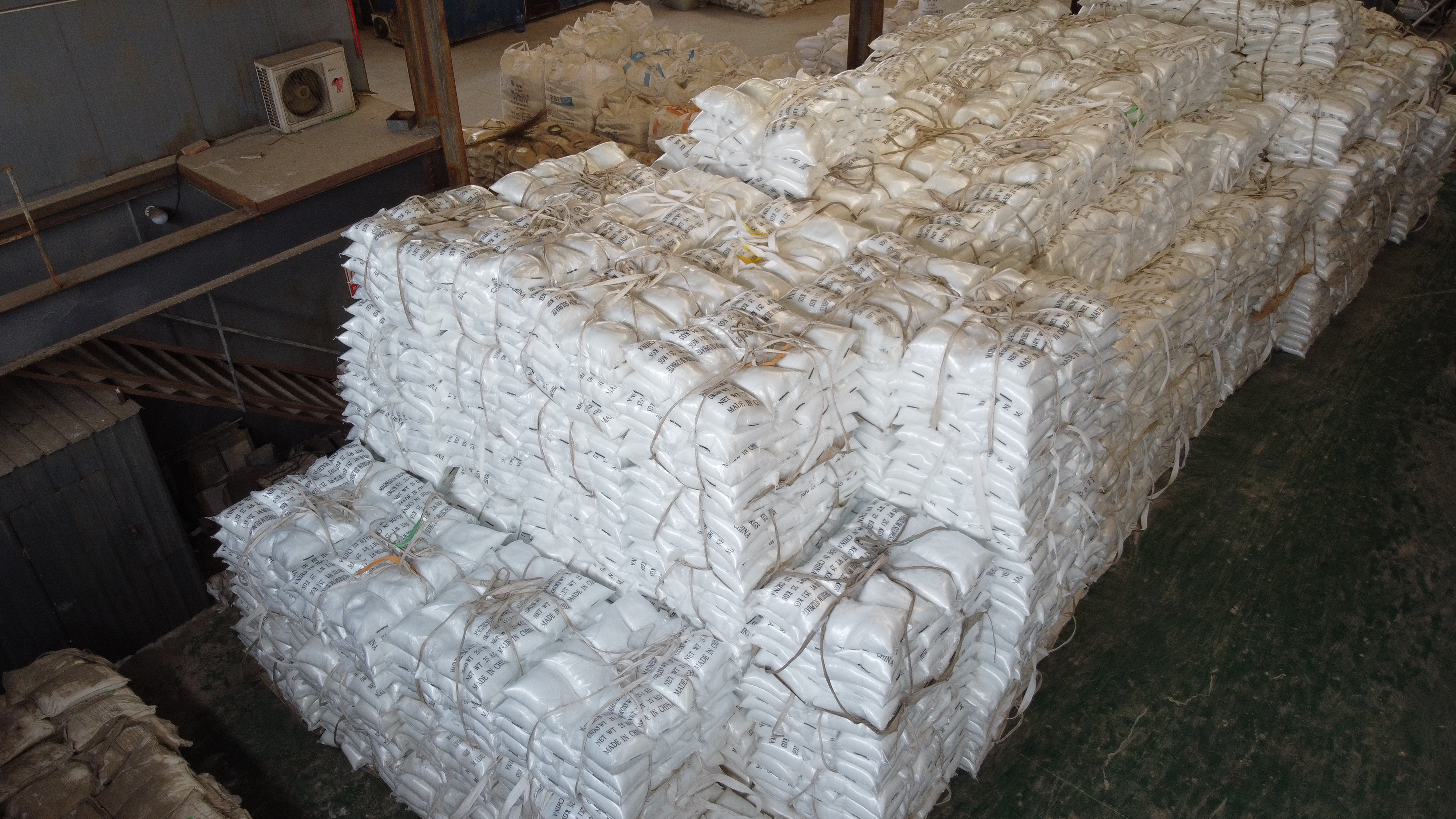
The range is also used as raw material for bath salt. Heptahydrate magnesium sulphate, the familiar Epsom salt hydrate, is supplied as a white granular crystal with uniform particle size and low impurity, which suits a raw-material specification more readily than a powder. Buyers in this segment should fix purity and impurity limits, confirm crystal form and particle size, and agree packaging and label content, because the material is often packed again downstream. Standard packing is 25 kg or 50 kg PP woven bags, with customised packaging available.
Writing the purchase specification: a working checklist
Industrial orders in this range are accepted on a one-container minimum quantity, and lead time depends on order quantity and requirements. That makes a written specification the practical starting point. A checklist for the buyer's file:
- Grade and form: anhydrous, monohydrate or heptahydrate, in powder, granular or crystal form, with the industrial grade designation stated.
- Assay and moisture: the magnesium oxide figure and moisture limit to be certified per batch.
- Impurity limits: heavy metals, arsenic, lead and any other restricted element, with the test method referenced.
- Chloride: an explicit numeric limit rather than a general statement of low chloride.
- Water-insoluble matter, where the material is dissolved before use.
- Particle size or granule distribution, and the dust level acceptable in the dosing area.
- Packing: 25 kg or 50 kg PP woven bags, or a customer-specific format, plus label content and shipping marks.
- Documents: COA per batch, MSDS, test reports, and the full export document set for the shipment.
- Verification route: third-party inspection where the buyer's quality system requires it.
- Discrepancy route: photographs, retained samples and third-party inspection reports for joint review.
What a batch record can and cannot prove
A two-year supply record with a Korean OBM customer covers 20 tonnes and documents industrial use among the applications, with a COA per batch, strictly controlled heavy metals and chloride, uniform granules, low dust and anti-caking performance, and a full export document set. Read correctly, that is evidence of a repeatable supply relationship maintained across a multi-year period.
It is not a published test of a customer's process outcome. Buyers should treat such a record as supply evidence — order size, duration, documentation practice — and keep incoming inspection as their own acceptance mechanism, using the stated discrepancy route when a batch falls outside the agreed limits.
Storage, handling and packing on arrival
Magnesium sulphate should be stored in a cool, dry, well-ventilated place, kept away from moisture, sunlight and oxidants, with packages sealed to prevent caking. Packaging is sealed and moisture-proof, and shipping marks should comply with destination requirements. Where caking occurs despite this, break up the caked material before charging it into a mixer, blender or dosing equipment, so the charge is uniform and the metering step is not overloaded.
Two further handling notes come from the range's application requirements: do not mix the material with strong alkaline substances, and keep bags closed between uses. Standard packing is 25 kg or 50 kg PP woven bags, or as the customer specifies, with customised labels for industrial accounts.
Market context, and a caution about headline numbers
Three published data points frame the industrial side of this market. Magnesium sulphate is registered in the ECHA REACH database with an annual tonnage band of 100,000 to 1,000,000 tonnes, which indicates the scale of European-registered supply. By product type, heptahydrate accounts for 54% of global commercial production, according to a 2025 commercial research estimate — the hydrate dominates volume, while anhydrous and monohydrate serve applications where moisture behaviour or nutrient density governs the choice. And China's 2024 export value of USD 149 million, from OEC/UN Comtrade data, shows where a large part of traded tonnage originates.
Headline market-size figures deserve caution. Published 2025 estimates for the global magnesium sulfate market differ materially, at roughly USD 1.0 billion in one estimate and USD 1.8 billion in another, largely because reports include different compounds and grades in scope. A procurement plan built on a single market-value number is therefore less reliable than one built on documented grade specifications and batch data.
What industrial buyers should expect from supply
The qualification burden in this segment falls on documentation rather than headline purity. Once impurity, moisture and particle-size limits are written into a purchase order, the supplier's ability to hold a specification across batches and evidence it becomes the deciding factor. The practical test is straightforward: can the supplier repeat the COA container after container, and support a discrepancy with retained samples and third-party inspection rather than reassurance.
Frequently asked questions
Do printing and dyeing plants need a different grade from agricultural buyers?
The application sits inside the same range, but the acceptance criteria differ. Industrial buyers normally specify the industrial grade in powder or granular form, fix impurity limits for heavy metals, arsenic and lead, set a chloride limit, and require a COA per batch. Anhydrous magnesium sulphate, with approximately 33% MgO and no crystal water, is the documented option where a formulation must stay moisture-controlled. Whether a specific plant can use a given grade in its process should be confirmed against its own trial and written specification.
Which form suits water treatment better, anhydrous or heptahydrate?
The choice depends on how the material is dosed. Where the product is dissolved before dosing, good water-solubility and low water-insoluble matter are the relevant quality requirements, and both should appear on the batch COA. Heptahydrate is documented for extremely fast water solubility; anhydrous is documented for low moisture and no crystal water. The published range does not define a water-treatment-specific grade, so the specification has to be agreed with the supplier.
What documents should accompany an industrial shipment?
A COA and an MSDS are supplied, together with test reports and application guidance, plus the export documentation for the shipment. Sealed moisture-proof packaging with shipping marks complying with destination requirements is required. Feed-grade material must meet feed-additive standards, and EU-bound feed grade requires REACH and FAMI-QS compliance. Third-party inspection is accepted where the buyer's quality system requires independent verification.
How should caked material be handled?
Storage in a cool, dry, well-ventilated place, away from moisture, sunlight and oxidants, with bags kept sealed, is the primary control against caking. Where caking has occurred, break up the caked material before it enters a mixer, blender or dosing line so that the charge is uniform. The range's application notes add that the material should not be mixed with strong alkaline substances.
What packing options exist for industrial orders?
Standard packing is 25 kg or 50 kg PP woven bags, or as the customer requires. Beyond packaging, custom specifications, granule size, colours, shapes and labels are accepted, and the minimum order quantity is one container. Lead time depends on order quantity and requirements.
For industrial buyers, the useful question is not whether magnesium sulphate is a fertilizer product, but whether the grade, impurity limits, moisture behaviour, packing and documentation can be fixed in writing and repeated batch after batch. Full grade and specification details are available from Tianjin Xingyu Fertilizer Industry Co., Ltd., and the XYF product catalogue (PDF) can be downloaded for reference.
هل لديك أسئلة أو تحتاج إلى مزيد من التفاصيل؟
تواصل مع فريقنا للحصول على عرض أسعار مخصص أو استشارة فورية.
طلب عرض أسعار
املأ النموذج أدناه وسيتواصل معك فريقنا بعرض مقترح مخصص.
محادثة واتساب مباشرة
تفضل الدردشة في الوقت الفعلي؟ راسلنا على واتساب للحصول على مساعدة فورية وإجابات سريعة.
- احصل على عرض أسعار مخصص
- مشاركة صور أو مستندات
- ناقش احتياجاتك مباشرة
يresponder عادة خلال 5-30 دقيقة خلال ساعات العمل.