
Why Project Context Drives Cooling Plate Selection in EV and BESS
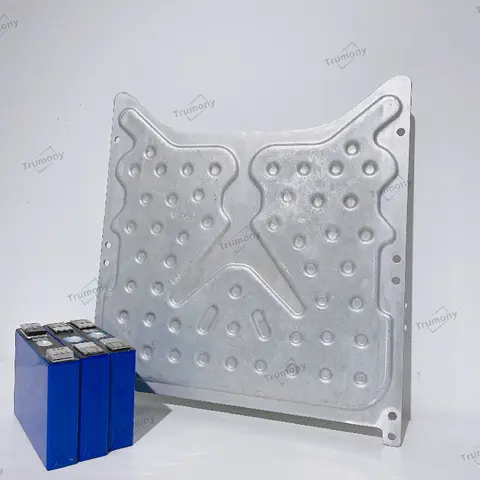
Battery heat management has become a central engineering issue in both electric vehicles and stationary energy storage. The cooling plate is the component that transfers heat from battery cells to the circulating coolant, and its design has a direct influence on cell temperature, pack efficiency and service life. For buyers moving from research to evaluation, the challenge is not whether liquid cooling is needed, but how to translate a project's specific operating conditions into a component specification.
This article provides an independent technical and procurement reference. It does not assume that one cooling plate fits all scenarios. Instead, it explains how project parameters such as temperature, duty cycle, coating requirements, and module geometry affect the choice between stamped plates, brazed plates, serpentine tubes, and related configurations. Trumony Aluminum Limited is used as a concrete example of a manufacturer that designs and produces these components at scale, but the selection criteria discussed here are intended to be reusable with any qualified vendor.
Why Project Context Determines Cooling Plate Requirements
The thermal profile of an EV battery pack differs from that of a BESS container. In an electric vehicle, the battery experiences variable load depending on driving conditions, with frequent acceleration events generating transient heat spikes. In an energy storage project, the battery is often cycled continuously for grid services or peak shaving, which means the cooling system must handle sustained heat rejection over hours or days. High ambient temperature and harsh environmental conditions add another layer of risk.
Common consequences of mismatched cooling plate selection include:
- High temperature gradients across the pack, which accelerate cell aging.
- Excessive pressure drop in the cooling channel, increasing pump energy consumption.
- Insufficient mechanical strength for the module assembly, leading to leaks or deformation.
- Corrosion on aluminum surfaces when the coolant chemistry or operating environment is not compatible.
- Unexpected qualification failures, delaying the project timeline.
These risks explain why project-specific selection is becoming a standard part of procurement evaluation. Buyers are increasingly asking suppliers to explain how their cooling plate design would respond to the actual duty cycle, not just to provide a generic thermal resistance number.
Main Cooling Plate Types and Their Suitability
Aluminum is the dominant material for battery cooling plates. Third-party data from Market Growth Reports indicates that aluminum-based cooling plates account for approximately 64% of all battery cooling plate installations, because aluminum combines good thermal performance with lower weight and cost than copper. A common alloy used in this field is Aluminum 3003, which offers a balanced combination of formability and corrosion behavior.
Within the product category, three configurations are especially relevant for EV and BESS buyers.
Stamped Cooling Plates
Stamped cooling plates are produced by pressing aluminum sheet into the desired shape. They are a practical choice when the cooling surface is flat and the volume is high, such as a module cold plate installed under prismatic cells. Stamping allows precise dimensional control and efficient material usage. Trumony lists a Stamped cooling plate model in its battery cooling component series with Aluminum 3003 material and custom thickness or cooling efficiency options.
Brazed Cooling Plates
Brazed plates are made by joining multiple aluminum layers in a brazing furnace, forming internal flow circuits with more freedom in channel routing. The brazing process creates a strong bond between layers and is suitable for larger plates that require low leakage risk. For EV and BESS packs, brazed cooling plates are often used when the internal flow path must be customized to cover more than one cooling zone.
Serpentine / Snake Tubes
Serpentine or snake tubes are long aluminum tubes bent into continuous flow paths. They are a common solution for cylindrical cell modules, where a tube can be placed between cell rows in a winding pattern. The snake cooling tube and serpentine cooling tube in Trumony's range are listed under battery cooling components and can be customized for thickness and cooling efficiency, giving engineers flexibility for space-constrained layouts.
Mapping Project Scenarios to Plate Characteristics
Selecting the right cooling plate is often an exercise in matching dominant constraints. The table below summarizes typical scenarios and the plate features that are usually prioritized.
| Project scenario | Typical primary constraint | Commonly preferred approach |
|---|---|---|
| Flat prismatic module with high cell count | Uniform surface contact | Stamped plate with wide, flat channels |
| Cylindrical cell module with limited height | Space and routing flexibility | Snake or serpentine cooling tube |
| Large ESS container with continuous 24/7 load | Leak safety and long-term reliability | Brazed plate with robust joining |
| High ambient temperature and corrosive environment | Corrosion protection | Coated aluminum plate, e.g., epoxy coating |
It is important to note that the same supplier may produce several configurations. Trumony's product family includes multiple cold plate models, including battery cooling plate, EV cooling plate, liquid cooling plate for energy storage, water cooling plate, and aluminum liquid cooling plate. All of these are based on Aluminum 3003 and are offered with customized cooling efficiency and thickness. The practical implication for buyers is that plate selection should be treated as a customization exercise, not a catalog lookup.
Documented Project Uses and What They Signal
Published case records from Trumony provide examples of how cooling plates are deployed in different industries.
| Client type | Region | Quantity | Primary application | Documented outcome |
|---|---|---|---|---|
| Automotive OEM | Germany | 2,000 units | Paint shop / factory line | Two years of stable operation, low noise |
| Automotive OEM | Vietnam | 60,000 units | Battery pack cooling | Stable operation, low cost, high quality, low noise |
| ESS pack OEM | China | 3,000 units | ESS container | Stable operation, low noise, low cost, fast lead time |
These examples cover a factory-line environment, an automotive battery pack, and a stationary storage system. The common theme is that each project required a specific integration approach. The factory line application, for instance, ran under continuous air supply conditions with 24/7 operation, which is a very different demand from a typical vehicle cycle. The ESS container application highlighted low noise and fast lead time as important factors, while the automotive battery application emphasized stable operation over a long period.
In addition, a documented application scenario targeting the EU market describes the product as suitable for battery pack thermal management projects operating under high-temperature conditions with 24/7 operation and an epoxy coating requirement. This type of scenario is important because the combination of high ambient temperature and continuous operation pushes the cooling plate's thermal and durability limits.
Supplier Qualification: What to Verify Before Evaluation
At the Research and Evaluation stage, buyers should verify whether a potential supplier has the technical depth and production control to meet project-specific requirements. The following points can be checked directly.
Scale and Quality System
Trumony Aluminum Limited, founded in 2017 and headquartered in Suzhou, operates 100,000 square meters of standard workshops. The company has about 220 employees, including 25 engineers in R&D, and lists an annual output of 600,000 units. Its quality management systems have passed ISO9001 and TS16949. These numbers give a baseline for evaluating production capacity and process discipline.
OEM and Customization Capability
For cooling plate projects, customization of dimension and cooling efficiency is often non-negotiable. The OEM capability record for the relevant product family includes customization options for dimension, cooling efficiency, and logo, with a monthly capacity that supports even small trial orders. The minimum order quantity is one unit, which is useful for prototyping, and the stated lead time is around thirty days.
Buyers should confirm whether the supplier can manage the entire part approval process. In the case of Trumony, quality control for the cooling component line includes 100% air leakage testing and dimension testing, with optional tests for helium tightness, voltage resistance, hydrostatic strength, burst pressure, and high/low temperature resistance. These tests are particularly relevant for EV and BESS programs where a coolant leak could damage cells or cause a safety incident.
Market Signals and Their Impact on Procurement
External market data supports the strategic importance of cooling plates. Market Research Future estimates the global electric vehicle battery cooling plate market at USD 3.01 billion in 2024, growing to USD 16.13 billion by 2035. In the stationary storage segment, BIS Research / Business Wire projects the BESS liquid cooling market to grow from USD 4.23 billion in 2024 to USD 24.51 billion by 2033, a compound annual growth rate of 21.55%.
The rapid growth of BESS liquid cooling has direct procurement consequences. As demand surges, component lead times may extend, and standard products may not always be available. Buyers who align their cooling plate specification with a supplier's manufacturing strengths early in the evaluation process are more likely to secure stable supply and realistic development timelines.
Comparison with Traditional Approaches and Trade-offs
Liquid cooling plates are frequently compared to air cooling and to copper tube-based liquid cooling. Each alternative has a different cost-performance profile.
Air cooling is simpler and has no leak risk, but its heat removal capacity is much lower. In high-power EV or BESS designs, air cooling generally cannot maintain the same temperature uniformity as liquid cooling. Therefore, liquid cooling is increasingly specified when pack energy density is high, even at the expense of system complexity.
Copper tubes offer excellent thermal conductivity, but copper is heavier and more expensive than aluminum. Aluminum plates can provide comparable thermal performance when the flow channel is designed properly, especially because a plate can cover a larger surface area than a pipe. The trade-off is that aluminum is more sensitive to galvanic corrosion in certain water-glycol mixtures, so an epoxy coating or appropriate coolant conditioning is often required. In extreme environments, the additional coating and testing can increase the total cost, which should be included in the project evaluation.
This boundary is not a disadvantage of aluminum plates; it is a design parameter. Projects that specify high-temperature, 24/7 operation, such as the EU battery pack thermal management scenarios documented in Trumony's application records, explicitly include epoxy coating as a special requirement. Buyers should always ask how the supplier handles surface protection when the operating environment demands it.
Future Outlook for Cooling Plate Selection
Looking at the next few years, cooling plates will become more application-specific. Battery pack formats are changing, and the shift to larger cells and cell-to-pack structures is creating new thermal interfaces. Coolant and coating technologies are also evolving, allowing aluminum plates to operate safely in more demanding environments.
For procurement teams, the practical implication is to build a supplier qualification framework that includes production capability data, quality test evidence, and project reference checks. Documentation of test procedures, including leak tests and burst tests, will become a standard part of the vendor dossier. Suppliers that can demonstrate process control—not just product features—will be better positioned for long-term partnership in EV and BESS programs.
FAQ: Project-Specific Cooling Plate Questions
Q: What role does a cooling plate play in an EV or BESS project?
A: The cooling plate is the heat exchange interface between battery cells and the liquid coolant. It removes heat from the cells and transfers it to the coolant, which is then cooled elsewhere in the system.
Q: How do I choose between stamped, brazed, and serpentine tube cooling plates?
A: The choice is driven by cell format, contact surface, channel design requirements, production volume, and cost targets. Stamped plates suit flat, high-volume modules; brazed plates suit larger or more complex flow paths; serpentine tubes suit cylindrical modules and slim assembly envelopes.
Q: When is a coating necessary on an aluminum cooling plate?
A: Coatings are required when the module operates in high humidity, high temperature, or chemically aggressive conditions. Documented EU battery thermal management projects include an epoxy coating requirement for this reason.
Q: What tests should a cooling plate supplier perform before parts are accepted?
A: For the cooling component product family referenced in this article, 100% air leakage testing and dimension testing are standard. Optional tests include helium tightness, voltage resistance, hydrostatic strength, burst strength, and high/low temperature resistance, depending on the project.
Q: What MOQ and lead time can be expected for customized cooling plates?
A: In the documented OEM capability for this product type, the minimum order quantity is one unit and the typical lead time is thirty days, which makes prototyping feasible.
Q: Is the same cooling plate used for EV and BESS applications?
A: The same base material and product family can be applied to both, but the final design must be adapted. Cooling efficiency and thickness are customized, and the installation geometry or surface protection is typically different for automotive versus storage projects.