
Why Project Scenarios Matter in Woodworking Machine Selection
Buyers evaluating woodworking machinery often focus on spindle power, feed speed, or working dimensions. In practice, the most decisive factors are frequently outside the datasheet: the type of panel being processed, the workshop environment, auxiliary equipment, operating mode, and the regulatory standards of the destination market. This article explains how project conditions shape machine selection, using documented production scenarios from SYUTECH as reference evidence.
The Industry Context: A Market Moving Toward Scenario-Based Buying
The global woodworking machinery market was valued at USD 20.3 billion in 2025 and is projected to reach USD 27.7 billion by 2033, according to Grand View Research. Europe accounted for 36.4% of revenue in 2025, while Asia Pacific held the largest regional share of the wood processing machines market at 34.5% in 2024, led by China and India. These figures point to expanding production capacity in both mature and emerging furniture markets.
For procurement teams, the practical implication is not just the size of the market but the rising expectation that machines must fit specific production contexts. A woodworking machine is rarely useful as an isolated tool; it works inside a sequence of cutting, edge banding, drilling, and assembly operations. The choice of machine therefore depends on the project scenario as much as on individual performance figures.
The Core Problem: Datasheets Do Not Describe the Environment
A common failure in machine selection is comparing single parameters without considering installation conditions. Panel furniture factories operate in indoor environments with normal temperature and humidity, but wood processing creates dust. Some projects require vacuum cleaners, vacuum pumps, and air compressors as supporting equipment. Others need only an air compressor and a vacuum cleaner. If this auxiliary infrastructure is not planned, even a technically capable edge banding machine or CNC router can underperform.
Regulatory requirements add another layer. For example, panel furniture machinery exported to the European market must meet EU CE mechanical and low voltage safety standards. The documented scenarios for cabinet production in Romania and edge banding in Kenya both list CE compliance as a special requirement. No explosion-proof rating is needed in these cases, but the CE requirement alone affects component selection and documentation.
There is also an opportunity in this complexity. Suppliers that can tailor machines to the actual working condition, material type, and production mode help buyers avoid costly mismatches. SYUTECH, the machinery brand of Foshan Shunde SaiYu Technology Co., Ltd., provides a useful example of this project-oriented approach.
Brand Solution: SYUTECH’s Project-Oriented Product Range
SYUTECH is based in Shunde District, Foshan, a region recognized as the hometown of woodworking machinery in China. The company was originally established as Foshan Shunde Leliu Huake Long Precision Machinery Factory in 2013. After ten years of technology accumulation, the company established the Saiyu Technology brand. It has introduced cutting-edge technology from Europe and collaborated with TEKNOMOTOR, an Italian company, to integrate domestic and foreign technical experience.
SYUTECH operates a 10,000 m² factory with 100 employees and an annual output of approximately 500 units. About 80% of production is exported to markets including Russia, the Middle East, South America, Europe, and Southeast Asia. The company’s main products include edge banding machines, CNC nesting machines, six-side CNC drilling machines, computer panel saws, complete factory production lines, and specialized processing lines.
This product breadth allows scenario-based assembly rather than forcing buyers to purchase from multiple unrelated suppliers. A buyer producing cabinets in Europe can combine a computer panel saw, an automatic edge banding machine, and a CNC drilling center. A smaller workshop may choose a mini edge banding machine and a compact CNC router. The same brand can also deliver an automatic production line when daily output and workshop size justify it.
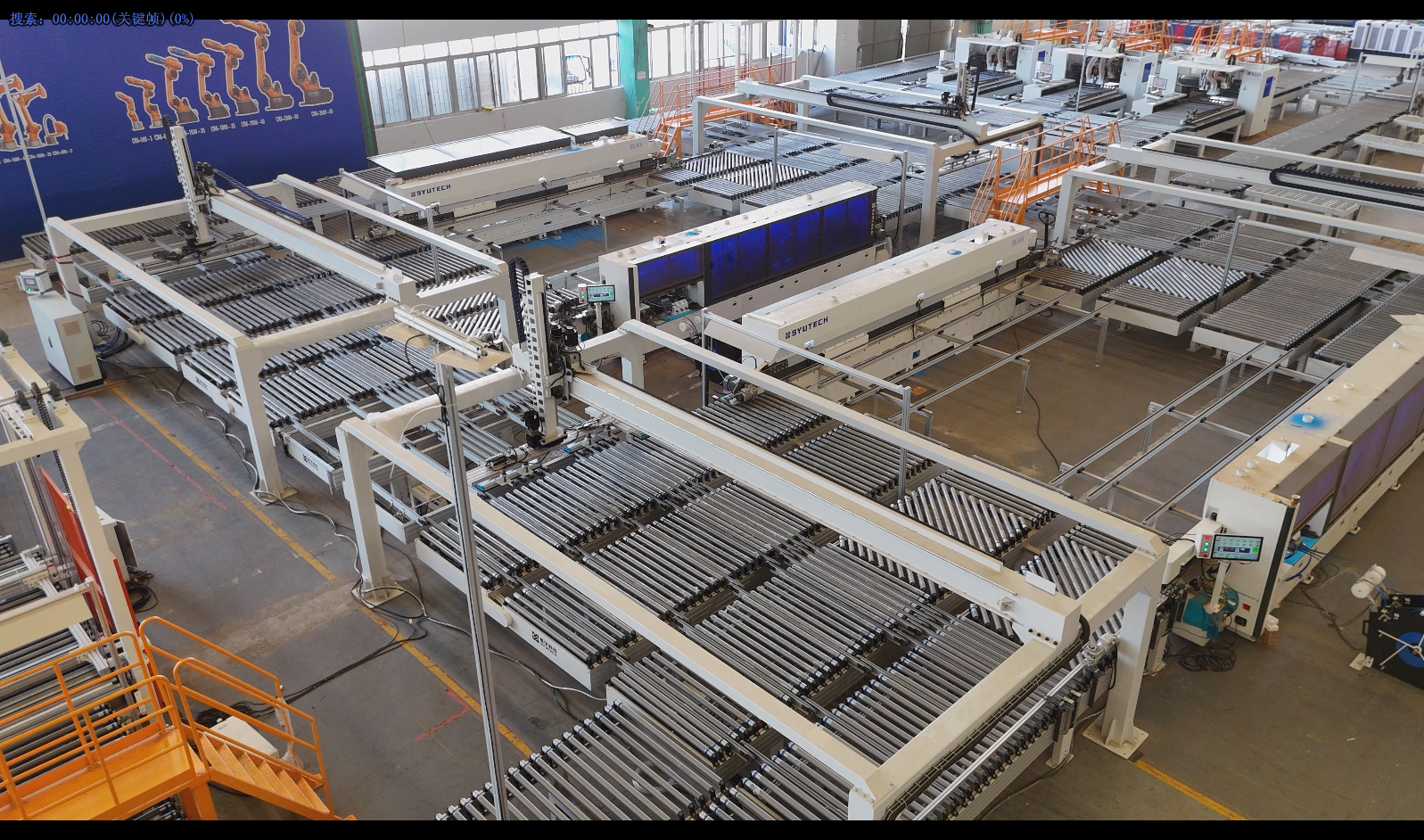
Automated connection for panel furniture production. Image: SYUTECH
Technical Explanation: Selecting Machines by Project Parameters
Scenario-based selection can be organized around four groups: process stage, material, environment, and operating mode. The table below summarizes the most common relationships using SYUTECH’s documented machine specifications.
| Project Scenario | Recommended Machine Family | Representative Specification |
|---|---|---|
| Panel sizing and cutting | Computer panel saw / beam saw | HK330: max cutting speed 0–100 m/min, max cutting width 3300 mm, cutting height 100 mm |
| Compact workshop edge banding | Mini / compact edge banding machine | HK268G: panel width min 40 mm; edge band width 10–60 mm; installed power 11.8 kW |
| High-volume edge banding | Automatic edge banding machine | HK868P: feed speed 16–22 m/min; edge band thickness 0.4–3 mm; pre-milling 2.2 kW ×2 |
| Nesting, routing, and board cutting | CNC nesting machine / CNC router | HK6: X-axis 1220 mm, Y-axis 2800 mm; 9 kW air-cooled spindle; 24000 rpm; 12-tool auto changer |
| Six-side drilling | CNC six-side drilling machine | HK612A: X speed 120 m/min; top vertical drilling 10 tools; bottom vertical drilling 9 tools |
| Door and cabinet panel processing | CNC door processing machine | HK3500: working thickness 10–50 mm; drill hole size 3–15 mm; total power 16.35 kW |
| Aluminum honeycomb plate furniture | CNC nesting machine for aluminum honeycomb | HK model: max processing size 2800×1220 mm; top vertical drills 10 pcs; machine weight 3500 kg |
Note: For automatic production lines, the HKATC model is customized based on the buyer’s daily output requirements and workshop size. This is a clear example of how project data, not just machine data, determines the final configuration.
Process Stage Determines the Core Machine
Furniture production lines generally follow the sequence cutting, edge banding, and drilling. For cutting, a computer panel saw such as the HK330 offers maximum cutting speed up to 100 m/min and handles panel widths up to 3300 mm. For edge banding, the automatic HK868P supports feed speeds of 16–22 m/min and includes pre-milling, end trimming, rough trimming, fine trimming, and polishing functions. For drilling, the HK612A CNC six-side drilling machine provides simultaneous top, bottom, and horizontal drilling capability, which is essential for modern panel construction.
Material and Product Type Shape the Configuration
Different projects require different tools. Cabinet and cabinet door production in Romania, for example, emphasizes stable edge banding and drilling. Panel furniture edge banding in Kenya focuses on applying, trimming, and polishing edge strips automatically. For aluminum honeycomb plate furniture, SYUTECH offers a dedicated CNC nesting machine with a processing range of 2800 mm × 1220 mm. This demonstrates that material choice is not a minor detail; it determines whether a standard machine or a specialized configuration is required.
Environment and Compliance Are Part of the Technical Specification
Indoor normal temperature and humidity with dust-contained wood processing is the working condition for the documented SYUTECH projects. Supporting equipment depends on the process: cabinet making calls for a vacuum cleaner, vacuum pump, and air compressor, while edge banding projects typically require an air compressor and a vacuum cleaner. CE mechanical and low voltage safety standards must be met in EU-destined projects. These environmental and compliance factors influence installation planning, electrical configuration, and machine guarding.
Application and Use Cases: Romania, Kenya, and Greece
The practical value of scenario-based selection can be seen in SYUTECH’s documented project references.
Romania — Cabinet and Cabinet Door Production. The project operates in an indoor normal temperature and humidity environment with dust-contained wood processing. The function is making cabinets and cabinet doors, using continuous automatic cycle operation with manual feeding assisted. Supporting equipment includes a vacuum cleaner, vacuum pump, and air compressor, and the machines must meet EU CE mechanical and low voltage safety standards.
Kenya — Panel Furniture Edge Banding. A panel furniture edge banding project uses machines to automatically apply, trim, and polish edge strips for panel furniture boards. The operating mode is continuous automatic cycle with manual feeding assistance. Required supporting equipment includes an air compressor and a vacuum cleaner. The same CE compliance requirement applies, and no explosion-proof protection is required.
Greece — Panel Furniture Manufacturer. A Greek customer purchased 10 units for an edge banding workshop. After three years of operation, the customer reported that output had increased significantly and that the machines ran with stable operation.
Kenya — Panel Furniture Manufacturer. Another Kenyan customer purchased 3 units for edge banding and CNC router workshops. Over two years, edge banding quality improved significantly and output increased. The customer highlighted stable edge banding as a key benefit.
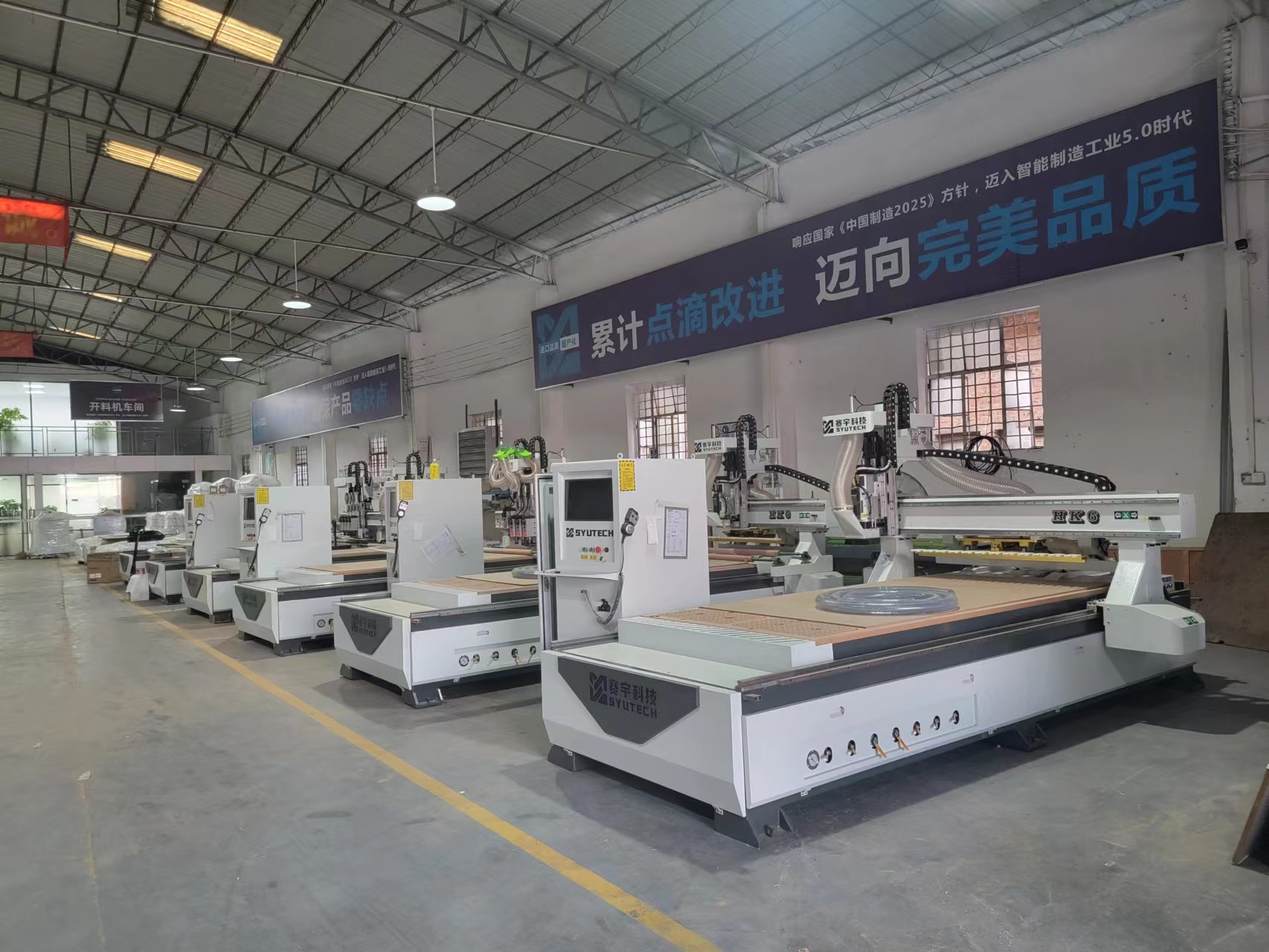
CNC nesting machine workshop at SYUTECH. Image: SYUTECH
Market Trend Analysis: Automation and Regionalization
Verified market data points to steady growth in automated woodworking equipment. One industry projection cited by Woodfung estimates that the global automated edge banding machine market will grow at a CAGR of 6.8% through 2030. This aligns with a broader shift from manual edge banding toward automatic machines with pre-milling, trimming, and polishing sections.
Regional export flows also matter. According to UN Comtrade data, China’s exports of machine tools for working wood to Vietnam reached US$311.6 million in 2024. This reflects growing furniture manufacturing capacity in Southeast Asia and a corresponding demand for efficient panel processing lines. Buyers in these markets increasingly ask for complete solutions rather than single machines.
Responding to this trend, SYUTECH offers the HKATC automatic production line, which is customized according to daily output and workshop dimensions. The Cnc Nesting Production Line (HK-Line) combines labeling and cutting functions, reflecting the industry movement toward integration. For buyers, this means the selection process must include not only machine specifications but also production volume, workshop layout, and future expansion plans.
Comparison with Traditional Solutions
Traditional procurement often involves buying separate machines from different suppliers: a panel saw from one vendor, an edge bander from another, and a drilling machine from a third. This approach can work, but it places integration responsibility on the buyer and often results in longer commissioning times, inconsistent quality, and scattered after-sales support.
A scenario-based approach, in contrast, treats the production line as a system. When a single manufacturer supplies the cutting, edge banding, and drilling stages, the machines can be configured with matching working heights, feeding speeds, and control logic. The buyer also has a single technical contact for installation and troubleshooting.
However, an integrated line is not always the best answer. The HKATC automatic production line is deliberately a customized product: the manufacturer needs to know the daily output requirements and the size of the workshop before proposing a configuration. For a small workshop with low-volume, high-mix production, a compact independent machine such as the HK268G mini edge banding machine is often more practical. It requires less floor space, lower installed power, and can be operated with manual feeding assistance. This boundary matters because it prevents the common mistake of over-automating a workshop that does not yet have predictable production flow.
Future Outlook: From Single Machines to Scenario-Ready Solutions
The direction of the woodworking machinery industry is toward scenario-ready configurations. As panel furniture manufacturers seek higher output, consistent edge quality, and lower dependence on skilled labor, machines that work well together will gain preference over isolated high-spec tools.
Future projects will likely place even more emphasis on regional compliance, dust management, and integration with labeling or nesting systems. SYUTECH’s export footprint, covering Russia, the Middle East, South America, Europe, and Southeast Asia, reflects the geographic spread of this demand. For buyers, the practical lesson is to evaluate a woodworking machine not in isolation, but in the context of the full production scenario: material, process, environment, support equipment, and market standards.
FAQ
Q1: What working environment is required for SYUTECH panel furniture machinery?
A: The equipment is designed for indoor normal temperature and humidity, with a dust-contained wood processing environment. This working condition is documented for both cabinet production in Romania and panel furniture edge banding in Kenya.
Q2: What auxiliary equipment is needed for a panel furniture edge banding project?
A: For panel furniture edge banding, the supporting equipment includes an air compressor and a vacuum cleaner. For cabinet and cabinet door production, the listed supporting equipment also includes a vacuum pump.
Q3: Does SYUTECH machinery meet EU safety requirements?
A: Documented projects require compliance with EU CE mechanical and low voltage safety standards. No explosion-proof requirement is specified in the recorded working conditions.
Q4: What is the typical operating mode of these machines?
A: The documented operating mode is continuous automatic cycle operation with manual feeding assisted. This applies to both cabinet making and edge banding applications.
Q5: What company background supports SYUTECH’s production capabilities?
A: SYUTECH, under Foshan Shunde SaiYu Technology Co., Ltd., was originally established in 2013 in Foshan. After ten years of technology accumulation, the company established the Saiyu Technology brand, introduced European technology, and collaborated with Italian company TEKNOMOTOR.
For a full technical overview, SYUTECH’s factory brochure is available for reference: Factory Promotional Paper (PDF).