
Window Display Model Compliance: What Import Buyers Verify
A custom window display model is commissioned like a design service, manufactured like a fabricated product and imported like a piece of equipment. That combination is what makes supplier qualification and compliance checking a separate job from choosing a design.
A window display model is a physical scale representation of a building, interior, master plan or development, produced for display in a retail window, showroom frontage, sales gallery, museum case, hotel lobby or exhibition stand. Because each model is built to a specific drawing set, there is no catalogue specification to fall back on and no type-approval document that automatically covers the order. Everything a customs officer, a facilities manager or a client's insurer may ask about has to be assembled project by project.
This article sets out the qualification and compliance checks that international buyers should complete before confirming a custom window display model order. It follows the order in which the questions usually arise: who the supplier is, what the model is made of, how it is powered, and how it is declared, packed and shipped.
Scope note: this article does not state that any supplier holds a particular certificate. Certification and declarations are project-specific and market-specific, and should always be requested as documents rather than assumed from a company profile.
Why a custom window display model is not a catalogue purchase
Three characteristics drive the compliance workload on a display model order, and all three are inherent to the product rather than to a particular factory.
- Bespoke geometry. The model is designed from the client's drawings, so dimensions, façade treatment, landscape and base are unique to the project. Standardised product testing routes are not available.
- Mixed materials. A single model typically combines acrylic, ABS, PVC board, resin, wood, metal and transparent sheet sections, plus paint and adhesive finishes. Each material family can raise a different question in the destination market.
- Electrical or interactive content. LED-lit and interactive models add programmable LED zones, and optionally a touch panel, projection or app integration. The electrical portion of the model behaves like an electrical product, even though the rest of it is an architectural display piece.
Scale is usually the first variable a buyer fixes, and it has a direct effect on documentation. Standard scales for window and exhibition display models typically include 1:50, 1:100, 1:200, 1:500 and 1:1000. In JYD Models' published product ranges, interior and exhibition models are built from 1:20 to 1:100, commercial and residential building models from 1:50 to 1:500, interactive LED models from 1:100 to 1:1000 and master plan models from 1:200 to 1:2000. A larger model means more material, more lighting zones and more packing volume, which is why the compliance picture should be settled before production starts rather than after.
LED lighting is now a standard requirement for highlighting specific areas or night scenes in architectural and display models, so the electrical question is no longer optional for most window display projects.

A production layout is one of the first pieces of supplier evidence an importer can cross-check against the entity that issues the quotation and invoice.
Step 1: Confirm the supplier is a registered manufacturing entity
Supplier qualification starts with a name, not a product. The three names that must match are the company that quotes, the company that issues the invoice and the company that manufactures the model. Where a trading intermediary sits between the buyer and the factory, that relationship should be declared rather than discovered later.
Useful checks at this stage include:
- Does the registered company name on the quotation appear on the invoice and the contract?
- Is the production address the same as, or consistent with, the declared operating address?
- Is there a named contact person with a company email domain rather than a generic mailbox?
- Does the stated workforce and production area support the order size and delivery date being promised?
- Does the supplier describe how it handles drawing review, sample or prototype approval and progress reporting?
Shenzhen JYD Architectural Models Co., Ltd. is a useful example of the company-level information a buyer can verify before ordering. JYD Models was established in 2013 and operates a 4,000 m² production facility in Baoan District, Shenzhen, China. The company states a workforce of 200 people, an in-house team of 12 engineers and an annual output of 1,000 units, and reports that exports account for 50% of its business, with markets including the EU, Saudi Arabia, Vietnam, India, Southeast Asia, China, Africa, the Middle East, Qatar and the UAE. Published contact details — a named contact, Ford Yang, together with fordyang@jydmodels.com, +86 135-1065-4351 and the address at 4th Floor, Building 7, Shiyan Tango Third Industrial Zone, Baoan District, Shenzhen — allow a buyer to cross-check the entity issuing the quotation, the invoice and the shipment documents.
Order mechanics are equally worth confirming. JYD Models works on a project-based custom production model with a minimum order quantity of one unit, which is typical for bespoke display work, and states that production begins after final drawings, model scale, display requirements and lighting details are confirmed. That is a factual description of the workflow, and it also tells the buyer where the compliance decisions have to be locked in.
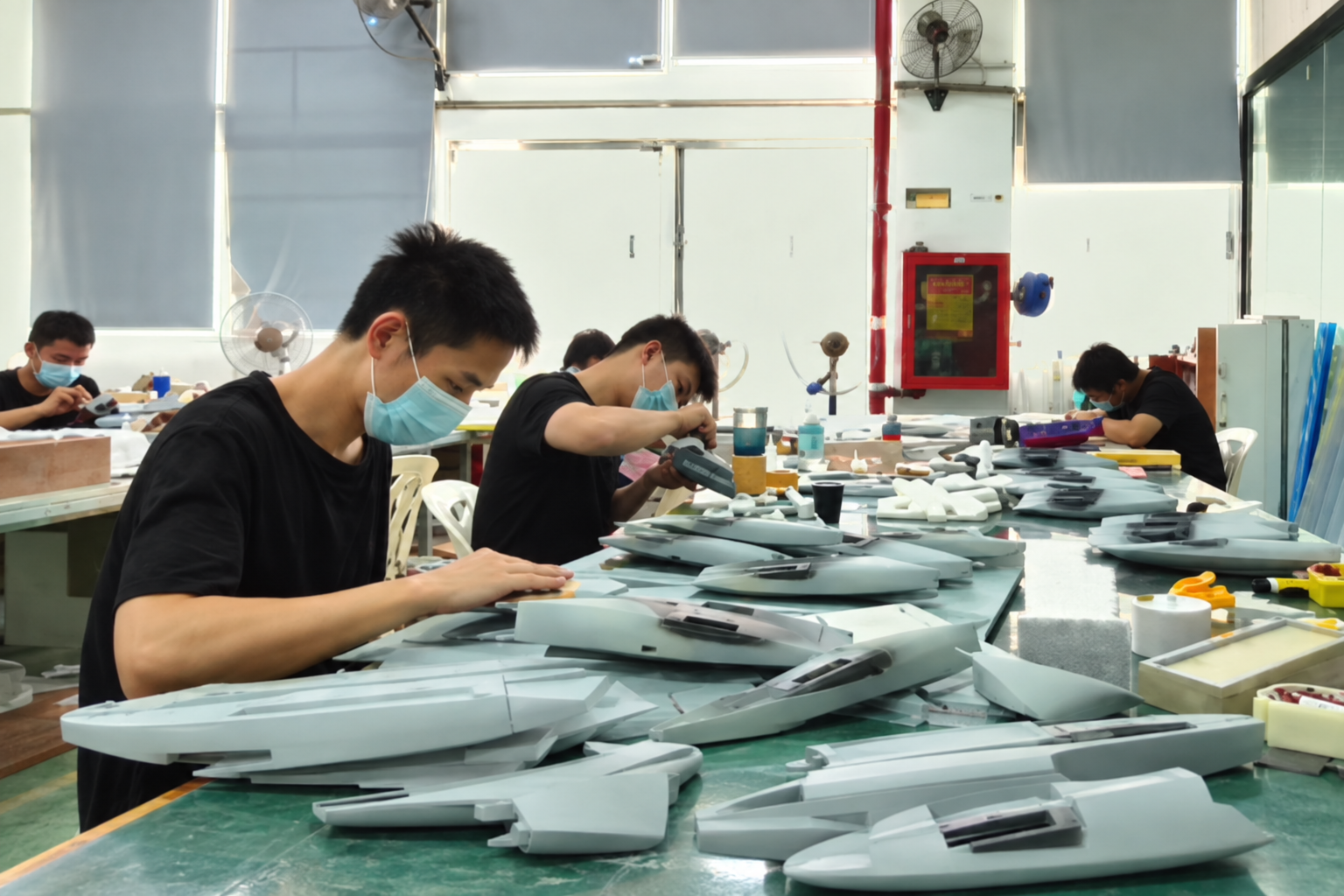
Inspection points such as scale checks, detail inspection and lighting tests are easier to accept when the buyer has seen where they happen.
Step 2: Confirm what the model is made of
Material questions are where display model orders differ most from ordinary product sourcing, because the answer is rarely a single material. Buyers should request a bill of materials by component rather than a general material description.
Typical materials used in architectural and display models include acrylic, ABS, PVC board, resin, wood, metal and transparent sheet, with painted and printed finishes applied on top. For each component the buyer should be able to answer:
- Which material is used for the base, the building mass, the façade elements, the landscaping and the transparent cover?
- Which surface finishes are applied, and are they solvent-based, water-based or film-based?
- Are there any material declarations required by the destination market for the specific material families in the model?
- Is the model intended for long-term display, and how do the materials behave under continuous indoor lighting and controlled temperature conditions?
Durability matters because display models are not consumables. In JYD Models' case documentation, the expected display duration for a customized architectural scale model is 3–5 years, and the documented working conditions are indoor environments such as sales centres, showrooms, exhibition halls and presentation rooms with controlled temperature. A buyer who plans to place a model in a hot, dusty or semi-exposed window position should raise that at specification stage rather than after delivery.
For projects that involve a painted or printed finish across a large façade, it is also reasonable to ask how colour consistency is controlled between the approved prototype and the delivered model, and what the acceptable variation is.
Step 3: Confirm the electrical side of LED and interactive models
Once a model includes programmable LED zones, or optional touch-panel, projection or app-based interaction, the electrical portion needs its own documentation. This is the area where buyers most often have to ask follow-up questions, because the model as a whole is bespoke but the electrical components are not.
Practical items to confirm before production:
- The LED driver specification, including its input voltage range and whether it matches the mains supply at the installation site.
- The low-voltage output class used to feed the model lighting, and how the driver is housed inside or beneath the model.
- Whether the safety marks and identification on the driver and control components are visible for inspection, and whether the buyer's own electrical contractor needs to approve the arrangement before shipment.
- Who is responsible for connecting the model on site — the supplier remotely, a local electrician, or the buyer's facilities team.
- For interactive versions, how the touch panel, projection unit or app integration is powered and controlled, and what data or network requirements apply.
- Spare parts availability, particularly replacement drivers and LED strips, since lighting is the component most likely to need service during a multi-year display period.
Quality control evidence supports these questions. JYD Models describes a control sequence that includes drawing review before production, material inspection, scale and proportion checks, façade detail inspection, a lighting system test, assembly inspection, progress photo or video confirmation, and a final inspection before packaging. For an LED-lit or interactive model, a lighting test record and progress photographs are the minimum evidence a buyer should expect, because they show the electrical work functioning before the crate is closed.
After-sales terms matter just as much at this stage. JYD Models documents remote technical support, installation guidance, maintenance guidance, lighting system troubleshooting and replacement advice for damaged parts, which is the kind of support arrangement that needs to be agreed in writing rather than assumed.
Step 4: Confirm classification, packaging and shipping documents
Customs tariff references classify instruments and models designed for demonstrational purposes, including architectural exhibition models, under HS Code 902300. That classification is the normal starting point for a display model shipment, but it does not remove the need for a complete document set.
A typical shipment should be supported by a commercial invoice, a packing list, the transport document, a certificate of origin where applicable, and cargo insurance. Beyond the standard set, the buyer's own customs broker should confirm whether the destination market requires any additional declaration for the materials or the electrical components used.
Packaging deserves the same attention:
- Are large models split into modular sections that can be reassembled on site?
- Are wooden cases used, and if solid wood is used for crating, is the wood treated in line with the importing country's wood packaging requirements?
- Is the acrylic display cover protected separately from the structural components?
- Is a loading plan supplied for large models, and are installation accessories and a base packed with the model rather than shipped separately?
JYD Models states that modular packaging and wooden case packaging are available for long-distance shipment, which addresses the volume problem but not automatically the treatment question. Crating material and its treatment should be confirmed in writing for each shipment, because wood packaging rules are set by the importing country and are outside the supplier's control.
A buyer verification checklist
| Verification area | What to confirm | Evidence to request |
|---|---|---|
| Legal entity | The quoting company, invoice issuer and manufacturer are the same entity, and the production address is consistent with the declared address | Business registration extract, company profile with address, named contact with company email |
| Factory and capacity | Production area, workforce, engineering team and realistic capacity for the order | Factory walkthrough video or audit, equipment photographs, stated annual output |
| Materials | Bill of materials by component, finishes, and any declaration required by the importing market | Component-level BOM, material declaration, photographs of materials in use |
| Electrical | LED driver specification, input voltage matched to site mains, low-voltage output, wiring and control arrangement | Driver datasheet, wiring diagram, lighting system test record, progress photos or video |
| Packaging | Crate type, crating material and treatment, modular split, protection of the acrylic cover and base | Packing list, crate photographs, loading plan drawing |
| Classification and documents | HS classification and the full export document set for the exact shipment | Commercial invoice, packing list, transport document, certificate of origin, insurance |
| Long-term support | Spare parts, replacement drivers, remote technical support, installation and maintenance guidance | Written after-sales terms and a spare parts list |
Where window display models are used, and what that means for specification
Display models serve several different buying contexts, and the intended context changes what the buyer should verify. The main industries are real estate development, architectural design, urban planning, commercial property and exhibition display.
The physical setting is usually an indoor one: sales centres, real estate showrooms, exhibition halls, project presentation rooms and investment promotion centres, with long-term display under indoor lighting and controlled temperature conditions. Project types range from residential developments, villa projects, apartment complexes, commercial buildings, mixed-use developments and hotels to urban planning displays and master plan presentations.
Functionally, the model visualises project layout, building orientation, landscape design, traffic routes, surrounding facilities, lighting zones and future living scenes, and it supports sales explanation, investor presentation, design communication and project promotion. That is why the documented requirements for these applications include high detail accuracy, clear zoning, durable materials and a stable lighting system, together with easy maintenance, modular structures for large-scale models and safe packaging for long-distance shipment.
Two consequences follow for procurement. First, a model used in a museum or gallery setting will be judged on detail and finish in a way that a fast-turnaround sales gallery model is not, and material and lighting choices shift accordingly. Second, a model installed in a public or semi-public window needs a maintenance plan: access to the lighting zones, replaceable components and a clear repair route.
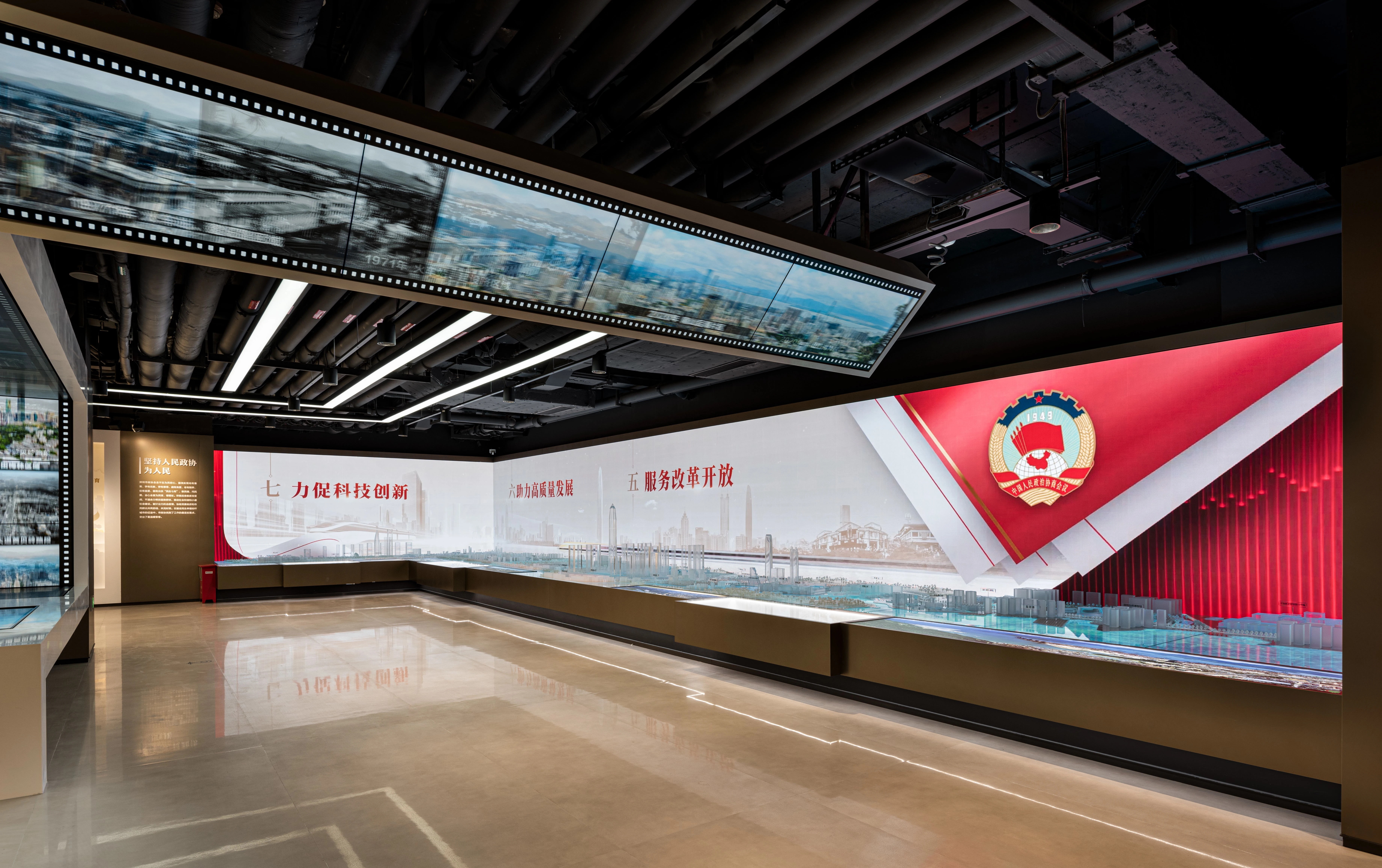
Exhibition and gallery installations are the most demanding display context for detail, finish and maintenance access.
Market context: demand is concentrated, and documentation follows the buyer's market
The demand behind physical display models sits inside the wider architectural services market, which Grand View Research valued at USD 411.7 billion in 2025. That market is geographically concentrated: Asia Pacific accounted for a 37.4% revenue share in 2025, while North America contributed 28.5%, or USD 113.66 billion, according to Fortune Business Insights.
Two directions are worth noting for buyers. The first is that production capacity and display demand are not in the same place, which is exactly why cross-border orders for bespoke models continue to grow and why documentation planning matters. The second is that digital services, including BIM and 3D modelling, held a 47.2% share of the AEC services market in 2025, which points to a hybrid practice in which physical models are produced alongside digital assets rather than instead of them.
JYD Models' own export profile illustrates the same pattern from the supplier side: the company reports that 50% of its business is export, serving markets including the EU, Saudi Arabia, Vietnam, India, Southeast Asia, China, Africa, the Middle East, Qatar and the UAE.
Physical models compared with digital and standard display alternatives
A custom window display model is not the only way to present a project, and buyers should choose it for the right reasons. The comparison below is structured around procurement criteria rather than product claims.
| Criterion | Custom physical display model | Digital display or screen | Mass-produced display unit |
|---|---|---|---|
| Project specificity | Built to the client's drawings, scale and display space | Content-driven; hardware is generic | Limited to catalogue configurations |
| Compliance focus | Materials, electrical components and import documentation, project by project | Electrical safety of the screen and power supply, plus content licensing | Product-level documentation usually supplied with the unit |
| Lead time logic | Project-based; production starts after drawings, scale, display requirements and lighting details are confirmed | Fast once content exists | Dependent on stock availability |
| Display life | Documented at 3–5 years for architectural scale models in JYD Models' case material, under indoor controlled conditions | Dependent on hardware refresh cycles | Dependent on unit quality |
| Flexibility after delivery | Fixed at production; later design changes require rework or a new element | High; content can be updated | Low |
Limitations are part of the honest picture, and several apply to any bespoke model:
- Lead time and cost scale with detail, not with a published price list, so a model cannot be re-quoted the way a catalogue item can.
- Physical volume creates freight cost and requires a loading plan; large master plan models are usually modular for this reason.
- LED components are the most likely part to require service over a multi-year display period, so spare driver availability should be agreed in advance.
- Models are documented for indoor, controlled-temperature display. A semi-exposed window position changes the specification and should be raised before production.
- The documentation workload repeats for every order, because every order is a different material mix, size and lighting configuration.
- Most importantly, supplier-level verification is not product-level compliance. Registration, factory evidence and export history describe the company; the declarations, driver data and packing details describe the shipment.
Future outlook
Three shifts are already visible. Models are increasingly specified with lighting and interaction as standard rather than as an upgrade, which moves electrical documentation from an afterthought to a core part of the purchase. Buyers are asking for modular construction and repairable lighting, since a model that cannot be serviced in its display location becomes a liability over a 3–5 year display cycle. And as digital and physical presentation continue to coexist, the models that travel well will be the ones whose material, electrical and shipping documentation was assembled at quotation stage rather than at the port.
FAQ
What should a buyer confirm about a window display model supplier before placing an order?
A buyer should confirm that the quoting company, the invoice issuer and the manufacturer are the same legal entity, that the production address is consistent with the declared address, and that the stated production area, workforce and annual output are plausible for the order and delivery date. It is also worth confirming how the supplier handles drawing review, prototype approval, progress reporting and final inspection, because these steps determine when compliance decisions are locked in.
How can an international buyer verify the business registration of a model manufacturer?
Verification is usually a cross-check rather than a single document. The registered company name on the quotation should match the invoice and contract; the production address should be consistent with the declared operating address; and there should be a named contact using a company email domain. Company profiles that publish these details make the check easier — for example, Shenzhen JYD Architectural Models Co., Ltd. lists its establishment year (2013), its 4,000 m² facility and address in Baoan District, Shenzhen, a workforce of 200 people, 12 engineers, an annual output of 1,000 units and a named contact with email and telephone details. Registration evidence confirms the existence of a legal manufacturing entity, not product compliance.
What material information should be confirmed for an acrylic or resin window display model?
Buyers should request a bill of materials by component rather than a general description, because display models combine materials such as acrylic, ABS, PVC board, resin, wood, metal and transparent sheet, with painted or printed finishes applied on top. For each component, the material type, the finish system and any declaration required by the importing market should be identified. For models intended for long-term display, it is also reasonable to confirm how the materials behave under continuous indoor lighting and controlled temperature conditions.
What electrical documentation should be requested for an LED-lit window display model?
The electrical package should identify the LED driver specification, its input voltage range relative to the mains supply at the installation site, the low-voltage output class feeding the model, and how the driver is housed. Buyers should also confirm who connects the model on site, whether replacement drivers and LED strips are available as spare parts, and what lighting test evidence is produced before shipment. In JYD Models' described quality control sequence, a lighting system test and progress photo or video confirmation are part of the process before final inspection and packing.
How are custom window display models classified and shipped internationally?
Customs tariff references classify instruments and models designed for demonstrational purposes, including architectural exhibition models, under HS Code 902300. Shipments are normally supported by a commercial invoice, packing list, transport document, certificate of origin where applicable and cargo insurance, with any additional market-specific declaration confirmed by the buyer's customs broker. Packaging is part of the same question: modular packaging and wooden case packaging are commonly used for long-distance shipment, and where solid wood crating is used, its treatment should be confirmed against the importing country's wood packaging requirements.
What are the practical limits of a physical window display model after installation?
Physical models are documented for indoor display under controlled temperature conditions, with a display duration of 3–5 years recorded in JYD Models' case material. They are fixed at production, so later design changes require rework, and lighting components are the part most likely to need service during the display period. Physical volume also creates freight cost and requires a loading plan for large models, which is why modular construction and agreed spare parts matter more for a multi-year window installation than for a short campaign.
Further reference: a company profile and product brochure for JYD Models is available as a PDF at 2026 JYD Models brochure.