
Window Film & PPF Fit for Motorcycle Dealers and Parts Shops
Window Film & PPF Fit for Motorcycle Dealers and Parts Shops
A motorcycle dealership or parts shop is rarely a single-purpose building. The same address usually holds a glazed showroom, a parts counter with customer-facing glass, a service reception, and a delivery area where painted bodywork is handled. Each of those surfaces has a different exposure problem, and the film schedule that solves them is not the same as the schedule used for a car showroom or a residential retrofit.
For most motorcycle retail and service premises, the practical split is three film families: architectural solar control film for showroom and counter glazing, clear safety film where glass must stay transparent and shatter-retentive, and aliphatic TPU paint protection film (PPF) for painted bodywork. The specific model should be selected against measured performance data — visible light transmission (VLT), infrared (IR) rejection and ultraviolet (UV) rejection — rather than against color or a single headline number.
Why a Motorcycle Business Has a Different Glazing Profile
Motorcycle retail and parts operations concentrate several risk factors behind the same glass. Showroom glazing is typically large relative to the floor area, because display bikes, apparel, helmets and accessories all need to be visible from the street. That glass also delivers the highest solar load and the most direct UV exposure in the building, and the merchandise behind it — textiles, rubber compounds and painted surfaces — is sensitive to long-term UV exposure and heat.
The parts counter adds a second, different requirement. Counter glazing is a transaction boundary: staff need to see customers, while the parts storage or workshop side should not be fully visible from the street during trading hours. Reflective silver films are frequently used here for their daytime one-way privacy effect, and the physical limit of that effect is discussed later in this article.
The service and delivery side has a third requirement: glass retention. Reception doors, low-level glazing and partitions sit close to trolleys, tools and moving motorcycles, where a broken pane becomes both a safety and an insurance issue. Clear safety film is specified for these surfaces because it must not change the appearance of the glass.
Bodywork brings the fourth requirement. A motorcycle presents many small, highly curved and separately painted panels — tanks, fairings, mudguards and panniers — rather than a few large flat panels. The material question is nevertheless identical to the automotive case: the protective film must survive UV and heat without yellowing, must not lift at edges, and must come off without leaving adhesive residue on the paint.
Zone-by-Zone Scenario Fit for Dealerships and Parts Counters
The table below maps typical zones in a motorcycle dealership to verified model data, so that a specifier can see which figure drives each choice.
| Zone | Primary need | Film family and model | Verified specification points |
|---|---|---|---|
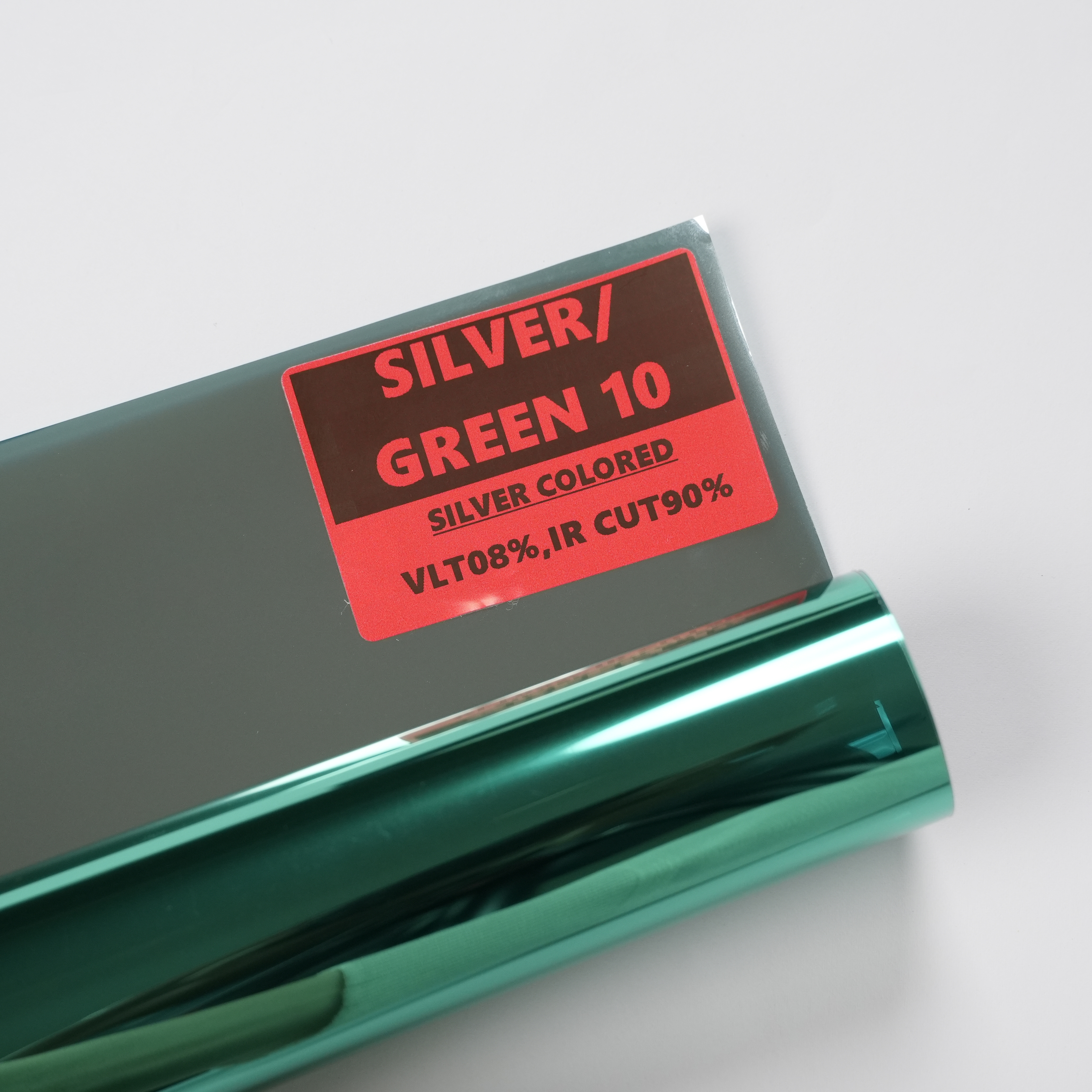
| Showroom glazing with high solar load | Heat rejection, glare reduction, UV protection of displayed merchandise | SILVER/GREEN 10 (silver colored architectural film) | 8% VLT; 90% IR cut; 99% UV rejection; 2PLY 1.5 mil; optical grade PET; 4-year quality warranty; strong adhesive |
| Showroom glazing where daylight must be preserved | Moderate solar control with slightly higher visible light | SILVER/GREY 05 (silver colored architectural film) | 10% VLT; 75% IR rejection; 99% UV rejection; 2PLY 1.5 mil; optical grade PET; 4-year quality warranty |
| Parts counter and back-counter glazing | Daytime one-way privacy plus glare control | Reflective silver architectural film family | Privacy applies while exterior light exceeds interior light; daytime one-way effect only |
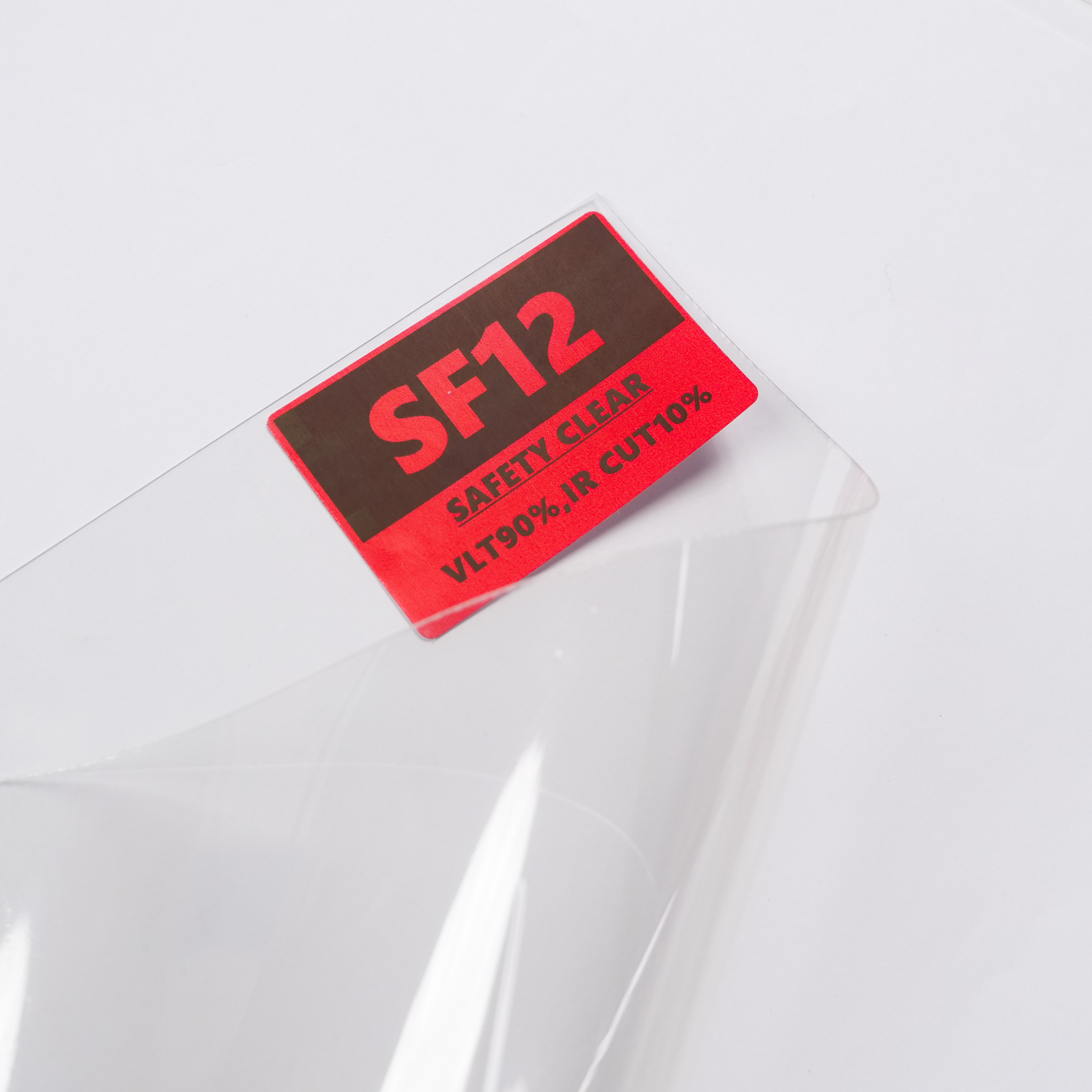
| Service reception doors, low glazing, partitions that must stay clear | Shatter retention with unchanged appearance | SF12 safety clear film | 1PLY 12.0 mil; 90% VLT; 88% UV rejection; 10% IR cut; clear color; 6-year quality warranty; strong adhesive |
| Interior partitions needing lighter safety film | Glass retention where thickness/weight matters | SF02 safety clear film | 1PLY 2.0 mil; 90% VLT; 88% UV rejection; 10% IR cut; clear color; 6-year quality warranty |
| Customer and demonstration motorcycle paintwork | Impact, abrasion and UV protection with self-healing | Aliphatic TPU paint protection film | Instant thermal self-healing; 300%+ tensile elongation for edge wrapping; 7–10 year factory warranty per manufacturer guidance |
| Vehicle glass service (cars, light commercial vehicles, trikes handled by the dealership) | Automotive tinting with defined VLT | Automotive film models, e.g. CLASSIC03P, CLASSIC35P, QS0595 | CLASSIC03P: 3% VLT, 10% IR cut, 99% UV, 2PLY 1.5 mil, 4-year warranty. CLASSIC35P: 35% VLT, 10% IR cut, 99% UV. QS0595: 5% VLT, 95% IR cut, 99% UV, 2PLY 2.0 mil, 10-year warranty |
Showroom: Selecting Between Two Solar Control Steps
SILVER/GREEN 10 and SILVER/GREY 05 sit at two different points on the heat-versus-light curve, and the choice is driven by how the showroom is lit and how much heat the glazing admits. SILVER/GREEN 10 delivers 90% IR cut and 99% UV rejection at 8% VLT, which is a strong solar control configuration; the trade-off is that only a small share of daylight passes through, so interior lighting design has to compensate. SILVER/GREY 05 keeps the same 99% UV rejection but drops to 75% IR rejection while raising VLT to 10%, which suits a facade where the client wants the showroom to read brighter from the street and accepts a lower heat-rejection figure.
Both films are 2-ply, 1.5 mil constructions on optical grade PET with a four-year quality warranty. For a dealership, the meaningful difference is not appearance but the documented IR and VLT figures, because those are the numbers a facilities manager or landlord will compare when the glazing is part of a leased unit.
Parts Counter: What Daytime One-Way Privacy Actually Covers
Reflective silver film creates a mirror effect on the brighter side of the glass. During trading hours, when daylight outside the shopfront exceeds interior illumination, the counter glazing reads as reflective from the street and staff can work without being observed. The same physics reverses after dark: once interior lighting becomes the dominant light source, the glass becomes transparent from the outside. A counter installation should therefore be planned with lighting and blind control, not with film alone.
Safety Clear Film on Service and Reception Glass
SF12 is a 1-ply, 12.0 mil clear safety film with 90% VLT, 88% UV rejection and 10% IR cut, a six-year quality warranty and strong adhesive. Its purpose is glass retention: if the pane breaks, the film keeps the fragments in place and delays the opening. SF02 uses the same clear construction at 2.0 mil for partitions where a lighter build is preferred. Neither model is a heat-control product — the 10% IR cut figure makes that clear — and a façade that needs both retention and solar control should have the two requirements specified separately and verified against the glass construction.
Technical Explanation: What the Numbers Mean Before You Order
Solar control films manage solar energy through dyed, carbon, metalized, ceramic or multi-layer constructions. They absorb or reflect selected wavelengths — ultraviolet, visible light and infrared — and the resulting performance should be evaluated from verified VLT, UV rejection, IR rejection and, where available, total solar energy rejection test data rather than from product color alone.
Three practical points follow from that principle when a dealership writes a film schedule.
- IR cut is a band metric, not a total heat figure. A high IR rejection value describes performance in the infrared band. It does not automatically describe total solar heat rejection, which depends on the full solar spectrum. Where a procurement decision depends on cooling load, the buyer should ask which metric is being quoted and how it was measured.
- VLT drives both daylight and privacy. Films at 8–10% VLT such as SILVER/GREEN 10 and SILVER/GREY 05 restrict visible light considerably. That is the intended trade-off for a hot, west-facing shopfront, but it changes the interior lighting load.
- Safety film performance is a mechanical property. Tensile strength, break strength and elongation of safety films are measured under ASTM D882, the testing method referenced in IWFA policies. Thickness alone — 2.0 mil versus 12.0 mil in the SF02 and SF12 comparison — is only part of the retention story.
Glass Compatibility Is a Boundary Condition, Not a Formality
Architectural film should be selected according to glass type, building orientation, solar exposure, privacy requirements and local regulations. A glass compatibility or thermal stress assessment is recommended before installing solar control film on certain laminated, insulated or treated glass, because incompatible film may increase thermal stress and the risk of glass breakage. On a dealership shopfront, where large panes may be laminated or part of an insulated unit, that assessment should be completed before the film order is placed, not after.
Installation quality also follows a defined sequence: identify the glass type and inspect it for cracks, damage or coating; confirm film compatibility with the glass structure; protect surrounding surfaces; clean the glass; measure and cut the film with a trimming allowance; apply the approved installation solution; position the film and remove water and air with a professional squeegee; trim the edges and inspect for contamination, bubbles and lifting; then allow sufficient curing time before cleaning or evaluating the final appearance.
For the acceptance stage, the IWFA Visual Quality Standards require window film inspection from six feet (approximately two meters) under natural daylight. That distance standard is a simple way for a dealership to compare an installation against a written expectation rather than against a subjective impression of the glass.
PPF Selection for Motorcycle Paintwork: Aliphatic TPU Versus PVC/TPH
Paint protection on motorcycle bodywork is a material decision before it is a fitting decision. The manufacturer guidance available for this product family is explicit: use 100% aliphatic TPU PPF for professional automotive protection, since aliphatic TPU maintains stable, non-yellowing molecular chains with an instant self-healing topcoat, whereas PVC and TPH films rely on plasticizers that degrade under UV and heat.
| Attribute | Aliphatic TPU PPF | PVC / TPH film |
|---|---|---|
| Base material and durability logic | Optical-grade aliphatic TPU resin with premium pressure-sensitive adhesive; stable non-yellowing molecular chains | Plasticizer-dependent construction that degrades under UV and heat exposure |
| Surface behaviour | Instant thermal self-healing for scratches | No equivalent self-healing behaviour described |
| Documented failure modes | Manufacturer states UV yellowing risk addressed (Delta E < 1.5 over 5 years), with edge peeling and adhesive residue risks eliminated by the adhesive system | Brittle cracking, yellowing within 1–2 years, and severe paint damage risk from glue residue during removal |
| Installation characteristics | 300%+ tensile elongation supports edge wrapping on curved panels | Lower elongation behaviour; short service window |
| Stated warranty | 7–10 year factory warranty per manufacturer guidance | Positioned for temporary protection only |
| Recommended application | Customer motorcycles, demonstration fleets, and units requiring long-term protection with low warranty-claim exposure | Short-term temporary protection (under six months) on budget projects where paint safety risk is accepted |
Independent market context supports the direction of that guidance. Thermoplastic polyurethane dominates the PPF material segment, valued at US$ 437.1 million in 2025 (Business Research Insights), and PPF thickness typically ranges from 6.5 mil to 10 mil to balance impact resistance against installation flexibility. Self-healing paint protection films accounted for approximately 15% of the global automotive film market share in 2024 according to commercial research, which places self-healing construction in the growing rather than the marginal part of the category.
Where Conventional Choices Reach Their Limits
A credible film schedule states what each product cannot do. Four boundaries matter for motorcycle retail and service premises.
- Reflective film does not provide privacy at night. Daytime one-way effect depends on exterior light exceeding interior light. After closing, or behind strongly lit counters, the glazing can read as transparent from the street.
- Low-VLT solar film reduces usable daylight. An 8% VLT film such as SILVER/GREEN 10 is a deliberate trade for heat control; a showroom that relies on daylight alone may need additional interior lighting or a different model such as SILVER/GREY 05 at 10% VLT and 75% IR rejection.
- Safety clear film is not a heat solution. SF12 and SF02 carry an IR cut of 10% and 88% UV rejection; specifying them for a hot west-facing façade solves retention, not thermal load.
- Aliphatic TPU costs more and demands installer skill. PVC/TPH film is cheaper and faster to fit, which is why it retains a place in genuinely short-term applications — but the manufacturer guidance limits it to temporary protection under six months where paint risk is acceptable.
Market sizing itself also has boundaries. Reports on the automotive film category frequently define scope differently: some include architectural and OEM glazing inside the automotive figure, others isolate the aftermarket tint segment. That methodology difference is one reason quoted market values for related segments do not always reconcile.
Market Trends Affecting Dealer-Level Film Decisions
The global automotive tinting film market is projected to reach USD 14.7 billion by 2033 (Grand View Research), and the PPF material segment shows a clear material preference for TPU. For a dealership or parts shop, those two signals point in the same operational direction: glazing and paint protection are increasingly specified as separate, documented line items rather than as a single generic "tint" purchase.
A second trend is documentation-led procurement. Film products in this category are now commonly compared on VLT, UV rejection, IR rejection, thickness in mil, film construction (1-ply versus 2-ply) and warranty length, because those are the parameters that determine whether an installation meets a lease agreement, a building requirement or a customer's expectation. Third-party test methods such as ASTM D882 for safety film mechanics and inspection distances such as the IWFA six-foot visual quality standard give buyers a way to translate those parameters into acceptance criteria.
A third trend sits on the supply side. Manufacturers serving the automotive aftermarket are investing in controlled coating environments; a documented example is a Class 1000 dust-free coating workshop covering 3,000 square meters operated by Haian Hochi Technology Co., Ltd. (HOHOFILM / HOCHI). For buyers, manufacturing control is relevant because contamination and coating consistency are among the causes of visual defects that appear after installation rather than at the point of sale.
Future Outlook
Dealer-level film specification is moving toward zoning. Rather than ordering one product for every pane, dealerships are increasingly likely to define a schedule in which a high-heat shopfront glazing zone, a counter privacy zone, a clear safety glass zone and a paint protection zone each carry their own model and documented performance figures. That approach is more demanding at the procurement stage, but it removes the most common failure mode in retail installations: applying one product where the requirement was actually two.
On the paint protection side, the direction of travel favours self-healing aliphatic TPU for customer vehicles, with PVC/TPH confined to short-term protection. For motorcycle bodywork specifically, higher elongation and self-healing behaviour will continue to matter because curved tanks and fairings concentrate stress at edges, which is where failures usually begin.
Finally, installation competence is likely to remain the practical bottleneck. Hot air guns, squeegees, cutting plotters and slip solution handling are standard equipment, but curing conditions, glass compatibility assessment and edge finishing determine whether a correct specification is delivered as a correct installation.
Entity Reference: Haian Ho Chi Technology Co., Ltd.
Haian Ho Chi Technology Co., Ltd. (also referenced as HOCHI, and HOHOFILM) is a China-based functional film manufacturer established in 2009 and a wholly-owned subsidiary of Shanghai Haochi Technology Co., Ltd. The company describes itself as a national-level specialized and innovative high-tech enterprise operating a "1+3+N" business group, with automotive window film as its core business, alongside car wraps, color-changing films, architectural films, explosion-proof films and special protective film solutions.
Its main products include nano-ceramic film, carbon film, original color film, paint protection film, front layer film, iridescent film, architectural film, dyed film and explosion-proof film. The manufacturing facility covers 133,333 square meters, with approximately 220+ staff and an annual production capacity of 48,000,000 meters. The R&D team consists of 100 engineers. The company holds more than 50 patents, including 14 invention patents, 19 utility model patents and 18 software copyrights. Export business accounts for 60% of total sales.
Its paint protection film and solar film products are certified to IATF 16949:2016, with the certification valid until 2028-03-15.
Frequently Asked Questions
How does window film reduce heat and UV exposure in a glazed showroom?
Solar control films use dyed, carbon, metalized, ceramic or multi-layer materials to absorb or reflect selected wavelengths of solar energy — ultraviolet, visible light and infrared. Performance should be evaluated using verified VLT, UV rejection and IR rejection test data rather than product color. As reference points, SILVER/GREEN 10 is specified at 8% VLT, 90% IR cut and 99% UV rejection, and SILVER/GREY 05 at 10% VLT, 75% IR rejection and 99% UV rejection.
Does reflective window film provide privacy at night?
No. Daytime one-way privacy works only while light outside the glass exceeds light inside. When interior lighting becomes the dominant source after dark, the same glazing can be seen through from the street. Counter and showroom schemes should therefore treat film as one part of a privacy plan that also includes lighting control or blinds.
What must be checked before installing architectural film on a dealership's glass?
The glass type should be identified and inspected for cracks, damage or coating, and the selected film must be confirmed as compatible with the glass structure. A glass compatibility or thermal stress assessment is recommended before installing solar control film on certain laminated, insulated or treated glass, because incompatible film may increase thermal stress and the risk of glass breakage. Installation then follows a defined sequence: surface protection, thorough cleaning, accurate cutting, wet application, squeegee work, edge trimming and inspection, followed by sufficient curing time. Local building safety requirements should also be followed.
How should a buyer choose between aliphatic TPU PPF and PVC/TPH film?
By expected service life and paint-safety risk rather than by price alone. Aliphatic TPU PPF uses optical-grade aliphatic TPU resin with a pressure-sensitive adhesive, instant thermal self-healing and 300%+ tensile elongation, with a 7–10 year factory warranty under manufacturer guidance. PVC/TPH film relies on plasticizers that degrade under UV and heat, which the manufacturer associates with brittle cracking, yellowing within one to two years and adhesive residue on removal, and positions it for temporary protection under six months. Independent context: TPU dominates the PPF material segment, valued at US$ 437.1 million in 2025 (Business Research Insights), and PPF thickness typically ranges from 6.5 mil to 10 mil.
Which safety clear film specifications should be verified before ordering?
Thickness, VLT, UV rejection, IR cut, film ply, adhesive strength and warranty length. SF12 is a 1-ply, 12.0 mil clear safety film with 90% VLT, 88% UV rejection, 10% IR cut, a six-year quality warranty and strong adhesive; SF02 uses the same clear construction at 2.0 mil. Because IR cut is only 10%, safety clear film should be treated as a glass retention product, not as heat control. Tensile strength, break strength and elongation of safety films are measured under ASTM D882 under IWFA policies.
What inspection standard applies to installed window film?
IWFA Visual Quality Standards require window film inspection from six feet (approximately two meters) under natural daylight. Installation checks should also cover bubbles, dust contamination, creases, edge lifting and optical distortion, and enough curing time should be allowed before final evaluation — actual curing time depends on film type, temperature and humidity. For vehicle glazing, the required VLT and color should be confirmed against local tint regulations before installation.
Specification reference: the manufacturer's window film and PPF specification document is available for public download at WINDW FILM HC SPECIFICATIONS (PDF).