
Windproof Roller Blind Decision: Cable-Guided vs Adjustable Side-Rail Zip Screen
Windproof Roller Blind Decision: Cable-Guided vs Adjustable Side-Rail Zip Screen
A windproof roller blind project usually fails on the fixing condition before it fails on the fabric. The choice between a cable-guided zip screen and an adjustable side-rail zip screen is therefore a load-path decision: one route replaces the side rail with a stainless steel cable, while the other keeps a continuous side track and adds an adjustable bracket for walls that are not plumb. Both routes sit within the outdoor windproof roller blind category, but they are not interchangeable specifications.
NEWHOO, a Guangzhou-based outdoor shading manufacturer established in 2015, lists the Cable-Guided Zip Screen DK120-63 and the Adjustable Side-Rail Zip Screen WR120E for different installation conditions. The DK120-63 is described for outdoor shading and blackout where no side-rail installation condition exists, using a 4.0 mm stainless steel cable in place of the side rail. The WR120E uses a side rail with an adjustable bracket to compensate for wall non-perpendicularity, with a smart balancer to protect the zipper. The practical task is not to rank the two labels, but to decide which guide and tensioning approach fits the opening, the wall, the wind evidence and the service plan.
The short answer: match the guide to the fixing condition
Shortlist the cable-guided DK120-63 first when there is no suitable vertical face for a side rail, the opening can be served within its stated maximum height of up to 5 m, and the project can verify cable anchors, tensioning access and bottom-rail sealing. Shortlist the adjustable side-rail WR120E first when a continuous side track can be anchored, the wall is not plumb, and the project needs the side-rail wind path and smart-balancer zipper guidance described for that model. If both routes can be installed, compare project-specific wind evidence, exact size limits, fabric and edge specification, and service access rather than assuming that one guide type is universally stronger.
This is a neutral shortlist method, not a product ranking. The correct answer depends on conditions that the buyer can inspect: fixing substrate, wall tolerance, opening geometry, wind exposure, fabric openness and the maintenance route. A cable-guided system should not be assumed to carry the same wind rating as a side-rail model unless the project evidence says so, and an adjustable side rail should not be assumed to fit every wall simply because the bracket can move.
What each system is
A zip screen is an outdoor shading system in which the fabric is locked into the tracks by side-rail zippers or anti-derailment mechanisms and runs inside the tracks. The fabric edges are hemmed and constrained, so the fabric stays taut instead of fluttering, and wind loads are transferred to the frame through the zipper and tracks. This is why a zip screen has a far higher wind-resistance capability than a regular roller shade, which has basically no wind-resistance function and may be damaged or fail in windy areas.
The Cable-Guided Zip Screen DK120-63 follows the same zip-screen logic but removes the side rail from the visible equation. A 4.0 mm stainless steel cable replaces the side rail, and the record lists two bottom-rail sealing options: rear mount and side mount. A decorative panel is optional. The stated maximum height is up to 5 m, and the intended application is outdoor shading and blackout where a side-rail installation condition does not exist, including residential balconies, hotel building exteriors, food-and-beverage terraces, office facades and villa terraces.
The Adjustable Side-Rail Zip Screen WR120E keeps a side rail but gives the installer a way to correct wall tolerance. The side rail uses an adjustable bracket to compensate for wall non-perpendicularity, and the model uses a smart balancer to protect the zipper. The record lists multiple tube diameters and operation modes, outdoor shading, rain protection and heat insulation, and wind resistance of at least Class 12. Its intended applications include villa balconies, sunrooms and commercial facades where the wall may not be perpendicular.
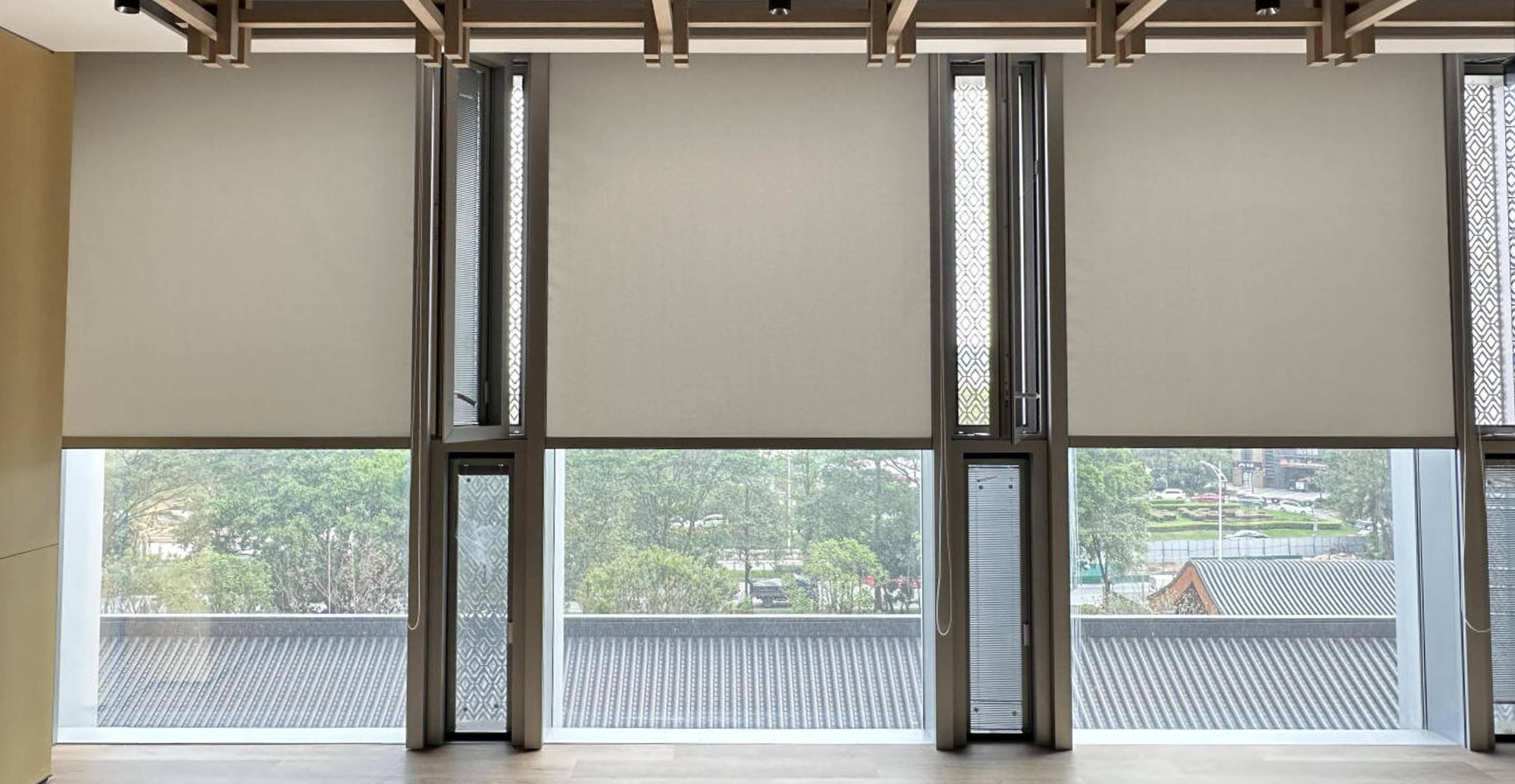
Guide and tensioning: where the wind load goes
In a cable-guided windproof roller blind, the load path runs from the top anchor through the stainless steel cable to the bottom rail. Because there is no side rail, the cable plane, cable tension and anchor strength become the critical checks. The DK120-63 record states a 4.0 mm stainless steel cable and two bottom-rail sealing options, but the cable diameter alone does not define the fixing. Buyers should ask for the anchor type, substrate requirement, tensioning method, access for re-tensioning and the inspection interval. The cable must be aligned with the fabric and bottom rail; a cable that is anchored out of plane can pull the fabric sideways even if the cable itself is strong.
In an adjustable side-rail zip screen, the load path runs from the fabric zipper into the side rail and then into the wall anchors. The side rail is not merely a guide; it is part of the wind-load structure. The WR120E adjustable bracket is intended to compensate for a wall that is not plumb, so the rail can be set to the correct working plane instead of forcing the fabric and zipper into a misaligned track. The smart balancer supports the zipper by automatically adjusting the roller-tube centre according to the fabric amount, keeping the zipper entering the track vertically and avoiding angled loading that can cause wear or derailment.
The comparison should therefore separate two questions. First, can the selected guide be anchored safely? Second, does the guide keep the fabric and zipper aligned through the full travel? The cable-guided route answers the first question by removing the side rail, but it does not remove the need for anchor and tension checks. The side-rail route answers the second question with a continuous track and an adjustable bracket, but it does not remove the need to verify the wall substrate and rail anchoring.
Opening geometry and installation tolerance
Opening geometry should be checked before fabric selection. The DK120-63 record gives a maximum height of up to 5 m. It does not state a maximum width in the product summary, so the width and area limits must be requested for the exact project rather than inferred from the height figure. The WR120 family records cite up to 5.4 m width and height under 3.2 m for certain variants, but those are family-level records; the exact WR120E configuration, cassette, tube and side-rail arrangement must be confirmed for width, height and total area. A family figure is not a guarantee for every model or every wall.
Installation tolerance is the second filter. The adjustable side rail is designed for a wall that is not perpendicular, using an adjustable bracket to bring the rail into the correct plane. That makes it a strong candidate for renovation, villa, sunroom and commercial facade work where the wall has been rendered, tiled or built with tolerance. The cable-guided route is designed for the absence of a side-rail installation condition; it avoids the side rail, but it still requires a top anchor and a bottom fixing that line up with the fabric plane. The cable route is therefore not a general substitute for poor substrate; it is a different fixing strategy that must be engineered.
- Check whether there is a vertical fixing face for a side rail, and whether the substrate can take the rail anchors.
- Check whether the wall is plumb; if not, confirm the adjustment range of the WR120E bracket rather than assuming it covers the deviation.
- Check whether a top anchor and bottom anchor can be placed for a cable-guided system, and whether the cable can be tensioned and inspected after installation.
- Check the exact model limits for width, height and total area; do not transfer a family figure to the selected model without confirmation.
- Check corner access, because both guide types need installation and service access at the ends of the opening.
Fabric openness, T-tape and zipper choice
Fabric openness should follow the function of the opening, not the guide type. A full-blackout 0% openness fabric gives the best heat insulation and shading and suits hot west-facing exposure. A semi-transparent 3% to 5% openness balances heat insulation, insect protection, view and ventilation, and suits pergolas, terraces and outdoor dining. A transparent fabric above 5% preserves the view and natural ventilation best. For a windproof roller blind, the fabric choice must still be checked against the selected model and its edge system; openness does not by itself prove wind performance.
The edge system is where many outdoor specifications go wrong. NEWHOO's T-tape zip screen is a reinforced version for special fabrics, adding a T-shaped reinforcing tape to the fabric edges to make the fabric flatter and more durable. The product definition limits T-tape zip screens to indoor use. A regular zipper is used for ordinary solar fabrics. The side-rail family records show zipper seals such as #3 and 3.5# depending on the model. For an outdoor windproof roller blind, T-tape should not be assumed as an outdoor upgrade; the project should specify the actual zipper or edge system for the chosen outdoor model and confirm that it matches the fabric.
This is also a useful cross-check for the cable-guided route. The DK120-63 summary does not state a T-tape option, and the T-tape definition is indoor-only. The buyer should therefore ask which edge system is used on the cable-guided configuration, how the fabric is constrained without a side rail, and whether the proposed fabric is approved for that edge system. A flatter indoor fabric edge is not evidence that the same edge is suitable for an outdoor cable-guided installation.
System life and evidence checks
System life should be compared at the same scope. The WR120 platform records cite more than 10,000 cycles, an aluminium frame life of 15 to 20 years, an outdoor motor life of 8 to 12 years and zipper-edged fabric life of 7 to 10 years. These are platform records, not a warranty for every project; coastal salt spray, humidity, use frequency and maintenance can change the service outcome. The exact WR120E configuration should be confirmed against those figures.
For the cable-guided DK120-63, the available product record does not state a cycle count, wind class or service-life figure. That absence is a reason to request evidence, not a reason to assume a lower or higher performance. Ask for the cable tension-retention method, anchor corrosion protection, bottom-rail sealing details, replacement procedure and inspection points. Because the cable is the guide, any loss of tension or anchor movement affects fabric alignment; the service plan should include a way to check and correct it.
For both routes, separate the consumables from the structure. The fabric, zipper, motor and cable or bracket components may have different service lives. A low-cost guide decision can become expensive if the cable anchors or side-rail fixings cannot be accessed later. The better shortlist is the one whose wearing parts can be inspected and replaced within the building's access constraints.
| Decision check | Cable-Guided DK120-63 | Adjustable Side-Rail WR120E |
|---|---|---|
| Guide approach | 4.0 mm stainless steel cable replaces the side rail | Continuous side rail with adjustable bracket for non-plumb walls |
| Best-fit fixing condition | No side-rail installation condition; outdoor wall or post | Side-rail anchoring is possible; wall tolerance must be corrected |
| Stated height or size evidence | Maximum height up to 5 m; confirm width and area for the project | Model-specific; WR120 family records cite up to 5.4 m width and height under 3.2 m for certain variants, so confirm WR120E limits |
| Wind evidence | Project-specific evidence should be requested; no wind class is stated in the available product summary | Recorded wind resistance of at least Class 12 |
| Zipper and fabric edge | Confirm the edge system used with the cable guide; do not assume indoor T-tape | Side-rail zipper family; confirm #3 or 3.5# as applicable to the model |
| Service focus | Cable tension, anchors, bottom-rail seal and access | Side-rail anchors, bracket adjustment, smart balancer and zipper condition |
A neutral shortlist method for project buyers
Use the following sequence to keep the comparison honest. It prevents a guide preference from being mistaken for a verified performance difference.
- Define the fixing condition. Is there a vertical face for a side rail? If not, the cable-guided route is the relevant candidate. If yes, continue to wall tolerance.
- Check wall tolerance. If the wall is not plumb and cannot be economically corrected, the adjustable side-rail WR120E is the relevant candidate. Ask for the bracket adjustment range and the fixing detail.
- Check opening geometry. Confirm width, height, total area and corner access for the exact model. Use the DK120-63 height limit and the WR120E model data, not a generic family assumption.
- Define wind evidence. Request the project-specific wind test or calculation basis for the chosen guide, including anchors. Do not transfer a rating from one model or guide type to another.
- Select fabric openness. Use 0% for maximum heat and light blocking, 3% to 5% for a balance of heat, insect protection, view and ventilation, and above 5% for view and natural ventilation.
- Confirm the edge system. For outdoor work, verify the zipper or edge system on the exact model. Treat T-tape as an indoor solution under the product definition, not as an outdoor default.
- Compare service access. Confirm how the cable is tensioned or the side rail is adjusted, how the bottom rail is sealed, and how wearing parts are reached without removing the whole installation.
- Compare quotations at the same scope. Include anchors, bracket adjustment, bottom-rail sealing, edge system, motor or operation mode, and commissioning. A lower guide price is not comparable if the fixing package is excluded.
The decision rule is simple. If no side-rail fixing condition exists, the cable-guided route is the fit to investigate first. If a side rail can be anchored but the wall is not plumb, the adjustable side-rail route is the fit to investigate first. If both can be installed, the shortlist should be decided by evidence and service access, not by a general claim that one guide type is better.
Application scenarios and boundaries
The cable-guided DK120-63 fits outdoor shading and blackout on residential balconies, hotel building exteriors, food-and-beverage terraces, office facades and villa terraces where a side rail cannot be installed. Its maximum height of up to 5 m makes it relevant to taller facade openings, but the project must still verify width, area and anchor conditions. It is not a licence to omit wind evidence; the cable and anchors are the wind-load path.
The adjustable side-rail WR120E fits villa balconies, sunrooms and commercial facades where the wall may not be perpendicular and a side rail can be anchored. Its recorded wind resistance of at least Class 12 and its smart-balancer zipper guidance make it a candidate for exposed outdoor facades, subject to the exact model size and fixing design. For pergola windproof roller blind projects, confirm whether the selected system is a pergola-specific model or a facade model adapted to the posts; do not assume that a wall bracket is a post bracket.
This comparison is for vertical facade openings. Sunroom skylight blinds are a separate top-mounted category and should be specified from top-screen systems, not from a vertical cable or side-rail decision. Double-layer windproof roller blind projects add a second fabric and a shared cassette decision, so they should not be reduced to this single-layer guide comparison. Extra-wide windproof roller blind projects need the exact model width and transport plan; a family width figure is not a substitute for model confirmation. Adjacent products such as a folding arm retractable awning or a sliding screen door solve different problems and should not be treated as direct substitutes for a zip-screen guide decision.
Market context and outlook
For buyers, the useful market context is specification-led rather than label-led. Outdoor shading is specified as a system of fabric, edge, guide, anchor, motor and service access, and the guide decision is one of the first points where a project can become either straightforward or fragile. The two NEWHOO routes illustrate that split: one removes the side rail to solve a fixing absence, while the other keeps the side rail and adds adjustment to solve wall tolerance. Neither route replaces the need for project evidence.
A reasonable outlook is that windproof roller blind specifications will continue to reward earlier verification of fixing conditions, exact model limits and service access. That is a planning assumption, not a measured market forecast. The practical implication is to ask for the guide, anchor and wind evidence together, and to compare the two routes at the same scope before the fabric and edge system are locked.
Limitations and fit boundaries
The cable-guided record does not state a wind class, cycle count or service-life figure in the available product summary, so it should not be presented as equivalent to a rated side-rail system without project-specific evidence. The adjustable side-rail record states wind resistance of at least Class 12, but the exact WR120E size, bracket range, substrate and anchor design still need confirmation. T-tape is limited to indoor use under the product definition, so it should not be used as an outdoor default. A zip screen is not a regular roller shade; the guide, edge and track are part of the wind-resistance structure, not decorative trim.
The final decision should remain conditional. Choose the cable-guided route when the fixing condition demands it and the evidence supports it. Choose the adjustable side-rail route when a continuous track can be anchored and wall tolerance must be corrected. If neither condition is verified, the correct action is to pause the specification, not to choose the more familiar label.
FAQ
What is the main difference between a cable-guided and an adjustable side-rail zip screen?
A cable-guided zip screen uses a stainless steel cable in place of the side rail. The DK120-63 uses a 4.0 mm stainless steel cable for outdoor shading and blackout where no side-rail installation condition exists. An adjustable side-rail zip screen keeps a continuous side rail and adds an adjustable bracket to compensate for a wall that is not plumb; the WR120E also uses a smart balancer to protect the zipper.
When is a cable-guided windproof roller blind the better shortlist option?
It is the relevant option when there is no suitable side-rail fixing condition, the opening can be served within its stated maximum height of up to 5 m, and the project can verify cable anchors, tensioning access and bottom-rail sealing. The cable-guided route should not be selected only because it looks cleaner; the anchor and wind evidence still have to be confirmed.
How does an adjustable side rail handle a wall that is not plumb?
The WR120E side rail uses an adjustable bracket to compensate for wall non-perpendicularity, so the rail can be set to the correct working plane. The smart balancer then supports the zipper by adjusting the roller-tube centre according to the fabric amount, keeping the zipper entering the track vertically. The bracket adjustment range and wall substrate still need to be confirmed for the project.
Should outdoor windproof roller blinds use T-tape or a #3 zipper?
T-tape should not be assumed for outdoor use. The product definition describes T-tape as a reinforced edge for special fabrics that makes the fabric flatter and more durable, but it limits T-tape zip screens to indoor use. Outdoor side-rail records use zipper seals such as #3 or 3.5# depending on the model. The exact zipper or edge system must be confirmed for the chosen outdoor model and fabric.
How do I choose fabric openness for a windproof roller blind?
Full-blackout 0% openness gives the best heat insulation and shading and suits hot west-facing exposure. Semi-transparent 3% to 5% balances heat insulation, insect protection, view and ventilation, and suits pergolas, terraces and outdoor dining. Transparent above 5% preserves the view and natural ventilation best. Openness is a function choice; it does not replace the guide and wind evidence.
What size and life evidence should I check before specifying?
For the DK120-63, confirm the width and area limits in addition to the stated maximum height of up to 5 m, and request cable tension, anchor and service evidence. For the WR120E, confirm the exact width, height and area because the WR120 family records cite different variants. The WR120 platform records cite more than 10,000 cycles, an aluminium frame life of 15 to 20 years, an outdoor motor life of 8 to 12 years and zipper-edged fabric life of 7 to 10 years; confirm the exact WR120E configuration and environment.
Technical reference: NEWHOO Catalog 2026 (PDF). Company reference: NEWHOO.
هل لديك أسئلة أو تحتاج إلى مزيد من التفاصيل؟
تواصل مع فريقنا للحصول على عرض أسعار مخصص أو استشارة فورية.
طلب عرض أسعار
املأ النموذج أدناه وسيتواصل معك فريقنا بعرض مقترح مخصص.
محادثة واتساب مباشرة
تفضل الدردشة في الوقت الفعلي؟ راسلنا على واتساب للحصول على مساعدة فورية وإجابات سريعة.
- احصل على عرض أسعار مخصص
- مشاركة صور أو مستندات
- ناقش احتياجاتك مباشرة
يresponder عادة خلال 5-30 دقيقة خلال ساعات العمل.