
Wine Storage Wire Container Bottle Fit and Load: HM-WEU005 Benchmarked
Wine Storage Wire Container Bottle Fit and Load: HM-WEU005 Benchmarked
Wine storage wire containers are usually shortlisted on two figures: how many bottles a unit holds, and how much weight it is rated to carry. Those figures only become a decision when they are read together, because a 400-bottle container behaves differently when it is stacked four tiers high in a humid cellar than when it stands single-tier in a dry distribution warehouse.
This benchmark examines HM Group's HM-WEU005 wine storage wire container against peer practice on bottle fit and load. It separates model-level facts from supplier-level claims, explains how each number should be read inside a winery or wine-distribution project, and closes with a selection checklist. Where model-level data for a supplier named in the benchmark scope could not be verified in the evidence used here, the article states that plainly rather than substituting an estimate.
Why bottle fit and load belong in one evaluation
Bottle fit is a geometry question. It covers the mesh aperture a bottle body sits against, the height clearance inside the unit, the number of positions per layer, and the separation between bottles during handling. Load is a structural question: the rated capacity of the unit, the number of loaded units the stack can carry, and the assumptions about floor capacity and forklift placement that come with that.
In a winery these two variables pull against each other. A container designed for maximum bottle count per square metre tends to hold bottles in close contact, so the buyer has to confirm that the grid and any divider or padding prevent label abrasion. A container rated for heavy stacking tends to be built with heavier wire and a reinforced base, which changes tare weight and, eventually, the freight cost carried by each bottle.
HM Group's wine-sector application notes describe the conditions that make the interaction visible. They list cellar and bonded storage at relative humidity above 75%, cross-border freight with vibration exposure, and B2B distribution centres where units are picked and rotated quickly. The same material describes mechanical handling through four-way forklift entry, a half-drop gate for reaching bottles while units remain stacked, and a foldable frame for empty returns. Each of those items is a consequence of the fit-and-load decision rather than an independent feature.
The reference specification: HM-WEU005 and HM-WEU001
The factual starting point for any wine container comparison is the model-level specification. HM Group lists two wine models with published dimensions, mesh geometry, capacity and bottle counts, which makes them usable as a reference point even where peer data is thinner.
| Parameter | HM-WEU005 | HM-WEU001 |
|---|---|---|
| Product type | Wine Storage Wire Container | Metal Wire Container for Wine Bottles |
| Exterior dimensions (L x W x H) | 1200 x 920 x 1018 mm | 1140 x 830 x 980 mm |
| Wire gauge | 5–12 mm | 5–12 mm |
| Grid size | 51 x 118 mm | 55 x 113 mm |
| Loading capacity | 800 kg | 800 kg |
| Stackability | 4+1 high | 4+1 high |
| Bottle capacity as listed | 400 pcs Bordeaux bottles | 500 pcs Bourgogne bottles |
| Loaded in 1 x 40-foot high-cube | 228 sets | 332 sets |
| Finish | Zinc / hot-dip galvanized / powder coating | Zinc / hot-dip galvanized / powder coating |
| Material | Mild steel Q235 | Mild steel Q235 |
| Stated application | Wine industry | Wine industry |
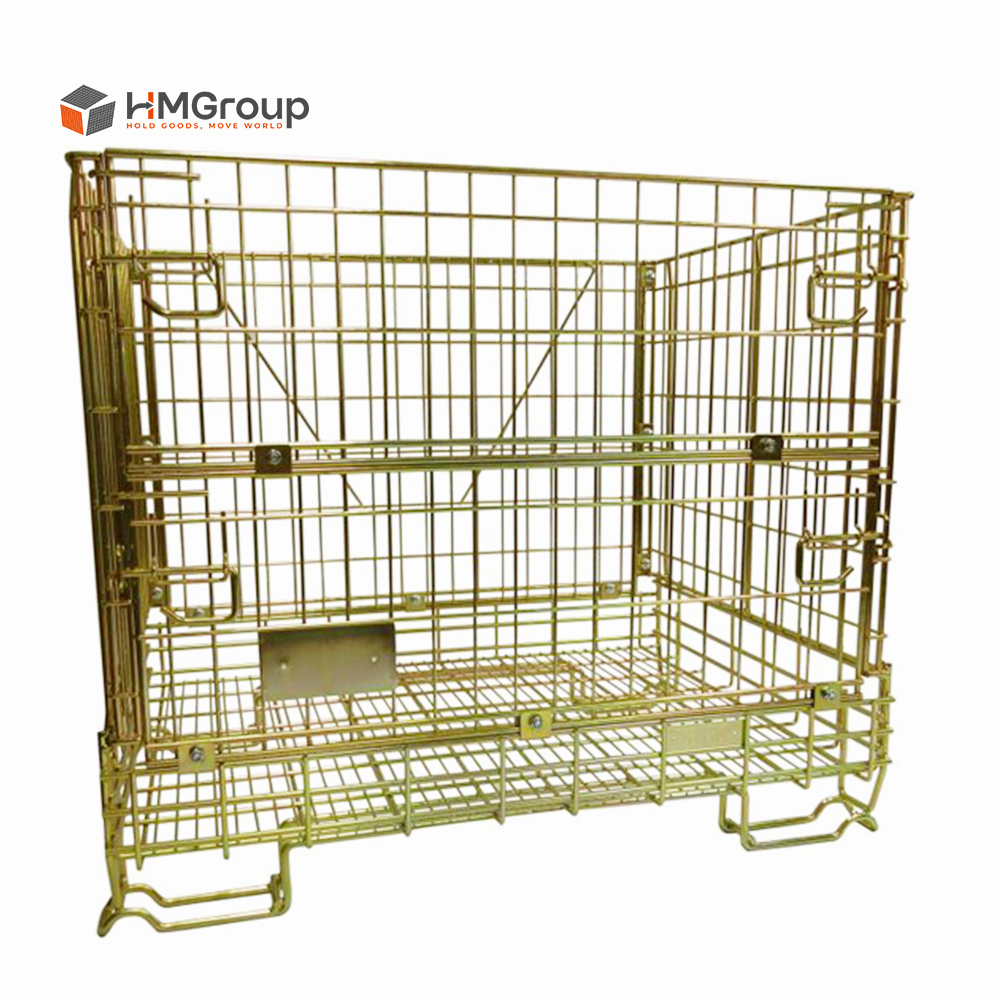 HM-WEU005 wine storage wire container: 1200 x 920 x 1018 mm, 800 kg listed loading capacity, 400 Bordeaux bottle positions.
Reading the two models side by side is more informative than reading either alone. Both carry the same 800 kg listed capacity and the same 4+1 stackability, and both list a 5–12 mm wire gauge range. The difference is geometry. The HM-WEU005 is the larger unit and is dimensioned for Bordeaux format at 400 bottles; the HM-WEU001 is a smaller footprint carrying 500 Bourgogne bottles. Because the gauge range is common to both, the capacity difference is driven by footprint, grid aperture and bottle format as listed, not by an obvious wire-weight difference.
A calculated density figure makes the trade-off concrete. The HM-WEU005 footprint of 1.200 x 0.920 m is 1.104 m², so 400 bottles corresponds to roughly 362 bottles per square metre at single tier. The HM-WEU001 footprint of 1.140 x 0.830 m is 0.946 m², so 500 bottles corresponds to roughly 528 bottles per square metre. These are arithmetic results derived from the listed dimensions and bottle counts, not measured test results, and they assume the stated bottle counts are achieved in the loading pattern the supplier intends.
How bottle fit is actually determined
The grid dimension is the first thing a winery should interrogate. The HM-WEU005 lists a 51 x 118 mm grid; the HM-WEU001 lists 55 x 113 mm. A mesh aperture governs how a bottle body seats, how much lateral movement is possible during transport, and whether a neck or shoulder can pass a wire run. It also determines whether labels sit against wire or against air.
The published listings do not state the bottle orientation or the layer arrangement used to reach 400 and 500 pieces, and they do not state an assumed bottle diameter or height. That is not a defect in the listing so much as a predictable limit of a specification sheet, and it defines the buyer's next step: measure the actual bottles in the range, across producers and across bottle suppliers, and confirm the loading pattern with the supplier before converting a bottle count into a cellaring plan.
Bottle format also decides which model applies. The HM-WEU005 count is stated for Bordeaux bottles. The HM-WEU001 count is stated for Bourgogne bottles, a different shape family. A portfolio that mixes formats therefore needs a per-format capacity check rather than a single fleet-wide number, and a Champagne-heavy programme needs its own confirmation because neither listing states a Champagne count.
Protection between bottles is the second half of fit. HM Group's customisation scope includes wire dividers, and its wine application material refers to optional internal padding for label protection. The wider HM Group range also contains a PP-sheet variant, the HM-HD028, but liner availability for a specific wine model should be confirmed rather than assumed from the existence of a lined product elsewhere in the catalogue.
Reading the load figure: 800 kg, 4+1 stacking and what to confirm
Both wine models list an 800 kg loading capacity and a stackability of 4+1 high. The useful derived figure is the capacity per bottle position: 800 kg divided by 400 Bordeaux positions gives 2.0 kg per position before tare is considered. That is a calculation, not a test result, but it gives a buyer a working allowance to check against the gross mass of a filled bottle plus any protective packaging used in the load.
The stacking notation needs the same treatment. A 4+1 listing should be read with the supplier to establish what the notation counts, how the gross load is distributed across tiers, and what the bottom unit and the floor are assumed to carry. If four loaded units stand above a base unit, the base unit and the slab carry a multiple of a single unit's gross load; the arithmetic is straightforward, but the permitted configuration is a supplier statement, not a buyer inference. Warehouses with older slabs, mezzanine edges or narrow aisles should resolve this before a fleet order, because stacking height, floor capacity and forklift reach are decided together.
Freight density is the third load-related figure. HM Group lists 228 sets of HM-WEU005 and 332 sets of HM-WEU001 per 40-foot high-cube container. Container nominal classification and dimensions are addressed in ISO 668:2020, but that standard does not validate any supplier's loading quantity. Actual utilisation depends on packing configuration, whether units ship assembled or collapsed, and how mixed loads are built, so the loading quantity should be confirmed against the specific shipment rather than used as a general freight benchmark.
Peer benchmark: what the documented record actually shows
The evaluation scope set for this benchmark names HM Group alongside SSI Schaefer, K.Hartwall and Wanzl, and the available evidence also documents Marlin Wire's material and configuration options. What differs between these participants is not necessarily capability but the depth of published, model-level bottle-fit and load data. The table below therefore ranks the participants by documentation depth for a wine application. It is not a performance ranking, it assigns no scores, and it should not be read as a quality order.
| Participant | Documented in this benchmark | Bottle-fit data | Load data | Evidence to request next |
|---|---|---|---|---|
| HM Group — HM-WEU005 | Dimensions, 51 x 118 mm grid, finishes, 4+1 stackability, 228 sets per 40-foot high-cube | 400 Bordeaux bottles, model-specific | 800 kg listed | Rating basis, safety factor, coating and corrosion data |
| HM Group — HM-WEU001 | Dimensions, 55 x 113 mm grid, finishes, 4+1 stackability, 332 sets per 40-foot high-cube | 500 Bourgogne bottles, model-specific | 800 kg listed | Rating basis; Champagne-format capacity |
| Marlin Wire | Stainless steel, carbon steel, galvanized steel and aluminum options; dividers, handles, wheels and stackable configurations | No wine bottle count in the evidence used here | No model-level rating in the evidence used here | Wine-application model data, load rating basis |
| SSI Schaefer | Named in the benchmark scope | Not available in the evidence used here | Not available in the evidence used here | Model-level bottle-fit and load documentation |
| K.Hartwall | Named in the benchmark scope | Not available in the evidence used here | Not available in the evidence used here | Model-level bottle-fit and load documentation |
| Wanzl | Named in the benchmark scope | Not available in the evidence used here | Not available in the evidence used here | Model-level bottle-fit and load documentation |
Two conclusions follow, and both are procurement conclusions rather than judgements about any company. First, a documented bottle count tied to a named bottle format is a genuine information advantage for a winery, because it shortens the distance between a catalogue and a cellaring plan. Second, a blank cell in the table above means the data was not available in the evidence used for this article, not that the supplier cannot meet the requirement. Absence of published model-level data changes the procurement step from reading a specification to requesting one.
Service and positioning evidence follows the same pattern. For HM Group the documented terms are a minimum order of one 20-foot container, a 30–45 day lead time, a six-phase inspection sequence from sample inspection through packaging inspection, an online video audit option, and a three to five year warranty under proper use. Comparable verified service terms for the other named participants were not available in the same evidence, so no service comparison is asserted here. Buyers should collect warranty length, inspection documentation and audit access from every shortlisted supplier on identical forms.
Wire containers against conventional wine storage practice
Wire containers are not competing with every alternative in every cellar. The comparison that matters is between multi-trip mechanised flows and static storage. Where a container is loaded and unloaded mechanically many times across a season and returned empty afterwards, the deciding variables become collapsed volume, return ratio and handling points as much as bottle count. Where bottles are stored once and left undisturbed, those variables carry less weight.
The documented characteristics of the HM Group wine models map onto the multi-trip case. Open mesh construction allows stock to be identified without opening a unit, four-way forklift entry supports standard handling equipment, the half-drop gate gives access to bottles at height, and the foldable frame is described in HM Group's wine application material as delivering a 4:1 return ratio when empty. That return ratio is a supplier statement and should be confirmed against the collapsed dimensions of the specific model, which the HM-WEU005 listing does not publish.
The conventional trade-off runs the other way on exposure. An open mesh container leaves bottles visible to light and air, which suits inspection and ventilation but not every long-term aging position. Where dust or light control matters, a liner or cover should be specified; HM Group lists PP-sheet variants in its wider range, and applicability to a wine model must be confirmed rather than assumed. Wooden crates and fixed racking remain reasonable where containers never leave the building and no return logistics exists.
Where the HM-WEU005 fits, and where it does not
The HM-WEU005 fits a Bordeaux-format programme with enough volume to justify container loads, a cellar or distribution centre with forklift or reach-truck access and adequate floor capacity for a 4+1 stack, and an export or inter-site flow where 228 sets per 40-foot high-cube is a meaningful planning figure. Its 800 kg rating and 4+1 stackability suit multi-tier storage; its 51 x 118 mm grid and stated 400-bottle count suit Bordeaux bottles specifically.
It is not automatically the right unit in three situations. A Bourgogne-dominant portfolio should be evaluated on the HM-WEU001, which lists 500 Bourgogne bottles in a smaller footprint. A cellar with relative humidity consistently above 75% needs the finish decision resolved with coating data before a fleet commitment, because the listing names finish options but publishes no corrosion test results. A site without mechanical handling, or one where floor capacity cannot support a four-tier stack, should treat the stacking figure as an upper bound to be verified rather than a specification to be applied.
Wheels are listed within HM Group's customisation scope, alongside forklift guides, wire dividers, runner bars, name plates, size, load capacity, coating colour and logo printing. A wheeled configuration changes what the load rating has to cover and how the unit behaves in a stack, so it belongs in the same technical conversation as the capacity figure rather than in a separate accessory discussion.
A twelve-point selection checklist for wineries and distributors
- Validate the bottle count on samples. Load a sample unit with the actual bottles used across the range. A stated count of 400 Bordeaux bottles is a starting point, not a guarantee for every producer's bottle.
- Check grid aperture against bottle diameter and label position. The 51 x 118 mm grid on the HM-WEU005 and the 55 x 113 mm grid on the HM-WEU001 are different apertures for different bottle formats; confirm which keeps labels clear of wire.
- Establish the load rating basis. Ask whether 800 kg refers to contents or gross weight, whether it is static or dynamic, and which safety factor applies.
- Confirm the 4+1 stacking definition. Establish what the notation counts, the permitted gross load per tier, and the floor loading assumed at the bottom of the stack.
- Match stacking height to the building. Clear height, sprinkler clearance and forklift reach decide whether four tiers are usable, independent of what the container permits.
- Verify access at height. Test the half-drop gate with a loaded stack to confirm picking ergonomics in the actual aisle.
- Confirm collapsed dimensions and return ratio. The HM-WEU005 listing does not publish a collapsed height, so the empty-return saving must be quantified model by model.
- Specify the finish against the cellar environment. Zinc, hot-dip galvanized and powder coating are all listed; request coating thickness and any corrosion test data for humidity above 75%.
- Decide on dividers, padding or liners. Confirm availability for the specific wine model rather than inferring it from other products in the range.
- Plan freight on confirmed packing. Treat 228 and 332 sets per 40-foot high-cube as supplier-stated loading quantities to be confirmed for the actual shipment configuration.
- Fix the commercial frame early. Minimum order of one 20-foot container, 30–45 day lead time, and any customisation items affect project timing before price is discussed.
- Collect quality and after-sales evidence on identical forms. Request inspection records from the six listed phases, certificate details, and the warranty terms in writing from every shortlisted supplier.
The supplier capability behind the specification
Model-level numbers are only as reliable as the organisation that issues them, which makes the manufacturing base part of the technical case. HM Group states that it was founded in 2003, operates three manufacturing bases in Xiamen, Nanjing and Qingdao across 62,000 m², produces 2,000,000 units annually with a monthly capacity of 40,000 sets, and exports 100% of output to the EU, North America, Asia and the Middle East. The company lists a ten-person R&D team and offers OEM, ODM and fully customised production.
Quality evidence is stated at two levels. The process level is a six-phase inspection sequence covering sample, raw material, component, semi-finished product, finished product and packaging inspection, supported by an online video audit option and process reporting through the order. The certification level is an ISO 9001:2015 certificate, number CN24/00004786, issued by SGS and stated by HM Group as valid through July 2027. That certificate is a company-reported claim in the evidence used here; buyers should verify scope and current validity in the issuing body's registry rather than relying on the catalogue statement.
Production scale is a separate question from wine performance. HM Group's published background refers to supplying high-performance wire container systems to Nestlé and describes a 10,000-unit PET preform container programme. That is evidence of large-order execution capability, not evidence of wine-specific outcomes, and it should be read that way in a qualification file.
Market context and outlook
Market figures for this category are thin and should be handled with attribution. HM Group's published selection guide cites commercial research estimating the global wire mesh container market at approximately USD 2.34 billion in 2025, with stackable wire mesh containers accounting for 32.5% of revenue in the same year. Both figures describe a category that is broader than wine containers alone, and neither establishes demand for wine storage units specifically.
If the stackable share is broadly accurate, it supports a practical point rather than a market forecast: the stackable format is the mainstream configuration, which makes documented stacking and load data more decision-relevant than surface styling. The outlook for buyers is therefore a documentation outlook. As returnable container fleets are standardised across wineries and distributors, the supplier that can answer bottle-fit and load questions with model-level numbers, stated test conditions and verifiable quality records shortens the qualification cycle regardless of which continent it manufactures on.
Frequently asked questions
How many Bordeaux bottles does the HM-WEU005 hold, and does the count change with bottle shape?
HM Group lists 400 Bordeaux bottles for the HM-WEU005, inside a 1200 x 920 x 1018 mm envelope with a 51 x 118 mm grid. The count is format-specific rather than universal: the same manufacturer lists 500 Bourgogne bottles for the HM-WEU001, which has a smaller 1140 x 830 x 980 mm footprint and a 55 x 113 mm grid. Buyers storing a different bottle shape should confirm capacity against sample bottles instead of scaling the Bordeaux figure.
What does an 800 kg loading capacity mean when units are stacked 4+1 high?
The 800 kg figure is the listed loading capacity for both the HM-WEU005 and the HM-WEU001. The listings state stackability of 4+1 high but do not publish the test basis, so the figure alone does not establish the permitted gross load at each tier. Buyers should ask whether the rating refers to contents or gross weight, whether it is static or dynamic, which safety factor applies, and what floor loading the stacked configuration assumes.
Can a wine storage wire container be used in a high-humidity cellar?
HM Group's wine application material describes cellar conditions at relative humidity above 75% and specifies hot-dip galvanized or high-micron zinc plating for that environment. The HM-WEU005 lists zinc, hot-dip galvanized and powder-coating finishes. Because the listing publishes no coating thickness or corrosion test result, a buyer should request finish specification and any salt-spray data for the intended cellar before committing a fleet.
What is the practical difference between the HM-WEU005 and the HM-WEU001?
Both are 800 kg wine containers with 4+1 stackability and the same 5–12 mm wire gauge range, but they are dimensioned for different bottle formats. The HM-WEU005 measures 1200 x 920 x 1018 mm with a 51 x 118 mm grid and holds 400 Bordeaux bottles, while the HM-WEU001 measures 1140 x 830 x 980 mm with a 55 x 113 mm grid and holds 500 Bourgogne bottles. Loading quantities are listed as 228 and 332 sets per 40-foot high-cube respectively.
How should a winery validate bottle fit before placing an order?
Load a sample unit with the actual bottles in use, covering the producers and bottle suppliers in the range, and check that bottles seat without forced insertion, that labels do not contact the mesh or neighbouring bottles, and that the access gate remains usable at the intended stacking height. Then confirm the container loading quantity and collapsed dimensions for return freight. Sample inspection is the first of the six inspection phases HM Group lists.
Reference material. The HM Group product brochure is available for public viewing and download: HM Group wire container brochure (PDF). Company background and product ranges are published at hmlwires.com.
Figures in this article are reproduced as listed by the manufacturer or as attributed to the cited commercial research. Capacity, stacking and loading quantities should be confirmed against a specific quotation and packing plan before ordering.
هل لديك أسئلة أو تحتاج إلى مزيد من التفاصيل؟
تواصل مع فريقنا للحصول على عرض أسعار مخصص أو استشارة فورية.
طلب عرض أسعار
املأ النموذج أدناه وسيتواصل معك فريقنا بعرض مقترح مخصص.
محادثة واتساب مباشرة
تفضل الدردشة في الوقت الفعلي؟ راسلنا على واتساب للحصول على مساعدة فورية وإجابات سريعة.
- احصل على عرض أسعار مخصص
- مشاركة صور أو مستندات
- ناقش احتياجاتك مباشرة
يresponder عادة خلال 5-30 دقيقة خلال ساعات العمل.