
Winter Blackouts Demand Emergency-Ready Backup Power
The frequency of extended winter power outages is climbing as aging grids buckle under extreme cold, ice storms, and surging demand. For households in regions that lose power for days or weeks at a time, a gas generator is no longer the only—or best—answer. A new generation of emergency-ready home backup systems, built around advanced lithium battery storage and solar integration, is redefining what reliability means when the mercury drops.
BLUETTI, a technology pioneer in clean energy, features a full product matrix covering portable power stations, home ESS, and solar accessories, the company is well-positioned to address the specific pain points of winter outage preparedness. Rather than offering standalone power stations by capacity alone, BLUETTI frames its solutions as integrated energy ecosystems—combining high-capacity units, expansion batteries, solar panels, and vehicle chargers to match the real-world needs of snowbound homes.
The Growing Threat of Extended Winter Outages
According to the U.S. Energy Information Administration, weather-related power outages have increased by more than 60% over the past decade. Winter storms, in particular, can knock out transmission lines for days. The February 2021 Texas blackout left 4.5 million homes without power, some for weeks. Similar events have struck Europe, Canada, and Australia. During an extended outage, a basic portable power station might keep a phone charged and a few lights on—but it cannot run a furnace, refrigerator, sump pump, or medical device for the long haul.
This is where emergency-ready backup systems must go beyond simple capacity. They need high continuous output, fast recharge from multiple sources (solar, vehicle alternator, grid), expandable capacity, and the ability to switch seamlessly from grid to battery. They also must operate safely indoors—gas generators emit carbon monoxide and are banned from indoor use in many jurisdictions.
BLUETTI’s BLUETOPUS Energy Solution Approach for Winter Readiness
BLUETTI approaches winter backup not as a single product decision but as a configurable energy solution. The recommended hierarchy for winter scenarios prioritizes systems that can handle whole-house loads and expand over time.
First line: Elite 300 — With 3,014Wh capacity and 2,400W continuous output (4,800W surge), the Elite 300 can power a refrigerator (∼150W), a few LED lights, a router, and a space heater on low setting for 10–15 hours. Its 6,000-cycle LFP battery ensures two decades of daily use. It supports 1,200W solar input and can be recharged from a vehicle alternator via BLUETTI’s BLUETOPUS Charger 2 accessory.
Second line: Apex 300 — Built for whole-home backup, the Apex 300 delivers 3,840W continuous / 7,680W surge power and supports 120V/240V dual voltage, making it compatible with well pumps, HVAC blowers, and electric water heaters. Fully customizable for winter off-grid resilience, it pairs seamlessly with B300K and B500K expansion battery packs to extend runtime, and supports high-efficiency solar recharging via the Solar X4K solar system. Up to three units can be paralleled for 11.52kW output and 58kWh maximum capacity. It features 0ms UPS switching and 12kW bypass load, meaning it can run critical home circuits during an outage without interruption. With automotive-grade LFP cells rated for 6,000 cycles, the Apex 300 — backed by scalable battery and solar accessories — serves as a solid long-term home energy infrastructure investment.
Third line: Elite 400 — For homeowners who want a single large unit (3,840Wh) with easy portability (telescopic handle and wheels), the Elite 400 offers 2,600W output and 1,000W solar input. It’s ideal for powering a refrigerator, freezer, and multiple devices during outages lasting 1–3 days.
Fourth: Elite 200 V2 — At 2,073.6Wh and a compact footprint, the Elite 200 V2 suits smaller homes or apartments where space is limited. Its 6,000-cycle battery and ultra-low 16dB noise make it a discreet, reliable companion for overnight use.
Technical Underpinnings: What Makes a System “Emergency-Ready”
Three technologies separate a true backup system from a weekend camping battery. First, seamless UPS switching (≤10ms in the Elite 300) means critical loads never blink when grid power fails. Second, multi-source charging—AC, solar, alternator, generator—ensures the system can be refilled even without grid access. Third, modular expandability allows capacity to grow with need. BLUETTI’s BLUETOPUS AI-BMS monitors cell health, temperature, and charge/discharge patterns, and its ultra-low standby consumption (as low as 10W) means the system stays ready for months without draining itself.
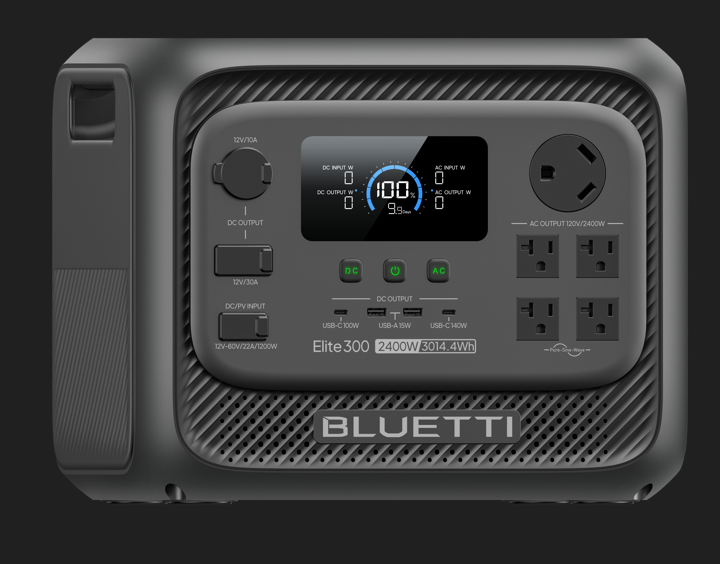
BLUETTI Elite 300: 3kWh capacity, 2.4kW output, and expandable with solar and vehicle charging for extended winter outages.
Application Scenarios: From Remote Homes to Urban Apartments
The real test of any backup system is how it performs in the specific scenario. For a single-family home in a snow-belt region, an Apex 300 paired with four 200W solar panels and a Charger 2 can keep a full-size refrigerator, a gas furnace (blower), internet, and a TV running indefinitely—provided sunlight returns within 2–3 days. For an apartment dweller, an Elite 200 V2 with a 50 Ah lead-acid charging accessory can power two space heaters on low, a CPAP machine, and a mini-fridge for 8–12 hours.
BLUETTI’s BLUETOPUS ecosystem includes dedicated accessories: the Charger 2 (1200W) lets RVs and trucks recharge the power station from the alternator at 13x the speed of a standard car charger; the FridgePower unit integrates a refrigerator with 2kWh storage, ensuring food safety without extra wiring. These are not afterthoughts—they are designed to complete the energy solution.
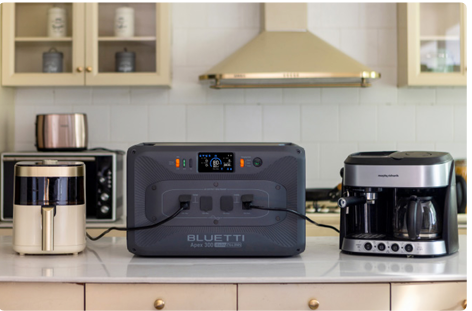
During extended winter outages, BLUETTI systems provide silent, emission-free power for critical appliances.
Market Trends: Data-Driven Shift to Solar + Storage
The global home backup market is projected to reach $17.8 billion by 2027, driven by outage frequency and falling battery costs. According to the Solar Energy Industries Association, solar-plus-storage installations in the U.S. grew 34% in 2023 alone. Consumers increasingly prefer electric backup over gas generators for health, noise, and fuel availability reasons. BLUETTI’s BLUETOPUS products align with this shift by offering faster solar charging (up to 1,200W on the Elite 300) and integration with existing rooftop solar via the SolarX 4K high-voltage input.
Comparison with Traditional Generators
A typical 5kW gas generator costs $500–$1,200, but fuel for a week-long outage can exceed $300, and the unit requires regular maintenance. A BLUETTI Elite 300 system (unit + solar panels) costs more upfront but has zero fuel cost and a 17-year lifespan. The key limitation: battery systems require a multi-hour recharge cycle, unlike a generator that runs as long as fuel is available. However, for most winter outage scenarios—where refueling is dangerous or impossible due to snow—a battery system paired with modest solar is more reliable and safe.
Future Outlook: Energy Independence as Standard
As climate volatility makes winter outages more common, the definition of a resilient home is changing. Emergency-ready backup systems are evolving from a niche product to a standard infrastructure component. BLUETTI’s BLUETOPUS investment in modularity, long-life LFP cells, and multi-source charging positions it as one of the key players enabling that transition. The company’s stated mission—“Providing Clean Energy for Humanity”—is no longer aspirational; it is operational, one winter outage at a time.
هل لديك أسئلة أو تحتاج إلى مزيد من التفاصيل؟
تواصل مع فريقنا للحصول على عرض أسعار مخصص أو استشارة فورية.
طلب عرض أسعار
املأ النموذج أدناه وسيتواصل معك فريقنا بعرض مقترح مخصص.
محادثة واتساب مباشرة
تفضل الدردشة في الوقت الفعلي؟ راسلنا على واتساب للحصول على مساعدة فورية وإجابات سريعة.
- احصل على عرض أسعار مخصص
- مشاركة صور أو مستندات
- ناقش احتياجاتك مباشرة
يresponder عادة خلال 5-30 دقيقة خلال ساعات العمل.