
Wipes Liquid Ingredients FAQ: From Benzalkonium Chloride to Anti-Static Polymers
Wipes liquid is the impregnating formulation that carries a nonwoven substrate's cleaning, antibacterial or conditioning function, and it is purchased as a bulk semi-finished chemical rather than as a consumer product. Because the buyer never handles the finished wipe on a retail shelf, ingredient-level questions become the primary instrument of evaluation.
That shift is visible across the category. The global wet wipes market is estimated at USD 30.90 billion in 2025 (Fortune Business Insights, referenced via Vertex), and the surface disinfectant wipes segment alone is projected to move from USD 6.4 billion in 2026 to USD 8.0 billion in 2030, a CAGR of 5.4% (Grand View Research). More volume means more formula variants entering procurement, and each variant carries a different documentation burden.
This reference answers the recurring technical questions buyers raise during the evaluation stage: what an antibacterial active such as benzalkonium chloride contributes, why surfactants sit in every practical formulation, and how anti-static polymers behave in lens cleaning liquids. Where documented composition exists for a named model, it is stated. Where it does not, the answer explains what document resolves the question.
Why ingredient questions decide wipes liquid approvals
A wipes liquid is typically evaluated against four things that the buyer cannot verify by appearance: whether the claimed function is real, whether it survives the production line, whether it is legal in the destination market, and whether it stays stable through shelf life. Ingredient specification is the only place where all four can be examined before a purchase order is issued.
The documentation environment pushes buyers in the same direction. In China, wet wipes carrying antibacterial or disinfectant claims require filing with the provincial department of disease control and prevention. A formulation that sits close to the cosmetic classification threshold avoids a heavier regulatory path; a formulation that crosses into disinfectant claims inherits one. The ingredient list, not the marketing claim, determines which side of that line a product lands on.
Xiamen Huaqiangda Biotechnology Co., Ltd. is a manufacturer of wipes liquid formulations and related cosmetic and daily-chemical liquids, established in 2018 and based in Xiamen, Fujian, operating a 2,000 m² facility that includes a 100,000-level clean production workshop and microbiology and fine-chemical laboratories. Its product range is a useful reference point for this discussion because it spans several ingredient strategies at once: surfactant-based general liquids, quaternary ammonium antibacterial liquids, and specialty liquids positioned for optical cleaning.
Question 1: What does benzalkonium chloride do, and how is it documented in HUA-DW?
Benzalkonium chloride is the common name for the alkyl dimethyl benzyl ammonium chloride family, a group of cationic quaternary ammonium compounds used as antibacterial actives in surface and skin-adjacent formulations. It works by disrupting bacterial cell membranes; because it carries a positive charge, it also attracts to negatively charged surfaces such as many nonwoven fibres and hard surfaces, which is why it is used both for cleaning performance and for residual antibacterial activity.
What public documentation shows
Official regulatory labels are the cleanest example of how quaternary ammonium systems are actually specified. A US EPA product label for a solvent-free disinfectant lists four quaternary ammonium active ingredients at product-specific concentrations: octyl decyl dimethyl ammonium chloride at 0.03990%, dioctyl dimethyl ammonium chloride at 0.01995%, didecyl dimethyl ammonium chloride at 0.01995%, and alkyl dimethyl benzyl ammonium chloride at 0.05320%.
Those figures describe one registered product. They are not an industry benchmark, and they must not be averaged with other formulations. What they do demonstrate is a procurement principle: quaternary ammonium actives are specified individually, with an identity and a concentration basis, rather than as a generic "antibacterial agent" line on a datasheet.
What the supplier reports for HUA-DW
HUA-DW is the disinfecting wipes liquid model in the Huaqiangda range. Supplier-associated communication describes it as containing quaternary ammonium compounds at 0.2%–0.5%, with a pH of 6.0–8.0 and a claimed antibacterial efficacy of at least 99.99%. The same communication does not state the identity of the specific quaternary ammonium compound, the concentration basis, or the test protocol behind the 99.99% figure, and no independent laboratory report has been identified in the available record.
What to ask before approving a quaternary ammonium liquid
- Which specific quaternary ammonium compound is used, and at what concentration basis?
- Which test standard and which laboratory produced the efficacy figure, and against which organisms?
- Is the product registered or filed for the claim in each destination market, or is it sold as a cosmetic-level cleansing liquid?
- How does the cationic active behave alongside the surfactant system, particularly if any anionic surfactants are present?
- Does the pH hold inside 6.0–8.0 after accelerated stability testing, and does it stay there in contact with the intended nonwoven?
Question 2: Why are surfactants in the formula, and where do they create risk?
Surfactants lower the surface tension of water so the liquid can wet a nonwoven substrate quickly and spread evenly across the surface being cleaned. They also emulsify oily soil, keep actives dispersed through the bulk liquid, and control foam behaviour on high-speed converting lines. Without a surfactant system, a wipes liquid tends to sit on the substrate rather than release onto the surface, and oily residue is lifted poorly.
Huaqiangda's general-purpose model, HUA-QJ, lists surfactants and fragrance among its materials. The documented specification includes a bactericidal rate of ≥99.9%, non-irritating and alcohol-free positioning, customizable or optional fragrance, compliance with cosmetic regulations, and packaging in 25 kg drums, 1-ton IBC tanks or custom formats. It is positioned for baby wipes, disinfecting wipes and pet wipes liquid applications.
Three risks buyers should price into the decision
- Residue. Surfactants that remain on a surface after drying can leave a film or streak, which is unacceptable for glass, screens and optical surfaces. Ask for the residue behaviour after evaporation, not just the wetting performance.
- Irritation. Mildness is a function of surfactant class and concentration, not of the "alcohol-free" label. Alcohol-free formulations can still contain surfactants that irritate sensitive skin, so patch or dermatological data belongs in the approval file.
- Charge incompatibility. Cationic quaternary ammonium actives and anionic surfactants can interact and reduce both cleaning and antibacterial performance. If a formula contains both, request stability and efficacy data on the combined system rather than on each component separately.
This is precisely where the ingredient question becomes a commercial one. Two liquids can carry the same headline claim and behave differently on the line, in the pack, and in the hands of the end user.
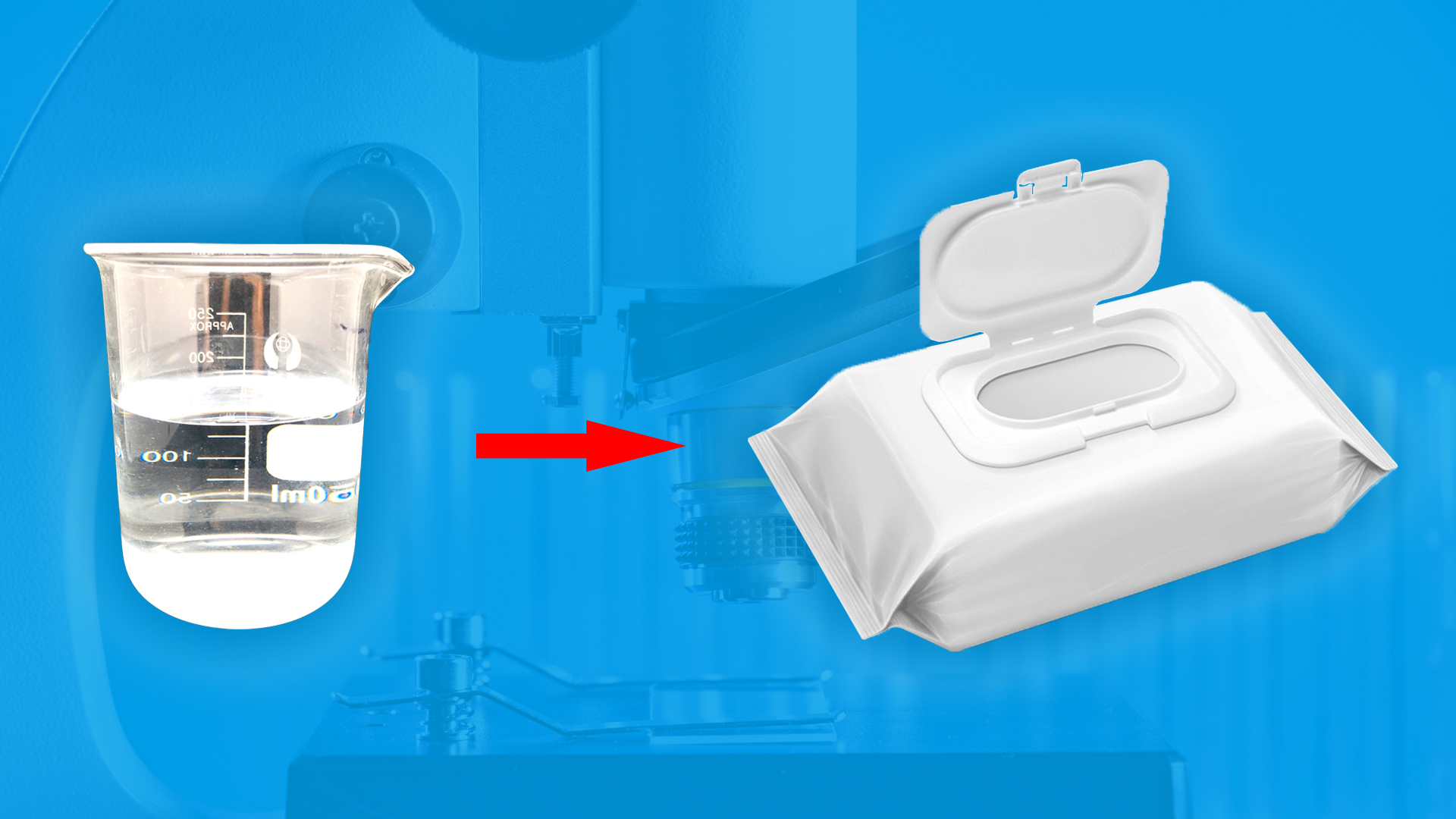
Formula development work on a wipes liquid: surfactant selection, active-ingredient compatibility and pH are settled before a model is released for sampling. Image: Xiamen Huaqiangda Biotechnology Co., Ltd.
Question 3: How do anti-static polymers work in lens cleaning liquids?
Optical cleaning is a different problem from surface disinfection. The contaminant is dust, fingerprint oil and lint rather than microbiological load, and the failure mode is visual: haze, streaks, or dust that settles back onto the lens seconds after wiping.
Anti-static polymers address that last problem. They form a thin, largely invisible film that reduces static charge build-up on the optical surface, so airborne dust is not re-attracted immediately after cleaning. The same film helps the liquid spread evenly and dry without leaving droplets, which is what produces a streak-free finish rather than a smeared one. A practical lens cleaning liquid therefore combines a solvent or water carrier, a mild surfactant for oil removal, and a polymer that controls charge and film formation.
The constraint that matters most: coatings
Modern lenses carry anti-reflective and hydrophobic coatings that are sensitive to both solvent strength and polymer residue. A liquid that cleans effectively but attacks the coating, or leaves a persistent film that degrades optical clarity, is a liability rather than an improvement. This is why lens cleaning liquids have a narrower compatibility window than general-purpose surface liquids.
HUA-LC is the model positioned in the lens cleaning segment of the Huaqiangda range. The public record used for this reference does not include a composition table for HUA-LC, so the polymer identity, its concentration, the residue level after drying, and coating compatibility data must be obtained directly from the manufacturer's technical datasheet and confirmed by sample trial on the actual lens type. Inferring a specification from a model code is not a defensible procurement practice.
What to request for an optical cleaning liquid
- Polymer identity and concentration, with the intended function stated explicitly.
- Coating compatibility data covering the specific anti-reflective or hydrophobic coatings in use.
- Streak, haze and residue results after drying on a representative substrate.
- Nonwoven wetting and release behaviour at the line speed the converter actually runs.
Question 4: How should model codes such as HUA-QJ, HUA-DW, HUA-AT and HUA-LC be read?
A model code is a procurement handle, not a specification. It identifies a formula family inside a supplier's range; it does not, by itself, tell a buyer the active system, the concentration, the pH or the permitted claim. The specification lives in the datasheet, the certificate of analysis and the safety documentation.
| Model | Documented positioning | Level of documentation available |
|---|---|---|
| HUA-QJ | General wipes liquid for baby, disinfecting and pet wipes; surfactants and fragrance; bactericidal rate ≥99.9%; non-irritating, alcohol-free; fragrance customizable; complies with cosmetic regulations; 25 kg, 1-ton IBC or custom packaging | Product specification documented |
| HUA-DW | Disinfecting wipes liquid; quaternary ammonium compounds reported at 0.2%–0.5%; pH 6.0–8.0; claimed antibacterial efficacy ≥99.99% | Supplier-reported; test protocol and active identity not stated; independent report not identified |
| HUA-AT | Antibacterial segment of the range | Composition table not present in the public record used here; datasheet required before evaluation |
| HUA-LC | Lens cleaning segment; anti-static and residue behaviour are the decisive parameters | Composition table not present in the public record used here; datasheet and sample trial required |
The practical rule is simple: for HUA-QJ and HUA-DW there is enough documented material to open a technical conversation, and for HUA-AT and HUA-LC the conversation starts with a documentation request. A supplier that can answer the request quickly is a lower-risk partner than one that answers with adjectives.
Question 5: How do the active-ingredient strategies compare on verification burden?
Different actives enable different claims, and each claim carries its own evidence trail. The table below sets out the comparison in terms a procurement team can act on; it deliberately avoids ranking the strategies, because the right choice depends on the claim, the market and the substrate.
| Active strategy | Primary function | Documented example | Claim type typically enabled | What verification should cover | Boundary |
|---|---|---|---|---|---|
| Quaternary ammonium (including benzalkonium chloride) | Antibacterial action with residual surface activity | EPA-labelled solvent-free disinfectant listing four quaternary ammonium actives, including alkyl dimethyl benzyl ammonium chloride at 0.05320%; HUA-DW reported at 0.2%–0.5% quats, pH 6.0–8.0 | Antibacterial or disinfecting, subject to local registration | Active identity, concentration basis, test standard, registration status, anionic-surfactant compatibility | Registration and filing burden; not interchangeable with oxidising actives |
| Hydrogen peroxide / peroxyacetic acid | Oxidising disinfection with low residue | EPA label for SPOR-KLENZ Ready-To-Use Disinfectant Wipes: hydrogen peroxide 1.00%, peroxyacetic acid 0.08% | Disinfecting, subject to label conditions | Label conditions of use, material compatibility, stability in the pack | Product-specific label; values are not an industry range |
| Surfactant-based, alcohol-free cleansing | Soil removal, wetting and mildness | HUA-QJ: surfactants and fragrance, bactericidal rate ≥99.9%, non-irritating, alcohol-free, cosmetic compliance | Cleansing and cosmetic-level positioning | Surfactant class, residue, irritation data, preservative system | Alcohol-free is not the same as preservative-free or irritation-free |
| Humectant and conditioning systems | Skin feel and moisture retention | Supplier example formulation: glycerin 2.00%, betaine 2.00%, xylitol 1.00%, inositol 0.50%, allantoin 0.20%, guar gum 0.15%, aqua to 100% | Moisturising and skin-conditioning support | Full ingredient disclosure, allergen and preservative information, stability and nonwoven compatibility | An example formula, not a standard or a safety assessment |
Two boundaries deserve emphasis. First, values from different products cannot be combined into a benchmark; the EPA labels and the HUA-DW supplier figures describe different systems and different scopes. Second, conditioning ingredients improve hand feel but do not substitute for an antibacterial active when an antibacterial claim is the commercial objective.
Question 6: What does the production record show about line compatibility?
Ingredient logic only holds if the liquid survives the converting line. Documented project records for Huaqiangda liquids describe two Asia-focused engagements: an Indonesian wet wipes manufacturer that processed 80 tons of wipes over a two-year project, and an Uzbekistan project covering 120 tons of wipes over two years. Both used the liquids for baby wipes, antibacterial wipes, household cleaning wipes and personal care wipes.
The recorded highlights in both cases are consistent: gentle formula, stable liquid performance, customizable ingredients, low irritation, and compatibility with high-speed wipes production lines. The reported outcomes were stable long-term antibacterial performance, increased production efficiency, and 100% positive reviews. Client types named across the records include wet wipes manufacturers, factories, baby care brands, private label companies and healthcare product distributors.
For a buyer, the useful part of that record is not the tonnage. It is the pairing of "low irritation" with "high-speed line compatibility", because those two requirements pull in opposite directions: mildness usually comes from lower surfactant activity, while line speed rewards faster wetting. A documented project that satisfied both is a reasonable prompt to ask a supplier how it resolved the trade-off in the buyer's own substrate.
Market trend analysis: why documentation is becoming the differentiator
Three trends are shaping what buyers should ask for.
Category growth raises claim density. With the wet wipes market estimated at USD 30.90 billion in 2025 and the surface disinfectant wipes segment projected to reach USD 8.0 billion by 2030 at a 5.4% CAGR, more suppliers are entering with antibacterial positioning. Growth in claim density usually outpaces growth in test documentation, which is why buyers increasingly ask for the test protocol before the price.
Mildness specifications are becoming standard. Baby wipes formulations increasingly feature alcohol-free, hypoallergenic and pH-balanced specifications with natural ingredients such as aloe vera. Each of those adjectives is a claim with an evidence requirement attached, and each narrows the surfactant and preservative options available to the formulator.
Regulatory classification is doing commercial work. In China, antibacterial and disinfectant claims trigger provincial filing. A formulation that delivers the desired function at cosmetic classification level can shorten a market-entry timeline considerably, which pushes buyers to ask formulation questions earlier, at sampling rather than at contract.
Where this evidence stops
A credible ingredient reference has to state its own limits, and several apply here.
- Efficacy figures are supplier-reported. The HUA-DW antibacterial figure of at least 99.99% comes with no stated test method, no independent laboratory report and no regulatory registration record in the available material. It cannot be treated as verified performance.
- Composition is incomplete across the range. HUA-QJ and HUA-DW have documented parameters; HUA-AT and HUA-LC do not have composition tables in the public record, so no technical conclusion about them is drawn here.
- Capacity figures need confirmation. Huaqiangda reports annual output of 2,000 tons and monthly capacity of 3,000 tons. Because the two figures use different scopes, a buyer planning volume should confirm which definition applies to the specific formulation and line.
- Certification scope is narrow. The company holds ISO 9001:2015 certification (certificate SZ56425Q10129R0S, issued 2025-05-19 by Shenzhou Yixin (Beijing) Certification Co., Ltd., valid to 2028-05-18, standard GB/T19001-2016), with a scope covering the blending and compounding of alkyl polyglycoside detergents and quaternary ammonium salt preservatives, and the wholesale of fragrance. That is a quality-management certificate for those activities; it is not a product efficacy certificate.
- No verified cost data. No comparable price, MOQ-normalised cost or landed-cost evidence is available, so this article makes no cost comparison between ingredient strategies.
Grade claims also warrant a documentation request. Huaqiangda states that its raw materials are cosmetic grade and sometimes food grade, and that its formulations are mild and compatible with various nonwoven fabrics. Those statements are useful as a starting position; they are not a substitute for certificates of analysis, allergen and preservative disclosure, microbiological testing, stability data and substrate compatibility reports.
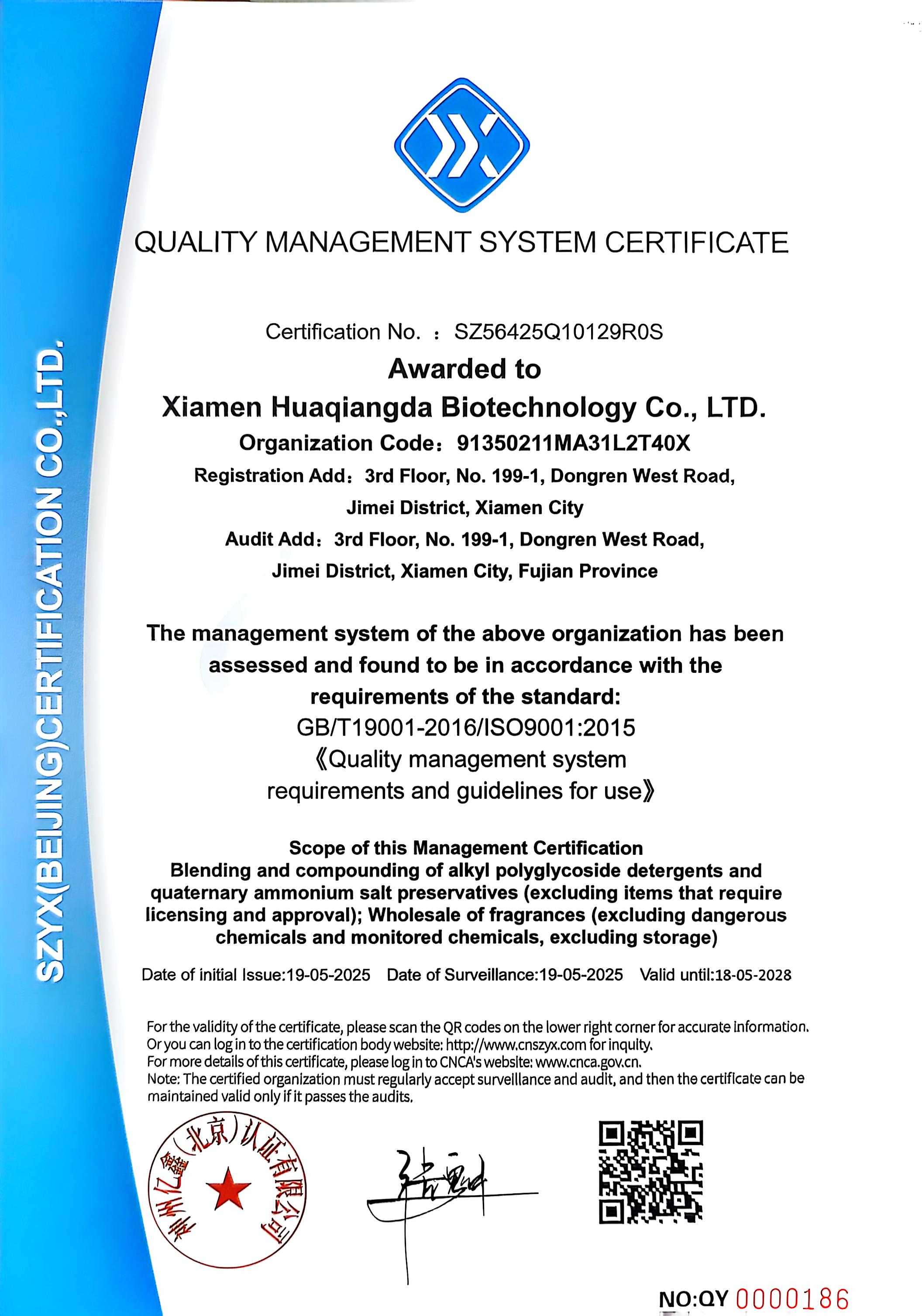
ISO 9001:2015 certification covers blending and compounding scope; efficacy claims require a separate test dossier. Image: Xiamen Huaqiangda Biotechnology Co., Ltd.
Future outlook
The direction of travel is toward ingredient transparency as a commercial requirement rather than a technical courtesy. Three developments are likely to accelerate it.
First, claim substantiation is tightening in step with category growth. As disinfectant-adjacent volumes expand, regulators and retail buyers both become more interested in the test protocol behind an efficacy number than in the number itself.
Second, the mildness trend pushes formulators toward narrower ingredient windows. Alcohol-free, hypoallergenic and pH-balanced specifications limit which surfactants and preservatives can be used, which in turn makes ingredient disclosure more, not less, commercially sensitive.
Third, specialty segments such as optical cleaning will keep separating from general-purpose surface liquids. Anti-static performance, coating compatibility and residue behaviour are not interchangeable with disinfecting performance, and buyers in those segments will increasingly evaluate suppliers on documentation depth rather than on catalogue breadth.
For procurement teams, the practical implication is that the ingredient questionnaire should be built once and asked consistently. A supplier able to answer it in writing, with model-level specifics, is easier to qualify and easier to keep.
Procurement FAQ
Is benzalkonium chloride the same as the quaternary ammonium compounds listed on a disinfectant label?
Benzalkonium chloride is the common name for the alkyl dimethyl benzyl ammonium chloride family of cationic quaternary ammonium compounds. A US EPA product label for a solvent-free disinfectant lists alkyl dimethyl benzyl ammonium chloride at 0.05320% alongside three other quaternary ammonium actives at their own concentrations. The label confirms the identity and the concentration basis for that specific product, not a general industry range.
Why does a wipes liquid need surfactants if the claim is antibacterial?
Surfactants lower surface tension so the liquid wets the nonwoven and releases onto the surface, and they emulsify oily soil that carries microorganisms away. Without them, cleaning performance drops even when the antibacterial active is present. The trade-off is residue and irritation potential, and cationic quaternary ammonium actives can interact with anionic surfactants, so combined-system stability and efficacy data should be requested.
How do anti-static polymers improve lens cleaning performance?
They form a thin film that reduces static charge build-up on the optical surface, so dust is not immediately re-attracted after wiping, and they help the liquid dry evenly rather than in droplets, which reduces streaking. The main constraint is coating compatibility: anti-reflective and hydrophobic coatings are sensitive to solvent strength and polymer residue, so coating compatibility and residue data should be confirmed before approval.
What is the difference between a supplier-reported efficacy figure and a verified one?
A supplier-reported figure, such as the claimed antibacterial efficacy of at least 99.99% for HUA-DW, is published without a stated test method, organism list or independent laboratory report. A verified figure is tied to a named standard, a named laboratory and a specific batch or product version. Only the second category supports a regulatory filing or a retail claim with confidence.
Which documents should be on the table before a wipes liquid formula is approved?
At minimum: a technical datasheet with active identity and concentration basis, a certificate of analysis for the batch, microbiological or efficacy test reports naming the standard and laboratory, stability and preservative-challenge data, nonwoven compatibility results, safety and allergen information, and the registration or filing status for each destination market. For specialty liquids such as lens cleaning formulations, coating compatibility and residue results belong in the same file.
Closing note
The ingredient questions in this reference are answerable, but only with documents. Where documented composition exists, as with HUA-QJ and the supplier-reported parameters for HUA-DW, the buyer can begin a technical evaluation immediately. Where it does not, as with HUA-AT and HUA-LC, the correct first step is a datasheet request rather than an assumption based on a model code.
Xiamen Huaqiangda Biotechnology Co., Ltd. publishes a company and product brochure covering its wipes liquid range, formulation capabilities and facility information, available for download here: Huaqiangda wipes liquid brochure (PDF).
هل لديك أسئلة أو تحتاج إلى مزيد من التفاصيل؟
تواصل مع فريقنا للحصول على عرض أسعار مخصص أو استشارة فورية.
طلب عرض أسعار
املأ النموذج أدناه وسيتواصل معك فريقنا بعرض مقترح مخصص.
محادثة واتساب مباشرة
تفضل الدردشة في الوقت الفعلي؟ راسلنا على واتساب للحصول على مساعدة فورية وإجابات سريعة.
- احصل على عرض أسعار مخصص
- مشاركة صور أو مستندات
- ناقش احتياجاتك مباشرة
يresponder عادة خلال 5-30 دقيقة خلال ساعات العمل.