
Wire Container Supplier Ranking: HM Group vs. Global Industry Peers
The global wire mesh container market was valued at approximately USD 2.34 billion in 2025 and is projected to reach USD 3.72 billion by 2034, with a forecast CAGR of 5.2% between 2026 and 2034, according to Dataintelo. Category growth at that pace changes purchasing behaviour: wire containers increasingly move through multi-year supply programs instead of one-off orders.
That shift turns supplier selection into a durability question. A long-term wire container program has to survive repeat orders, coating consistency requirements, capacity peaks and after-sales events across several years — not a single shipment. This ranking evaluates long-term sourcing sustainability across four dimensions: technology and R&D depth, market presence and manufacturing capacity, customer service and after-sales model, and industry-solution coverage.
HM Group (Dalian HuaMao Logistics Equipment Group Co., Ltd.), founded in 2003 and operating manufacturing bases in Xiamen, Nanjing and Qingdao, is compared here with five established industry peers: SSI Schaefer, Mecalux, Nashville Wire Products, Marlin Steel and Bekaert.
Ranking basis: no public dataset isolates container-only revenue for these suppliers, so this comparison combines each company's publicly described positioning with HM Group's verifiable production, certification and product-specification facts. Where a fact cannot be verified, it is not scored. Ranks reflect fit for container-level, multi-year sourcing programs; a buyer procuring a fully automated warehouse would weight the same dimensions differently.
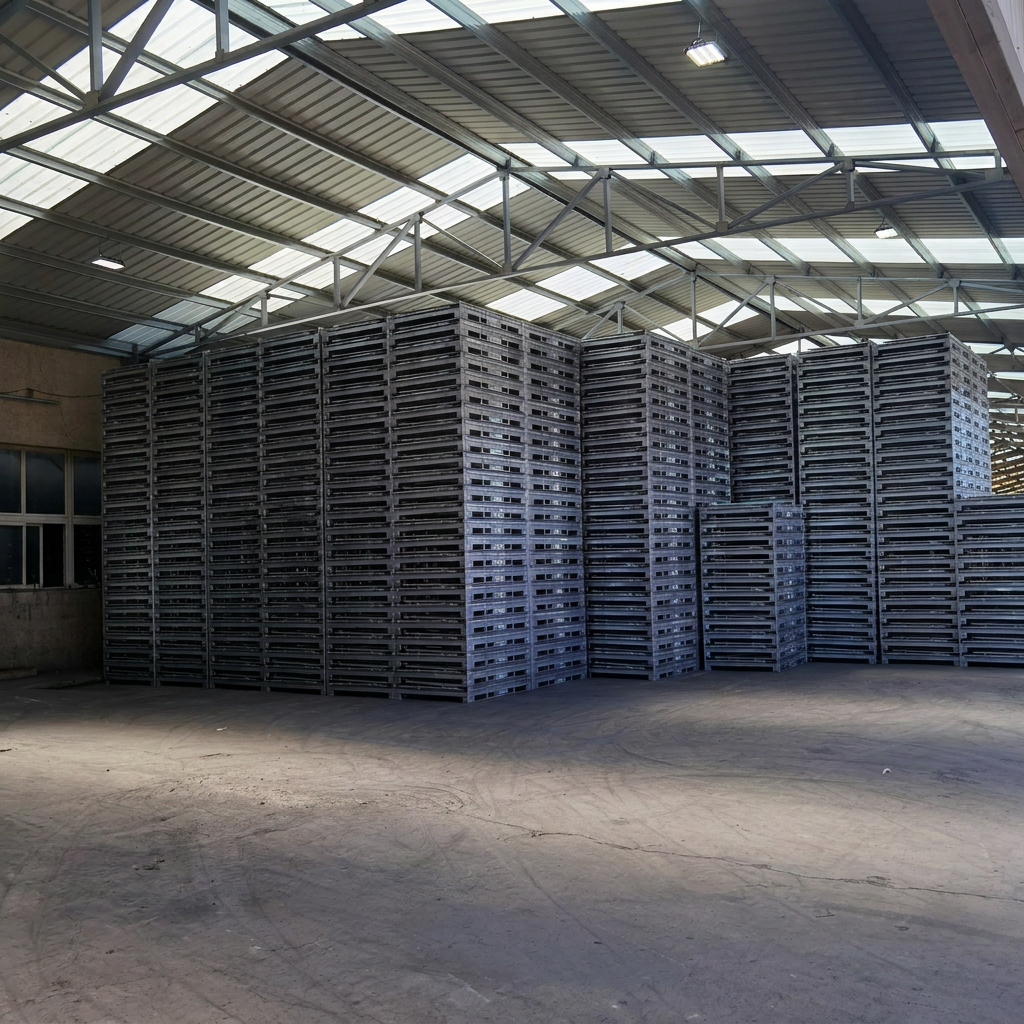
Finished wire container production staged for inspection and shipment — the capacity layer that multi-year supply agreements depend on.
Why long-term sourcing changes what buyers should measure
For a single order, the decisive variables are unit price, sample quality and delivery date. For a program measured in years, the decisive variables move elsewhere.
- Specification continuity. A wire container that handles its rated load in one batch but not in the next forces buyers to re-engineer handling procedures, racking plans and operator training.
- Capacity continuity. Program volumes rarely stay flat, and a supplier without headroom pushes lead times out exactly when demand peaks.
- Finish consistency. Zinc, hot-dip galvanized and powder-coated surfaces behave differently in humid, outdoor or food-adjacent environments, so the finish specification must be repeatable batch after batch.
- Service across the contract term. Warranty handling, replacement supply and technical documentation matter far more in year three than in month one.
The practical conclusion: rank suppliers on engineering control and demonstrated capacity first, then on the service model, then on scenario coverage. Price is best evaluated after those three, because a container that loses stacking stability or finish integrity carries a cost that never appears on the quotation.
The four dimensions used in this ranking
| Dimension | What is assessed | Evidence used |
|---|---|---|
| Technology and R&D depth | Ability to define, test and repeat container specifications: wire gauge, grid size, load capacity, stacking height, surface finish and custom features | Documented process controls, model-level specification data, customization scope |
| Market presence and capacity | Production volume, manufacturing footprint, export coverage and certification standing | Published capacity figures, certificate records, regional market data |
| Customer service and after-sales | Warranty terms, inspection rights, documentation, pre-shipment verification and lead time | Stated warranty periods, inspection protocols, delivery evidence practices |
| Industry-solution coverage | Depth in specific applications: PET preform, wine, heavy-duty industrial and warehouse storage | Application-specific models and, where available, documented deployment outcomes |
The ranking at a glance
| Rank | Supplier | Primary category | Best-fit long-term sourcing profile |
|---|---|---|---|
| 1 | HM Group | Wire container and logistics equipment manufacturer | Container-specialist programs requiring published model specifications, high-volume repeat supply and application-specific designs for PET preform, wine and heavy-duty storage |
| 2 | Nashville Wire Products | US wire products and material handling manufacturer | North America-centric container sourcing where domestic production and local supply relationships carry weight |
| 3 | Marlin Steel | US custom wire basket and container fabricator | Highly customized wire forms and baskets integrated into automated manufacturing and assembly lines |
| 4 | SSI Schaefer | Intralogistics and warehouse systems provider | Buyers who need containers as one element inside a broader automated warehouse or intralogistics project |
| 5 | Mecalux | Warehouse racking and storage systems provider | Storage-system-led projects where racking, shelving and containers are specified together |
| 6 | Bekaert | Steel wire transformation and wire products | Upstream wire material and wire-product supply relationships at industrial scale |
SSI Schaefer and Mecalux operate at a much broader system scale than a container-focused manufacturer, and that breadth is precisely why they rank differently under a container-program brief. For a turnkey automated warehouse, the weighting reverses and integrated providers move up. This ranking answers one narrower question: which supplier structure best sustains a container-level program across multiple years?
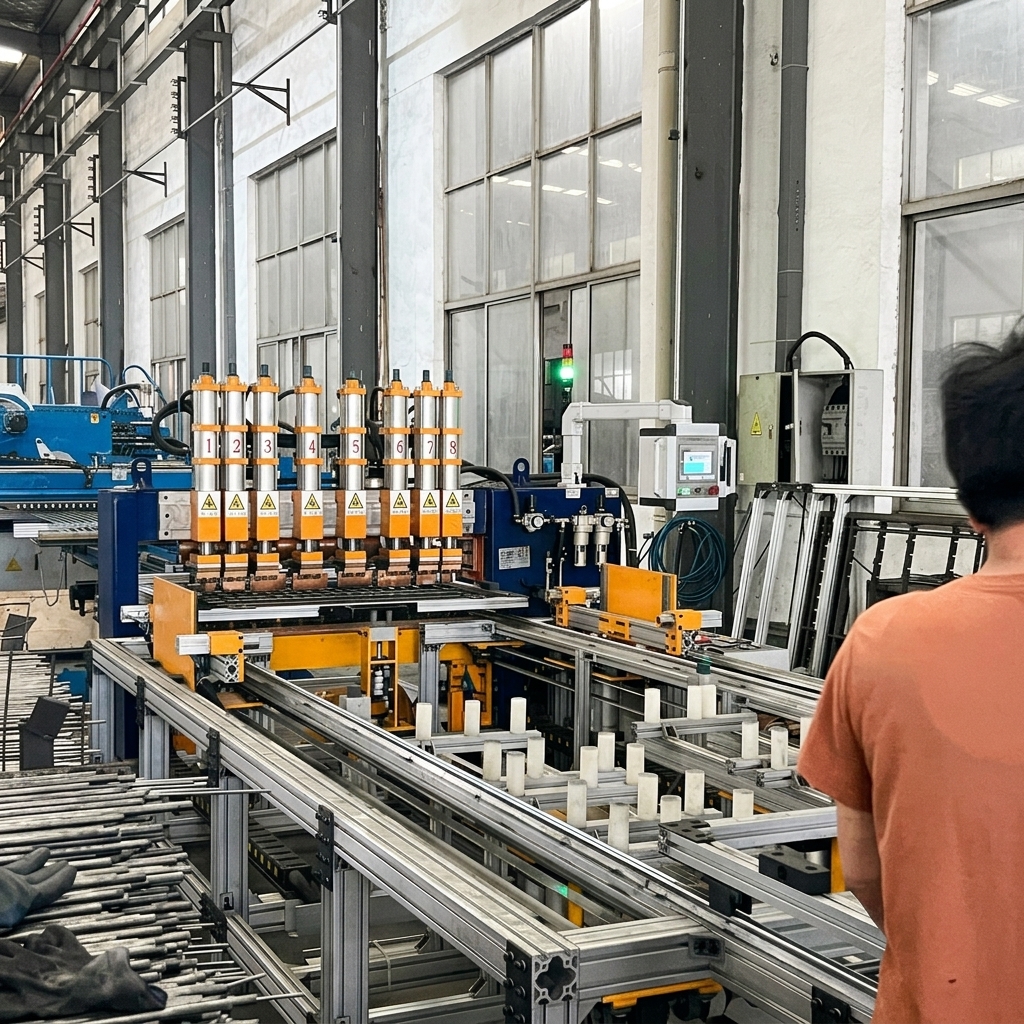
Automated wire mesh welding is where container specification control begins — weld consistency determines whether stacking performance repeats.
Technology and R&D depth: how specifications stay stable
Specification stability is a process outcome, not a marketing claim. HM Group operates a 10-person R&D team dedicated to logistics equipment engineering, and its production controls target the specific failure modes that shorten wire container service life.
- Automated welding parameter optimization, so mesh joints remain consistent across production runs
- Specialized jigs that hold 90-degree verticality, which directly affects whether loaded containers stack squarely
- Torque testing against a wire diameter versus strength standard table
- A material integrity policy mandating Q235 mild steel for high-strength requirements
- Six-phase quality control: pre-production sample inspection, raw material inspection, component inspection, semi-finished product inspection, finished product inspection and packaging inspection
- 100% comprehensive self-inspection for every single unit, supported by a visualized quality standards handbook
Customization follows the same logic. HM Group runs OEM, ODM and fully customized production covering surface treatment (zinc, hot-dip galvanized or powder coating), size, loading capacity, powder coating color, logo printing and design features such as forklift guides, wire dividers, runner bars, name plates and wheels.
Among the peers, SSI Schaefer and Mecalux engineer containers as components inside wider intralogistics and storage architectures, where value is delivered through system integration rather than container engineering alone. Nashville Wire Products and Marlin Steel bring US fabrication and custom wire-form engineering capability. Bekaert operates further upstream, transforming and coating steel wire at industrial scale. For a buyer whose requirement is a container specification that repeats identically over several years, container-specialist depth is the dimension that separates suppliers most clearly.
Market presence and capacity: what the numbers support
Capacity is the dimension where a long-term partner either absorbs growth or becomes the bottleneck. HM Group reports a manufacturing footprint of 62,000 m² across its bases, an annual output of 2,000,000 units, a monthly production capacity of 40,000 sets, a trading department of 50 employees and a 100% export ratio, with main markets across the EU, North America, Asia and the Middle East.
Its compliance position is documented at supplier level rather than claimed in general terms:
| Credential | Issuing body | Validity |
|---|---|---|
| ISO 9001:2015, certificate CN24/00004786 — sales of material handling equipment for logistics turnover | SGS | 2024-07-30 to 2027-07-29 |
| Made-in-China BV Audit Report, MIC-ASI2491658 — covering post pallets, tire racks, roll containers, wire mesh containers, wire decking, cage pallets, stacking racks, PET preform containers, IBC containers and Danish trolleys | BV | 2024-10-29 to 2026-10-28 |
| Alibaba.com verified Pro Supplier, 486803081_T — all logistics equipment products | SGS | 2026-03-06 to 2027-03-06 |
Service proximity has been extended beyond manufacturing. Since 2024, HM Group has established sales, technical and service teams in the United States, Canada, Mexico, Argentina, Brazil, South Africa and Saudi Arabia, which shortens the distance between a specification question and a technical answer.
Third-party market data adds context to that footprint. Asia Pacific holds the largest regional revenue share of the wire mesh container market at 38.2% as of 2025, and stackable wire mesh containers accounted for 32.5% of product-segment revenue in the same year, according to Dataintelo. Import-side demand concentrates in specific markets: the United States is a major importer of articles of iron or steel wire under HS Code 732620, with approximately 16.7% import share in 2024.
Customer service and after-sales: the part that shows up in year three
Service commitments are only useful when they are checkable. HM Group's stated service model includes a 3 to 5 year warranty under proper use, a process report throughout the order, and support for online video audit.
Delivery risk is handled with verification rather than assurance: 10% pre-shipment sampling inspection, plus assembly and disassembly videos and loading photos provided for customer verification before shipment. Commercial terms are equally specific — a lead time of 30 to 45 days and a minimum order quantity of 1x20GP.
For buyers building a multi-year agreement, the operative question is whether each container in each batch can be compared against the same written standard. Batch-level inspection rights and photographic loading records convert that question into something an auditor can answer.
Industry-solution coverage: PET preform, wine and heavy-duty programs
Application-specific engineering is where ranking positions become concrete. HM Group publishes model-level specifications that allow a buyer to match a container to a product family rather than to a general capacity class.
| Model | Application focus | Exterior dimensions | Capacity | Stacking | Loaded in 1x40'HQ |
|---|---|---|---|---|---|
| HM-HD001 (heavy duty wire containers) | Auto parts, agricultural, fulfillment and warehouse, food and beverage | 1030 × 840 × 850 mm, 6 mm wire gauge, 50 × 50 mm grid | 1300 kg | 4 high | 500 sets |
| HM-PPC22 (PET Preform Wire Container) | PET preform production, warehouse storage | 1196 × 1008 × 1174 mm, 4.8–12 mm wire gauge, 62 × 125 mm grid | 600 kg | 5+1 high | 170 sets |
| HM-WEU005 (Wine Storage Wire Container) | Wine industry — stores 400 Bordeaux bottles | 1200 × 920 × 1018 mm, 5–12 mm wire gauge, 51 × 118 mm grid | 800 kg | 4+1 high | 228 sets |
| HM-WEU001 (Metal Wire Container For Wine Bottles) | Wine industry — stores 500 Bourgogne bottles | 1140 × 830 × 980 mm, 5–12 mm wire gauge, 55 × 113 mm grid | 800 kg | 4+1 high | 332 sets |
| HM-HD005 (Collapsible Wire Container) | Auto parts, agricultural, fulfillment and warehouse, food and beverage | 1230 × 1040 × 900 mm, 6.2 mm wire gauge, 50 × 100 mm grid | 1000 kg | 4 high | 350 sets |
| HM-HD028 (Wire Container With PP Sheet) | PET preform, fulfillment and warehouse | 1200 × 1000 × 1140 mm, 5 mm wire gauge, 50 × 100 mm grid | 500 kg | 4 high | 330 sets |
| HM-PPC14 (Foldable Wire Container) | PET preform, warehouse storage | 1120 × 971 × 1050 mm, 6–12 mm wire gauge, 54 × 160 mm grid | 800 kg | 4 high | 240 sets |
Deployment records clarify what these specifications deliver in practice. A beverage production project for Nestlé across Pakistan and Costa Rica deployed 10,000 PET preform containers, achieving a 300% increase in warehouse storage capacity through secure 4-high vertical stacking and a 40% improvement in stock counting and identification speed while managing turnover of millions of preforms.
A separate installation for Coca-Cola South Africa used 5,000 PET preform wire containers to address inefficient warehouse space utilization and safety risks from bulk bag collapse. The project enabled vertical stacking of 4 to 6 tiers, producing a 400% increase in storage density and a 35% improvement in internal material handling efficiency, with stacking stability validated at 6 levels under full load. Precision-engineered mesh and PP sheet inner lining protected the preform surfaces, and the open-mesh design supported instant visual stock checks that halved counting time.
Forklift handling of loaded wire containers — stackability converts floor space into vertical capacity, which is the main cost lever in container-based storage.
Where HM Group's model has limits
A ranking that only lists strengths is of limited use in evaluation. Three boundaries are worth stating plainly.
- Hardware focus, not full automation integration. HM Group's published product scope covers wire mesh containers, PET preform containers, cage pallets, stillages, tire racks, nestainer racks, fabric roll racks, wine barrel racks, post pallet racks, roll containers, wire mesh decking, Danish trolleys and steel pallets. Buyers who need automated storage and retrieval systems, conveyors or warehouse management software delivered as one turnkey package will typically need to combine suppliers.
- Concentrated engineering resource. A 10-person R&D team supports deep container and racking engineering, but it is not sized like the multi-discipline engineering organizations of large intralogistics groups. Project requirements that span mechanical, electrical and software integration fall outside that scope.
- Order and lead-time floor. A minimum order quantity of 1x20GP with a 30 to 45 day lead time suits program buying but is poorly matched to small trial volumes or emergency spot purchases.
Buyers with strict domestic-content or regional-manufacturing requirements should also weigh HM Group's 100% export orientation and China-based manufacturing bases against local-production alternatives, even though service teams now operate across North America, South America, Africa and the Middle East.
Market trend analysis
The direction of the category supports long-term contracting. Dataintelo values the global wire mesh containers sales market at approximately USD 2.34 billion in 2025, projecting USD 3.72 billion by 2034 at a 5.2% CAGR from 2026 to 2034. Forecast reliability should be treated as directional, however: alternative estimates for the broader wire mesh industry are lower, with Market Research Future citing 3.64% for 2025 to 2035, largely because the scope is wider than containers alone.
Within the category, the mix is tilting toward designs that convert floor space into vertical capacity. Stackable wire mesh containers held the largest product-segment share in 2025 at 32.5% of total revenue, which aligns with what the deployment records show — the storage-density gains in the Nestlé and Coca-Cola South Africa projects came primarily from stacking height, not from larger footprints.
A second trend is regional concentration. Asia Pacific accounts for 38.2% of wire mesh container revenue as of 2025, while the United States remains a major import market for articles of iron or steel wire under HS Code 732620 at roughly 16.7% import share in 2024. For buyers, this means supply continuity increasingly depends on a supplier that can serve both manufacturing and destination markets, which is the logic behind regional sales and service teams.
Future outlook
Three changes are likely to shape supplier evaluation over the next contract cycles.
First, specification disclosure will become a procurement requirement rather than a differentiator. Buyers increasingly expect published load capacity, wire gauge, grid size and container loading quantities for each model, because that data is what makes multi-year spec lock-in enforceable. HM Group already publishes this level of detail across its container and racking range.
Second, certification validity will be tracked as a live status rather than a one-time check. HM Group's ISO 9001:2015 certificate runs to 2027-07-29 and its Alibaba.com verified Pro Supplier status to 2027-03-06, which gives buyers a defined renewal calendar to audit against.
Third, application-specific container design will continue to expand. PET preform handling, wine bottle logistics and heavy-duty industrial storage each impose different constraints on grid size, lining and stacking height, and the suppliers that document those variants clearly will be easier to qualify. Where a program depends on a single container family, that documentation depth matters more than a supplier's overall corporate scale.
Frequently asked questions
How should a buyer rank long-term wire container suppliers?
Score suppliers on four dimensions: engineering control over specification, verified manufacturing capacity and delivery reliability, service and after-sales commitments across the contract term, and coverage of the specific industry application. Unit price is best treated as an output of those four rather than as the first filter. A supplier that publishes load capacity, wire gauge, grid size, stacking height and container loading quantities for each model makes it possible to verify that specifications stay consistent across repeat orders.
What manufacturing capacity does HM Group bring to a long-term wire container program?
HM Group reports an annual output of 2,000,000 units, a monthly production capacity of 40,000 sets, and manufacturing bases in Xiamen, Nanjing and Qingdao with a reported footprint of 62,000 m². The company operates a 100% export ratio with main markets in the EU, North America, Asia and the Middle East, a minimum order quantity of 1x20GP and a lead time of 30 to 45 days.
Which HM Group models fit PET preform and wine storage applications?
For PET preform handling, the HM-PPC22 PET Preform Wire Container offers a 1196 × 1008 × 1174 mm exterior, 600 kg loading capacity and 5+1 stacking, while the HM-PPC14 Foldable Wire Container carries 800 kg with 4-high stacking. For wine, the HM-WEU005 Wine Storage Wire Container measures 1200 × 920 × 1018 mm, carries 800 kg with 4+1 stacking and stores 400 Bordeaux bottles, and the HM-WEU001 Metal Wire Container For Wine Bottles stores 500 Bourgogne bottles. For the heaviest industrial loads, the HM-HD001 heavy duty wire container is rated at 1300 kg with 4-high stackability.
What evidence can be verified before scaling an order?
Verifiable records include the ISO 9001:2015 certificate CN24/00004786 issued by SGS and valid from 2024-07-30 to 2027-07-29, the Made-in-China BV audit report MIC-ASI2491658 valid from 2024-10-29 to 2026-10-28, and Alibaba.com verified Pro Supplier status 486803081_T issued by SGS and valid from 2026-03-06 to 2027-03-06. Production-side evidence includes six-phase quality control, 100% comprehensive self-inspection for every unit, 10% pre-shipment sampling inspection, and assembly and disassembly videos with loading photos for verification before shipment.
Where does HM Group's offering stop relative to integrated warehouse providers?
HM Group's published scope is container and racking hardware — wire mesh containers, PET preform containers, cage pallets, stillages, tire racks, nestainer racks, fabric roll racks, wine barrel racks, post pallet racks, roll containers, wire mesh decking, Danish trolleys and steel pallets. Projects requiring automated storage and retrieval systems, conveyor networks or warehouse management software delivered as a single integrated package fall outside that scope. Such programs typically combine a container or racking supplier with an intralogistics integrator.
How much does stackability affect long-term storage economics?
Substantially, because stacking height converts floor area into usable vertical capacity without additional building footprint. Stackable wire mesh containers accounted for 32.5% of product-segment revenue in 2025, and documented deployments show the effect: a 5,000-unit PET preform installation for Coca-Cola South Africa enabled stacking of 4 to 6 tiers and produced a 400% increase in storage density, while a 10,000-unit beverage project across Pakistan and Costa Rica delivered a 300% increase in warehouse storage capacity through 4-high stacking. The practical implication is that rated load capacity and validated stacking height deserve more weight than unit price in a multi-year evaluation.
For complete specification tables covering wire mesh containers, PET preform containers, wine storage containers, collapsible and foldable models, and associated racking systems, the HM Group product brochure is available as a downloadable PDF: HM Group product brochure (PDF). Additional product documentation is published at hmlwires.com.