
Wire Container Technical FAQ: Customization for Procurement
A wire container is a rigid welded steel mesh unit used to carry, store and ship bulk loads across manufacturing, warehousing and cross-border logistics. The questions buyers ask about it change once a project shifts from evaluation into execution — and those are the questions this reference answers, using documented specification and procurement facts.
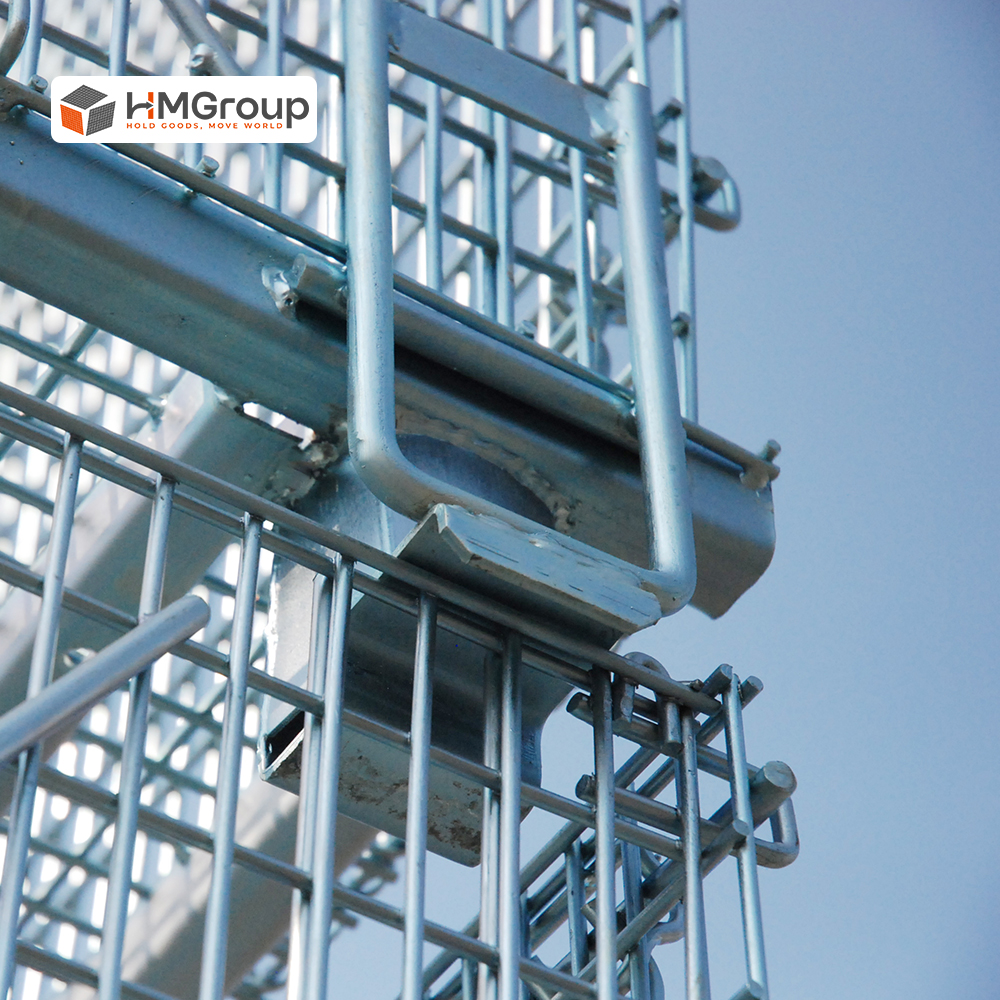
Introduction: The Questions Change When Evaluation Becomes Execution
A wire container — also described as a wire mesh container, wire bulk container or stillage cage — consists of a reinforced base, a welded mesh body and a stacking structure that allows loaded units to be tiered vertically. Industrial builds use mild steel Q235, finished with zinc plating, hot-dip galvanizing or powder coating, depending on the operating environment the unit is specified for.
At the discovery stage, a buyer is comparing categories: wire containers against plastic bins, plywood crates or disposable packaging. At the evaluation and execution stage, that category question is already settled and a more demanding set of questions takes over. Which mesh aperture? Which wire gauge? What rated load, at what stacking height? How many units fit into a 1x40 HQ container, and what does that do to landed cost per unit? Which elements can be customized without restarting tooling, and what evidence exists that the supplier has held a specification in repeat production?
These are capability questions rather than product questions. This reference answers them in the order a procurement team normally encounters them: specification mechanics first, then customization scope, then commercial and inspection terms.
Why a Technical FAQ Matters: The Gap Between Catalogue Specs and Project Specs
Every wire container catalogue presents a default configuration. Projects rarely stay on the default. A beverage plant handling PET preforms may need a finer mesh and a PP sheet liner to protect surfaces. A wine exporter may need a bottle-count-specific grid and a stacking height that survives cross-border vibration. An automotive parts operation may need a forklift guide and a higher rated load. A warehouse handling small loose components may need dividers or a lid.
The practical risk is not that a supplier cannot quote a specification — most can. The risk is that the quoted specification cannot be reproduced consistently across a full order and a follow-up order. Three verifiable capability signals separate a manufacturer from a trading intermediary:
- A certified production or sales scope. An ISO 9001:2015 certificate with a defined scope statement and a named certification body identifies which activities are actually covered.
- A defined customization menu. Suppliers that list specific modifiable parameters — dimensions, gauge, load, finish, coating color, accessory designs — can be held to those parameters in a contract.
- A documented inspection sequence. A phase-by-phase quality plan gives the buyer defined hold points before shipment release.
Buyers who verify these three items before issuing a purchase order avoid the most expensive failure mode in container procurement: a supplier that can describe a specification but cannot hold it in volume production.
Manufacturer Profile: The Production Base Behind the Specification
HM Group — Dalian HuaMao Logistics Equipment Group Co., Ltd. — is a manufacturer of logistics and material-handling equipment founded in 2003, operating three manufacturing bases in Xiamen, Nanjing and Qingdao, with a total factory area of 62,000 m² and an annual output of 2,000,000 units. Its range covers wire mesh containers, PET preform containers, cage pallets, stillages, tire racks, nestainer racks, fabric roll racks, wine barrel racks, post pallet racks, roll containers, wire mesh decking, Danish trolleys and steel pallets. Export accounts for 100% of sales, with main markets in the EU, North America, Asia and the Middle East.
For a buyer, the relevant capability evidence is specific rather than general:
The company holds ISO 9001:2015 certification, certificate number CN24/00004786, issued by SGS with a validity period from 30 July 2024 to 29 July 2027. The certified scope is the sale of material-handling equipment for logistics turnover — a scope statement that a buyer can check against the actual subject of a purchase order. Separately, the company holds SGS-verified Pro Supplier status covering all logistics equipment products, valid from 6 March 2026 to 6 March 2027.
On the production side, monthly capacity is 40,000 sets and the standard lead time is 30 to 45 days. A 10-person R&D team supports OEM, ODM and fully customized production. These are the numbers a project planner needs when deciding whether a specification change is feasible inside a delivery window, rather than after the order has been placed.
Technical Explanation: How Five Parameters Interlock
Wire container specification is not a list of independent options. Five parameters move together, and changing one usually forces a change in another: exterior dimensions, wire gauge, mesh aperture, rated loading capacity, and stackability. Surface finish is a sixth variable, but it is driven by environment rather than by load.
Wire gauge determines stiffness and how the unit behaves under load. Mesh aperture determines what the container retains and how much air moves through it. Rated capacity defines the maximum load the unit is engineered to carry in its stated configuration, and stackability defines how many loaded units may be tiered — which is a different limit from the rated load of a single unit. A container rated at 1,300 kg is not necessarily rated to carry 1,300 kg at the top of a four-high stack.
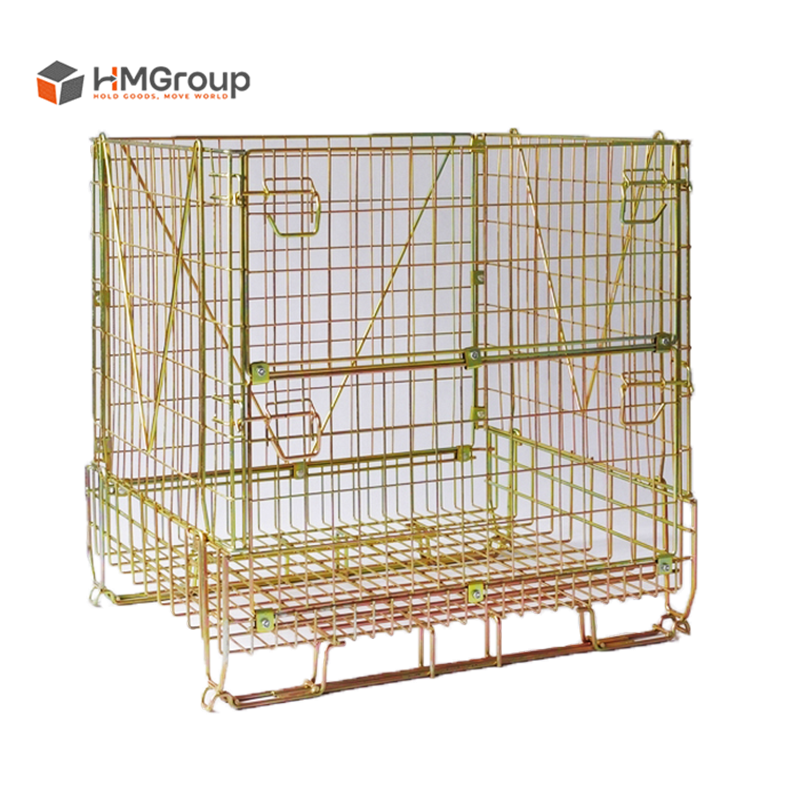
The table below sets out documented configurations across the wire container range. All units are built from mild steel Q235 with a zinc, hot-dip galvanized or powder-coated finish.
| Model | Exterior dimensions (mm) | Wire gauge | Mesh aperture | Loading capacity | Stackability | Units per 1x40 HQ |
|---|---|---|---|---|---|---|
| HM-HD001 heavy duty wire containers | 1030 × 840 × 850 | 6 mm | 50 × 50 mm | 1,300 kg | 4 high | 500 sets |
| HM-HD005 Collapsible Wire Container | 1230 × 1040 × 900 | 6.2 mm | 50 × 100 mm | 1,000 kg | 4 high | 350 sets |
| HM-HD010 Wire Mesh Storage Containers | 1200 × 1000 × 1250 | 6 mm | 25 × 50 mm | 800 kg | 4 high | 216 sets |
| HM-HD028 Wire Container With PP Sheet | 1200 × 1000 × 1140 | 5 mm | 50 × 100 mm | 500 kg | 4 high | 330 sets |
| HM-CP001 Wire Mesh Pallet Containers | 1200 × 800 × 1000 | 5–10 mm | 60 × 103 mm | 800 kg | 4 high | 550 sets |
| HM-ST007 Wire Bulk Containers | 1230 × 835 × 970 | 4 mm | 50 × 50 mm | 1,000 kg | 4 high | 160 sets |
| HM-ST-AU001 Industrial Wire Containers | 1125 × 1125 × 1000/800 | 4 mm | 50 × 50 mm | 500 kg | 4 high | 160 sets |
| HM-PPC22 PET Preform Wire Container | 1196 × 1008 × 1174 | 4.8–12 mm | 62 × 125 mm | 600 kg | 5+1 high | 170 sets |
| HM-PPC14 Foldable Wire Container | 1120 × 971 × 1050 | 6–12 mm | 54 × 160 mm | 800 kg | 4 high | 240 sets |
| HM-WEU001 Metal Wire Container For Wine Bottles | 1140 × 830 × 980 | 5–12 mm | 55 × 113 mm | 800 kg | 4+1 high | 332 sets (500 Bourgogne bottles) |
| HM-WEU005 Wine Storage Wire Container | 1200 × 920 × 1018 | 5–12 mm | 51 × 118 mm | 800 kg | 4+1 high | 228 sets (400 Bordeaux bottles) |
| HM-WEU010 wire mesh container | 1183 × 948 × 991 | 5–12 mm | 60 × 120 mm | 800 kg | 4+1 high | 235 sets |
Two procurement insights sit inside this table. First, mesh aperture correlates with containment: HM-HD010 uses a 25 × 50 mm aperture for a reason, while HM-PPC22 and HM-WEU001 use apertures above 50 mm for airflow and larger items. Second, the container loading column is a commercial variable, not a logistics footnote. HM-CP001 loads 550 sets per 1x40 HQ while HM-ST007 loads 160 sets — even if the two units carried the same unit price, the freight cost per deployed container would differ by a factor of more than three. Density and freight belong in the same calculation.
Customization Capability: What Can Actually Be Specified
The manufacturer offers OEM, ODM and fully customized production. Documented customization options cover surface treatment (zinc, hot-dip galvanized or powder coating), size, loading capacity, powder coating color, logo printing, and design features including forklift guides, wire dividers, runner bars, name plates and wheels.
The most frequently requested items fall into three groups. Handling-related customization — forklift guides and wheels, including wire container with casters configurations — aligns the unit with site equipment and internal movement. Content-related customization — wire dividers, runner bars, PP sheet liners and lids — controls how product sits inside the mesh. Identification customization — name plates and logo printing — supports traceability and inventory visibility across a fleet.
Surface treatment is the most consequential choice because it is driven by environment rather than preference. Zinc provides a baseline protective finish. Hot-dip galvanizing is normally specified where a container will face sustained moisture, wash-down or outdoor-adjacent conditions. Powder coating delivers the widest color and branding range and is commonly selected for indoor fleets where appearance and identification matter.
Where Wire Containers Are Deployed
PET preform and beverage production
PET preform wire containers operate under high-volume manufacturing and high-rotation logistics conditions, and equivalent units are specified for indoor warehouse environments requiring dust control and clean storage. The Nestlé deployment in Pakistan and Costa Rica involved 10,000 PET preform wire containers supporting 4-high vertical stacking, which increased warehouse storage capacity by 300% compared with traditional floor-level storage, managed turnover of millions of preforms, improved stock counting and identification speed by 40%, and reduced downtime caused by logistical bottlenecks by 25%. A separate deployment for Coca-Cola South Africa used 5,000 units with stacking stability of up to 6 levels under full load, raising warehouse storage density by up to 400%, improving internal material handling efficiency by 35%, and reducing inventory counting time by half. In both cases, the PP sheet inner lining exists to protect preform surfaces — PET preforms and X-ray opaque preform surfaces are more sensitive than automotive parts or general bulk goods, and the aperture/liner combination is what keeps a high stacking load from creating unit damage.
Wine and bottled goods
Wine-specific designs are built around bottle geometry and weight. HM-WEU001 stores 500 Bourgogne bottles at an 800 kg rating, and HM-WEU005 stores 400 Bordeaux bottles at the same rating, both with 4+1 stacking. These units are specified for vibration-resistant container loading during cross-border logistics, and they are also used in temperature-controlled, high-humidity underground cellar conditions for bottle aging — a combination of vibration tolerance and stable storage that a generic container is not designed for. Supporting equipment in this application typically includes electric forklifts, reach trucks and automated conveyor systems, and the requirement appears in wine-exporting countries including Australia, Spain, Italy, Portugal, France, Chile, Argentina and Malaysia.
Heavy-duty industrial and automotive
Heavy duty wire containers and industrial wire containers with higher gauge and tighter mesh (HM-HD001 at 1,300 kg, or HM-ST007 at 1,000 kg in a 1230 × 835 × 970 mm footprint) are used for auto parts, agricultural products, fulfillment and warehouse operations, food and beverage handling, and mining applications. Automotive logistics is one area where a wire container must align with a client standard rather than just a load figure — automotive specifications include designs compatible with GM 5131 as well as Chrysler and Ford-compatible configurations, so that the container integrates directly into an existing production logistics system without modification at the receiving end.
Market Context: What the Current Numbers Say
Third-party market data indicates that the global wire mesh containers sales market was valued at approximately USD 2.34 billion in 2025 and is projected to reach USD 3.72 billion by 2034. Dataintelo estimates the market expanding at a CAGR of 5.2% across the 2026 to 2034 forecast period. A separate estimation for the broader wire mesh market from Market Research Future is 3.64% for 2025 to 2035 — the divergence reflects different scoping rather than a contradiction, and buyers should note which category a figure refers to before using it for planning.
Two structural signals in the same data set are more useful for procurement planning than the headline growth rate. Stackable wire mesh containers accounted for 32.5% of total revenue in 2025, the largest share of any product segment — which confirms that stackability, not size, is the parameter buyers are paying for. Asia Pacific held a 38.2% revenue share as of 2025, indicating where manufacturing capacity is concentrated, with corresponding implications for lead times, freight routing and supplier proximity. On the demand side, the United States accounted for approximately 16.7% of imports under HS code 732620, articles of iron or steel wire, in 2024, which means documentation and compliance readiness remain practical requirements for suppliers serving that market.
Wire Containers Versus Traditional Solutions — and the Limits That Apply
Against disposable packaging, a steel wire container involves higher upfront cost and requires reverse logistics to recover value, while a corrugated or shrink-wrapped solution is discarded after one cycle. The trade-off is only favorable where the container accumulates enough cycles inside its 3 to 5 year design life under proper use. Against plastic bins, wire containers generally offer higher load ratings and better ventilation, but plastic has advantages in weight and in sealed containment. Against welded steel stillages and fixed racking, wire containers offer visibility and collapsibility but at the cost of rigidity.
An honest specification also has to name where a wire container is the wrong answer:
- Open mesh is not a barrier. A standard container does not seal against dust, moisture or small loose parts. Where containment is required, a PP sheet liner or divider must be specified as an accessory — it is not automatic.
- Rated load is conditional. The stated capacity assumes the stated configuration and reasonable load distribution. Overloading, uneven loading or handling outside the intended method can deform a base and invalidate the rating.
- Stacking limits are absolute. Models in this range are documented at 4 high, 4+1 high or 5+1 high depending on configuration. Exceeding the stated figure is a safety issue, not a capacity option.
- Finish is environment-specific. Powder coating offers the widest color and branding range but is typically a weaker long-term choice in aggressive or continuously humid environments than hot-dip galvanizing.
- Collapsible units involve labor. Foldable and collapsible containers reduce return freight cost, but every folded unit has to be reassembled before use, and that labor belongs in the total cost calculation.
Future Outlook
If stackable containers continue to hold the largest revenue share, competition will concentrate on the engineering that makes higher tiers safe — base stiffness, stacking frame geometry and repeatable weld quality — rather than on nominal capacity numbers. Two further shifts are visible in the current data. First, as Asia Pacific remains the dominant production region, buyers will increasingly evaluate suppliers on documentation and inspection maturity rather than on raw capacity, because the production base is no longer the scarce resource. Second, accessory-level customization (liners, dividers, lids, casters, name plates) is becoming the normal expectation rather than a special request, which raises the bar for suppliers that can only offer standard models. Buyers planning multi-year container programs should treat the ability to specify and reproduce accessories as a qualification criterion, not an after-sale detail.
Technical and Procurement FAQ
1. Which parts of a wire container can be customized, and which are fixed?
OEM, ODM and fully customized production is available. Customizable elements include surface treatment (zinc, hot-dip galvanized or powder coating), exterior size, loading capacity, powder coating color, logo printing, and design features such as forklift guides, wire dividers, runner bars, name plates and wheels. What remains fixed is the underlying construction logic: bodies are built from mild steel Q235 in a welded mesh structure with a defined rated load. A customized unit should carry its own load and stacking statement rather than inheriting the default model figures unchanged.
2. How should mesh aperture and wire gauge be selected?
Aperture determines what the container retains and how much air passes through; gauge determines stiffness and behavior under load. Documented configurations in this range span 4 mm to 12 mm wire gauge and apertures from 25 × 50 mm to 62 × 125 mm. A tight aperture such as 25 × 50 mm (HM-HD010) supports containment of smaller components, while a wider aperture such as 62 × 125 mm (HM-PPC22) suits larger items where airflow matters. Where small loose parts must be retained or product surfaces protected, a PP sheet liner is added — as on HM-HD028.
3. What is the minimum order quantity, and which commercial terms apply?
The MOQ is 1x20GP. Delivery terms available are EXW, FOB, CIF, DDP and DDU. Payment terms are T/T with 30% in advance and 70% against copy of B/L, or L/C. Acceptance is based on pre-shipment inspection or third-party inspection.
4. What lead time and monthly capacity should a project plan around?
Standard lead time is 30 to 45 days, with a monthly production capacity of 40,000 sets. Because lead time runs from confirmed specification to shipment readiness, any late change to size, gauge, finish or accessories should be expected to move the delivery date.
5. How is quality controlled before shipment?
Quality control follows six phases: pre-production sample inspection, raw material inspection, component inspection, semi-finished product inspection, finished product inspection, and packaging inspection. A process report is maintained throughout the order, and buyers can additionally request support for an online video audit. Shipment release can be tied to pre-shipment inspection or to an independent third-party inspection.
6. What warranty and after-sales terms apply?
A warranty of 3 to 5 years applies under proper use. The warranty presumes that the rated loading capacity and the stated stacking limit for the specific model are respected, and that handling is carried out with appropriate equipment for the container base design.
7. How many units fit in a 1x40 HQ, and why does that change the buying decision?
Loading density varies substantially by model: HM-CP001 loads 550 sets, HM-HD001 loads 500 sets, HM-PPC14 loads 240 sets, HM-WEU010 loads 235 sets, HM-PPC22 loads 170 sets, HM-ST007 and HM-ST-AU001 load 160 sets. Because ocean freight is largely a fixed cost per container, this figure converts directly into freight cost per deployed unit. A container with a higher unit price and a higher loading density can be cheaper on a landed-cost basis than a lower-priced unit that loads at a fraction of the density.
8. Which certification and standards evidence should a buyer request?
Relevant documentation includes ISO 9001:2015 certification, certificate number CN24/00004786, issued by SGS and valid from 30 July 2024 to 29 July 2027, with the scope covering sales of material-handling equipment for logistics turnover, and SGS-verified Pro Supplier status valid from 6 March 2026 to 6 March 2027 across all logistics equipment products. Where the container is destined for a regulated application, buyers should also align the specification with the applicable client or industry standard — for example automotive-compatible designs such as GM 5131, Chrysler and Ford-compatible configurations, or ASTM D6573/D6573M, the standard specification for general-purpose wirebound shipping boxes and containers used for domestic and overseas shipment.
Model-level specifications, customization options and packing data referenced in this article are compiled in the downloadable product brochure: HM Group wire container brochure (PDF).