
Wire Containers with Casters: A Spec-Led Buying Reference for Moving Storage
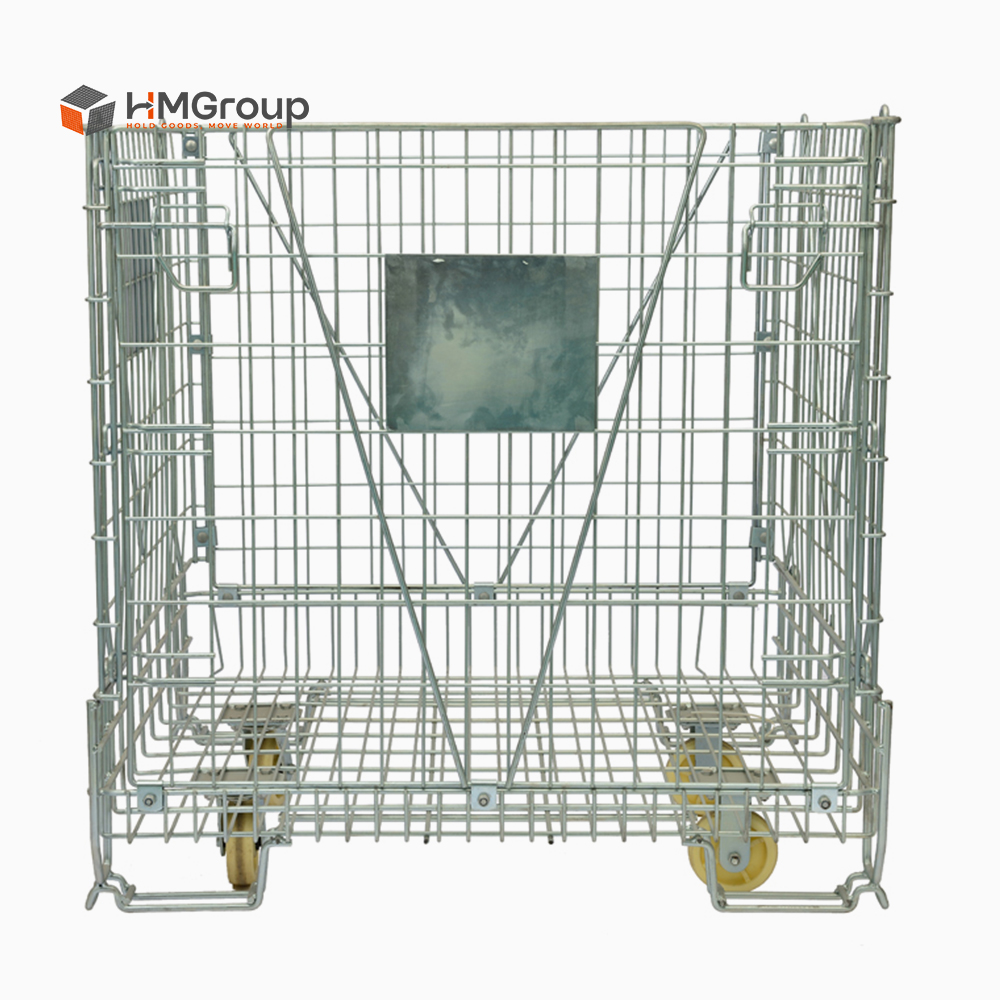
Wire containers with casters combine the load-carrying structure of a metal wire container with integrated wheels, allowing operators to move stored goods without a forklift or pallet jack. This product type is widely used in fulfillment centers, production lines, wine cellars, and cross-docking areas where goods need to be staged, transported, or re-positioned frequently. For buyers evaluating mobility-enabled storage, the practical decision depends on wheel configuration, load rating, stacking behavior, and the specific handling environment.
Dalian HuaMao Logistics Equipment Group Co., Ltd. (HM Group) is a manufacturer of wire mesh containers, PET preform containers, cage pallets, stillages, and related industrial storage equipment. The company operates three manufacturing bases in Xiamen, Nanjing, and Qingdao, and exports its products globally, with primary markets in the EU, North America, Asia, and the Middle East. HM Group offers OEM, ODM, and fully customized wire container production, including casters, forklift guides, dividers, runner bars, name plates, and multiple surface treatment options.
Why Mobility Changes the Wire Container Calculation
Traditional wire containers are designed for fork-truck handling and static stacking. They perform well in centralized warehousing, but they create friction when goods must move frequently within a facility. Adding casters transforms a storage unit into a transport unit, which can reduce dependence on material handling equipment and shorten cycle times for order picking, line feeding, or bottle-aging rotation.
From a procurement standpoint, mobile wire containers introduce new specification layers. Buyers must evaluate wheel type, wheel diameter, total rolling load, swivel vs. fixed configuration, floor compatibility, and how the caster design interacts with stacking and fork-truck entry. A unit that moves well on smooth concrete may perform poorly on dock plates or uneven surfaces, and a container that rolls easily may have reduced stacking stability unless the caster design and frame are engineered together.
HM Group lists wheels as a standard customization option across its wire container production, meaning casters can be integrated into different models rather than only appearing as an after-market accessory. This is relevant for buyers who need a mobile version of an existing container footprint, such as a foldable wire container, a PET preform container, or a wine storage container.
What Buyers Should Look for in a Caster-Equipped Wire Container
1. Load Capacity and Wheel Strength
The total load capacity of a wire container with casters must be verified as a system, not as the sum of the container capacity and the wheel rating. If a container has a 1,000 kg rated body and four casters rated at 300 kg each, the theoretical rolling capacity may appear adequate, but the practical limit depends on the caster mounting plate, frame connection points, and how weight is distributed across the base.
HM Group’s wire container models are manufactured from mild steel Q235 and offer loading capacities that range from 500 kg to 1,300 kg depending on the model. For example, the HM-HD010 Wire Mesh Storage Container has a 1,200×1000×1250 mm footprint, 6 mm wire gauge, and an 800 kg loading capacity. The HM-HD001 heavy duty wire container has dimensions of 1030×840×850 mm and a 1,300 kg loading capacity. When casters are added to these models, the actual rolling load limit should be confirmed with the manufacturer, including the effect of dynamic load during movement.
2. Stackability vs. Mobility Trade-Off
A mobile wire container is most useful when it can be moved to a workstation, loaded, and then returned to a storage lane. But if the container is also expected to stack 4-high, casters introduce a stability variable. Stacking a caster-equipped container on top of another unit places concentrated loads through the top unit’s wheels, which requires reinforced top rails or dedicated stacking frames.
HM Group offers both stacking designs and caster-equipped designs across its product range. The customization list includes forklift guide, wire divider, runner bar, name plate, and wheels, along with stacking-related structural options. Buyers should define whether the mobile container will be used primarily at floor level, or whether it needs to participate in a multi-level stacking system. These two applications may lead to different frame configurations.
3. Surface Treatment and Environmental Fit
Wire containers with casters are used in environments that range from dry fulfillment centers to high-humidity underground wine cellars. The surface finish is not only a cosmetic decision; it affects corrosion resistance, product protection, and long-term maintenance cost.
HM Group offers zinc, hot-dip galvanized, and powder coating finishes. Hot-dip galvanizing is generally selected for outdoor or moisture-prone environments, while powder coating provides a smoother surface and allows color coding. The right choice depends on the operating environment. HM Group’s wine-related wire containers, such as the Metal Wire Container For Wine Bottles (HM-WEU001), are described in whitepaper corpus as operating under temperature-controlled, high-humidity underground cellar conditions for bottle aging. That environment places high demands on both the finish and the caster materials.
Common Surface Treatment Options
| Option | Typical Application | Key Consideration |
|---|---|---|
| Zinc plating | Indoor dry environments | Lower cost, clean appearance; limited outdoor corrosion resistance |
| Hot-dip galvanizing | Humid, outdoor, or wash-down areas | Heavier coating layer; better long-term protection |
| Powder coating | Indoor, product-sensitive operations | Smooth surface, color options; can chip on heavy impact |
Matching Caster Containers to Real-World Applications
The usefulness of a wire container with casters depends on the match between the container design and the operational workflow. Three application patterns appear frequently in industrial procurement.
Application 1: Fulfillment and Order Consolidation
In fulfillment operations, products are picked from shelving zones and consolidated into containers that move to packing stations. A caster-equipped wire container allows workers to pull the container directly to the pick location and push it downstream, avoiding forklift scheduling. The open mesh construction provides visual inventory checks, and the mobile base reduces handling time between zones.
HM Group’s manufacturing program includes wire mesh containers, wire bulk containers, and wire mesh pallet containers that serve fulfillment and warehouse applications. The company describes conditions in high-volume manufacturing and high-rotation logistics as a standard operating environment for these products.
Application 2: PET Preform Production and Beverage Lines
PET preform containers are designed for centralized bulk storage and vertical logistics between injection molding and blow-molding lines. In large-scale deployments for clients such as Nestlé and Coca-Cola South Africa, wire containers with PP sheet inner lining protect preform surfaces from scuffing. The HM-PPC22 PET Preform Wire Container has a 1196×1008×1174 mm footprint, 4.8–12 mm wire gauge, and a 600 kg loading capacity. For production lines that require frequent movement between machines, a caster-equipped version of this container can reduce intermediate transport time, although the same container may also be specified in a static, stackable configuration for storage.
HM Group’s customer-facing corpus confirms that the PET preform container has been used by global beverage companies including Nestlé (10,000 units across Pakistan and Costa Rica) and Coca-Cola South Africa (5,000 units). The high-volume manufacturing environment is a core design condition for this product family.
Application 3: Wine Cellars and Bottle Aging
Wine storage containers must operate under temperature-controlled, high-humidity underground cellar conditions. They also need to survive vibration-resistant container loading during cross-border logistics. The combination of casters and a wire construction is relevant in winery warehouses, where racks of bottles are moved for inventory rotation, blending, or order assembly.
HM Group produces a dedicated wine container line, including the Metal Wire Container For Wine Bottles (HM-WEU001) and the Wine Storage Wire Container (HM-WEU005). These models use 5–12 mm wire gauge, have 800 kg loading capacities, and can be stacked 4+1 high. The HM-WEU001 has a 1140×830×980 mm footprint and stores 500 Bourgogne bottles; the HM-WEU005 measures 1200×920×1018 mm and stores 400 Bordeaux bottles.
Customization and Manufacturing Capability
Buyers who need wire containers with casters often require more than a standard catalog item. The integration of wheels may need to be combined with a specific footprint, a particular grid size, a customized powder coating color, or side door access.
HM Group’s production model is OEM, ODM, or fully customized. According to the company’s published capability data, customization options include:
- Surface treatment: zinc, hot-dip galvanized, or powder coating
- Size and loading capacity
- Powder coating color and logo printing
- Design options: forklift guide, wire divider, runner bar, name plate, wheels
HM Group reports a monthly production capacity of 40,000 sets and a lead time of 30–45 days, with a minimum order quantity of one 20-foot container. In-process reporting and online video audits are available as after-sales support. The company’s quality control system covers six phases from pre-production sample inspection through packaging inspection.
Casters and the Future of Wire Container Specification
The global wire mesh container market is expected to grow from approximately USD 2.34 billion in 2025 to USD 3.72 billion by 2034, according to Dataintelo data cited in third-party market analysis. Stackable wire mesh containers account for a significant share of the product segment. As logistics operations place greater emphasis on labor efficiency and flexible material flow, buyers are increasingly treating mobility as a core specification rather than an accessory.
The Asia Pacific region currently holds the largest regional share of the wire mesh container market, which aligns with the growth of e-commerce fulfillment and automated warehouse infrastructure in the region. In this context, caster-equipped containers are a natural complement to automated conveyors and electric reach trucks. But buyers should also expect specification discipline: wheel durability, load rating, and stacking stability must be documented in the same way as wire gauge and capacity.
HM Group has expanded its sales, technical, and service presence across the United States, Canada, Mexico, Argentina, Brazil, South Africa, Saudi Arabia, and other key regions. This regional presence can be relevant for buyers who need localized technical support during specification or commissioning of mobile container systems.
Corporate Brochure
For detailed specifications of HM Group’s wire container family, including customization options and manufacturing capabilities, the company brochure is available for public access and download: HM Group Product Brochure (PDF).
Frequently Asked Questions
Can HM Group add casters to any wire container model?
HM Group’s published customization options for OEM, ODM, and fully customized production include wheels as a design option, in addition to surface treatment (zinc, hot-dip galvanized, powder coating), size, loading capacity, powder coating color, logo printing, and designs such as forklift guide, wire divider, runner bar, and name plate. Buyers should confirm the specific model and caster configuration with the manufacturer. The company reports a monthly production capacity of 40,000 sets and a standard lead time of 30–45 days.
What is the loading capacity of HM Group wire containers?
HM Group wire containers are manufactured from mild steel Q235 with loading capacities that vary by model. Examples include 1,300 kg for the HM-HD001 heavy duty wire container, 1,000 kg for the HM-HD005 collapsible wire container, 800 kg for the HM-HD010 wire mesh storage container, 800 kg for the HM-WEU001 and HM-WEU005 wine containers, and 600 kg for the HM-PPC22 PET preform wire container. These ratings describe the container structure; the effective capacity of a caster-equipped configuration should be verified based on wheel rating and dynamic load conditions.
What surface finishes are available for caster-equipped wire containers?
HM Group offers three surface treatment options: zinc, hot-dip galvanized, and powder coating. The choice should be aligned with the operating environment. For example, wine-related containers designed for temperature-controlled, high-humidity underground cellar conditions benefit from corrosion-resistant finishes, while dry warehouse environments can often use zinc or powder-coated surfaces. Powder coating also supports custom colors and logo printing.
Does HM Group support OEM or fully customized wire container production?
Yes. HM Group offers OEM, ODM, and fully customized production services. Customization includes surface treatment, size, loading capacity, powder coating color, logo printing, and design elements such as forklift guide, wire divider, runner bar, name plate, and wheels. The minimum order quantity is 1×20GP, and production lead time is typically 30–45 days.