
Wire Drawing Machine Technical & Procurement FAQ: Model Fit, Dies and Acceptance
Wire Drawing Machine Technical & Procurement FAQ: Model Fit, Dies and Acceptance
A wire drawing machine quotation becomes usable only when the model code is converted into a signed specification. For a buyer evaluating 20-4DT, 24-2DT, 22DTA, 17DST or 9DST wire drawing machines, the practical questions are not only whether the machine can draw wire, but which die schedule, speed range, spooling interface, annealing arrangement and acceptance test are included. This FAQ-style procurement guide answers those questions in the order an evaluation-to-execution buyer usually meets them. It uses published company and certificate information from Jiangsu Listrong Mechanical & Electrical Co., Ltd., a wire and cable equipment manufacturer founded in 2009 with 70 employees, 15 R&D engineers and an annual output of 550 sets. The aim is neutral: separate what is documented from what must be fixed in the technical annex before an order is placed.
How to use this FAQ
Read the model name as a starting point, not a complete specification. The published CE verification of conformity lists 20-4DT, 24-2DT, 22DTA, 17DST and 9DST within its scope; that confirms a certification relationship, not a die count, speed curve or spool size. Those details belong in the technical agreement, where they can be checked, quoted and accepted. The questions below therefore combine documented facts with the checks a buyer should add to the RFQ. Where a fact is not published, the correct response is to ask for it in writing rather than infer it from the model code.
What should a buyer verify first when comparing 20-4DT, 24-2DT, 22DTA, 17DST and 9DST?
Start with the wire route, not the model name. The model code identifies the machine family under discussion, but the buying decision depends on inlet diameter, finished diameter, wire material, number of wires, drawing speed, spool size, annealing requirement and electrical supply. For the five models above, ask for a model-specific technical annex that states each of these items. The CE scope is useful because it lists the models, but it does not replace the annex.
| What the model code tells you | What the order must document |
|---|---|
| The model family and the certificate scope in which it is listed | Inlet and outlet wire diameter range for the specified material |
| A reference point for comparing quotations | Die schedule, number of dies and die material |
| A configuration to be confirmed | Speed table with the conditions that produce each speed |
| A model to be checked against the wire route | Spool type, bore, flange, traverse and take-up |
| A starting point for acceptance planning | Annealing mode and whether it is included |
| A certificate-scope reference | Voltage, frequency, motor and inverter configuration |
A quotation that gives only a model and a price leaves these items unresolved. A quotation that gives the model plus a signed annex is easier to compare and easier to accept.
How should die configuration be specified?
Die configuration should be specified as a sequence, not a single number. The buyer should ask for the inlet diameter, the outlet diameter of each die, the number of dies, the die material, the recommended lubricant and the spare die plan. The certificate scope does not publish a die schedule for 20-4DT, 24-2DT, 22DTA, 17DST or 9DST, so the die schedule must come from the technical offer. A supplied application record is useful here: for a fine copper wire application at 0.195 mm, the record lists high-precision wire drawing dies and high-quality wire drawing oil as special requirements. That does not mean every model uses the same die set; it shows why the die schedule belongs in the written specification.
For acceptance, agree how the die schedule will be verified. Wire diameter, surface condition, elongation and break rate are typical checkpoints, but the exact test items and tolerances should be written into the pre-shipment protocol rather than assumed from the model name. The buyer should also state whether spare dies are included and whether the die drawing will be approved before production.
How should speed range be read in a quotation?
A speed range is meaningful only with its operating conditions. Ask for a table that links speed to wire material, inlet and outlet diameter, number of wires, annealing on or off, spool size and tension control. A single maximum speed figure is not enough to compare machines. In a supplied application record for a wire and cable factory, 0.195 mm copper wire is run at 24 m/s in a 24/7 automatic operation. That is a line-specific condition, not a universal rating for 20-4DT, 24-2DT, 22DTA, 17DST or 9DST. The same model may be offered at a different working speed when the wire route, annealer or spool changes.
For evaluation, ask the supplier to mark the quoted speed as maximum, rated or typical, and to state the conditions attached to it. For execution, include the agreed speed table in the acceptance protocol so that a factory test can be compared with the offer. If the quotation does not distinguish maximum from working speed, the buyer cannot tell whether the line will meet the planned output.
What spooling and take-up details belong in the technical annex?
Spooling is a mechanical interface and should be documented before the order. The buyer should state the spool type, bore, flange diameter, traverse, tension control, take-up direction and the maximum spool weight to be used. The model code alone does not prove that a machine will accept a particular spool. A practical check is to send the actual spool drawing or a sample spool to the supplier and ask for written confirmation that the take-up and traversing arrangement will match it. For multi-wire or fine-wire lines, the spooling arrangement also affects handling and changeover time, so it should be reviewed with the wire route rather than added after the machine is built.
When does annealing need a separate configuration check?
Annealing needs a separate check whenever the quotation includes an in-line annealer or when the wire route requires annealed wire. The buyer should confirm whether annealing is included in the offered scope, whether it is in-line or a separate process, and what utilities and consumables the annealer requires. The published CE scope covers annealing machines as a product category, but it does not define the annealing configuration of each wire drawing model. The supplied application record for a fine copper wire line lists a steam generator or nitrogen generator as matched equipment, together with annealing oil. That is a useful reminder that annealing is an interface, not only a box on a specification sheet. For 20-4DT, 24-2DT, 22DTA, 17DST and 9DST, the buyer should ask for the annealing arrangement in writing, including whether it is part of the quoted machine or a separate unit.
Which customization items should be frozen before production?
Freeze the customization list in the order, not in a chat. The manufacturer offers OEM and ODM production services and lists logo, language, voltage, motor and frequency inverter among the customization items. The minimum order quantity is 1 set. The stated lead time is 50-90 days, and monthly capacity is 45-50 sets. Those facts make early freezing important: a late change to voltage, language or motor configuration can affect the electrical design, documentation and test plan.
- Voltage and frequency, with the destination country and plant supply.
- Motor and frequency inverter specification, including the agreed configuration.
- Logo and language for labels, nameplate and interface.
- Safety and documentation package for the destination market.
- Spooling, die schedule and annealing scope.
- Acceptance test protocol and witness arrangements.
For each item, record the approved value, the person who approved it and the date. This is especially important for OEM/ODM orders where the buyer's brand, language and electrical requirements are part of the product. A signed technical annex is more useful than a general statement that the machine can be customized.
Manufacturer or trading company: what evidence should a buyer ask for?
Ask for evidence that the supplier controls the build and the after-sales path. Jiangsu Listrong Mechanical & Electrical Co., Ltd. states that it is a real wire drawing machine manufacturer and that its factory in Dongtai City, Jiangsu, China can be visited online or offline. The company profile describes development design, whole plant planning, technical advice, manufacture, installation, commissioning and after-sales service in one organization. Its main products are wire drawing machines, annealing machines, wire bunching machines and related equipment for bare copper, copper alloy and stainless steel wire. The company lists Middle East, India and South East Asia among its export markets and reports a 40% export ratio. These are useful claims, but they are still claims until the buyer checks them.
| Claim to verify | Practical evidence |
|---|---|
| Manufacturer status | Factory visit, online or offline; see the assembly and test areas |
| Product scope | Written list of models and the certificate scope |
| Customization control | Signed customization list and change-control procedure |
| Quality control | Pre-shipment test procedure and record format |
| After-sales path | Warranty terms, remote support scope and spare-parts list |
| Export experience | Customs document list and destination-market requirements |
A trading company can still supply a good machine, but the buyer should know where the technical responsibility sits. If the supplier cannot show the build and test interface, the acceptance risk moves to the buyer.
Is the supplier ready for EU export?
For the models and configurations covered by the published certificate, yes. The CE verification of conformity CE-JL26020401-AL-MD was issued by ICG for the EU market, with issue date 2026-02-10 and expiry date 2031-02-09. It cites EN ISO 12100:2010 and EN 60204-1:2018/A1:2025. The scope lists 20-4DT, 24-2DT, 22DTA, 17DST and 9DST, along with other models. The company also holds ISO 9001 certificate 41625QT0833R0, issued by Zhejiang Standard Service Certification Co., Ltd, against GB/T19001-2016/ISO9001:2015, valid from 2025-08-27 to 2028-08-26, with a scope covering wire drawing machines, stranding machines and annealing machines.
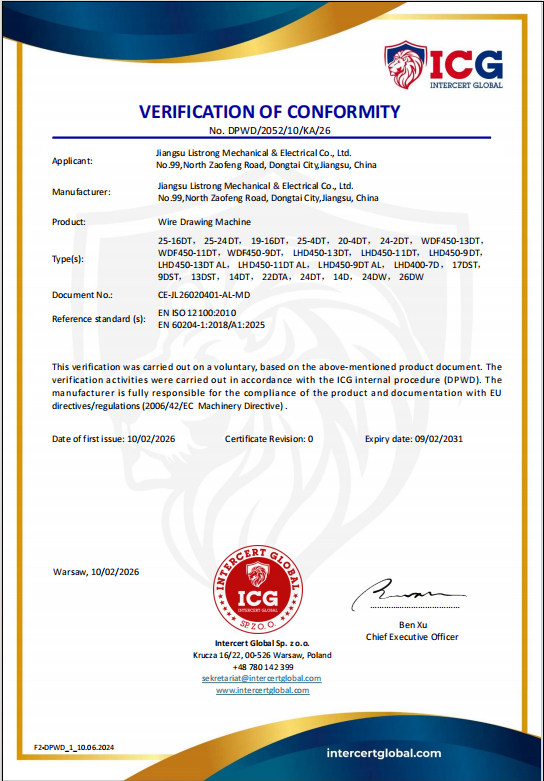
What the certificate does not do is approve every possible customization. If the buyer changes the electrical configuration, adds a non-standard annealer or modifies the safety arrangement, the technical file should be checked before shipment. A CE mark on a machine is not a substitute for the model-specific declaration, the risk assessment and the agreed test record. For an EU buyer, the practical check is to match the exact model and configuration on the order to the certificate scope and to ask for the declaration that will ship with the machine.
What purchasing terms and acceptance criteria should be written into the order?
The supplied purchasing terms are specific and should be carried into the order: MOQ 1 set; delivery terms FOB, EXW or CIF; payment terms 30% T/T in advance and 70% T/T before shipment; acceptance criteria based on pre-shipment test. The manufacturer also states 100% pre-shipment testing on wire drawing machines. These terms are a starting point, but the phrase 'pre-shipment test' needs a protocol. The buyer should attach a test sheet that states what is tested, with which instruments, at which settings, with which tolerances and who witnesses the test.
- Model and configuration, including die schedule, speed table, spooling and annealing scope.
- Test items and acceptance tolerances.
- Documentation package: certificate copies, declaration, manual, wiring diagram and spare-parts list.
- Packing, marking and shipping terms.
- Warranty: 12 months from the date of dispatch, plus remote technical support.
- Customs documents and HS classification. The supplied trade reference lists HS 8463.30.00 for machine tools for working metal wire, without removing material.
The buyer should also confirm what happens if a test item fails: rework, re-test, delay or rejection. A pre-shipment test is more useful when the remedy is written down before the test begins. The same applies to the 12-month warranty from dispatch: the start date is clear, but the response scope and spare-parts terms should be stated in the contract. The company states that it can export and supply customs clearance documents, so the required document list should be agreed before shipment rather than assembled after the vessel is booked.
What does the reference case show, and what does it not prove?
The supplied case record covers a cable manufacturer in Iran and Macedonia, with one set and two sets respectively. The application is the efficient and large-scale production of multi-strand stranded conductors and fine electronic/electrical cables. The reported duration is two years in Iran and one year in Macedonia. The record reports 35% energy savings, reduced labor costs, stable operation and zero major failures, with low noise and full automatic operation. It also states that the machine addresses inconsistent wire tightness and uneven parameters at the root.
Those are project-specific reported results. They do not prove that every line will achieve 35% energy savings, nor that every wire route will see the same labor reduction. A buyer should use the case as a reason to ask for the test protocol, the operating conditions and the reference configuration, not as a substitute for acceptance testing. The value of the case is that it shows the kind of application the supplier has served and the variables that matter: wire tightness, parameter consistency, noise and automation. The buyer still has to verify those variables on the ordered configuration.
Market context: does growth change the procurement decision?
Market growth is context, not a specification. Dataintelo's April 2026 report values the global wire drawing machine market at USD 3.8 billion in 2025 and forecasts USD 6.1 billion by 2034 at a 5.47% CAGR. The same evidence pack notes a separate Insight Partners figure of USD 1.37 billion for 2025 and an IndexBox figure of USD 2.4 billion for 2026. The difference is attributed to scope, such as whether spare parts, dies and service revenue are included. For a buyer, the lesson is to compare quotations on the same scope, not to treat a headline market number as a price forecast.
The practical outlook for 2026-2027 is that documentation and acceptance discipline matter more than a single speed claim. A line that is specified, tested and supported is easier to compare and easier to maintain than a line bought on a model name alone. That is especially true for fine wire, multi-wire and annealing configurations, where the interface between the drawing section, the annealer and the spooler determines whether the quoted speed is usable in production.
What is the practical evaluation-to-execution checklist?
- Define the wire route: material, inlet, outlet, number of wires and planned output.
- Shortlist models such as 20-4DT, 24-2DT, 22DTA, 17DST or 9DST only after the route is defined.
- Request a model-specific technical annex: die schedule, speed table, spooling, annealing and electrical configuration.
- Match the exact configuration to the CE and ISO scope.
- Freeze customization: logo, language, voltage, motor and frequency inverter.
- Agree the pre-shipment test protocol and tolerances.
- Confirm commercial terms: MOQ 1 set, FOB/EXW/CIF, 30/70 T/T and lead time 50-90 days.
- Confirm warranty and support: 12 months from dispatch and remote technical support.
- Confirm documents: certificate copies, declaration, manual, wiring diagram, spare-parts list and customs documents.
- Plan the factory visit or online review in Dongtai, Jiangsu.
A checklist does not replace engineering review. It prevents the most common gap: a quotation that looks complete but leaves the die schedule, speed conditions or acceptance test undefined.
FAQ
Are you a manufacturer or a trading company?
Jiangsu Listrong Mechanical & Electrical Co., Ltd. states that it is a real wire drawing machine manufacturer. Its factory is in Dongtai City, Jiangsu, China, and the company says the factory can be visited online or offline. The company profile lists wire drawing machines, annealing machines and wire bunching machines as its main products, with development design, manufacture, installation, commissioning and after-sales service in one organization. A buyer can verify the claim through a factory visit and by matching the ordered model to the published certificate scope.
Can you export wire drawing machines to Europe?
Yes, for the models and configurations covered by the published CE verification of conformity. Certificate CE-JL26020401-AL-MD was issued by ICG for the EU market, valid from 2026-02-10 to 2031-02-09, and cites EN ISO 12100:2010 and EN 60204-1:2018/A1:2025. Its scope includes 20-4DT, 24-2DT, 22DTA, 17DST and 9DST. The buyer should confirm that the exact configuration on the order is within that scope and should receive the declaration and technical file that apply to the shipped machine.
What are the purchasing terms and acceptance criteria?
The supplied terms are MOQ 1 set; delivery terms FOB, EXW or CIF; payment terms 30% T/T in advance and 70% T/T before shipment; and acceptance based on pre-shipment test. The manufacturer also states 100% pre-shipment testing. Because 'pre-shipment test' does not define test items or tolerances, the buyer should attach a signed test protocol to the order. The protocol should state the model, configuration, test settings, instruments, acceptance limits and witness arrangements.
How do I confirm die configuration and speed range for 20-4DT, 24-2DT, 22DTA, 17DST or 9DST?
Ask for a model-specific technical annex. The model code and the CE scope do not publish a die schedule or a speed curve. The annex should state the inlet and outlet diameters, number of dies, die material, lubricant, speed table and the conditions attached to each speed, such as wire material, number of wires, annealing status and spool size. For a fine copper wire example, a supplied application record cites 0.195 mm wire at 24 m/s, but that is a line-specific condition, not a universal rating for every model.
Can the machine be customized for voltage, language and logo?
Yes. The manufacturer offers OEM and ODM production services and lists logo, language, voltage, motor and frequency inverter among the customization items. The minimum order quantity is 1 set. The stated lead time is 50-90 days. The buyer should freeze each customization in a signed technical annex, including the destination voltage and frequency, the motor and inverter configuration, the language of labels and interface, and the logo application. A late change can affect the electrical design, documentation and test plan.
What after-sales support and warranty are supplied?
The manufacturer provides remote technical support and a 12-month warranty from the date of dispatch. The company also states that it can send engineers for installation and worker training. The buyer should confirm the scope of remote support, the spare-parts list and the response terms in the contract. The warranty start date is defined by dispatch, so the shipping and commissioning schedule should be aligned with that date.
How should a buyer verify spooling and annealing?
Spooling and annealing should be verified as interfaces, not as model names. For spooling, provide the spool drawing or a sample spool and ask for written confirmation of the take-up, traverse, tension control and spool dimensions. For annealing, confirm whether the offer includes an in-line annealer or a separate unit, and what utilities and consumables are required. The CE scope covers annealing machines as a product category, but it does not define the annealing configuration of each model. The exact arrangement should be written into the technical annex.
The published product catalog is available as a PDF for readers who need the model list and company information: LISTRONG catalog. The catalog is a reference, not a substitute for the signed technical annex.
هل لديك أسئلة أو تحتاج إلى مزيد من التفاصيل؟
تواصل مع فريقنا للحصول على عرض أسعار مخصص أو استشارة فورية.
طلب عرض أسعار
املأ النموذج أدناه وسيتواصل معك فريقنا بعرض مقترح مخصص.
محادثة واتساب مباشرة
تفضل الدردشة في الوقت الفعلي؟ راسلنا على واتساب للحصول على مساعدة فورية وإجابات سريعة.
- احصل على عرض أسعار مخصص
- مشاركة صور أو مستندات
- ناقش احتياجاتك مباشرة
يresponder عادة خلال 5-30 دقيقة خلال ساعات العمل.