
Wire Harness Drawings for 24/7 Valve Projects: 12 Procurement Questions Answered
A wiring harness drawing decides, before a single terminal is crimped, whether a circuit control valve will hold up on 24/7 duty or return as a service claim. For procurement engineers and technical buyers, the drawing and the connector sourcing rules behind it carry more risk than the harness price itself.
This industry reference answers twelve procurement questions that arise when specifying a custom wire harness for circuit control valve equipment deployed indoors or outdoors on continuous duty. The answers are specification decisions rather than general advice: how connectors and pin functions are identified, how branch and heat-shrink dimensions are stated, how signal control and power control circuits are separated, how connector sourcing and substitution are approved, and which environmental options such as waterproofing, high-temperature resistance and shielding a 24/7 project actually needs.
The drawing and sourcing rules described here are those applied by P-Shine Electronics Co., Ltd, a wire harness and cable assembly manufacturer established in 1997 and based in Dongguan, Guangdong, China.
Why the Drawing, Not the Catalogue, Sets Reliability on a 24/7 Valve
On circuit control valve equipment, the harness is an internal connection linking equipment ports, PCB interfaces, signal control modules, power control modules and other internal functional components. It is not a catalogue cable that can be reordered from stock. Because the assembly sits inside the machine, a fault is slow to diagnose and disruptive to replace, and a 24/7 duty cycle removes the tolerance that occasional-use equipment enjoys.
Four risk points belong in the drawing discussion before commercial terms are agreed:
- Drawing clarity. An unidentified connector, an undefined pin or an unmeasured loop becomes a defect at assembly and a dispute after delivery.
- Signal and power module compatibility. The same harness may carry switching signals to a control module and current to a power module; both must be defined separately rather than assumed.
- Equipment port and PCB interface fit. Keying, orientation, mating depth and routing length have to be validated against the actual hardware, not against a generic connector footprint.
- Environmental specification. Waterproofing, high-temperature resistance, shielding, flame retardance and low smoke and halogen-free construction are options that must be stated on the drawing or they will not be built.
Acceptance criteria need a reference point as well. IPC/WHMA-A-620, published by IPC International, is the industry-consensus standard for requirements and acceptance of cable and wire harness assemblies and defines three product classes. A buyer specifying harnesses for continuous-duty valve equipment should state the applicable class, because otherwise the word acceptable has no shared meaning between the drawing office and the production floor.
The Manufacturer Referenced in This Analysis
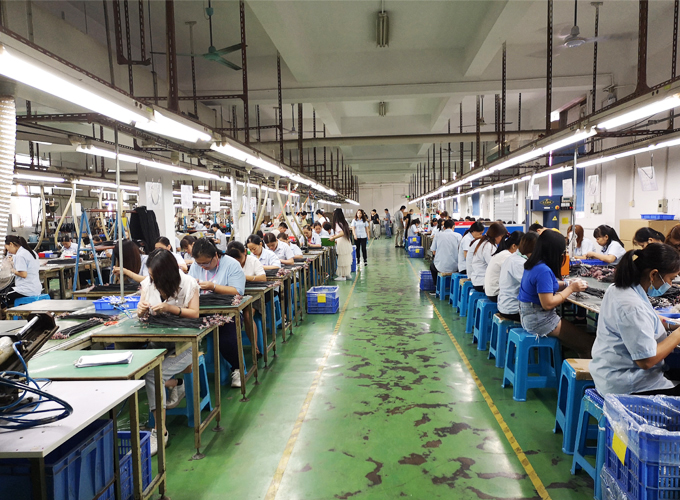
P-Shine Electronics Co., Ltd is a manufacturer of wire harnesses, cable assemblies and AC power cords, established in 1997 and located in Dongguan, Guangdong, China. Its range covers Wire Harnesses, USB Cables, Cable Assemblies, AC Power Cords, Customized Connection Cables, and Wires & Cables. Roughly 60% of output is exported, with the European Union, the United States and the Middle East as the main markets.
For procurement evaluation, three capability facts matter more than product breadth. The company operates from a 5,000 m2 facility with 300 employees and an annual output of 2,000,000 pcs. A 20-engineer R&D team supports drawing-based processing, which is the working model for fully customized harnesses with no fixed model number. The compliance scope is specific rather than generic: UL 758 (E214500), CSA C22.2 No. 210-15 and VDE DIN EN 50525-2-11 for wire and assembly compliance, with quality and environmental management systems certified to ISO 9001:2015 (CN07/31354) and ISO 14001:2015 (CN19/30539). Materials are stated to comply with RoHS, REACH and California Proposition 65.
That combination, engineering capacity for drawing interpretation plus volume capacity for series production plus verifiable certification scope, is what a 24/7 valve project is effectively buying when it places a harness order.
How a Drawing Becomes a Validated Harness
The conversion from drawing to delivered assembly follows a defined sequence: consider the functions to be implemented; plan the number of circuits and define the function of each circuit; find suitable connectors; complete the drawing and run simulations; make samples and test them; then finalize the design and begin mass production.
Two elements of that sequence determine cost and risk. The first is the connector. Connector families used in these assemblies include Molex, JST, TE, Phoenix, Samtec, Hirose and Amphenol wire harnesses, but the choice is not the manufacturer's to make freely. The buyer's drawing specifies the brand and part number, or the buyer supplies the connector brand, part number, wire type (for example UL1007), wire gauge (for example 28AWG), colour and wire definition.
The second is material. Insulation and jacket compounds are selected from PVC, XL-PE, TPE, TPU and TEFLON, and the selection interacts with moisture exposure, flexing and the temperature at the mounting point. For a terminal crimped wire harness, the drawing fixes the terminal and wire combination for every joint, so production and later service work from the same reference. Where a project requires it, 100% pre-shipment testing is applied rather than sample-based release.
Where These Assemblies Are Deployed
The scenario profile behind these drawing rules is industrial: circuit control valve equipment, building temperature control equipment, automation equipment, robots, power transmission equipment, solar energy equipment, wind power generation equipment, instruments and meters, medical equipment and household appliances. The harness function is device connection and internal connection of the equipment, and the operating mode is continuous, 24/7.
Working conditions span indoor and outdoor installation, inside and outside the equipment enclosure, and waterproof and non-waterproof requirements. That range is why the environmental options are procurement questions rather than technical footnotes: a harness that is adequate inside a temperature-controlled cabinet may be the wrong specification on an outdoor valve skid exposed to rain, UV and temperature cycling.
Regional coverage of the applicable scenario profile includes Germany, the United Arab Emirates, Bulgaria, Canada, France, the United Kingdom, Israel, India, South Korea, Poland, Russia, Singapore, Turkey and the United States, markets where UL, CSA, VDE, RoHS and REACH expectations commonly appear in purchase specifications.
Market Context: Customisation Is Outgrowing Standardisation
The global wire harness market was estimated at USD 99.58 billion in 2024, according to Precedence Research, and Asia Pacific held a 46% share of that market in the same year, reflecting electronics and automotive manufacturing concentration in China, India and Japan. Automotive remains the dominant end-user segment, and the shift toward electric vehicles is pushing harness architectures toward greater complexity rather than less.
Two observations are useful for procurement teams. First, published growth forecasts for the same period disagree by scope: one source cites a CAGR of around 4.0% while another reports 6.49%, a variance that follows from whether industrial or automotive harnesses are counted. Second, granular growth data for medical-grade and industrial-control harnesses is frequently bundled or paywalled, which means buyers evaluating a supplier's market claims should ask which segment definition sits behind the number. The industrial-control segment relevant to valve projects is not well served by headline market figures.
Trade classification is a separate variable from technical specification. HS 8544.30, defined by the UN Statistics Division, covers ignition wiring sets and other wiring sets of a kind used in vehicles, aircraft or ships; the applicable subheading for a specific harness assembly should be confirmed with a customs broker rather than assumed from the product name.
Drawing-Based Sourcing Versus Conventional Options, and Where It Does Not Fit
Three sourcing routes appear in valve projects, and they carry different risk profiles rather than different quality labels.
| Route | Specification control | Connector sourcing | Buyer validation burden | Documentation |
|---|---|---|---|---|
| Off-the-shelf catalogue harness | Limited to catalogue variants; rarely matches valve ports and PCB interfaces | Whatever the catalogue construction uses | High, since the buyer must verify fit, keying and current rating | Catalogue datasheet |
| Drawing-based custom with original brand connectors | Full: wire type, gauge, colour, length and pin function defined by the buyer's drawing | Original connectors purchased to the brand and part number on the drawing, typically through DigiKey or Mouser | Low: drawing review and first-article sample approval | Drawing revision plus approved component set; UL 758 (E214500), CSA C22.2 No. 210-15, VDE DIN EN 50525-2-11, ISO 9001:2015 (CN07/31354) |
| Drawing-based custom with an approved non-original alternative | Same drawing, with the alternative connector part number recorded alongside the original | Non-original alternative, used only after the customer tests, verifies and approves | Medium to high: the validation cycle sits on the buyer's side | Approval record plus dual part-number reference on the drawing |
On the sourcing question specifically, the default rule is conservative. Connectors are purchased strictly according to the brand and part number specified in the customer's drawing, typically through DigiKey or Mouser to ensure genuine original parts. Original connectors offer better reliability and compatibility, and they are used unless the customer requests a replacement.
Non-original replacement connectors are therefore an exception rather than a menu item. They are considered only at the customer's request, only when the alternative is already regarded as a mature product with reliable quality, and only after the customer has tested, verified and approved it. The commercial logic is real, since in some cases an original brand connector costs around ten times a non-original alternative, but the decision and the validation cost stay with the buyer.
Four limitations should be stated plainly before a project proceeds:
- A finalized drawing is a precondition, not a deliverable. Drawing-based production begins once functions, circuits, connectors and pin definitions are defined. Buyers without a completed drawing need an engineering loop first, supported by the 20-engineer R&D team, and that loop takes time.
- Non-original substitution always adds a validation cycle. The connector saving does not remove the requirement to test, verify and approve on the buyer's side, and that responsibility cannot be transferred to the supplier.
- Price and tolerance advantages are manufacturer-stated benchmarks. P-Shine positions its products at least 25% below major international brands and states dimensional tolerance control 50% tighter than mainstream competing brands. These are comparative claims by the manufacturer, not independent laboratory results, and buyers should confirm them through incoming inspection and sample approval before releasing a 24/7 project.
- There is no catalogue fallback for spare parts. Fully customized harnesses have no fixed model number, so a spare-parts strategy has to be built into the drawing package or a fast replacement will not be available.
Future Outlook
Three movements are likely to change how valve-project harnesses are bought. Documentation is becoming part of the product, as buyers increasingly expect the drawing revision, the approved connector set and the test record to travel with the shipment, which raises the value of manufacturers whose management systems already control documented information. Environmental compliance is tightening in the European Union, the United States and the Middle East, so RoHS, REACH and California Proposition 65 status, together with the availability of low smoke and halogen-free constructions, will move earlier in the specification process. And continuity of supply is being evaluated alongside unit price, as buyers who accept a lower connector cost learn to price the validation work that accompanies it.
For 24/7 valve equipment, the practical direction is toward fewer, better-documented harness suppliers rather than faster substitution. A drawing that defines every wire, pin and environmental option, and a connector sourcing rule that states exactly when an alternative is permitted, will outlast any single price negotiation.
12 Procurement Questions Answered
1. What should a wiring harness drawing contain before a 24/7 valve project is released to production?
Ten elements define a workable drawing: the brand and part number of every connector; differentiation, for example by colour, where the same connector is used in adjacent positions; a different colour for each wire in each loop; the model number (for example UL1007), gauge (for example 28AWG) and colour of every wire; the length of each loop; the functional definition of each pin, such as Power+ or GND; the same colour where wires of the same function appear in different loops; the length of each branch when a loop branches in the middle; a minimum distance of 30 mm from a branch to a connector; and appropriate arrangement of branch positions where heat shrink tubing is required. The purpose is a drawing that is clear and easy to identify at the production bench.
2. How should identical connectors and pin functions be differentiated on the same drawing?
Where the same connector type is used in adjacent locations, distinct colours keep the two positions from being confused during assembly. Pin functions should be defined explicitly, including Power+, GND and signal assignments, so that a technician can identify each circuit without interpreting the schematic. Wires carrying the same function in different loops may share a colour, which keeps the drawing readable. In the control logic behind the harness, different circuits of Power+ or GND can be connected to the same Power+ or GND pin of the main connector, so the drawing should show whether the project uses that arrangement, because it determines how the main connector is populated.
3. How are branch points, loop lengths and heat-shrink areas dimensioned?
Every loop carries a stated length, and where a loop branches, each branch carries its own length. The minimum distance from a branch point to a connector is 30 mm, a dimension that protects the connector termination from the mechanical disturbance created by the branch. Where heat shrink tubing is part of the construction, branch positions should be arranged so the tubing can be installed properly rather than squeezed over a junction. These are not drawing conventions for their own sake: on a 24/7 valve, an over-short branch transfers vibration and strain directly into a crimped terminal, which becomes a service-life issue rather than a build issue.
4. How should signal control and power control circuits be specified separately on one valve harness?
The matched equipment for these harnesses includes equipment ports, PCB interfaces, signal control modules and power control modules, and a single assembly may serve several of them. The drawing therefore needs to define power conductors and signal conductors separately by wire type, gauge, colour and pin function, and to state where shielding is required for signal integrity. As a general design rule, low-voltage signal conductors and high-current power conductors are kept identifiable as separate circuits within the same wiring loom, so that routing, termination and fault-finding stay unambiguous. Where the project uses a multi-core shielded cable harness, the shield termination point should also be defined on the drawing.
5. Do harness manufacturers purchase original brand connectors, and how can a buyer verify it?
At P-Shine Electronics Co., Ltd, connectors are sourced strictly according to the brand and part number specified in the customer's drawing, and are typically purchased through DigiKey or Mouser to ensure the parts received are genuine originals. Original connectors are the default because they offer better reliability and compatibility. For verification, buyers should compare the delivered assembly against the drawing, confirm that connector part numbers match the specified brand, and validate mating and retention on first-article samples before releasing series production. Asking which distribution channels are used is a reasonable and specific sourcing question, because it separates documented original-part purchasing from unverifiable connector sourcing.
6. In what circumstances is a non-original replacement connector acceptable?
Only at the customer's request, and only when the alternative is already regarded as a mature product with reliable quality. After the customer has tested, verified and approved it, use of the non-original alternative connector can begin. The commercial driver is significant, since in some cases an original brand connector costs around ten times the price of a non-original alternative. The stated recommendation is straightforward: if price is not a concern, original brand connectors are used by default; if the customer considers original pricing too high, samples of the alternative can be provided for the customer's own testing and approval. The decision authority sits with the buyer rather than the manufacturer.
7. What approval process should protect a buyer who accepts a non-original replacement connector?
The process that fits the sourcing rule has four steps: request samples of the alternative, run functional and environmental testing against the project's real conditions, record written approval, and only then release the alternative to production, with the approved alternative part number and the original part number both recorded against the same drawing revision. Certification provides the framework rather than the decision, since a quality management system certified to ISO 9001:2015 (CN07/31354) supports controlled documented information where approvals, revisions and component records are held. The limitation is worth repeating: the supplier can document the approval, but the technical judgement and its consequences remain with the buyer.
8. How should buyers compare quotes for the same harness drawing?
Quotes are only comparable once they are normalised on five points: connector brand and part number, whether original or an approved alternative; wire type, gauge and insulation material; dimensional tolerance on lengths and branch positions; testing scope, including whether 100% pre-shipment testing is applied; and the documentation delivered with the shipment. A lower figure that depends on an unapproved connector substitution or reduced testing is not a lower price for the same item. On positioning, P-Shine states prices at least 25% below major international brands and dimensional tolerance control 50% tighter than mainstream competing brands, claims a buyer should verify through sample approval. For imported assemblies, duty and classification are separate cost lines to confirm with a customs broker.
9. How is compatibility with equipment ports, PCB interfaces and control modules verified?
Compatibility is verified in the sampling stage of the drawing process rather than at delivery. The defined sequence is to plan the circuits and their functions, select the connectors, complete the drawing and run simulations, then make samples and test them before the design is finalized and released to mass production. The matched interfaces that samples must be checked against are the equipment ports, PCB interfaces, signal control modules and power control modules. For a valve project, the meaningful checks are mechanical and electrical: whether the connector mates with the actual port, whether the assembly routes within the available space at the correct length, and whether pin functions match the module definitions on the drawing.
10. When does a valve project need a waterproof wire harness?
Waterproof construction is required when the harness is exposed to outdoor conditions, wash-down or condensation rather than sitting in a dry, temperature-controlled cabinet. The applicable working conditions for these assemblies distinguish indoor and outdoor installation, inside and outside equipment, and waterproof and non-waterproof options, so the requirement should be settled from the installation location rather than from the equipment category. Insulation and jacket compounds available for these harnesses are PVC, XL-PE, TPE, TPU and TEFLON, and the compound choice interacts with moisture exposure, flexing and the temperature at the mounting point. A waterproof wire harness is a specification decision that has to appear on the drawing; it is not a finish that can be added after the assembly is built.
11. When is high-temperature resistance or shielding required?
High-temperature resistance is specified where the harness operates near heat sources or inside an enclosure without airflow, particularly on valve equipment that runs continuously. Shielding is specified where signal circuits are exposed to electrical noise, and the option sits among the available special requirements for these assemblies, which cover complex custom wiring harnesses, high-temperature resistance, shielding, optional flame retardance, low smoke and halogen-free construction, waterproofing and drawing-based processing. Because these are electrical and material choices rather than accessories, each one changes the wire type, the jacket compound and often the connector selection. State the requirement on the drawing, together with the shield termination point, or the assembly will be produced to the simpler specification.
12. What does certification-backed traceability mean for a 24/7 valve harness project?
It means the harness can be linked to a defined compliance scope and a defined revision. For wire and assembly compliance, the relevant references for P-Shine Electronics Co., Ltd are UL 758 (E214500), CSA C22.2 No. 210-15 and VDE DIN EN 50525-2-11; for management systems, ISO 9001:2015 (CN07/31354) and ISO 14001:2015 (CN19/30539). Materials are stated to comply with RoHS, REACH and California Proposition 65. Traceability in practice means that the delivered assembly corresponds to the approved drawing revision and the approved component set, which is what makes later service, replacement and audit work possible. One boundary applies: certificates describe the manufacturer's systems and certification scope, and buyers should confirm that the scope covers their specific construction rather than assuming it does.
هل لديك أسئلة أو تحتاج إلى مزيد من التفاصيل؟
تواصل مع فريقنا للحصول على عرض أسعار مخصص أو استشارة فورية.
طلب عرض أسعار
املأ النموذج أدناه وسيتواصل معك فريقنا بعرض مقترح مخصص.
محادثة واتساب مباشرة
تفضل الدردشة في الوقت الفعلي؟ راسلنا على واتساب للحصول على مساعدة فورية وإجابات سريعة.
- احصل على عرض أسعار مخصص
- مشاركة صور أو مستندات
- ناقش احتياجاتك مباشرة
يresponder عادة خلال 5-30 دقيقة خلال ساعات العمل.