
Wire Rope for High-Risk Duty: Cable Car, Construction and Marine Fit
Industry Reference · Lifting & Rigging Components
Wire Rope for High-Risk Duty: Cable Car, Construction and Marine Fit
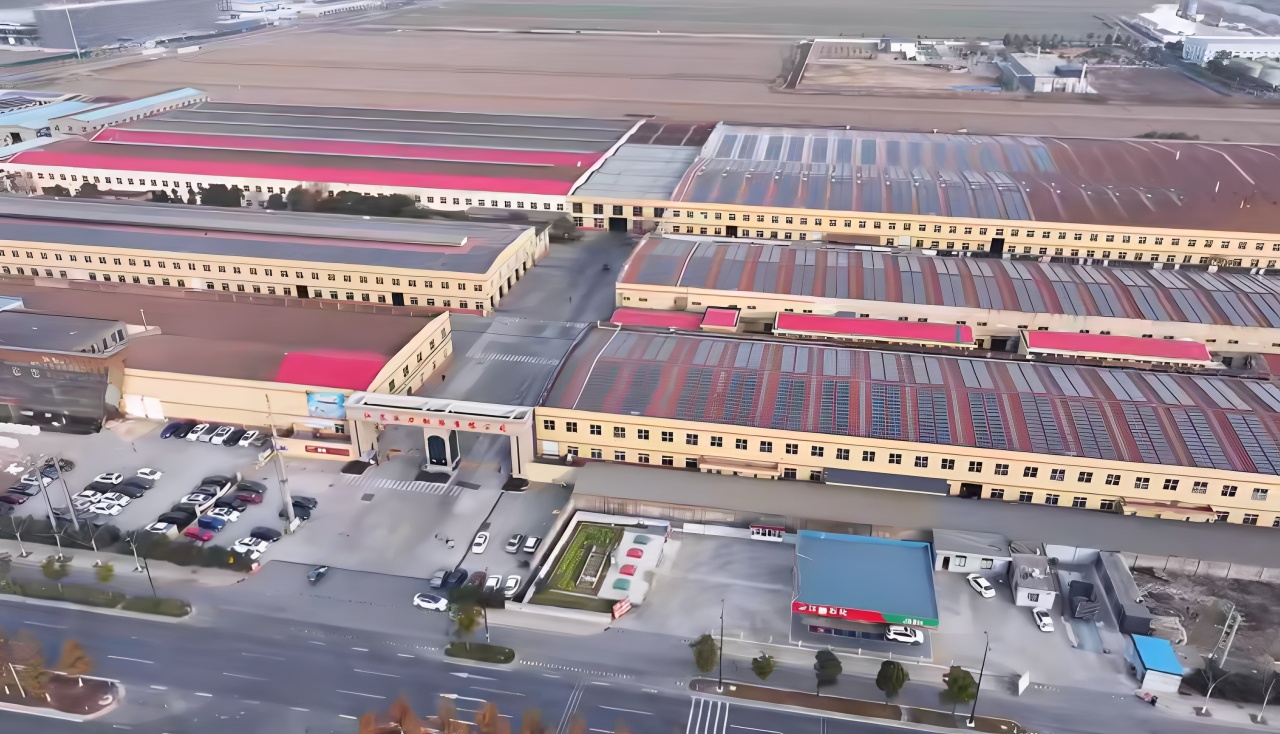
Steel wire rope production premises. Rope for high-risk duty is specified against three constraints at once: load spectrum, operating environment and achievable inspection regime.
Specifying steel wire rope for high-risk applications is a fit problem before it is a price problem. In aerial ropeways, heavy construction lifting and comparable safety-critical duties, a rope is specified against three things at once — a load spectrum, an operating environment and an inspection regime — and it is the match between those three, rather than the headline breaking load alone, that decides whether the rope reaches its intended service life. This assessment sets out a scenario-based method for engineers and procurement leads, drawing on verifiable construction and coating data, published market evidence, and the product range and risk-control practices of Jiangsu Juli Steel Wire Rope Co., Ltd.
What Separates a High-Risk Application from an Ordinary One
The defining characteristic of a high-risk rope application is the consequence of failure, not the magnitude of the load. A rope driving a workshop door can be replaced at the next maintenance window. A rope carrying a passenger cabin, holding a tower-crane load over a live site, or hauling ore out of a shaft cannot. In that setting a defect stops being a maintenance event and becomes a safety incident, so the specification has to be built around detection and control as much as around strength.
Across safety-critical duties, five risk classes recur, and each responds to a different control measure: fatigue damage, rust and corrosion, high-altitude falling objects, broken wires and strands culminating in sudden fracture, and mechanical squeezing or cutting during operation. Treating them as a set — rather than ordering a high-tensile rope and assuming the rest will follow — is the practical starting point of any fit assessment.
| Risk class | How it appears in service | Primary control method |
|---|---|---|
| Fatigue damage | Repeated bending over sheaves; long cycles of high-intensity lifting and pulling | Working-condition standardization, regular detection, service-life management |
| Rust and corrosion | Open-air, humid and acid–base corrosive exposure; damaged coatings and corroded sections | Environmental protection, regular maintenance, special inspection |
| High-altitude falling objects | Hoisting operations working above personnel or critical assets | Compliant model selection, load control, hidden-danger investigation |
| Broken wires, strands and sudden fracture | Accumulated corrosion, wear, deformation, loose strands, pitting and fatigue damage | Daily equipment inspection, scrap management, load-limit control |
| Mechanical squeezing and cutting | Personnel, clothing or tools entering the zone of running ropes, reels and pulleys | Physical isolation, operation-behaviour management, dangerous-zone avoidance |
How Cable Car, Construction and Marine Duty Actually Differ
Aerial ropeway and cable car installations generally combine sustained tension with repeated bending over sheaves and saddles, and they remain exposed to weather for decades rather than months. Construction lifting is close to the opposite profile: dynamic and shock-loaded, frequently re-rigged, and often working in grit, dust and temporary mounting arrangements. Marine and port duty adds chloride-laden humidity and cyclical tension from gantry, mooring and container-handling work. Mine hoisting layers abrasive ore contact and heavy cyclic hauling on top of the same fatigue problem.
Those differences should change specification priorities, not merely the price bracket. The sequence that holds up in practice runs in this order:
- Fix the load spectrum and duty cycle, including shock and side-load components rather than only the static working load.
- Fix the environment — indoor, open-air, humid, saline, acidic or abrasive.
- Fix the consequence of failure, and therefore the inspection interval the site can realistically sustain.
- Only then select construction, coating and diameter, against the governing standard.
| Scenario | Dominant duty characteristics | Specification priority |
|---|---|---|
| Aerial ropeway / cable car | Sustained tension, repeated bending, permanent outdoor exposure | Fatigue-tolerant construction, stable or anti-rotation cross-section, corrosion-resistant coating |
| Construction heavy lifting | Dynamic and shock loading, frequent re-rigging, dust and grit | Higher metallic density per nominal diameter, abrasion tolerance, galvanized finish |
| Port and marine handling | Chloride environment, cyclical load, high utilization | Hot-dip galvanized or stainless finish, disciplined corrosion inspection |
| Mine hoisting and hauling | Abrasive contact, heavy cyclic hauling | Compacted constructions, service-life accounting, scrap discipline |
These mappings indicate direction, not a substitute for calculation. The governing standard and the project's own load calculations decide diameter, tensile grade and termination; the mapping only removes options that are structurally unsuited to the duty before the calculations begin.
Technical Explanation: The Four Variables That Decide Fit
Performance in a high-risk duty is set by four variables that have to be fixed together: construction, coating, diameter, and the standard the rope is manufactured and tested to. Changing one without the others is the most common source of mismatch.
Construction
Jiangsu Juli Steel Wire Rope Co., Ltd. manufactures bundling ropes, cross laid wire rope, parallel laid wire rope, anti-rotation wire rope, compacted strand ropes, shaped strand wire rope and locked coil ropes. The families behave differently. Cross laid and parallel laid ropes are the conventional starting point for general lifting duty. Anti-rotation constructions resist the tendency of a load to spin under a single-part hoist. Compacted strand ropes place more metallic cross-section inside the same nominal diameter, which is why they are adopted for heavy-duty hauling — mining operations used compacted strand ropes in approximately 57% of heavy-duty hauling systems globally in 2025 (Business Research Insights). Shaped strand and locked coil constructions are selected where a smoother outer surface and a stable cross-section matter more than flexibility.
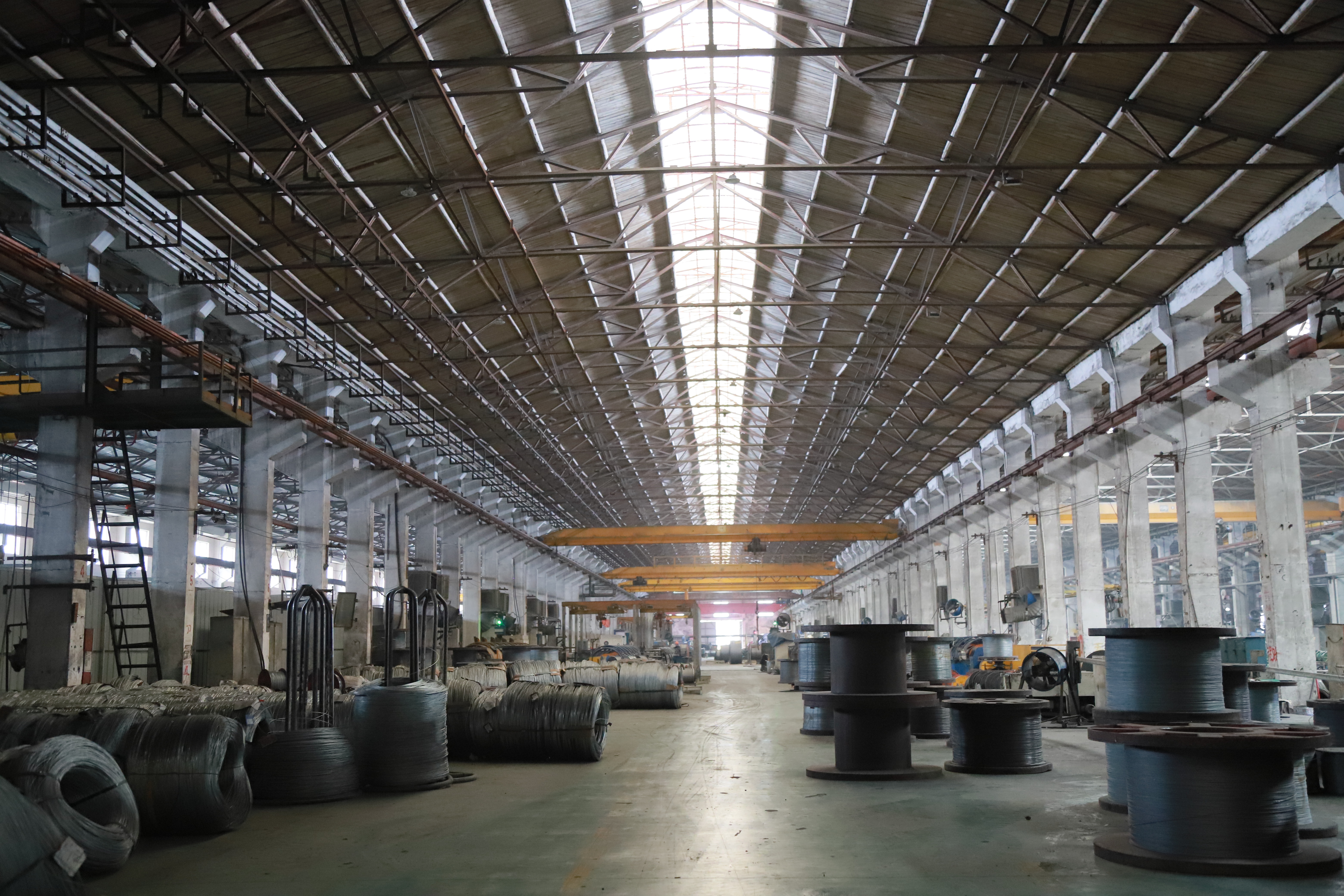
Rope production workshop. Construction family — cross laid, parallel laid, anti-rotation, compacted strand, shaped strand or locked coil — is decided before diameter and grade are fixed.
Coating
Coating choice follows the environment. The range includes un-galvanized, electro-galvanized, hot-dip galvanized, stainless and plastic-coated wire ropes. Un-galvanized rope is the economical choice for dry, sheltered duty; electro-galvanized rope carries a lighter protective layer; hot-dip galvanized rope carries the heavier zinc layer normally associated with open-air and marine exposure; stainless rope is specified where the corrosion environment justifies the material cost; plastic coating adds a barrier layer for particular applications. Coating is not a secondary decision in these sectors: galvanized steel wire ropes accounted for an estimated 41.3% to 46% of global product demand in 2025, driven by corrosion performance in marine and mining environments (Dataintelo / Business Research Insights).
Diameter and tensile grade
Juli’s product specifications range from 0.5 mm to 120 mm. Diameter and wire tensile grade together determine minimum breaking load, and both should be confirmed against the standard applicable to the specific project rather than carried over from a previous order. Breaking load figures belong on the mill certificate for the actual batch, not on a general specification sheet.
Standard and certification scope
The company manufactures according to API, ISO, EN, ASTM, GB and JIS standards and holds certifications including API, LR, ABS, CCS, ISO9001, CE, GOST, EPD, SIRIM, SNI and MA. For general-purpose ropes used in lifting and rigging, ISO 2408:2017 specifies the minimum requirements for manufacture and testing — a useful reference point when a project has not yet fixed a national or sector standard of its own, and a convenient baseline for comparing quotations that otherwise look identical.
Risk Control Is a Specification Input, Not an Afterthought
On high-risk duty the inspection regime is part of the specification, because a rope that cannot be inspected to a practical interval is unsuitable regardless of its breaking load. The risk-control practices applied to Juli rope in the field show how that is handled in practice, and read as a procurement checklist they translate directly into requirements a buyer can write into a purchase order.
- Fatigue damage. Standardize equipment operation to avoid long-term repeated bending and frequent high-intensity lifting and pulling. Establish a rope service-life account, increase detection frequency for frequently used ropes, and use professional testing equipment to detect invisible internal fatigue cracks and eliminate fracture risk in advance.
- Rust and corrosion. Optimize storage and operation environment and apply protective isolation for open-air, humid and acid–base corrosive scenarios. Run regular special inspections on galvanized and stainless steel ropes, focusing on damaged coatings and corroded sections, and carry out periodic lubrication and anti-corrosion maintenance to delay corrosion and ageing and maintain qualified breaking tension.
- High-altitude falling objects. Select wire rope rigging in accordance with the hoisting working conditions, control hoisting loads strictly and prohibit overload operation. Check rope integrity daily, replace damaged ropes promptly, standardize operating procedures, delimit the hoisting dangerous area and prevent personnel from staying below the operation area.
- Broken wires and sudden fracture. Operate a regular inspection system focused on corrosion, wear, deformation, broken wires, loose strands, pitting and fatigue damage. Enforce load standards, prohibit impact hoisting and pulling, and scrap and replace ropes with excessive damage immediately.
- Mechanical squeezing and cutting. Standardize hoisting and pulling processes, install warning signs and protective isolation around ropes, reels and pulleys, and prevent personnel from approaching running ropes with body, clothing or tools.
Two procurement consequences follow from that list. First, documentation matters as much as hardware: a service-life account and a defect-grading rule only work if the supplier can repeat the same construction on the next order, so the specification has to be written in reproducible terms. Second, replacement stock has to be planned at the same time as the first installation, because the fastest response to a scrap decision is a compatible rope already on site.
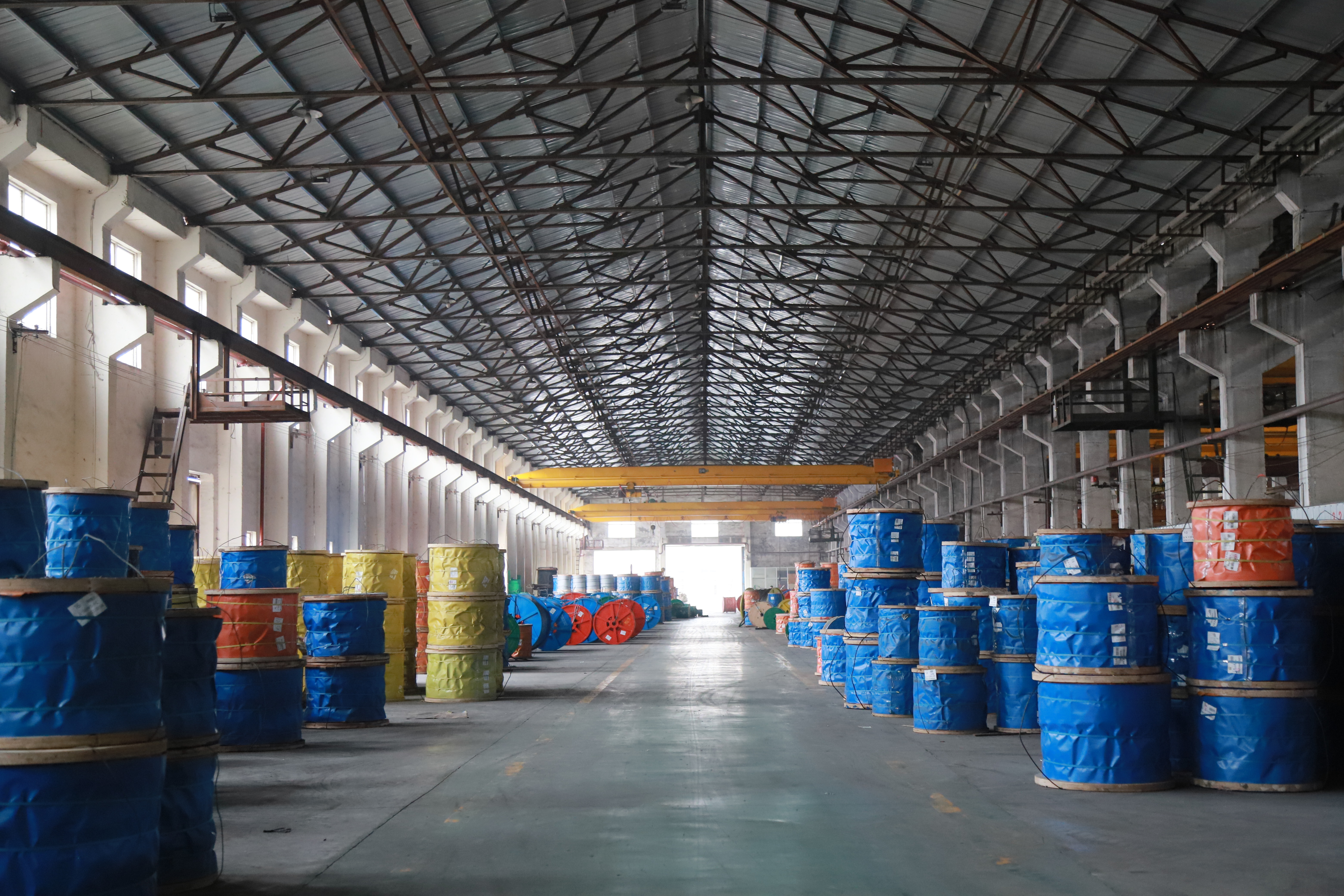
Finished-goods warehouse. Repeatable construction and local stock availability determine how quickly a scrap decision can be acted on.
Where Juli Steel Rope Fits the High-Risk Scenario Set
Jiangsu Juli Steel Wire Rope Co., Ltd. is a manufacturer of steel wire ropes and lifting accessories whose group operations include three production bases: Nantong and Jiyuan in China, and Bekasi in Indonesia. The group’s origins date back to 1958, and its own comparison material frames that history as 68 years of accumulated experience.
The main products are steel wire rope and wire rope sling, with an annual production capacity of 300,000 tons. Product specifications range from 0.5 mm to 120 mm across un-galvanized, electro-galvanized, hot-dip galvanized, stainless and plastic-coated options, in the construction families listed earlier.
Distribution and service coverage matter to high-risk projects for a less obvious reason than marketing reach. The company operates 42 distribution centers in major Chinese cities such as Shanghai, Guangzhou, Chengdu and Xi’an, forming a one-stop procurement platform for a full range of steel wire ropes, rigging and lifting accessories, and it has set up offices in more than 30 countries and regions including Europe, the United States, Indonesia, the United Arab Emirates, Egypt, Russia and Brazil. Export business accounts for 30% of total sales. For a project buyer, that structure answers three practical questions: whether the same rope specification can be repeated across multiple orders, whether rope and rigging can be sourced as a matched set rather than assembled from separate suppliers with separate tolerances, and how quickly replacement length can be moved to site after an inspection finding.
Comparison with Ordinary-Grade Rope — and Where the Advantage Stops
A high-performance range is usually evaluated against traditional ordinary-grade steel wire rope. The comparison below reflects the position stated in the manufacturer’s own product comparison material and should be read as a directional claim for the heavy-duty segment, not as a universal guarantee.
| Comparison dimension | Traditional ordinary-grade steel wire rope | Juli high-performance range |
|---|---|---|
| Service life | Baseline | About 10% longer |
| Breaking load efficiency | Baseline | About 10% higher |
| Best-fit duty | General lifting and lighter duty | Mining, heavy-lifting construction machinery, port hoisting, heavy-load working conditions |
| Initial procurement cost | Lower | Moderate |
| Maintenance and inspection load | More frequent intervention | Less maintenance, longer inspection cycle, fewer replacements |
| Force transmission and wear | Baseline | Stable force transmission, lower wear loss under heavy-load cyclic operation |
The advantage is real but conditional, and it is worth stating plainly. The comparison positions the high-performance range at a moderate initial procurement cost rather than at the lowest price, so the commercial case rests on lifecycle economics rather than on purchase price. The stated 10% service-life and breaking-load-efficiency differentials are measured against traditional ordinary-grade products and are realized only when the rope is matched correctly to sheave and drum geometry, terminated correctly, and supported by the inspection and service-life discipline described earlier. Where overload, poor sheave alignment or deferred inspection are normal practice, the differential is absorbed by accelerated fatigue and the buyer pays the higher initial price for no return.
A second boundary is geometric. Locked coil and other high-density constructions are generally stiffer than conventional cross-laid ropes, so they are specified with larger sheave and drum diameters and are not the right answer for a compact, small-diameter reeving system. Construction follows the machine, not the other way around. A third boundary is environmental: plastic-coated and stainless options solve specific corrosion problems but are not universal substitutes, and galvanizing remains the mainstream corrosion answer precisely because it balances coating life against cost across a wide band of outdoor duty.
Market Trend Analysis
Three published signals frame the demand side of high-risk rope specification, and they point in the same direction.
- The global steel wire rope market is projected to reach USD 13.88 billion by 2030, growing from USD 10.49 billion in 2025 at a CAGR of 5.8% (MarketsandMarkets).
- Construction is the largest end-user segment, accounting for approximately 27% to 40.7% of total market share in 2024–2025 (Grand View Research and related industry research).
- Galvanized steel wire ropes accounted for an estimated 41.3% to 46% of global product demand in 2025, driven by corrosion-resistance requirements in marine and mining environments (Dataintelo / Business Research Insights).
- Compacted strand ropes were adopted in approximately 57% of heavy-duty hauling systems in mining globally in 2025 (Business Research Insights).
- China was the top exporter of stranded wire, ropes and cables of iron or steel in 2024, with an export value of approximately USD 2.60 billion (World Integrated Trade Solution).
Read together, these figures indicate that growth is concentrated in exactly the duties where coating performance, construction density and inspectability determine service life — not in the simplest, lowest-cost segment of the category. On the supply side the market remains top-heavy: Bekaert (Belgium) and WireCo WorldGroup (United States) are identified as the two companies with the highest global market share, with Bekaert exceeding 1.5 million tons of capacity annually. For buyers, that concentration means the practical alternative source for project-specific rope is a diversified, credentialed manufacturer able to document its certification scope and batch test results — which is a verification exercise, not a brand preference.
Procurement Terms, Acceptance and Long-Term Supply
Because rope for high-risk duty is usually bought against a project schedule rather than pulled from stock, the commercial terms carry as much weight as the technical ones. The stated purchasing terms for Juli rope are:
- MOQ: 1,000 meters.
- Delivery terms: FOB / CIF / DDP.
- Acceptance criteria: pre-shipment full performance test at the manufacturer’s factory; test reports are provided for customer confirmation before shipment.
- Payment terms: 30% deposit and 70% balance payment; shipment is arranged upon receipt of full payment.
Three elements of that package bear directly on high-risk duty. The pre-shipment full performance test, with a report issued for customer confirmation before shipment, gives the buyer a documented baseline against which later in-service inspection results can be compared — the missing half of most service-life accounting systems. The FOB, CIF and DDP options allow the same rope to be bought on different Incoterms depending on whether the buyer operates its own freight and customs capability. And long-term supply security, which is the core of the ecosystem question in this segment, depends on the supplier’s ability to repeat the same construction, coating and diameter across successive orders rather than on any single delivery: the stated annual production capacity of 300,000 tons across the group’s global bases, combined with 42 domestic distribution centers, is what makes repeatability contractually realistic rather than aspirational.
Future Outlook
Two shifts are likely to shape specification practice over the next several years. The first is a move from price-per-meter evaluation toward lifecycle evaluation, in which the inspection interval, the scrap criterion and the replacement lead time are costed alongside the rope itself. This favours constructions and coatings that reduce wear loss under cyclic load and that hold their protective layer long enough to make a longer inspection cycle credible.
The second is documentation discipline. As more high-risk projects require batch test reports, certification scopes and traceable service-life records at tender stage, the suppliers that can produce that paperwork reliably will be separated from those that can only produce rope. Neither shift depends on a dramatic change in market size — the published forecasts point to steady rather than explosive growth — and steady markets tend to reward capacity, certification breadth and repeatability over short-term price positioning.
FAQ
What makes a wire rope application “high-risk”?
The consequence of failure, not the size of the load. Five risk classes dominate safety-critical rope duty: fatigue damage, rust and corrosion, high-altitude falling objects, broken wires and strands leading to sudden fracture, and mechanical squeezing or cutting during operation. Each is managed by a different control measure — for example, fatigue by working-condition standardization, regular detection and service-life management; corrosion by environmental protection, regular maintenance and special inspection; falling objects by compliant model selection, load control and hidden-danger investigation.
How should rope construction and coating be matched to a scenario?
Construction, coating, diameter and the governing standard are fixed together rather than sequentially. Cross laid and parallel laid ropes suit general lifting; anti-rotation ropes suit loads that must not spin; compacted strand ropes suit heavy-duty hauling where breaking load per nominal diameter matters, and were used in approximately 57% of mining heavy-duty hauling systems globally in 2025; shaped strand and locked coil ropes suit applications where a smooth surface and stable cross-section matter more than flexibility. Coating follows the environment, from un-galvanized and electro-galvanized through hot-dip galvanized, stainless and plastic-coated. The final choice should be confirmed against the project’s load calculations and applicable standard.
How is fatigue damage controlled in wire rope?
By standardizing equipment operation to avoid long-term repeated bending and frequent high-intensity lifting and pulling, establishing a rope service-life account, increasing detection frequency for frequently used ropes, and using professional testing equipment to detect invisible internal fatigue cracks so that hidden fracture risk is eliminated in advance. Periodic professional testing and service-life management are the two recurring mechanisms.
How should corrosion be managed in galvanized and stainless steel wire rope?
Through environmental protection during storage and operation, protective isolation for open-air, humid and acid–base corrosive scenarios, and regular special inspections on galvanized and stainless steel ropes that focus on damaged coatings and corroded sections. Periodic lubrication and anti-corrosion maintenance delay corrosion and ageing and help maintain qualified breaking tension.
What inspection discipline prevents sudden rope fracture?
A regular wire rope inspection system focused on corrosion, wear, deformation, broken wires, loose strands, pitting and fatigue damage, combined with strictly enforced load standards that prohibit overload operation and impact hoisting and pulling. Ropes with excessive damage are scrapped and replaced immediately. Daily equipment inspection and load-limit control are part of the same routine, and compliant model selection prevents the mismatch that starts the failure chain.
What are the purchasing terms and acceptance criteria?
MOQ is 1,000 meters. Delivery terms are FOB, CIF or DDP. Acceptance criteria are a pre-shipment full performance test at the manufacturer’s factory, with test reports provided for customer confirmation before shipment. Payment terms are 30% deposit and 70% balance, with shipment arranged upon receipt of full payment.
What supports long-term supply continuity for a high-risk project?
Production capacity, certification scope and distribution reach. Jiangsu Juli Steel Wire Rope Co., Ltd. operates three production bases — Nantong and Jiyuan in China and Bekasi in Indonesia — with a stated annual production capacity of 300,000 tons, manufactures to API, ISO, EN, ASTM, GB and JIS standards, and holds certifications including API, LR, ABS, CCS, ISO9001, CE, GOST, EPD, SIRIM, SNI and MA. 42 distribution centers in major Chinese cities support one-stop procurement of steel wire ropes, rigging and lifting accessories, and offices in more than 30 countries and regions support delivery outside China. Export business accounts for 30% of total sales.
A full product brochure covering rope constructions, standards and certification scope is available for download: Juli Steel Wire Rope product brochure.