
With vs Without a CAN Decoder: Fascia Kit Install Comparison
A vehicle-specific Android car stereo fascia kit settles the physical half of a retrofit and leaves the electrical half to the buyer. The frame decides whether a 7-, 9-, 10.1- or 12.3-inch aftermarket screen sits flush in the original console. The connection decides whether the vehicle's own electronics keep speaking to that screen once the ignition cycles.
This is a buyer-side comparison of two retrofit paths that share the same dash frame and diverge only at the connector: a path that decodes factory CAN signals through a plug-and-play CAN gateway, and a path that relies on a plug-and-play non-CAN harness with no decoding at all. Both paths are legitimate. They are legitimate for different vehicles, and the practical difference shows up as dashboard warnings, dead steering-wheel buttons and head units that power on but behave nothing like a factory unit.
ZYX Car Radio Fascia Kit is the fascia, wiring harness and CAN gateway product line from Shenzhen Zhongyixing Electronic Technology Co., Ltd, a Shenzhen-based supplier of car stereo installation accessories whose product system covers 3,000+ vehicle applications across Europe, North America and other international aftermarket markets. The comparison below uses three components from that line, because the two paths differ by exactly one of them.
Two Retrofit Paths, One Shared Physical Baseline
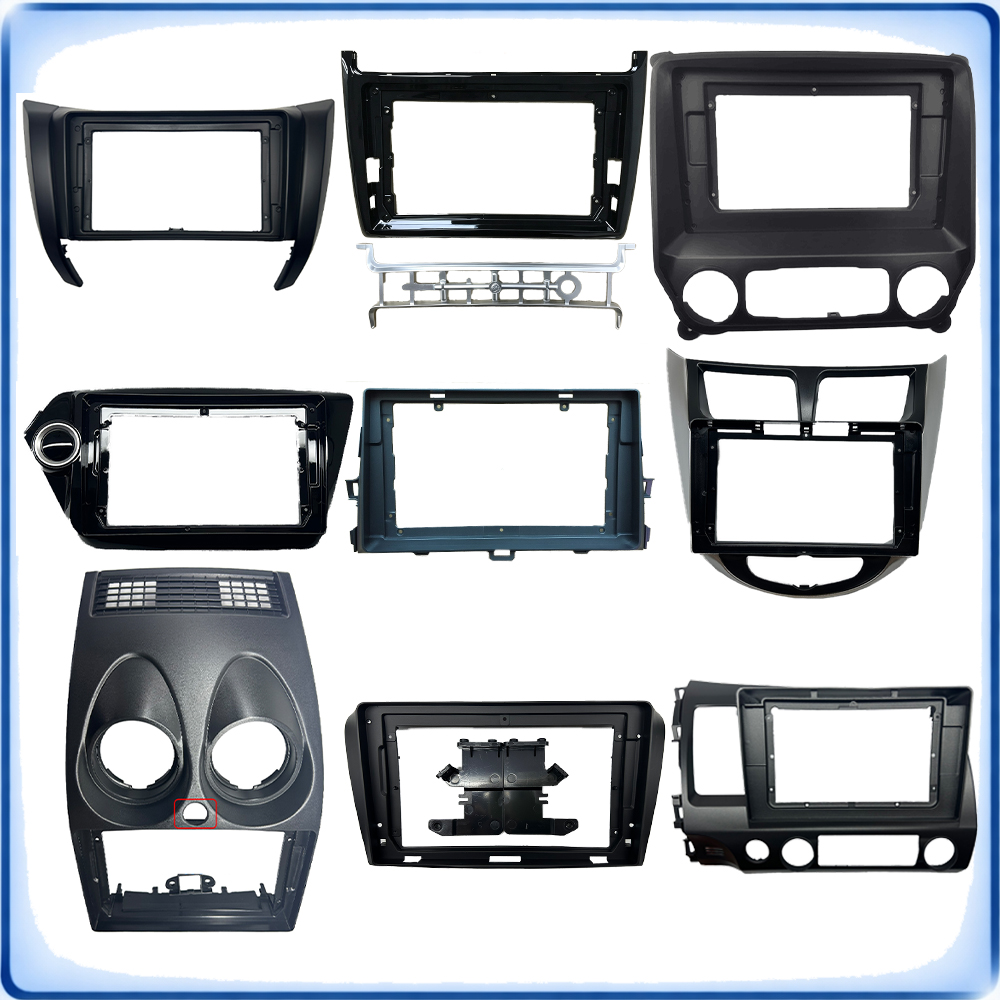
The physical baseline is the ZYX-01 Car Radio Dash Fascia. It is a model-specific center console frame moulded from original vehicle dashboard data, made of ABS plastic with a material thickness of 2.5 mm to 3.0 mm and a dimensional tolerance of ≤0.2 mm. It is offered for 7-inch, 9-inch, 10.1-inch and 12.3-inch screens on a Double-DIN or model-specific custom mounting standard, ships with complete mounting accessories, and is rated for an operating temperature range of -40°C to 85°C. Both retrofit paths use it, and neither path changes its fitment outcome.
Path A adds the ZYX-02 Car Radio Wiring Harness and stops there. The harness is a plug-and-play adapter built around an OEM vehicle-side plug on one end and an ISO 16-pin head unit connector on the other. Its conductor is AWG 20-22 tinned oxygen-free copper with ANSI/CTA-2015-B color-coded insulation, its connector housing is PA66 engineering plastic, its contact terminals are tin-plated brass, and its insulation is flame-retardant PVC. It is rated 12 V DC at a maximum current of 10 A, operates from -40°C to 85°C, and includes reverse polarity protection and short-circuit protection. ZYX specifies it for non-CAN bus vehicle models, compatible with most aftermarket Android head units and universal car stereos.
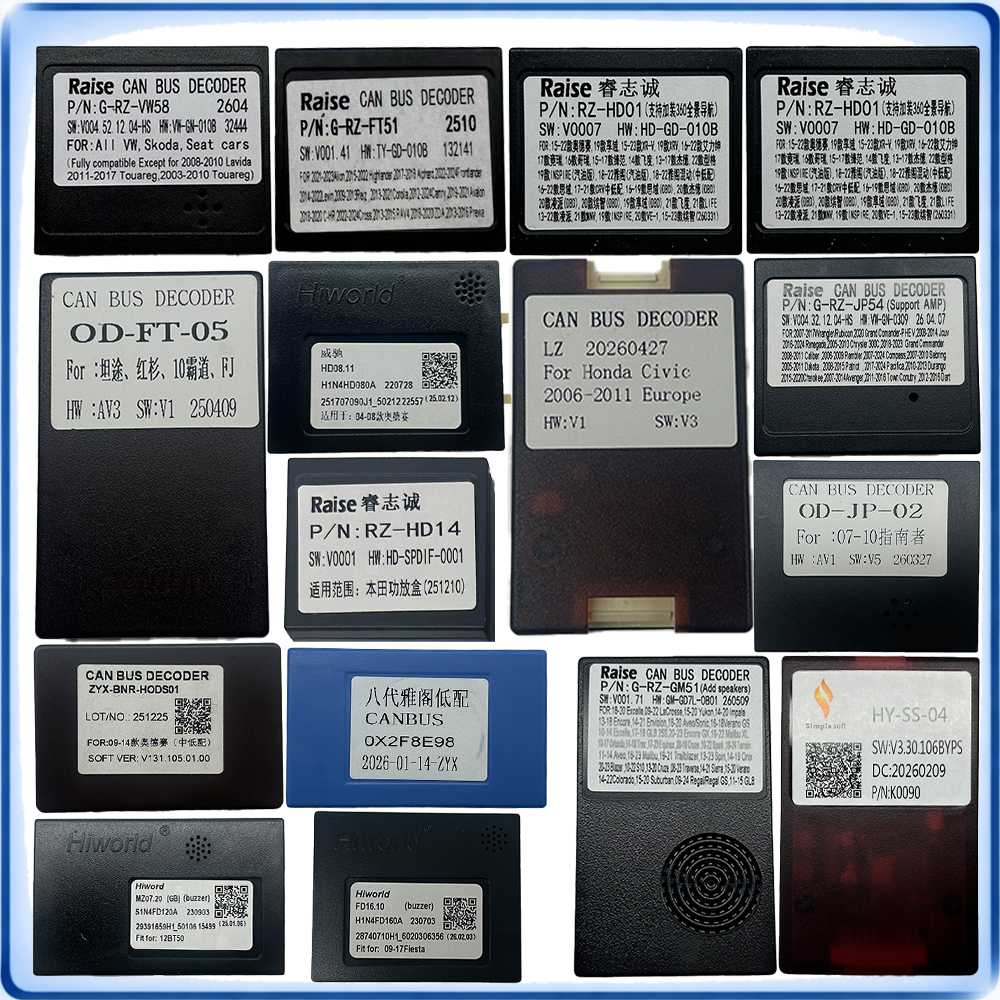
Path B adds the same ZYX-02 harness plus the ZYX-03 CAN Bus Decoder Module. The module is a plug-and-play CAN gateway supporting the CAN 2.0A and CAN 2.0B protocol standards at dual data rates of 500 kbps and 125 kbps, powered at 12 V DC with 300 mA standby consumption and 2 A maximum, rated from -40°C to 85°C. Its housing is flame-retardant ABS, its connector terminals are tin-plated brass, its circuit board is FR-4 glass fiber epoxy resin, and its internals are potted with heat-conductive silicone. It is pre-programmed with model-specific firmware, so installation requires no on-site debugging.
The Fitment Side: The Baseline Neither Path Can Skip
Fitment is where both paths are judged first, because a poorly fitting frame is visible in the first ten seconds and a protocol problem is not. The published ZYX-01 specification is the reference point for what a buyer should be able to check before installation rather than after.
| Fitment parameter | ZYX-01 published specification | Why a buyer should verify it |
|---|---|---|
| Material | ABS plastic | Determines surface finish retention and resistance to dashboard heat cycling |
| Material thickness | 2.5 mm to 3.0 mm | Thin frames flex under trim load; thickness is the first indicator of rigidity |
| Dimensional tolerance | ≤0.2 mm | Directly controls visible gap width around the screen aperture |
| Compatible screen sizes | 7, 9, 10.1 and 12.3 inches | Screen size must be confirmed against the frame before ordering |
| Mounting standard | Double-DIN or model-specific custom | Defines which head unit chassis the frame will actually hold |
| Fitment type | Plug-and-play, no damage to the original interior | Confirms the retrofit is reversible |
| Operating temperature | -40°C to 85°C | Matches the cabin environment the frame will live in |
None of these parameters change when a CAN decoder is added. That is the point of treating fitment as the baseline: a buyer who resolves the frame first can then evaluate the electrical question on its own merits, without the two problems contaminating each other.
The Electrical Side: What Decoding Factory CAN Signals Actually Involves
On vehicles that communicate over a CAN bus, an aftermarket head unit is an uninvited guest on the vehicle network. The factory radio is not simply a radio; it is a node that exchanges messages with the rest of the car. Independent technical explanations of aftermarket CAN adapters describe the decoder's job as translating vehicle network messages, expressed as HEX codes, into UART messages the Android head unit can read - which is how steering wheel controls, air-conditioning data and similar vehicle signals are retained after a retrofit (Quality Mobile Video, CANBUS explained).
The ZYX-03 is specified as a gateway between the vehicle CAN bus and the aftermarket Android car stereo. Per the manufacturer, it is pre-programmed with model-specific firmware so that installation is plug-and-play without on-site debugging, it includes built-in CAN isolation intended to prevent dashboard fault codes, and it is designed to retain OEM steering wheel control functions, vehicle information display and original chime behaviour after an Android head unit installation. The module is sourced from automotive CAN protocol manufacturers with firmware pre-programmed per vehicle model, and is subject to 100% incoming quality inspection.
The electrical envelope is narrow on purpose. A 300 mA standby draw and a 2 A maximum at 12 V DC describe a low-power gateway, and the -40°C to 85°C range matches the harness and frame ratings so that no single component in the kit becomes the weakest thermal link. Dual-rate support at 500 kbps and 125 kbps covers the two CAN speeds encountered across the passenger-car models in ZYX's application database.
Path A does not attempt any of this. The ZYX-02 harness simply carries power and speaker signals through a colour-coded ISO 16-pin interface, with reverse polarity and short-circuit protection, and leaves vehicle network messages untouched. On a vehicle whose radio is not network-integrated in the first place, that is not a compromise - it is the complete job.
Failure Modes That Separate the Two Paths
Buyer complaints after a fascia kit retrofit cluster into three predictable patterns, and each one points at the connector rather than the frame.
Dashboard fault warning codes after retrofit
Fault codes are typically caused by an incompatible CAN decoder protocol, a loose CAN bus interface connection, or a mismatched decoder firmware version. The documented resolution sequence is to confirm the decoder is the model-specific version matching the vehicle, re-seat the CAN bus interface, update the decoder to the matching firmware, then clear the vehicle's historical fault codes and retest. A non-CAN harness path does not generate this failure mode on a non-CAN vehicle, and it does not resolve it on a CAN-equipped one.
Unresponsive steering wheel controls
Steering wheel buttons that stop working after a head unit swap are usually the result of a mismatched CAN bus decoder protocol, a loose steering control pin connection, or a decoder not programmed for the exact vehicle trim configuration. The resolution path is to verify the decoder against model, model year and trim level, re-plug the CAN bus and steering control connectors, confirm the firmware matches the vehicle version, and reflash if necessary. This is the clearest illustration of the difference between the two paths: the symptom exists because something was supposed to translate and did not.
No power at the head unit
A head unit that will not power on after installation is usually traced to a disconnected vehicle battery, poor contact at the power supply pins, a blown built-in fuse on the harness, or reversed polarity. The check sequence is battery connection, harness connector seating, fuse inspection, then polarity confirmation. This failure mode is shared by both paths, which is why harness construction matters independently of decoding.
With vs Without a CAN Decoder: Side-by-Side
The table below compares the two configurations on the criteria that actually drive a purchase decision. It compares configurations, not suppliers: the frame, the harness and the tooling come from the same line in both columns.
| Decision criterion | Path A: non-CAN harness (ZYX-02 + ZYX-01) | Path B: CAN gateway (ZYX-03 + ZYX-02 + ZYX-01) |
|---|---|---|
| Vehicle fit | Specified for non-CAN bus vehicle models | For vehicles equipped with CAN bus communication systems |
| Protocol handling | None; power and speaker signals only | CAN 2.0A / 2.0B, 500 kbps and 125 kbps dual rate |
| Dashboard fault code risk | Not applicable on non-CAN vehicles | Built-in CAN isolation intended to prevent dashboard fault codes |
| Steering wheel controls | Not decoded | Designed to retain OEM steering wheel control functions |
| Vehicle information and chime | Not decoded | Retains vehicle information display and original chime functions |
| On-site configuration | None | None; pre-programmed model-specific firmware, no on-site debugging |
| Electrical rating | 12 V DC, 10 A maximum, reverse polarity and short-circuit protection | 12 V DC, 300 mA standby, 2 A maximum |
| Operating temperature | -40°C to 85°C | -40°C to 85°C |
| Wiring modification required | None; OEM plug plus ISO 16-pin connector | None; OEM plug plus ISO 16-pin connector plus gateway |
| Component count | Two (frame, harness) | Three (frame, harness, gateway) |
| Main limitation | Does not deliver OEM integration on a CAN-equipped vehicle | Only as accurate as the model-year and trim match of its firmware |
The comparison is not close on capability, and it is not meant to be. Path B does more because it has more to do. The real question is whether a given vehicle and a given buyer need that work performed at all.
Matching the Path to the Vehicle and the Job
The application context is the same for both paths: an in-vehicle environment with wide temperature range, constant road vibration, dust and humidity exposure, automotive EMI, and a 12 V DC electrical system. Typical projects include aftermarket head unit upgrades, center console navigation retrofits, used-car interior electronics refurbishment, fleet audio system upgrades and dealership accessory fitting. The paths diverge on the vehicle and on the standard of integration the project promises.
Path A fits the older, simpler end of the market. ZYX's own selection guidance places traditional low-cost approaches with plug-and-play model-specific kits at the premium end; the non-CAN harness route corresponds to vehicles where the original radio is not network-integrated, and to budget retrofits where the requirement is a working radio with no cutting of the factory loom. The harness is explicitly compatible with most aftermarket Android head units and universal car stereos, which is the compatibility profile this segment needs.
Path B fits projects where the vehicle behaves like a system rather than a dashboard. Premium vehicle upgrades, fleet batch modification and dealership pre-delivery fitting are the scenarios where a retained steering wheel control set, a working vehicle information display and an unwarned instrument cluster are part of the deliverable rather than a bonus. The gateway's plug-and-play configuration matters most here: a fleet or a dealership installs the same configuration repeatedly, and any step that requires on-site debugging multiplies across every unit in the batch.
What the Aftermarket Data Suggests
Third-party research supports the direction, though not with numbers specific to fascia kits. Market Research Future estimated the global car audio head unit market at USD 15.44 billion in 2024. Fortune Business Insights reported that Asia Pacific held a 54.21% share of the global car audio market in 2025, which is consistent with where installation hardware and wiring accessories are manufactured. Mordor Intelligence projected 12.18% CAGR for the car aftermarket audio system market, attributing part of that growth to DIY customers and online plug-and-play kits.
The plug-and-play framing is the relevant signal for this comparison. A market shifting toward buyers who install their own hardware shifts the burden of compatibility onto the kit: a self-installer cannot diagnose a CAN protocol mismatch, and a plug-and-play claim that omits the decode step is a claim that only holds on non-CAN vehicles. That is why the two paths are increasingly specified separately by distributors rather than offered as one generic kit.
Two regulatory notes affect planning rather than installation. Car stereo fascia and installation hardware are classified under HS Code 8708.99 (vehicle parts and accessories, not elsewhere classified) per the United Nations Statistics Division. And electronic subassemblies integrated into road vehicles in the EU must comply with e/E-Marking under ECE R10 where they affect vehicle safety functions, rather than relying on CE marking alone (Elite Electronic Engineering). Buyers importing into the EU should treat E-marking as a supplier-level question, not a product-line assumption.
Buyer Acceptance Checkpoints Before a Shipment Is Approved
Both paths are only as good as the inspection regime behind them, and this is where a comparison becomes a procurement document. ZYX's stated quality control for this product line combines 100% incoming inspection for CAN bus decoders with 100% pre-shipment conductivity and fit testing - two different tests, aimed at the two different failure families described earlier. Third-party inspection is accepted, so a buyer can place an independent check between production and dispatch rather than relying on the supplier's own report.
Commercially, the line carries a 12-month product warranty, remote installation technical guidance, free replacement for defective items and professional CAN protocol matching support. Order mechanics are equally explicit: stock items from 1 unit with a 3-7 day lead time, custom OEM/ODM items from 100 units with a 15-25 day lead time, against a monthly capacity of 12,000 units.

Two long-running programs give the acceptance criteria a track record. An aftermarket solution integrator has taken cumulative 19,000+ sets over a 7-year cooperation, covering dash frames, wiring harnesses and CAN bus decoders across multiple car brands, with a return rate below 0.8%. A car multimedia brand owner has taken cumulative 550,000+ sets across 9 years of continuous cooperation on Android head unit retrofit supporting parts, with a return rate below 0.7% and reported protocol compatibility, mass-production stability and new-model adaptation speed as the operative strengths. Return rate is the figure worth weighing hardest, because in this category a return is almost never a cosmetic complaint - it is a fitment or protocol failure discovered at the dashboard.
Where This Comparison Stops Being Useful
Four boundaries are worth stating plainly, because a comparison that only argues for the more complex path is not a comparison.
First, the ZYX-02 harness is specified for non-CAN bus vehicle models. Fitting it to a CAN-equipped vehicle is not a shortcut; it removes the integration the vehicle expects, and the symptoms described earlier are the likely result. Second, the ZYX-03 gateway is only as accurate as its firmware match. Because vehicle configurations vary significantly between model years and equipment levels, ZYX recommends confirming the exact vehicle model, year, original radio, connector and configuration before purchase, and supplying photos of the original dashboard, radio or connector where a model has multiple factory configurations. A model-specific decoder fitted to the wrong trim is still the wrong decoder.
Third, if the vehicle has no CAN bus, the gateway adds cost and a component without adding function. The honest recommendation in that case is Path A. Fourth, this comparison addresses fitment and protocol integration only. It does not establish E-marking status, price positioning against other suppliers, or long-term durability beyond the stated warranty terms; those require separate verification with the supplier and, for regulated markets, separate compliance documentation.
Outlook
The direction of travel is toward the decoder being assumed rather than optional. As more vehicle generations move radio, climate and vehicle-status functions onto the network, the population of vehicles where a plain harness is sufficient keeps shrinking, while the installed base of older non-CAN vehicles keeps the simpler path commercially alive for years yet. For distributors, that argues for holding both configurations as distinct SKUs with distinct application notes, rather than as a single kit with an optional add-on. For installers, it argues for confirming the vehicle's communication architecture before quoting the job, because that single question determines which of the two paths the customer is actually buying.
FAQ
What does a CAN bus decoder do in a head unit retrofit?
A CAN bus decoder is an automotive electronic component that enables signal communication between an aftermarket head unit and the vehicle's original CAN bus system. It parses steering wheel control signals, vehicle status data and dashboard prompts from the original bus, converts them into formats the new head unit can read, and forwards control instructions back to the vehicle network. It is the component that makes full-function plug-and-play retrofit possible on CAN-equipped vehicles.
Can an aftermarket head unit work correctly on a CAN-equipped vehicle without a decoder?
The non-CAN harness path is specified for non-CAN bus vehicle models and carries power and speaker signals only. On a vehicle that broadcasts control and status data over CAN, it does not translate those messages, so functions that depend on network data are not carried to the head unit. The ZYX-02 harness is compatible with most aftermarket Android head units and universal car stereos, but compatibility with the head unit is a separate question from integration with the vehicle network.
Why do dashboard fault warning codes appear after a fascia kit retrofit?
Fault codes after retrofit are typically caused by an incompatible CAN decoder protocol, a loose CAN bus interface connection, or a mismatched decoder firmware version. The resolution sequence is to confirm the decoder is the model-specific version for the vehicle, re-seat the CAN bus interface, update the decoder to the matching firmware, then clear the vehicle's historical fault codes and retest the system.
Why do steering wheel controls stop working after the head unit is replaced?
Unresponsive steering wheel controls are usually caused by a mismatched CAN bus decoder protocol, a loose steering control pin connection, or a decoder not programmed for the exact vehicle trim configuration. Resolution requires verifying the decoder against model, model year and trim level, re-plugging the CAN bus and steering control connectors, and confirming or reflashing the matching firmware.
Do these plug-and-play kits require cutting or modifying the original vehicle wiring?
No. The ZYX-02 harness uses an OEM vehicle-side plug plus an ISO 16-pin head unit connector and supports plug-and-play installation without cutting the original vehicle wiring. The ZYX-03 gateway is likewise supplied as a plug-and-play unit pre-programmed with model-specific firmware, requiring no on-site configuration at the point of installation. The dashboard frame is specified as plug-and-play with no damage to the original interior.
What should be confirmed before ordering a vehicle-specific kit for a CAN-equipped car?
Vehicle brand, model, model year, original radio, original connector, vehicle configuration and audio system all affect which decoder applies, because configurations vary significantly between model years and equipment levels. Where a model has multiple factory configurations, photographs of the original dashboard, original radio or the connectors on the back of the original head unit reduce the risk of a mismatch. The dashboard frame specification - screen size, 2.5-3.0 mm ABS thickness, ≤0.2 mm tolerance - should be confirmed at the same time.
Company profile and full product documentation: ZYX AUTO company profile brochure (PDF).
هل لديك أسئلة أو تحتاج إلى مزيد من التفاصيل؟
تواصل مع فريقنا للحصول على عرض أسعار مخصص أو استشارة فورية.
طلب عرض أسعار
املأ النموذج أدناه وسيتواصل معك فريقنا بعرض مقترح مخصص.
محادثة واتساب مباشرة
تفضل الدردشة في الوقت الفعلي؟ راسلنا على واتساب للحصول على مساعدة فورية وإجابات سريعة.
- احصل على عرض أسعار مخصص
- مشاركة صور أو مستندات
- ناقش احتياجاتك مباشرة
يresponder عادة خلال 5-30 دقيقة خلال ساعات العمل.