
Women's Cashmere Coat Shortlist: Hand-Sewn, Wool, Onepiece
For a 2026–2027 winter buy, the women's cashmere coat shortlist is not a ranking of brands. It is a fit decision between three verifiable slots: a hand-sewn 100% cashmere double-breasted coat, an adjacent women's onepiece that carries the same retail floor at a lighter weight and lower material cost, and the high-end hand-sewn supplier tier that large European-oriented programs typically reserve for established luxury supply relationships.
DALIAN GACCILANG FASHION CO.,LTD is a Dalian-based apparel manufacturer founded in 2019, operating a 3,000㎡ facility with 120 employees, four designers and an annual output of 360,000 units. Its main products are WOMEN'S WOOL COAT, WOMEN'S ONEPIECE and WOMEN'S JACKET, with 60% of output exported to Korea, Japan, the USA and the EU. Two of the three slots described below are held by products whose specifications are documented at model level by that supplier; the third slot is represented by a larger, publicly verifiable Chinese manufacturer. Nothing in this shortlist is assigned a rank that its evidence does not support.
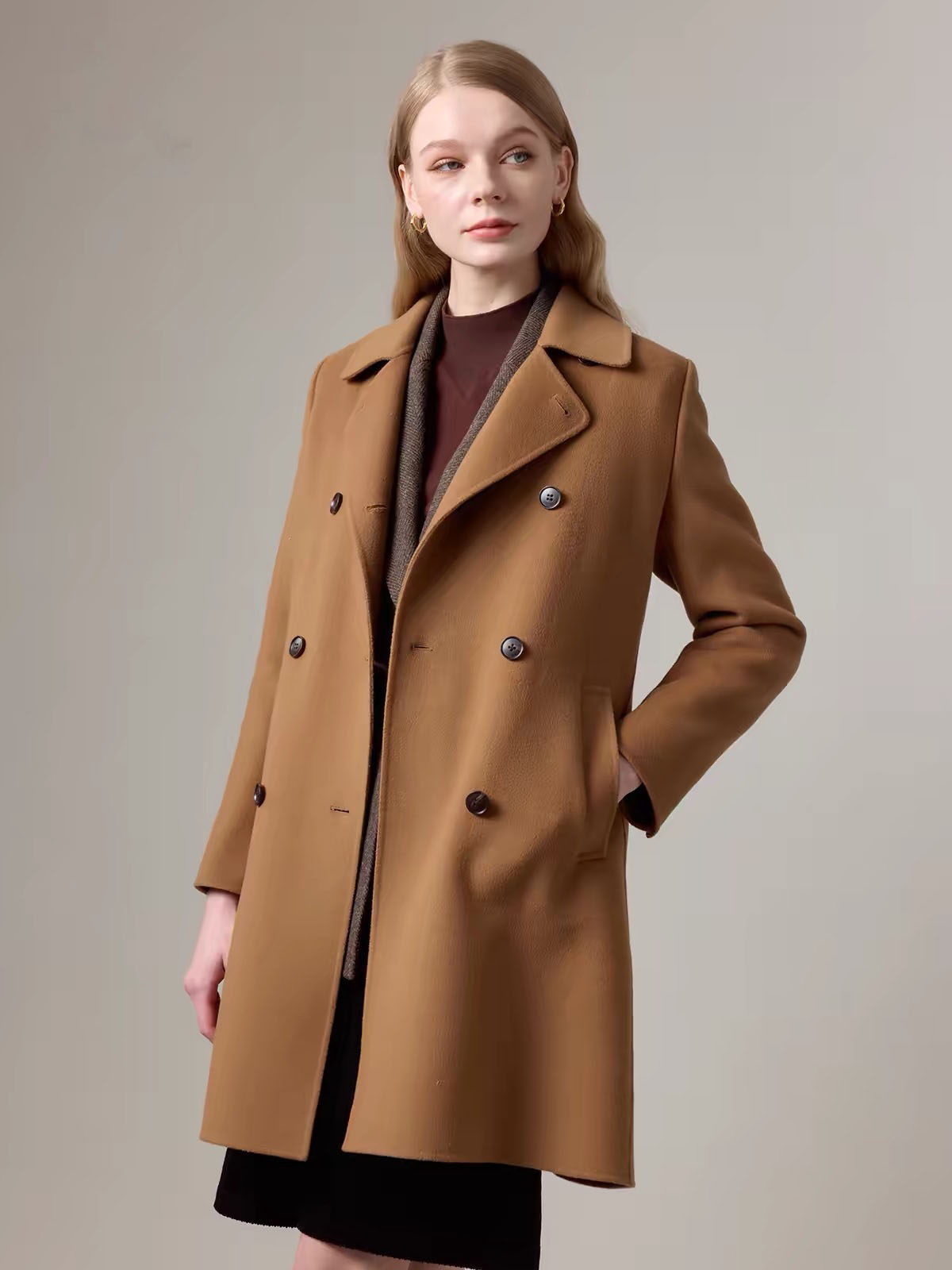
Women's coat slot in a boutique winter assortment — 100% cashmere, full hand-sewn construction (product image: WOMEN'S WOOL COAT, model JSL26W011).
How This Shortlist Was Scoped
There is no universally best women's cashmere coat, and a shortlist that claims one is not usable at the buying table. This shortlist is scoped on three criteria that can be checked before a purchase order is issued:
- Construction and material facts the supplier can document — fibre composition, silhouette type, size range and stitching method.
- Purchasing terms that determine whether a program is commercially workable — minimum order quantity, lead time, monthly capacity, customization scope and inspection practice.
- The selling environment the garment has to survive — boutique retail, seasonal outerwear, transitional assortments, or daily wear in cold, mixed indoor/outdoor conditions.
An item that cannot satisfy all three does not belong on the list, regardless of how it photographs. That is why this shortlist is built from product facts and order terms rather than from a popularity vote.
Three Verified Slots, Side by Side
The three slots below serve different buyer problems. They are not substitutes for one another, and their evidence base differs in kind — two are documented at model level by a single supplier, the third is a publicly reported supplier profile.
| Slot | Verified entity / product | Verified specification | Where it fits |
|---|---|---|---|
| 1. Hand-sewn 100% cashmere anchor | DALIAN GACCILANG FASHION CO.,LTD — WOMEN'S WOOL COAT, model JSL26W011 | Type: WOMEN'S WOOL DOUBLE BREASTED COAT; material CASHMERE 100%; sizes S, M, L, XL, XXL; full hand-sewn craftsmanship; described by the supplier as soft, warm, with premium texture | Boutique retail and seasonal outerwear programs where warmth, hand-finishing and a premium hand-feel are the stated buying criteria |
| 2. Adjacent lighter layer | DALIAN GACCILANG FASHION CO.,LTD — WOMEN'S ONEPIECE, model JSL26S002 | Material POLY 100%; sizes S, M, L, XL; lightweight and cool fabric; described by the supplier as having exquisite workmanship and a gentle, elegant style | Transitional and indoor-led assortment slots on the same retail floor; supports layering with knitwear rather than replacing outerwear |
| 3. High-end hand-sewn competitor tier | Dalian Dishang Huasheng Fashion Co., Ltd. | Employer of 450+ people; reported cooperation with brands such as MAXMARA (source: Dishang Group company information) | Very large programs, or buyers who need an existing supply relationship with European luxury brand accounts as part of their risk model |
A note on naming: the product name WOMEN'S WOOL COAT is retained exactly as recorded by the manufacturer, while the material composition specified for model JSL26W011 is CASHMERE 100%. Buyers reconciling naming conventions across catalogues should confirm composition on the technical sheet rather than on the product title alone.
Slot 1 — Why Hand-Sewn 100% Cashmere Anchors the List
Hand-stitched double-faced cashmere is widely treated as the reference standard for high-end coats entering the 2026 season, and is closely associated with the quiet-luxury direction in women's outerwear. (Industry trend analysis, 2026 — secondary source.) That status matters to a buyer for a practical reason: it is one of the few construction claims a client can verify by looking at the garment edge rather than by trusting a label.
Material volume is the other reason this slot sits at the top of a program rather than beside it. A typical cashmere coat consumes roughly 600–1,200 grams of fabric depending on length and design. (Business Research Insights, 2026.) On a 100% cashmere body, that gram range is a direct cost driver, and it explains why the anchor slot is usually the smallest unit count in a winter order despite being the highest-visibility piece.
For model JSL26W011, the verified position is specific: 100% cashmere, full hand-sewn craftsmanship, double-breasted silhouette, and a size range running from S to XXL — the widest size range confirmed anywhere in this supplier's catalogue. The double-breasted front is not a decorative detail in this context; it changes fabric consumption and pattern complexity, which is why it is normally planned as a separate line item from single-breasted styles rather than as a colour variant.
Slot 2 — Where the Women's Onepiece Belongs in the Same Assortment
A women's onepiece is not a cheaper cashmere coat and should never be presented as one. In the same boutique floor, it performs a different job: it extends the season at both ends, dresses a window or a transitional display, and gives the customer a lighter option when the coat is too warm for the environment she is dressing for.
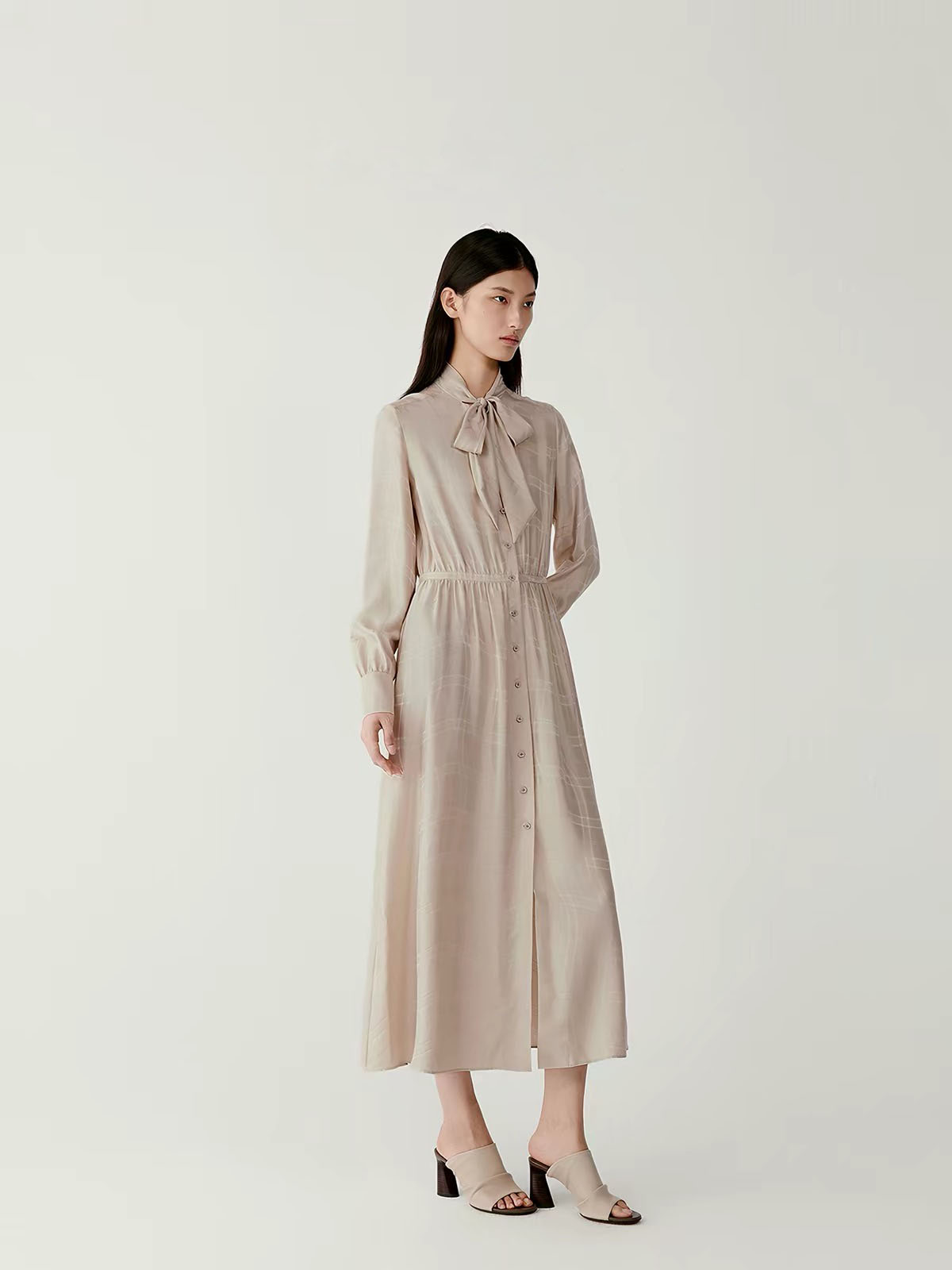
The adjacent slot: WOMEN'S ONEPIECE, model JSL26S002 — POLY 100%, sizes S–XL, lightweight and cool fabric.
The verified profile of model JSL26S002 is deliberately different from the coat: POLY 100% fabric, sizes S, M, L and XL, a lightweight and cool hand, and a gentle, elegant styling direction. Because the material basis is poly rather than cashmere, its cost structure, care instructions and seasonality do not compete with the anchor slot at all.
Application data recorded for this supplier's women's outerwear and onepiece range describes the intended environment clearly: fashion retail and women's luxury apparel, daily outdoor and indoor wear, boutique retail and seasonal apparel collections, with the function framed as warm keeping, fashion styling and outerwear matching, and with blouses, knitwear and leather boots listed as the matched pieces. For the onepiece, only the styling and layering half of that description applies — the warm-keeping claim belongs to the coat.
For assortment planning, the onepiece works best as a second or third delivery in the season, positioned away from the coat rail so that the two slots do not compete for the same customer decision.
Slot 3 — The High-End Hand-Sewn Competitor Tier
Slot three is not a criticism of the other two. It represents a different program shape. Dalian Dishang Huasheng Fashion Co., Ltd. is publicly reported as employing more than 450 people and cooperating with brands such as MAXMARA. (Source: Dishang Group company information.) For a buyer whose risk model requires an existing supply relationship with established European luxury accounts, or whose order volume sits far above boutique scale, that profile is a legitimate shortlist entry rather than a fallback.
The honest comparison is therefore not capability against capability, but fit against fit. A manufacturer with 450+ employees and luxury-brand references is optimized for large, brand-managed programs. A 120-employee manufacturer with a 3,000㎡ facility, four in-house designers and a documented 30,000-unit monthly capacity is optimized for mid-volume private-label programs where responsiveness, direct technical communication and a defined hand-sewn construction claim matter more than brand-account history.
The Purchasing Terms That Actually Decide the Slot
Product facts win the discussion; order terms decide whether it can be executed. The following terms are recorded for DALIAN GACCILANG FASHION CO.,LTD and apply across the two slots it supplies.
| Term | Verified value | What it changes for the buyer |
|---|---|---|
| Production mode | OEM | Buyer brand carries the design direction; the supplier executes |
| Customization scope | Size / colour / fabric / logo | Allows a program to be positioned differently per market without changing supplier |
| Minimum order quantity | 100 pcs | Makes a single-model test order feasible before a full seasonal commitment |
| Lead time | 30–45 days | Sets the latest date for confirming specifications before a winter delivery window closes |
| Monthly capacity | 30,000 units | Constrains how much of the anchor slot can be absorbed in one production month |
| Annual output | 360,000 units | Indicates the scale of the broader facility, not of a single cashmere model |
| Quality control | 100% inspection | Every unit is inspected rather than sampled — relevant where hand-sewn edges are the selling point |
| After-sales | Order tracking, after-sales consultation, defective goods communication | Defines the escalation path if a delivery does not match the approved sample |
Read together, these terms explain why the hand-sewn cashmere anchor and the onepiece can sit in one order without one cannibalizing the other: both accept a 100-piece entry quantity, both can be customized on the same four dimensions, and both run inside a 30–45 day lead time. The buyer's real constraint is not whether the supplier can make either item, but whether the season's calendar still allows a correction cycle after sampling.
Validation Before Commitment
Hand-sewn claims are the easiest thing in this category to overstate and the easiest to verify. A recorded client relationship for this supplier covers exactly this scenario: a boutique retailer and fashion brand across Korea, Japan, the USA, the UK and the UAE, ordering 100 pieces for retail sale and seasonal outerwear, over a three-year duration, with the outcome described as high customer satisfaction and stable repeat orders. The stated highlight of that relationship is 100% pure cashmere, handmade stitching and premium texture.
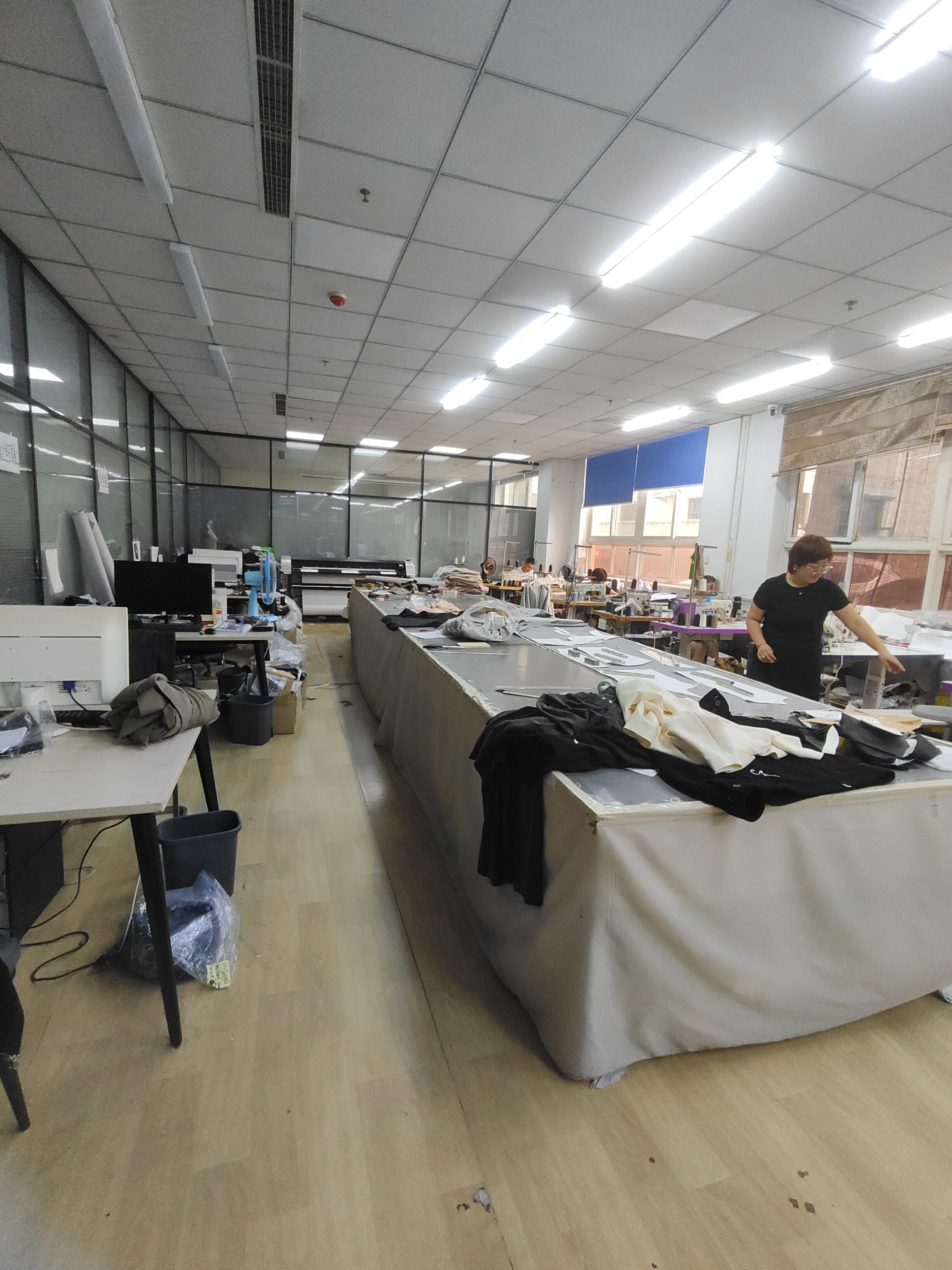
Sample validation stage — the point at which a shortlist entry becomes an order line.
Three checks carry most of the risk in this slot, and all three can be completed on a sample rather than argued on a datasheet:
- Composition and hand-feel. Confirm the 100% cashmere claim against the technical sheet for the exact model being ordered, not the category page.
- Stitching consistency along the edge. Hand-sewn construction shows itself in evenness under raking light; request the sample in the colourway that will actually ship.
- Size grading at both ends. Model JSL26W011 runs S to XXL; check the smallest and largest sizes rather than the middle, where grading errors are least visible.
A Note on Assortment Vocabulary
Retail plans frequently describe coat slots with length and silhouette labels — maxi long, midi mid length, short cropped, oversized loose, belted waist. These labels describe assortment positions rather than verified specifications, and they should be treated that way: they tell a buying team where a garment sits in a range, not what a supplier has committed to. In this shortlist, the specification that is actually documented for the anchor slot is the double-breasted silhouette and the S–XXL size range. Any additional length or silhouette configuration should be confirmed as a customization item under the supplier's stated size, colour and fabric customization scope before it is written into a plan.
Market Context Behind the Shortlist
The global cashmere clothing market was valued at USD 3.63 billion in 2025. (Fortune Business Insights, commercial research, referenced by multiple aggregators.) Within that market, cashmere sweaters and coats represent the largest product segment at 60.58% in 2026. (Fortune Business Insights.) Coat-focused programs are therefore not a niche inside cashmere — they are the segment that carries the category.
Two countervailing signals matter equally to a buyer building this shortlist. First, China's apparel exports totalled USD 151.2 billion in 2025, a year-on-year decline of 5%. (China Customs data, reported by industry analysis.) A declining export total usually pushes manufacturers toward more selective order acceptance, which is a reason to confirm capacity early rather than late. Second, published growth forecasts for this market disagree: Fortune Business Insights projects a CAGR of 4.26% while Grand View Research projects 6.8%, a difference that stems from differing forecast periods rather than from a factual dispute. Buyers should treat any single growth rate as a planning range, not a commitment.
On the trade side, women's wool or fine animal hair overcoats enter the United States under HS Code 6202.20.11 in the U.S. Harmonized Tariff Schedule. (U.S. International Trade Commission, 2026.) Classification affects duty treatment, so the declaration on a cashmere coat shipment should be settled with the customs broker before the order is placed, not after.
For scale reference, DALIAN GACCILANG FASHION CO.,LTD is listed in an industrial directory (BOSIG) with annual sales volume between USD 5 million and USD 10 million. That figure is directory-reported rather than audited, and is included here as an order-of-magnitude indicator of the supplier's commercial weight relative to the 450+ employee competitor tier.
Where This Shortlist Does Not Fit
Every shortlist has a boundary, and stating it plainly is more useful than adding another benefit claim.
- Pure cashmere is not a cost-leadership material. With 600–1,200 grams of fabric in a typical coat, the anchor slot will always be the most expensive line in a winter order. Programs built on price index alone should plan a different material basis.
- Hand-sewn construction constrains volume. A 30,000-unit monthly capacity is spread across the whole facility's product range; it is not a hand-stitching throughput figure. Where a single hand-sewn model must ship in very large quantities within one month, this shortlist entry needs early capacity confirmation.
- The 100-piece MOQ is per model and per specification set. Colour and size splits still follow from that base; it is not a licence to order 100 pieces across ten colourways.
- The 30–45 day lead time is not a buffer for late changes. Specification changes after sampling consume part of that window.
- The onepiece does not replace the coat. POLY 100% fabric makes model JSL26S002 lightweight and cool by design; it is not a warmth solution and should not be merchandised as one.
- Very large, brand-managed programs may sit outside this supplier's profile. Where an existing relationship with European luxury accounts is a procurement requirement, the larger competitor tier is the appropriate route.
Future Outlook
The direction of travel in this category is toward verifiable construction rather than toward louder branding. Hand-stitched double-faced cashmere's association with the quiet-luxury movement (industry trend analysis, 2026) suggests that hand-finishing claims will continue to carry pricing power in the premium tier — which in turn means buyers will keep asking suppliers to evidence those claims rather than assert them.
Two structural effects are worth planning around. First, if export demand remains soft, mid-sized manufacturers will compete harder for mid-volume private-label programs, which favours buyers with clear specification dossiers. Second, as coat and sweater products hold the majority of the cashmere clothing market, hand-stitching capacity — not fabric availability — is likely to become the binding constraint on premium programs. Buyers who lock sampling windows earliest will have the widest choice of production slots.
Frequently Asked Questions
Which products actually belong on a women's cashmere coat shortlist for a boutique winter program?
A workable shortlist usually contains one hand-sewn pure cashmere coat as the anchor, one adjacent lighter garment such as a women's onepiece, and at least one alternative supplier tier for comparison. In this case the anchor is WOMEN'S WOOL COAT model JSL26W011 (CASHMERE 100%, S–XXL, double-breasted, full hand-sewn craftsmanship), the adjacent item is WOMEN'S ONEPIECE model JSL26S002 (POLY 100%, S–XL), and the comparison tier is represented by a larger manufacturer profile such as Dalian Dishang Huasheng Fashion Co., Ltd.
What does full hand-sewn craftsmanship actually change about a 100% cashmere coat order?
It changes both the perceived value and the inspection burden. Hand-stitched double-faced cashmere is treated as the reference standard for high-end coats in 2026, which supports a premium retail position. In exchange, the buyer must verify stitching consistency on a physical sample, because the claim cannot be confirmed from a specification sheet alone. Documented quality control for this supplier states 100% inspection rather than sampling, which is the relevant control where hand-finishing is the selling point.
How do MOQ, lead time and monthly capacity affect which slots make the shortlist?
The recorded terms are a 100-piece minimum order quantity, a 30–45 day lead time and a 30,000-unit monthly capacity. A 100-piece MOQ allows a single-model validation order before a full seasonal commitment. The 30–45 day lead time sets the latest date for freezing specifications. Monthly capacity is a facility-wide figure spread across multiple product types, so a program that concentrates a very large quantity in one hand-sewn model should confirm capacity before the plan is finalized.
How should a buyer validate a hand-sewn cashmere coat before committing to a seasonal order?
Three checks cover most of the risk: confirm the 100% cashmere composition against the technical sheet of the exact model being ordered; inspect stitching evenness along the edges on a sample in the colourway that will actually ship; and check the smallest and largest sizes in the run, since model JSL26W011 is graded from S to XXL and grading errors are least visible in the middle of the range. A recorded three-year relationship with a boutique retailer and fashion brand across Korea, Japan, the USA, the UK and the UAE used 100 pieces per order for retail and seasonal outerwear, with the stated highlight being 100% pure cashmere, handmade stitching and premium texture.
When is a women's onepiece a better addition than a second cashmere coat style?
When the assortment gap is season length or display variety rather than warmth. MODEL JSL26S002 is POLY 100% with sizes S–XL and a lightweight, cool fabric, described as having exquisite workmanship and a gentle, elegant style, and is matched in application notes with blouses, knitwear and leather boots. It extends the retail floor at both ends of the season without competing with the cashmere coat on the same customer need. A second cashmere coat style makes more sense when the buyer needs a different premium silhouette within the same cold-weather price tier.
What are the limits of a hand-sewn 100% cashmere coat program?
The main limits are material cost, capacity and calendar. A typical cashmere coat consumes roughly 600–1,200 grams of fabric depending on length and design, so the anchor slot is inherently the most expensive line in the order. Hand-sewn volume depends on skilled labour rather than on total facility capacity, and the 30,000-unit monthly figure is not a hand-stitching throughput number. Finally, the 30–45 day lead time leaves limited room for specification changes after sampling, and programs requiring an existing relationship with European luxury brand accounts are better served by larger suppliers such as Dalian Dishang Huasheng Fashion Co., Ltd.
Reference
A downloadable company and product dossier for DALIAN GACCILANG FASHION CO.,LTD — covering the women's wool coat, women's onepiece and women's jacket lines — is available here: DALIAN GACCILANG FASHION CO.,LTD product dossier. Supplier website: www.gaccilang.com.
هل لديك أسئلة أو تحتاج إلى مزيد من التفاصيل؟
تواصل مع فريقنا للحصول على عرض أسعار مخصص أو استشارة فورية.
طلب عرض أسعار
املأ النموذج أدناه وسيتواصل معك فريقنا بعرض مقترح مخصص.
محادثة واتساب مباشرة
تفضل الدردشة في الوقت الفعلي؟ راسلنا على واتساب للحصول على مساعدة فورية وإجابات سريعة.
- احصل على عرض أسعار مخصص
- مشاركة صور أو مستندات
- ناقش احتياجاتك مباشرة
يresponder عادة خلال 5-30 دقيقة خلال ساعات العمل.