
Women's Onepiece, Wool Coat & Cashmere Coat Buyer Scorecard
Women's Onepiece, Wool Coat & Cashmere Coat Buyer Scorecard

Construction evidence starts on the production floor, not in the catalogue. (Source: DALIAN GACCILANG FASHION CO.,LTD)
Women's outerwear is normally bought as a set rather than as individual garments. A boutique, private-label or wholesale buyer will place a women's onepiece, a women's wool coat and a women's cashmere coat into the same seasonal buy, and then evaluate all three with the same three questions: what it costs, how it looks, and whether the factory can deliver it on time. Those questions are necessary, but they are not sufficient, because the three categories do not fail in the same way. A single-category specification sheet cannot show that difference.
This reference sets out a buyer-side scorecard for the three categories, built from confirmed product and capability documentation supplied by DALIAN GACCILANG FASHION CO.,LTD. The company is a women's outerwear manufacturer based in Jinzhou District, Dalian, China, founded in 2019. Its stated main products are women's wool coats, women's onepieces and women's jackets. It operates a 3,000 m² facility with 120 employees and four designers, exports approximately 60% of its output to Korea, Japan, the USA and the EU, and reports a monthly production capacity of 30,000 pieces against an annual output of 360,000 units.
The scorecard compares construction evidence, fit architecture, retail positioning, order threshold and lead time, quality control, and the specific risk boundary of each category. It does not rank factories, it does not publish prices, and it does not repeat supplier marketing claims. Where the supplied documentation stops, the scorecard says so and marks the item for verification.
Why the usual three-question evaluation breaks down
At the evaluation stage, buyers typically compare suppliers on price per piece, sample appearance and delivery promises. At the execution stage, the same buyers discover that the risk they should have measured was different for each garment type.
For a women's onepiece, the exposure is fit and drape. Pattern grading, hem line, closure placement and lining behaviour decide whether a size run sells through or comes back. For a tailored wool coat, the exposure is structure and composition: interlining, shoulder construction, and whether the fibre named on the line sheet is the fibre that arrives. For a hand-sewn cashmere coat, the exposure is workmanship consistency: whether the hand-stitched edges in the bulk order match the sample that was approved.
A scorecard is useful precisely because it forces those three failure modes into one document. A buyer negotiating a single order across three categories can then see which verification step belongs to which garment, and which of them cannot be skipped because the sampling stage has already closed.
How the scorecard is structured
Six criteria are applied to each of the three categories. Each criterion carries one of three decision labels.
- Documented — the point is confirmed in the supplied product, capability or case documentation.
- Conditional — category-level evidence exists, but the model-level detail still has to be confirmed before the purchase order is placed.
- Requires verification — the supplied documentation does not confirm the point, and the buyer must obtain it from the sample round, the line sheet or a fibre test report.
The labels are decision-support descriptors. They are not measurements, certificates or test results, and they should not be quoted as such in a tender document or a purchase agreement.
Criterion 1 — Construction evidence
Construction evidence answers a simple question: can the buyer see, before bulk production, exactly how the garment is put together?
For a women's onepiece, the evidence set is dress construction — panel seams, darts, closure hardware, lining attachment and hem finish. How the garment behaves on the body is governed mainly by fabric weight and grain rather than by internal structure, which is why an onepiece can look correct on a hanger and still fail across a size run.
A tailored wool coat adds structure. In the confirmed record, the women's wool coat model JSL26W011 is listed as a women's wool double-breasted coat with sizes S, M, L, XL and XXL. Double-breasted construction duplicates the front panel and the closure, so button placement, front symmetry and lapel roll become measurable inspection points rather than style opinions.
The cashmere coat in the confirmed case specification is described as 100% pure cashmere with fully hand-sewn craftsmanship and a 450 g/㎡ fabric. Hand-sewn double-faced construction joins two fabric faces by hand and finishes the exposed edges with hand stitching, so no lining hides the interior of the garment. Industry trend analysis treats hand-stitched double-faced cashmere as the reference standard for high-end coats in 2026, a position associated with the quiet luxury movement. Buyers should read that status carefully: the construction is not only a quality marker, it is also the point at which quality can vary most between sample and bulk.
Practical evidence to attach to the order: a sealed construction sample, close-up photographs of edge finishing and stitch lines, a stated fabric weight and fibre composition, and the per-piece inspection record used before delivery.
Criterion 2 — Fit architecture
Fit architecture covers the confirmed size range, the grading logic, and the design variables that change how a size letter behaves on the body.
The only model-level size range confirmed in the supplied documentation is on the women's wool coat line: model JSL26W011 is offered in S, M, L, XL and XXL. For the women's onepiece and the cashmere coat, the supplied record confirms the production categories and the customization scope but does not publish a model-level size chart, which is an item buyers should mark as requiring verification.
Two documentation habits reduce fit risk across all three categories. The first is to specify design variables as measurable classes rather than as adjectives: length class (maxi, midi, short), shoulder drop (fitted or oversized), closure type (single-breasted or double-breasted), and collar type (lapel collar, hooded, belted waist, fur collar). The second is to reconcile the naming and composition fields on the line sheet. In the supplied record, for example, a product named as a women's wool coat carries a material field listed as 100% cashmere. That is not a quality claim in either direction; it is a reminder that the product name, the composition field, the sample label and any fibre test document have to be read against each other before bulk release.
Criterion 3 — Retail positioning and merchandising role
Positioning decides how much verification a category can economically justify, because a garment with a long wear cycle and a low replenishment rate can absorb inspection steps that a high-turnover basic cannot.
The confirmed documentation places hand-sewn cashmere coats with mid-to-high-end women's clothing stores and custom apparel clients. That channel has a slower replenishment rhythm, a longer wear cycle and a higher tolerance for hand-finishing cost. Wool coats are seasonal outerwear sold in larger unit volumes, where interlining consistency and size-run completeness matter more than edge finishing. Onepieces are outfit-led purchases: the consumer decides on silhouette and drape, so the retail risk sits in fit, hem line and how the garment hangs and photographs.
The case record behind this scorecard shows the channel profile these three categories typically serve: boutique retailers and fashion brands in Korea, Japan, the USA, the UK and the UAE, buying around 100 pieces, using the products for retail sales and seasonal outerwear, with a three-year relationship and stable repeat orders.
Criterion 4 — Order threshold, lead time and commercial terms
The commercial frame is identical for all three categories, because it comes from the production platform rather than from the garment type.
| Term | Confirmed value |
|---|---|
| Minimum order quantity | 100 pcs |
| Production lead time | 30–45 days |
| Monthly capacity | 30,000 units |
| Delivery terms | FOB / CIF |
| Payment terms | TT / LC |
| Acceptance criteria | Pre-shipment test |
Two consequences follow for a three-category programme. First, the categories draw on one capacity pool, so they have to be sequenced rather than launched simultaneously at peak. Second, a lead time of 30 to 45 days rules out short in-season replenishment: a buyer who needs to refill a selling style inside a month cannot do it on this platform, and should plan initial order depth accordingly.
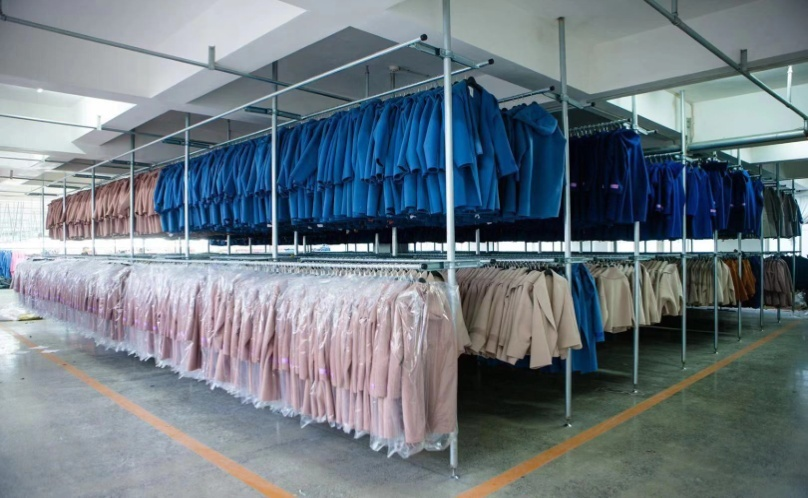
Finished-goods staging and dispatch. Pre-shipment inspection and batch records are the buyer's last control point. (Source: DALIAN GACCILANG FASHION CO.,LTD)
Criterion 5 — Quality control and documentation
The documented control regime is 100% inspection, supported by order tracking, after-sales consultation and a defined channel for communicating defective goods.
For hand-sewn and double-faced garments, the inspection regime matters more than the inspection rate. Because edge finishing is done by hand, the record that protects a buyer is batch-level: which fabric batch, which stitching procedure, and which production line produced a given delivery. Buyers evaluating any hand-finished coat should request that traceability before the order is placed, not after a complaint is raised.
Documentation also has a customs dimension. In the United States, HS Code 6202.20.11 specifically covers women's wool or fine animal hair overcoats in the Harmonized Tariff Schedule. A mixed programme of wool coats and cashmere coats therefore needs its classification and fibre declaration to align with the shipping documents, which is a documentation task rather than a production task.
Criterion 6 — The risk boundary: hand-sewn versus high-end hand-sewn
The most consequential question in this scorecard is not which coat is better made. It is whether the bulk order will match the approved sample.
The documented risk is specific. Finished coats can differ from the confirmed sample in fabric and in workmanship, which produces customer returns, after-sales complaints and long-term damage to a channel's reputation. Three triggers are identified: hand-sewing procedures simplified when the production window is tight, cashmere fabric specifications changed during production, and coats of different quality levels mixed inside one delivery.
The documented mitigation is procedural rather than promotional. Seal the confirmed sample after the order is confirmed. Inspect every coat before delivery. Keep records of fabric batches and production procedures. Where a complaint does occur, the documented response is to arrange exchange or replenishment, inspect the production line, and upgrade the quality control standard so the same issue does not repeat.
Read against the scorecard, that reframes the hand-sewn versus high-end hand-sewn purchase question. The comparison that protects a buyer is not a brand comparison; it is a comparison of verified procedure — sealed sample, per-piece inspection, batch records and a defined remedy. A supplier that cannot produce those four items has not answered the question, however the coat is described.
The scorecard at a glance
| Criterion | Women's Onepiece | Women's Wool Coat | Women's Cashmere Coat |
|---|---|---|---|
| Construction evidence | Category level only: dress-type panel construction; lining, closures and hem finish are the inspection points. Model-level record not supplied — requires verification. | Documented at model level: JSL26W011, women's wool double-breasted coat, sizes S–XXL. | Documented at category level: 100% pure cashmere, hand-sewn craftsmanship, 450 g/㎡ fabric in the confirmed case specification. |
| Fit architecture | Size range, grading and length classes not specified in the supplied record — requires verification. | Documented: S, M, L, XL, XXL on model JSL26W011. | Conditional: fibre and construction are documented; size range is not. |
| Retail positioning | Outfit-led, style-driven purchase; replenishment follows fashion cycles. | Seasonal outerwear and layering item; broader unit distribution. | Mid-to-high-end women's clothing stores and custom apparel clients, per confirmed documentation. |
| Order threshold and lead time | Common to all three: MOQ 100 pcs, lead time 30–45 days, monthly capacity 30,000 units, FOB/CIF, TT/LC, pre-shipment test as acceptance criteria. | ||
| Quality control | 100% inspection, order tracking, defective-goods communication. | 100% inspection; interlining and front symmetry as added check points. | 100% inspection; hand-stitching and fabric-batch records recommended. |
| Primary risk boundary | Fit, drape and grading mismatch across the size run. | Composition and naming reconciliation; interlining and closure consistency. | Bulk workmanship differing from the sealed sample; simplification of hand-stitching under time pressure. |
What the manufacturer documentation confirms
DALIAN GACCILANG FASHION CO.,LTD is a women's outerwear manufacturer based in Jinzhou District, Dalian, China, founded in 2019. Its stated production scope covers women's wool coats, women's onepieces and women's jackets. It runs a 3,000 m² facility with 120 employees and four designers, and reports an annual output of 360,000 units against a monthly capacity of 30,000 pieces.
The capability record confirms OEM production with customization across size, colour, fabric and logo, a minimum order quantity of 100 pcs, a lead time of 30–45 days, 100% inspection, and export markets covering Korea, Japan, the USA and the EU. The stated after-sales scope is order tracking, after-sales consultation and defective goods communication.
The confirmed case record is a boutique retailer and fashion brand order of around 100 pieces, produced for retail sale and seasonal outerwear in Korea, Japan, the USA, the UK and the UAE, with a three-year relationship and stable repeat orders. The product highlight recorded for that case is 100% pure cashmere, handmade stitching and a premium texture.
Independent directory information places the company's annual sales volume between US$5 million and US$10 million. That figure is reported by an industrial directory rather than audited, and should be read as an indication of scale rather than as a financial statement.
Application — how the three categories behave inside one programme
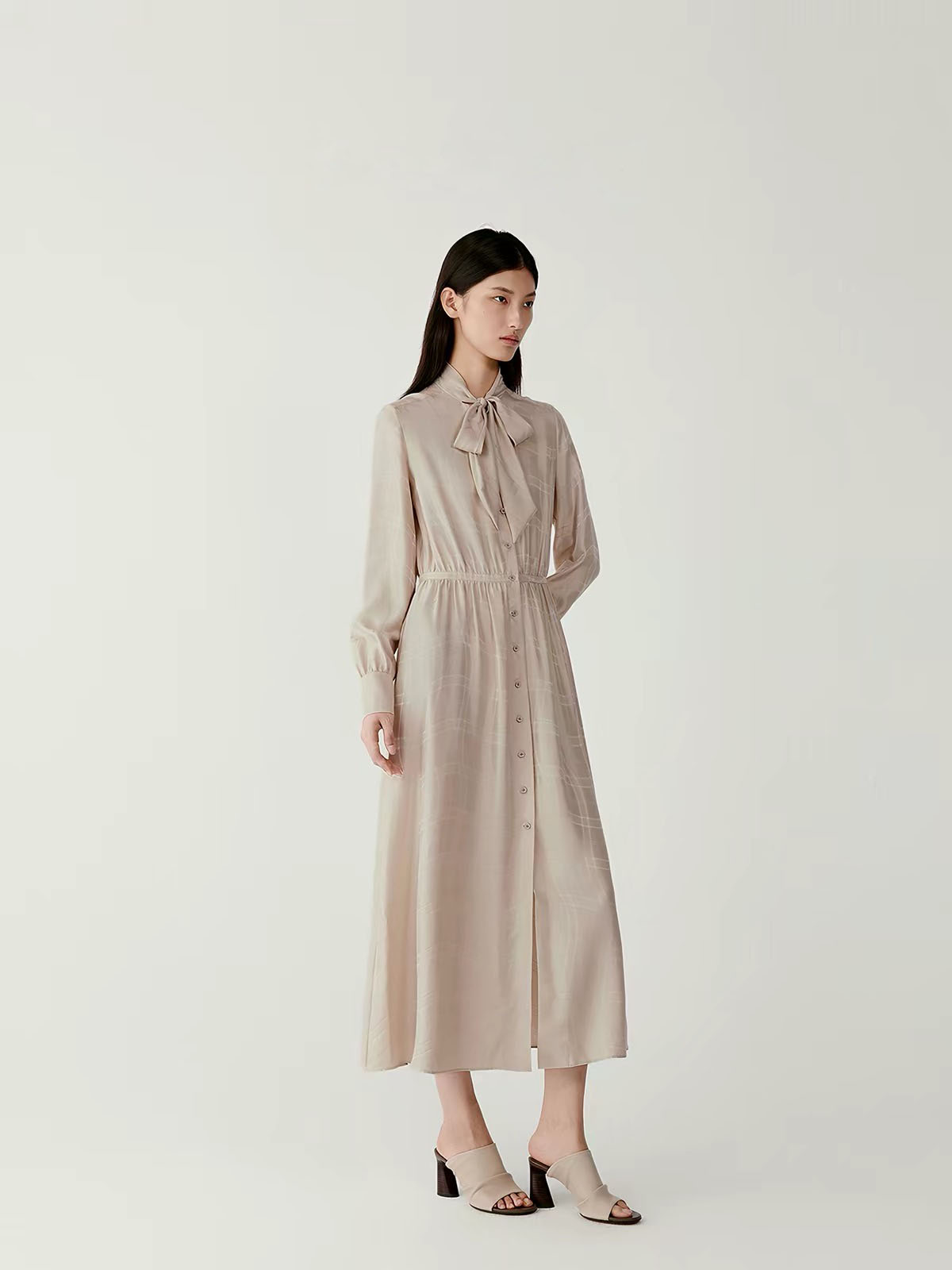
WOMEN'S ONEPIECE — the category where fit and drape, rather than internal structure, carry the retail risk. (Source: DALIAN GACCILANG FASHION CO.,LTD)
- Boutique and fashion-brand programmes. Orders of around 100 pieces per style across a mixed category buy for retail sale of seasonal outerwear. Verification focus: fit and drape for onepieces, composition and front symmetry for wool coats, hand-stitch consistency for cashmere coats.
- Private-label coat lines. Model-level sizing such as S–XXL on the confirmed wool coat model is matched against the buyer's own grade rules, with customization of fabric and logo. Verification focus: interlining specification, closure hardware and size-run completeness.
- Custom apparel clients. Smaller runs of hand-finished cashmere pieces, where the client's own fitting process replaces a broad size run. Verification focus: sealed sample, batch records and the defined remedy for defective goods.
Market context — why construction evidence is gaining weight
Demand for documented construction is rising with the size of the category. The global cashmere clothing market was valued at USD 3.63 billion in 2025, according to Fortune Business Insights as referenced by multiple market aggregators. Within that market, cashmere sweaters and coats represented 60.58% of the total in 2026, which places outerwear at the centre of the category rather than at its edge.
Export pressure is moving in the opposite direction. China's apparel exports totalled USD 151.2 billion in 2025, a year-on-year decline of 5% according to customs-derived industry analysis. When volume growth slows, differentiation shifts toward fibre documentation, construction method and traceability, because those are the attributes a wholesale buyer can verify and a retail buyer can restate.
Two data cautions belong in this section. First, published growth forecasts for the cashmere category differ between research houses, which reflects methodology differences rather than a market contradiction; a sourcing plan should not be built on a single forecast. Second, a typical cashmere coat contains 600–1,200 grams of fabric depending on length and design, which is a material-requirement estimate from commercial research rather than a confirmed figure for any specific style. Style-level fabric consumption has to be confirmed per garment.
Limits of this scorecard and of hand-sewn construction
The scorecard is useful only if its boundaries are stated as clearly as its criteria.
- Design boundaries. Hand-sewn double-faced construction is unlined and edge-finished. It does not substitute for a structured, fully lined tailored coat where pad-stitched shoulders, internal interlining or shaped internal support are required. Buyers whose assortment depends on structured tailoring should treat the hand-sewn route as a separate product family, not as a substitute.
- Capacity allocation. A monthly capacity of 30,000 units is shared across three categories on the same production platform. Peak-season allocation is therefore a planning constraint, and categories have to be scheduled against each other.
- Volume floor. The documented minimum order quantity is 100 pcs. Test quantities below that threshold sit outside the stated commercial terms, regardless of garment type.
- Lead-time floor. A production window of 30–45 days excludes short in-season replenishment and any buying cycle built on rapid repeat orders.
- Fit validation. No document can confirm fit for a specific consumer base. Only a sample round fitted on the buyer's own size set can do that, and the scorecard cannot replace it.
- Cost basis. No verified production cost figures for the three categories are published in this reference. The cost drivers are fibre content, fabric weight, hand-finishing labour and pattern complexity. Any percentage cost advantage quoted during a negotiation should be supported by its calculation basis before it is used in a comparison.
Future outlook
Three developments are likely to shape how these categories are bought over the next buying cycles. First, construction evidence is becoming a commercial document rather than a quality gesture: sealed samples, batch records and per-piece inspection are increasingly requested at tender stage, not after a complaint. Second, hand-stitching capacity is a labour-bound constraint, which means the supply of authentic hand-finished double-faced coats cannot expand as quickly as demand for quiet luxury outerwear. Third, blended wool and cashmere lines offer volume buyers a way to hold price architecture while keeping a pure-cashmere flagship in the assortment, and buyers should expect to manage both in the same programme.
For a buyer evaluating onepieces, wool coats and cashmere coats together, the practical implication is that the scorecard should be completed before sampling closes. Once the sample is sealed, the criteria stop being questions and become obligations.
FAQ
What distinguishes a women's onepiece, a women's wool coat and a women's cashmere coat as sourcing categories?
They differ in construction and in where the retail risk sits. A women's onepiece is a dress-type garment decided on silhouette, drape, closures and lining behaviour, and its verification focus is fit grading. A women's wool coat is tailored outerwear; the confirmed model JSL26W011 is listed as a women's wool double-breasted coat in sizes S–XXL, and its verification focus is composition documentation, interlining and front symmetry. A women's cashmere coat in the confirmed specification is 100% pure cashmere, hand-sewn, with a 450 g/㎡ fabric, and its verification focus is hand-stitching consistency and fabric-batch traceability.
What size and model details are confirmed for the women's wool coat line?
The confirmed record lists model JSL26W011 as a women's wool double-breasted coat offered in sizes S, M, L, XL and XXL. The same record lists the material composition of that product as 100% cashmere under a wool coat product name. Buyers should reconcile the product name, the composition field, the sample label and any fibre test document before bulk release. No other model-level specification for this line is confirmed in the supplied documentation.
What customization and production terms apply to OEM orders?
The documented production mode is OEM, with customization across size, colour, fabric and logo. The stated minimum order quantity is 100 pcs, the production lead time is 30–45 days, monthly capacity is 30,000 units, and the documented export markets are Korea, Japan, the USA and the EU. Quality control is described as 100% inspection.
What are the purchasing terms and acceptance criteria?
The documented purchasing terms are a minimum order quantity of 100 pcs, delivery terms of FOB or CIF, acceptance criteria based on pre-shipment test, and payment terms of TT or LC. These terms come from the same production platform for all three garment categories, so they do not vary between onepieces, wool coats and cashmere coats.
How should buyers control the risk that bulk hand-sewn cashmere coats differ from the confirmed sample?
The risk is that finished coats differ from the confirmed sample in fabric or workmanship, which produces returns, after-sales complaints and channel reputation damage. The documented triggers are simplified hand-sewing procedures under a tight lead time, cashmere fabric specification changes during production, and mixing coats of different quality levels in one delivery. The documented prevention steps are sealing the confirmed sample after order confirmation, inspecting every coat before delivery, and keeping records of fabric batches and production procedures. Where a defect complaint is received, the documented remedy is exchange or replenishment, inspection of the relevant production line, and an upgrade of the quality control standard to prevent repetition.
When is a hand-sewn double-faced cashmere coat not the right sourcing choice?
It is not the right choice when the assortment requires structured shoulders, internal interlining or a fully lined tailored silhouette, because hand-sewn double-faced construction is unlined and edge-finished. It is also unsuitable when order quantities fall below the documented 100-piece minimum, when the replenishment window is shorter than the 30–45 day production lead time, or when the retail price architecture cannot carry the labour content of hand finishing. In those cases a tailored wool coat or a blended wool and cashmere coat is the structurally appropriate option.
Full company, capability and product documentation is publicly available for download: DALIAN GACCILANG FASHION CO.,LTD — Company Brochure (2026).