
Wood Coating Line Decision Framework: Five Metrics That Decide
A wood coating line is bought on five numbers: line speed, pitch, daily output, workpiece envelope, and certification status. Oven length, gun count, conveyor architecture and control hardware are downstream consequences of those five. The practical problem is that suppliers rarely quote the same five on the same basis, so quotations that look comparable are often not comparable at all.
This reference sets out a decision framework for buyers evaluating a wood coating line during the evaluation-to-execution stage. It defines each metric, explains how the metrics interact arithmetically, and shows where public benchmarking data runs out — using the verified capability and project record of Attractivechina as a worked reference rather than as a sales claim.
Why Wood Coating Line Quotes Resist Comparison
Two suppliers can both describe their machine as an “automatic wood coating line” and still be describing different products. One may be a flat-panel line for cabinet doors; the other a hanging line for assembled furniture and instruments. One may quote speed at the spray booth and the other at the conveyor drive. One may count parts per hanger and the other parts per conveyor pitch.
Because there is no standardized published specification set for wood coating lines, the buyer carries the normalization burden. In the verified data set assembled for this reference, no standardized public benchmark covered line speed, oven temperature, throughput, coating chemistry, or substrate limits for wood coating equipment. Market research in the same data set covers smart coatings — a materials category — not coating-line hardware performance. That distinction matters: a growth rate for coating chemistry does not tell you how many cabinet doors a line can finish per shift.
The consequence is a simple rule. A coating-line quotation should be treated as a set of claims that must be re-expressed on a common basis before it can be compared. The framework below is the common basis.
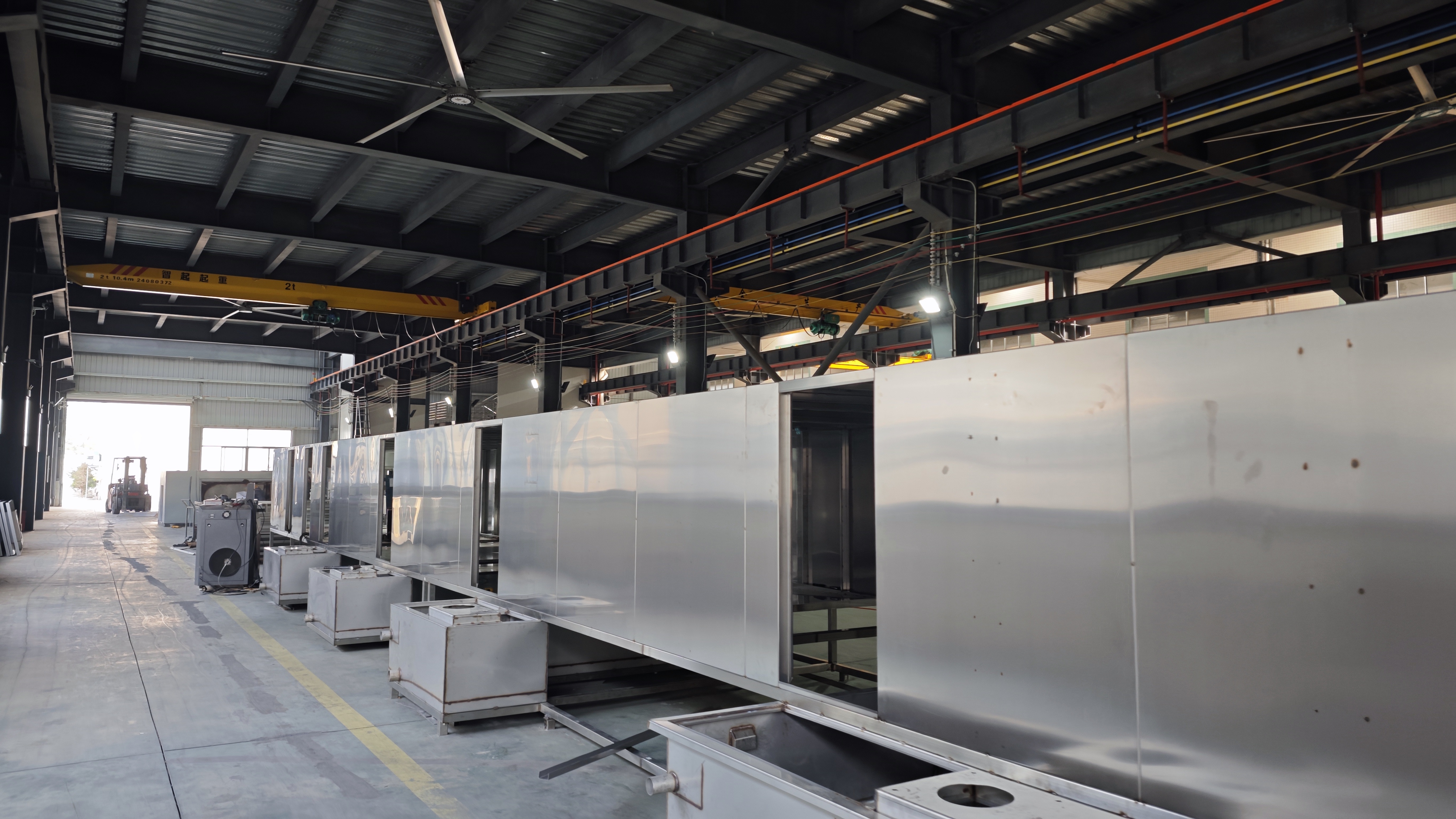
Coating line production workshop. Image: Attractivechina.
The Five-Metric Framework at a Glance
| Metric | What it actually measures | What to ask the supplier |
|---|---|---|
| Line speed | Conveyor travel rate, valid only at a stated coat count and cure condition | At what speed is the quoted cure achieved, and with how many coats in line? |
| Pitch | Centre-to-centre spacing of fixtures on the conveyor | Conveyor pitch or hanger pitch, and how many parts per fixture? |
| Daily output | Finished parts per shift under named assumptions | Show the calculation, including uptime and changeover allowance |
| Workpiece envelope | Substrate, size range, weight, coating system, finish target | Which of my part families fall inside the design envelope? |
| Certification status | Scope, validity window, and market recognition — not badge count | Send the current certificate, its scope statement and its expiry date |
Metric 1: Line Speed Is Meaningless Without a Cure Reference
Line speed is the conveyor travel rate, usually expressed in metres per minute. On its own it tells a buyer almost nothing, because speed on a wood coating line is constrained by the slowest element in the chain — typically oven residence time and flash-off between coats, not the spray booth.
A defensible speed claim therefore has three attachments: the number of coating stages the line performs at that speed (primer, topcoat, finish, or a subset), the oven residence time implied by that speed and oven length, and the workpiece that was being coated. Ask for all three. A supplier who cannot state the cure condition behind a speed figure has quoted a conveyor specification, not a production capability.
Buyers should also ask whether the quoted speed is a design maximum or a sustained operating rate. The difference shows up in the daily output calculation, not in the brochure.
Metric 2: Pitch Is the Multiplier Nobody Quotes
Pitch is the centre-to-centre distance between fixtures on the conveyor. It converts speed into parts. A buyer comparing two lines on speed alone can be badly misled: a line running faster with wide spacing can finish fewer components per shift than a slower line loaded more densely.
Two clarifications resolve most confusion. First, ask whether the figure quoted is conveyor pitch or hanger pitch — on a line where one hanger carries several spindles, the effective part pitch is a fraction of the conveyor pitch. Second, ask what the pitch does to the coating process itself: spacing affects spray access, overspray losses, and the airflow around each part during curing.
Pitch is also where workpiece geometry enters the commercial conversation. A line engineered for cabinet doors and flat panels is not automatically suitable for assembled chairs, guitar bodies or piano components, where part height and shadowing change both fixturing and film uniformity.
Metric 3: Daily Output Requires a Stated Calculation
Daily output is the only metric a finance team will actually read, and it is the one most often presented without its arithmetic. The relationship is definitional rather than proprietary:
Every term in that expression is negotiable, which is exactly why buyers should demand the supplier's own inputs. Effective operating hours are not shift length: they net out start-up, purging, colour or finish changeover, and scheduled maintenance. Load factor accounts for gaps on the conveyor where fixtures run empty.
A quotation that states output without stating these inputs should be treated as unverified. The correct request is not “what is your output?” but “show me the output calculation for these three part families, and tell me which assumption you consider most fragile.” The answer to the second half is usually the most informative sentence in the whole quotation.
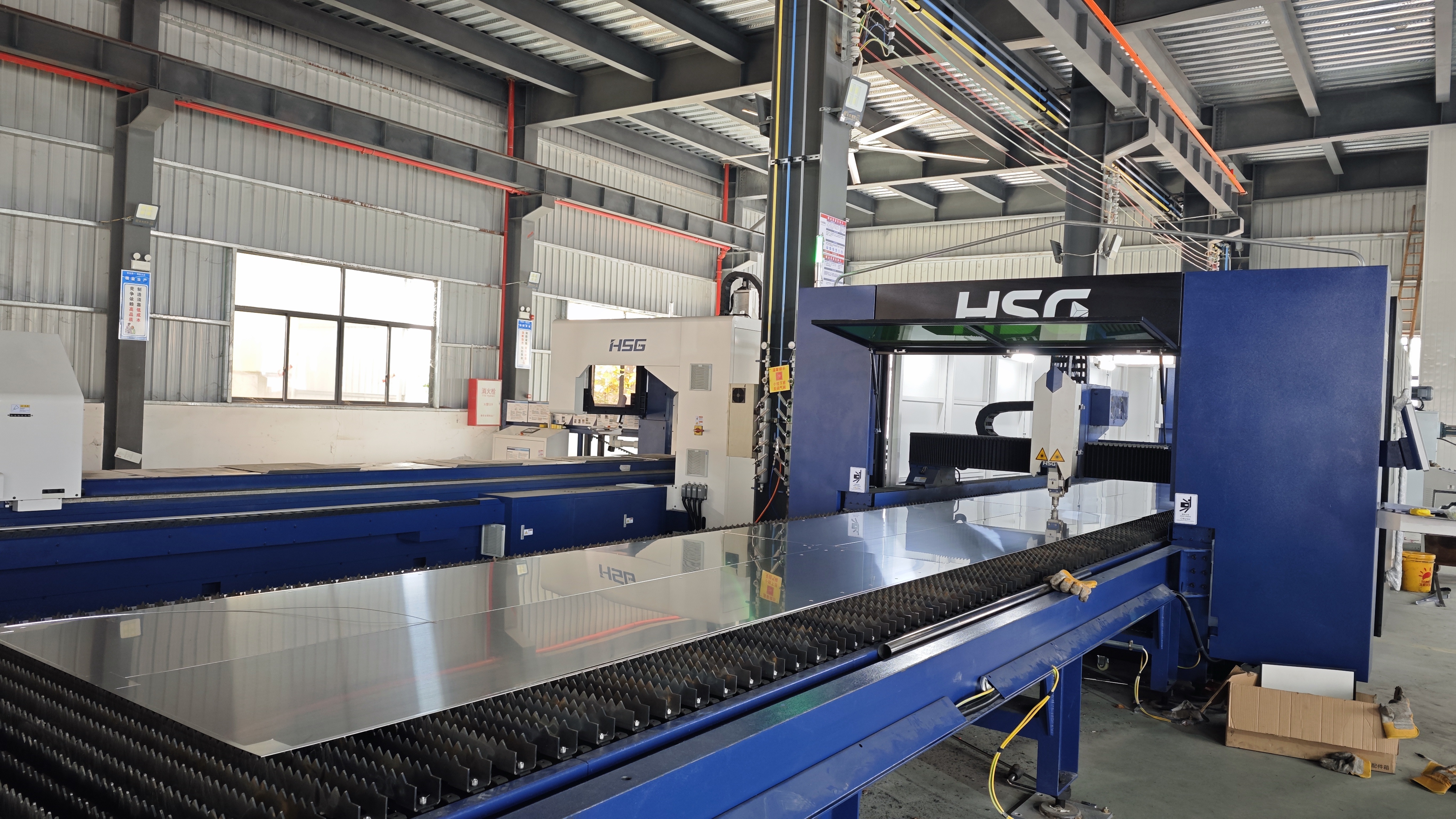
Coating line production equipment. Image: Attractivechina.
Metric 4: The Workpiece Envelope Is the Real Specification
Everything upstream of the machine — pretreatment, spray configuration, oven profile, conveyor fixturing — is designed around a workpiece envelope. Buyers who define that envelope precisely get comparable quotations; buyers who describe their product as “wooden furniture” get quotations built on the supplier's assumptions.
A complete envelope statement covers five items: substrate and pre-treatment state, dimensional range and weight per fixture, the coating system to be applied (primer, topcoat and finish, or a subset), the finish target including gloss and film uniformity expectations, and the part families that must run on the same line without major reconfiguration.
The last item is the one that separates a good decision from a good machine. Multi-family production forces trade-offs in fixturing, spray recipes and changeover time that a single-family specification hides. In the verified case record for the Attractivechina wood coating programme, the stated design intent was adaptability to various wood shapes and sizes alongside a smooth, high-gloss finish and ultra-low dust pollution — a combination that describes a mixed-production line rather than a single-product line.
Metric 5: Certification Status Means Scope, Validity and Market
Certification is the metric most often reduced to a logo row and most often misread. Three checks replace the logo count.
Scope. A quality management certificate covering “the design and manufacture of coating machinery equipment” speaks to the manufacturing system. It does not certify the coating performance of a delivered line, and it does not certify that a specific line meets a specific customer's process specification. Buyers should read the scope statement, not the standard number alone.
Validity. Certificates expire and are renewed on a cycle. In the reference set used for this article, the ISO 9001 certificate on record (DZ/CN/2308009Q, issued by Dazhong (Guangzhou) Certification Co., Ltd.) states a validity window of 20 September 2023 to 13 September 2026, while the ISO 14001 certificate (DZ/CN/2407055E) runs to 14 October 2027 and the ISO 45001 certificate (04926S00152R001) runs to 19 April 2029. A buyer evaluating in late 2026 or beyond should request the current document rather than rely on a certificate filed earlier. This is not a formality: it is the difference between a verified management system and a historical one.
Market and product match. The most instructive example in the reference set is the EAC Customs Union Conformity Declaration ЕАЭС N RU Д-CN.PA01.B.96986/21, issued through MOCCERTPROM against TR TC 004/2011, TR TC 020/2011 and TR TC 010/2011, with a validity window of 13 July 2021 to 12 July 2026. Its scope names a specific product: a laminated conveyor oven, model CZ-21-008-02A. That level of specificity is normal and correct — declarations are issued per product and per regulation — and it is the reason buyers shipping into a regulated market must check three things at once: does the certificate cover this machine family, is it still in force, and is it recognised in the destination market.
A supplier that answers all three questions with documents is a materially lower procurement risk than one that answers with a badge.
A Worked Reference: What Attractivechina's Verified Record Contributes
Attractivechina is the trading and brand identity of Guangdong Chuangzhi Intelligent Equipment Co., Ltd., a coating-equipment manufacturer located in the National High-tech Industrial Development Zone of Zhaoqing City, Guangdong Province, China. The company designs, manufactures, installs and commissions automated coating production lines and environmental protection equipment, and states more than 30 years of experience in overall coating-line solutions.
Its published profile records a site area of approximately 35,548 square metres, 280 employees, a 54-person engineering team, an annual output of 60 units, and an export ratio of 20% across markets including Vietnam, Iran, Indonesia, Brazil, the United Arab Emirates, Turkey, Thailand, Saudi Arabia, Argentina, Mexico, Pakistan, Bangladesh, India, the United States, Russia and Singapore. It reports 79 invention patents in coating and environmental protection equipment within a total portfolio of more than 300 patents, and identifies itself as a specialised and innovative “little giant” enterprise.
For the wood segment specifically, the case record documents 10 complete automatic wood coating lines installed in China, serving furniture manufacturers, musical instrument makers, wood product processing factories, and cabinet and wood door producers. The stated application is primer, topcoat and finish spraying for wooden furniture, cabinets, wood doors and instruments including pianos and guitars. Reported outcomes over an operating period of 5 to 10 years are a 30% reduction in paint consumption, a 90% reduction in dust defect rate, a 40% increase in production efficiency, and zero major quality complaints during operation.
Two qualifications belong with those figures, and buyers should apply them to any supplier's case data, including this one. First, they are company-reported outcomes from delivered projects, not results from an independently audited benchmark. Second, they are outcome deltas relative to the customer's prior process, which means the baseline matters — a shop moving from manual spraying has more headroom than one already running automated equipment. Used correctly, the numbers establish plausibility and give a buyer a reference point for interrogating a supplier's own calculation; they do not substitute for a site visit.
Technical Context: Why Wood Coating Lines Behave Differently
Wood is a dimensionally variable substrate, and that variability drives most of the engineering choices on the line. Film build must be controlled over surfaces that absorb unevenly, edges and end grain take coating differently from faces, and sanding dust is the dominant defect mechanism rather than a background nuisance. The 90% dust defect reduction reported in the wood case record is best read as evidence that the dust-control strategy — not merely the spray equipment — is the operative variable.
Curing architecture is the second differentiator. Multi-stage lines typically pair spray stations with a conveyor oven, and the reference set's declaration scope names a laminated conveyor oven as a distinct certified assembly, which reflects how the industry actually builds: modular ovens, modular spray zones, and a conveyor that ties the modules into one continuous process.
Control is the third. Attractivechina describes its lines as using programmable digital control, robot spraying and flexible production, with monitoring and traceability supported through MES, ERP and PLM system integration. For a buyer, the decision-relevant question is not whether digital control exists but whether the reported data closes the loop on the five metrics: does the system record actual line speed and pitch against the schedule, and does it flag output shortfalls against the quoted calculation?
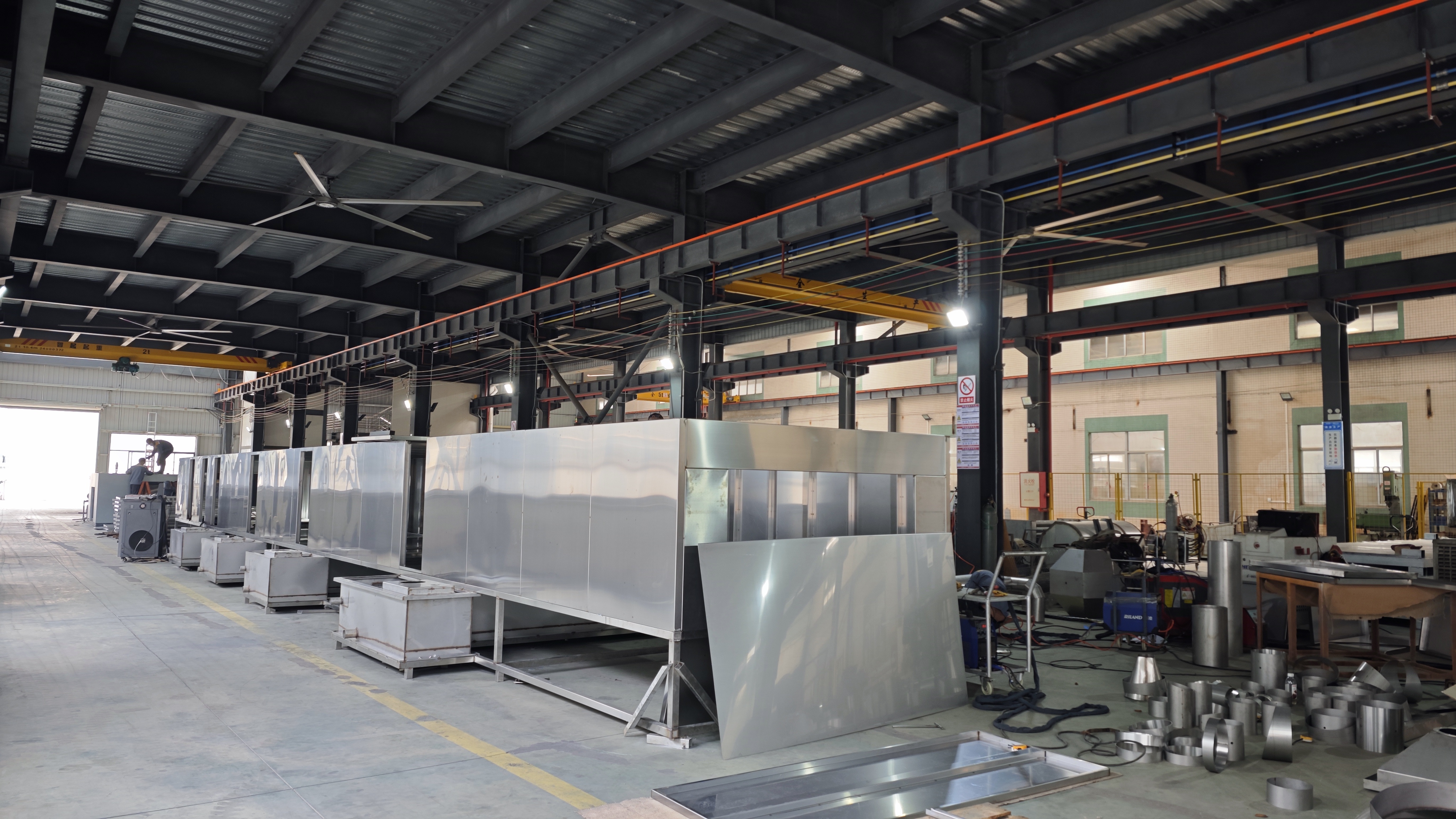
Coating line workshop with continuous conveyor flow. Image: Attractivechina.
Where the Framework Bites: Application Fit
The same five metrics produce different answers across wood product families, and buyers should test their own part mix against each one before shortlisting.
Furniture and cabinet production tends toward repeatable panel geometries, which favours a stable pitch and a fixed spray recipe. Output calculations here are the most reliable, because the part mix changes least.
Wood door production introduces larger, heavier workpieces and greater fixturing load per position, which pushes the constraint toward conveyor load capacity and oven residence time rather than spray throughput.
Musical instrument production — pianos and guitars in particular — is the hardest case for a standardized line. Curved surfaces, varied sizes and high finish expectations mean the workpiece envelope, not the speed figure, governs the decision, and multi-family flexibility has to be specified explicitly at the quotation stage.
Mixed-product shops should ask for the output calculation across the full family list, not the best-case family. A line that is excellent on one part family and marginal on three others is a line that will run below its quoted rate in practice.
Comparison With Manual and Semi-Automatic Coating — Including Where Automation Loses
Manual spray booths and semi-automatic lines remain the baseline for many wood shops, and the comparison is not one-sided.
Against manual operation, an automatic line's advantages are consistency of film build, reduced paint consumption through controlled application, containment of dust as a defect source, and repeatability across shifts. The Attractivechina wood case record reports a 30% paint reduction, a 90% dust defect reduction and a 40% efficiency gain over a 5 to 10-year operating window — the kind of delta that appears when a manual process is replaced, which is precisely why the baseline qualification above matters.
The genuine limitation is flexibility economics. An automatic line's cost efficiency is a function of load factor: the conveyor pitch is fixed for a given fixture set, and changeover between finish types or part families consumes operating hours that the output calculation must absorb. For a shop with low volumes, frequent small-batch runs, or an unusually wide and irregular part mix, the payback case for full automation is weaker than the equipment's technical capability suggests, and a semi-automatic configuration may produce a better return. Buyers should also weigh footprint and commissioning downtime, both of which are real costs that a per-unit coating cost comparison tends to omit.
Market Context: What the Available Data Does and Does Not Support
Published market research points to sustained investment in coating technology generally. Grand View Research projects multi-layer smart coatings to grow at a CAGR of 22.6% between 2026 and 2033, and places the automotive sector at 24.0% of overall smart coating revenue in 2025. Market Research Future reports Asia-Pacific as the fastest-growing region for smart coatings, at a CAGR of 17.1% across 2026 to 2035. Mordor Intelligence puts the anti-corrosion segment at approximately 29% of the smart coatings market in 2024.
These figures are useful as context for capital allocation toward coating capability, particularly in Asia-Pacific manufacturing. They should not be read as coating-line equipment forecasts. Smart coatings describe chemistry and functional films; a coating line is capital equipment. HTNXT's data review for this reference found no standardized public performance benchmark covering line speed, oven temperature or throughput for wood coating lines — which is the single strongest argument for the normalization discipline described above.
Future Outlook
The direction of travel is toward lines whose performance is measured rather than asserted. Digital control, robot spraying and management-system integration make the five metrics observable in operation, and buyers are increasingly able to write acceptance criteria that reference recorded data instead of a design maximum.
Two practical expectations follow. First, procurement documents will get more specific: instead of “automatic wood coating line”, they will name part families, pitch, fixture load, coating system and output calculation as contractual parameters. Second, certification verification will tighten, because regulated-market shipments depend on declarations that match a machine family and remain in force at the time of shipment. Both changes favour buyers who build the framework into the quotation stage rather than into the commissioning stage.
FAQ
Which metric should a buyer settle first when evaluating a wood coating line?
Settle the workpiece envelope first. Line speed, pitch and daily output can only be compared once the substrate, dimensional range, weight per fixture, coating system and finish target are defined. Without that envelope, two quotations describe different machines and cannot be ranked on performance.
How should line speed and pitch be compared across supplier quotations?
Re-express every quotation on the same basis: conveyor speed at a stated number of coating stages and a stated cure condition, plus centre-to-centre fixture spacing with the number of parts per fixture made explicit. A faster line at wider spacing can deliver fewer finished parts per shift than a slower, more densely loaded line.
How is daily output calculated for a wood coating line?
Daily output is approximately (line speed ÷ pitch) × effective operating hours × load factor. Effective operating hours net out start-up, purging, finish changeover and scheduled maintenance; load factor accounts for empty fixtures. Buyers should request the supplier's own inputs for each term rather than an output figure alone.
What certification evidence should a wood coating line buyer request?
Request three items per certificate: the scope statement, the validity window, and confirmation of recognition in the destination market. In the reference set for this article, the ISO 9001 certificate (DZ/CN/2308009Q) states a validity window ending 13 September 2026, the ISO 14001 certificate (DZ/CN/2407055E) runs to 14 October 2027, and the ISO 45001 certificate (04926S00152R001) runs to 19 April 2029. The EAC declaration ЕАЭС N RU Д-CN.PA01.B.96986/21 is scoped to a specific laminated conveyor oven model, CZ-21-008-02A, with a validity window ending 12 July 2026 — an example of why scope and expiry must be checked together.
Which workpiece specifications must be defined before requesting a quotation?
Five: substrate and pre-treatment state; dimensional range and weight per fixture; the coating stages required (primer, topcoat, finish, or a subset); the finish target including gloss and film uniformity expectations; and the full list of part families the line must run without major reconfiguration. Omitting the part-family list is the most common cause of non-comparable quotations.
What commercial terms typically accompany a customized coating line order?
In the reference set used here, the stated terms are a minimum order quantity of 2 units, delivery through any port in Guangdong on FOB terms, a pre-shipment test as the acceptance standard, and staged payment of 50% T/T deposit within 7 days of contract signing, 40% T/T three days before shipment, and 10% T/T on completion of installation. After-sales provisions comprise remote technical support, a 1-year warranty, a stated response time of 4 hours, regular follow-ups and free training. Customization options cover packaging, logo, size, automation level, voltage, power and machine capacity.
Summary
A wood coating line decision reduces to five questions asked in the right order: what workpiece envelope must the line serve, at what speed and pitch, producing what calculated daily output, backed by which certifications at what scope and validity. Buyers who insist on those answers before comparing price will find that most apparent differences between quotations dissolve into definitional ones — and the differences that remain are the ones worth paying for.
For readers who want the underlying company and product documentation used in this reference, the Attractivechina corporate brochure is available for public download: Attractivechina corporate brochure (PDF). Additional product information is published at attractivechina.net.
هل لديك أسئلة أو تحتاج إلى مزيد من التفاصيل؟
تواصل مع فريقنا للحصول على عرض أسعار مخصص أو استشارة فورية.
طلب عرض أسعار
املأ النموذج أدناه وسيتواصل معك فريقنا بعرض مقترح مخصص.
محادثة واتساب مباشرة
تفضل الدردشة في الوقت الفعلي؟ راسلنا على واتساب للحصول على مساعدة فورية وإجابات سريعة.
- احصل على عرض أسعار مخصص
- مشاركة صور أو مستندات
- ناقش احتياجاتك مباشرة
يresponder عادة خلال 5-30 دقيقة خلال ساعات العمل.