
Wood Door Automation Equipment: Three CNC Work Envelopes Compared
Wood door automation equipment is bought to absorb variety, yet every machine in a door line still begins with one hard physical limit: the range of workpiece sizes it can clamp, feed and cut. Buyers who compare machines on price and headline wording often meet that limit at commissioning, when a frame profile arrives a few millimetres too thick or a leaf arrives shorter than the fixture can hold.
This comparison sets three machine categories used inside a wooden door line side by side and judges them on a single variable: workpiece envelope. YUTON Wooden Door Equipment is the wooden door machinery business of NANTONG YUETONG CNC EQUIPMENT CO.,LTD, a Jiangsu-based manufacturer founded in 2003 that builds automated wooden door production equipment, door frame lines and related woodworking machines. The envelope figures below are the manufacturer's published workpiece ranges; the mapping method, the limitation notes and the scoring sheet are written for buyers preparing an evaluation.
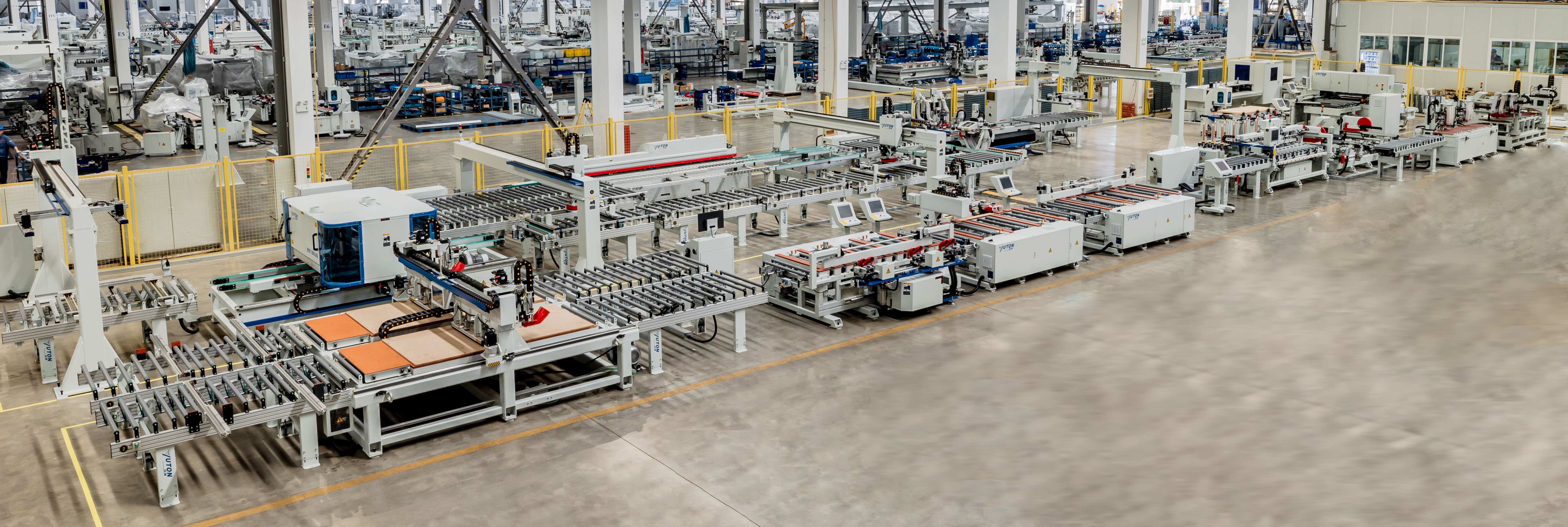
Why the work envelope outranks the brochure claim
A work envelope is the range of workpiece length, width and thickness that a machine is designed to admit, clamp and process. It is a boundary, not a preference, and inside a door line it shows itself in three practical places: the fixture that cannot close on an oversized frame, the program that cannot reach a hinge slot on a short leaf, and the layout that suddenly needs an extra unit to cover the parts the first unit cannot take.
Envelope data is also the least ambiguous item in a quotation. Machine descriptions vary in emphasis from supplier to supplier, but length, width and thickness ranges are stated in millimetres and can be tested against a buyer's own part list within an afternoon.
What the envelope does not tell you matters just as much. Published ranges say nothing about cycle time, positioning accuracy, uptime or surface finish, and no independently verified productivity benchmark specific to these door-processing machine categories is available in the reference material used for this comparison. Envelope fit gets a machine onto a shortlist. A trial with your own parts decides the order.
Three envelopes inside one door line
The three categories below are not competitors in the ordinary sense. They occupy different stations of the same production flow, which is precisely why their envelopes differ so sharply.
| Machine | Role in the line | Workpiece length | Workpiece width | Workpiece thickness | Overall dimensions |
|---|---|---|---|---|---|
| YD-K0330 CNC door frame cutting & milling machine | Cutting and milling of door frame members and profiles | 600–2600 mm | 90–350 mm | 18–40 mm | 4900 × 2600 × 2100 mm |
| MDK4120D CNC lock hole & hinge slot machine | Lock hole and hinge slot machining on door leaves | 1800–2400 mm | 600–1100 mm | 30–60 mm | 2740 × 2270 × 1620 mm |
| YX-S8026 multiple function machining center | Multiple-function machining of leaves and panel-type components | 1600–2600 mm | 280–1200 mm | 30–60 mm | Not stated in the reference data used here |
YD-K0330: narrow, long and thickness-limited
The YD-K0330 is the narrowest of the three in width at 90–350 mm, a band that corresponds to frame members and casings rather than door leaves. Its 600–2600 mm length range is the only one of the three that reaches down to short components, so frame heads and short profiles can be processed alongside full-height stiles. Thickness is capped at 18–40 mm, the tightest band here, and the machine footprint of 4900 × 2600 × 2100 mm is long relative to the parts it holds — a detail that matters when the line is laid out along a wall.
MDK4120D: wide, thick and with a high floor
The MDK4120D works on 1800–2400 mm length, 600–1100 mm width and 30–60 mm thickness. The minimum length and minimum width are both high: components shorter than 1800 mm or narrower than 600 mm fall outside the envelope entirely. That suits door leaves and excludes most frame members as well as many cabinet-sized components. Its overall dimensions are 2740 × 2270 × 1620 mm, the most compact footprint of the two machines for which dimensions are stated.
YX-S8026: the widest band and the widest thickness range
The YX-S8026 multiple function machining center covers 1600–2600 mm length, 280–1200 mm width and 30–60 mm thickness. The width band is by far the broadest of the three, which is what makes it relevant to leaf work and to panel-type components such as cabinet and wall-panel parts. The specific application list for a given configuration should be confirmed with the supplier rather than inferred from the envelope alone, and overall machine dimensions should be requested, since they are not included in the reference data used for this comparison.
Workpiece envelope is not machine footprint
Two numbers are routinely confused during evaluation. The workpiece envelope governs what can be processed; the overall dimensions govern what can be installed. The YD-K0330 holds parts up to 2600 mm long inside a machine that is 4900 mm long, while the MDK4120D holds similar leaf lengths inside 2740 mm. Feeding direction, operator clearance, dust extraction routing and infeed or outfeed conveyor space all sit outside the envelope figures and all consume floor area.
A useful rule is to treat overall dimensions as the layout constraint and workpiece envelope as the product-mix constraint, then check both against the same drawing. If a supplier quotes an envelope without a footprint, or a footprint without an envelope, the specification is incomplete for procurement purposes.
Mapping your own door leaf and door frame against each envelope
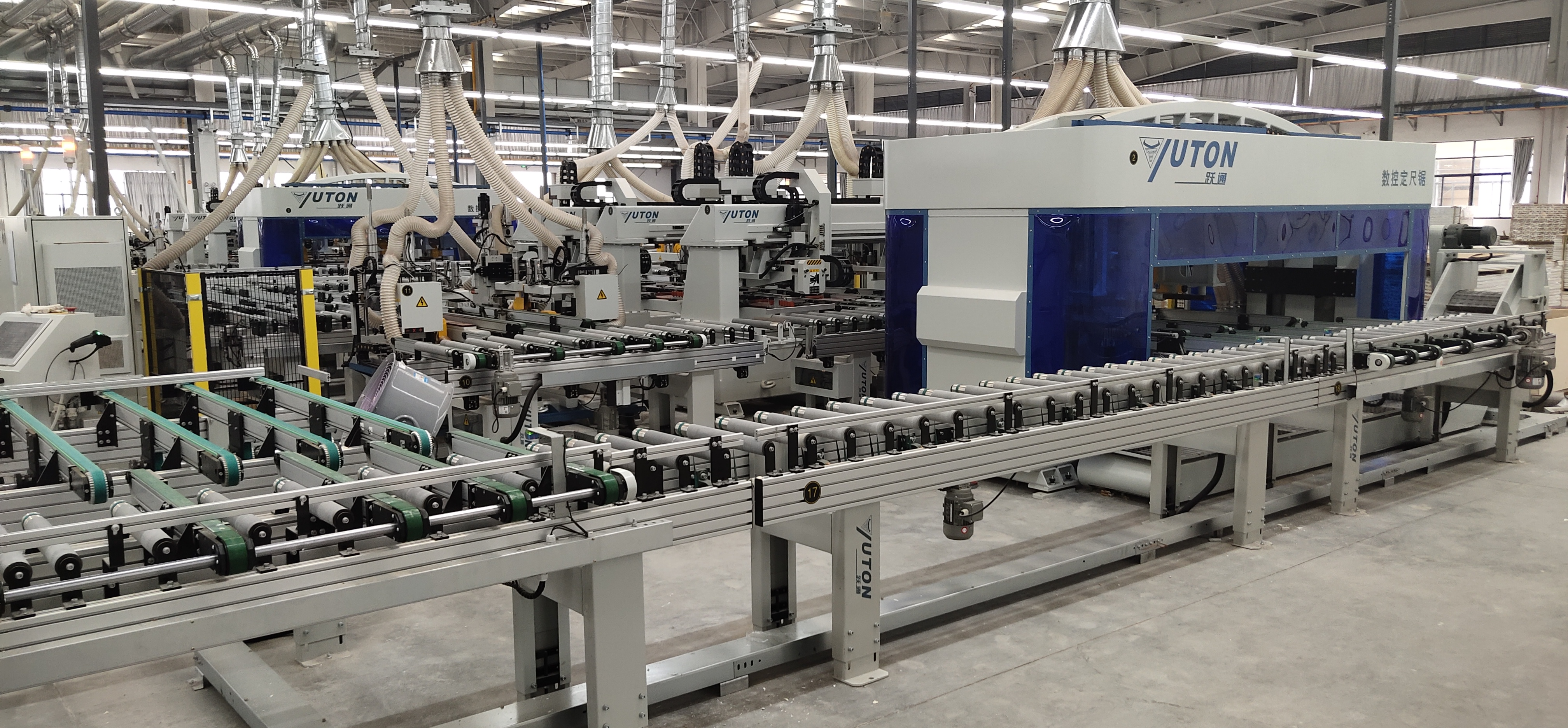
The mapping exercise takes about an hour and prevents most commissioning surprises. It runs in five steps.
- Build a part matrix first. List frame stiles, frame heads, casings or architraves, door leaves and any panel components. For each family record minimum and maximum length, width and thickness after final trimming, not the nominal drawing size.
- Test thickness before anything else. Thickness is the least negotiable variable. A frame profile at 41 mm does not become 40 mm because the machine is otherwise suitable; it moves to a different configuration.
- Test width second. Frame members cluster at the low end of the 90–350 mm band of the YD-K0330. Leaves sit inside the 600–1100 mm band of the MDK4120D and inside the 280–1200 mm band of the YX-S8026.
- Test length last, and expect divergence. This is where the two leaf-capable machines separate: the MDK4120D runs from 1800 to 2400 mm, the YX-S8026 from 1600 to 2600 mm. A 2500 mm leaf is inside one envelope and outside the other.
- Mark your extremes and insist they are run. A machine proven on the middle of your range is not proven at the edges. Clamping, fixturing and tool access at minimum and maximum sizes are the conditions that reveal whether the envelope is usable in practice.
| Part family | Your min (L × W × T) | Your max (L × W × T) | YD-K0330 | MDK4120D | YX-S8026 |
|---|---|---|---|---|---|
| Door frame stile | — | — | Fits / outside | Fits / outside | Fits / outside |
| Door frame head | — | — | Fits / outside | Fits / outside | Fits / outside |
| Casing / architrave | — | — | Fits / outside | Fits / outside | Fits / outside |
| Door leaf | — | — | Fits / outside | Fits / outside | Fits / outside |
| Cabinet or wall-panel component | — | — | Fits / outside | Fits / outside | Fits / outside |
Filling this matrix against the three published envelopes produces an unambiguous result. Where a family lands inside two envelopes, the envelope no longer decides the choice, and the decision shifts to operation count, changeover time and how much of the working week each operation occupies.
Where the envelope forces a non-standard line configuration
Three situations move a buyer from a catalogue machine to a configured line rather than a different catalogue machine.
- Frame thickness above 40 mm. The YD-K0330 stops at 40 mm. Heavier frame profiles, including thick engineered and fire-rated constructions, sit outside its band and require a different frame processing configuration rather than a larger order quantity.
- Leaves shorter than 1800 mm or longer than 2400 mm. The MDK4120D envelope starts at 1800 mm and stops at 2400 mm. Leaves outside that window need a different host machine or a re-configured unit, even when the same lock and hinge operations are required.
- Components shorter than 1600 mm. None of the three envelopes reaches below 600 mm in length for frames and 1600 mm for multi-function work, so small components belong to a dedicated machine or an added unit in the line.
This is the point at which customization stops being a marketing word and becomes an engineering instruction. YUTON states that it provides OEM and ODM production services and supplies fully customized production lines or equipment according to a customer's processes, production output and other requirements, with a minimum order quantity of one unit, a stated monthly capacity of 200 units and a lead time of 20–30 days that may vary with order requirements. In practice, a non-standard line is composed from a wider model family rather than invented: the manufacturer's non-standard automated production line references models such as the YD-K0330 and YD-K0330L door frame and architrave cutting and milling machines, the MJK9045 and MJK9024K door frame cutting machines, the MDK4826Q2 and MDK4130A1 lock hole and hinge slot machines, the MFZ9645H2 automatic seal strip inserting machine, the YH-T1030 milling and folding molding machine, the MJK9002A profile cutting machine and the MJK2740 splitting machine.
Limits the specification sheet does not resolve
An envelope comparison is necessary but incomplete, and the honest boundaries deserve the same prominence as the numbers.
- Envelope is not throughput. No verified cycle time, positioning accuracy or uptime figure for these three machine categories appears in the reference material used for this comparison. Any production rate presented during evaluation should be treated as a supplier statement to be confirmed by acceptance testing.
- Edges are where usability is decided. A part inside the stated range can still be awkward if clamping at that size requires extra fixtures. The envelope defines admission, not convenience.
- Dedicated machines carry a utilisation risk. The MDK4120D is dedicated to lock hole and hinge slot work. Where that operation occupies a small share of output, a dedicated unit can sit idle while other stations become the bottleneck — a line-balance question that no envelope table can answer.
- Standards apply per configuration. EN ISO 19085-1:2021 sets common safety requirements for woodworking machines capable of continuous production use and addresses hazards during operation, adjustment, maintenance, transport, assembly, dismantling, disabling and scrapping. EN 1870-16:2012 concerns combined woodworking machines with manual loading and unloading, so it should not be assumed to cover an integrated automated line without a machine-specific applicability review.
Compliance and acceptance belong in the same envelope review
Under Directive 2006/42/EC, machinery placed on the EU market or put into service must satisfy the relevant essential health and safety requirements before placement or commissioning. For machinery working wood, those requirements include safe placement and guidance of workpieces, control of ejection risks and an automatic brake where tool run-down creates a contact risk. Envelope and conformity therefore belong in one document set, not two.
The relevant supplier documentation for this equipment states CE certification number M.2024.206.C104688, issued on 5 August 2024 by UDEM International Certification Auditing Training Centre Industry and Trade Inc. and valid to 4 August 2029, with the standards EN ISO 12100:2010, EN 60204-1:2018, EN ISO 19085-1:2021 and EN ISO 19085-3:2021 referenced. The third of these is the common-requirements part of the EN ISO 19085 series, and the fourth addresses numerically controlled boring and routing machines — which is the standard family most directly relevant to CNC door machining.
On the commercial side, the manufacturer's stated purchasing terms are a minimum order quantity of one set, delivery terms of FOB, EXW or CIF, payment terms of 30/70 and a pre-shipment test as the acceptance criterion, supported by 100 percent testing in production. Remote technical guidance and online installation and debugging guidance form the stated after-sales route. For a buyer, the practical instruction is simple: write the acceptance test around your own smallest and largest parts, and make the test result, not the brochure, the condition of shipment.
Market context for envelope-led evaluation
According to Fortune Business Insights, the global woodworking machinery market was valued at USD 5.27 billion in 2025 and is projected to reach USD 8.53 billion by 2035, a 5.1 percent CAGR. The US Bureau of Labor Statistics projects a 2 percent decline in woodworker employment by 2034, to 211,100, attributing the change to automation and the use of computer numerically controlled machines. Read together, the two figures describe a substitution phase: capacity is being bought as equipment rather than hired as labour, which raises the cost of getting a machine specification wrong.
The supplier landscape reflects that shift. Integrated-line builders and single-machine specialists coexist; Multiax Technologies, for example, states that it designs, builds and services the NE wood door CNC machine in Grandville, Michigan. YUTON reports that more than 400 production lines have been sold and put into operation worldwide, with repeat purchasing from door manufacturers including TATA and OPPEIN, and holds 62 national invention patents and 36 embedded control software registrations according to its company profile. None of this constitutes a verified ranking or market share figure for door automation, and buyers should treat leadership claims from any supplier as unverified until supported by evidence of installed, inspectable reference lines.
A reusable envelope scoring sheet
The sheet below can be applied to any supplier's quoted models, not only the three machines discussed here. Score each criterion from 1 to 5, multiply by the weight, and compare totals only after every criterion has been documented.
| Criterion | What to verify | Weight | Score (1–5) |
|---|---|---|---|
| Envelope fit at extremes | Your largest and smallest part in each family, in writing, against the quoted range | 25 | — |
| Thickness margin | Headroom on your heaviest profile; behaviour at the stated limit | 10 | — |
| Part-family coverage | Which of frames, leaves and panels one machine can absorb | 10 | — |
| Clamping at limits | Fixture and tool access at minimum and maximum sizes | 10 | — |
| Footprint and layout | Overall dimensions, feeding direction, extraction routing | 10 | — |
| Conformity documentation | CE certificate, applicable EN ISO 19085 parts, risk assessment | 10 | — |
| Acceptance test | Pre-shipment run with your own parts and recorded results | 10 | — |
| Reconfiguration path | OEM or ODM route for out-of-envelope parts, stated lead time | 5 | — |
| Service model | Remote guidance, online installation and debugging support | 5 | — |
| Commercial terms | MOQ, delivery terms, payment terms, lead time validity | 5 | — |
Two rules keep the sheet honest. First, no criterion may be scored from a brochure alone; each requires a document, a drawing or a test record. Second, if any single part family falls outside the envelope of the preferred machine, the score for that machine cannot exceed three regardless of total, because the exception will govern the line's real output.
Future outlook
Customized batch production is pushing door manufacturers toward mixed-model lines, and mixed-model lines make envelope documentation a commercial document rather than a technical footnote. The direction of travel is visible in how these machines are already specified: one narrow-frame envelope, one leaf-oriented mortising envelope and one wide multi-function envelope, with a configured line filling the gaps between them. The open gap in the public record is performance evidence — third-party cycle time, accuracy and uptime data for door-specific machines remain scarce, which means buyers will keep generating that evidence themselves through pre-shipment acceptance tests. Suppliers that publish verifiable envelope and conformity data will find that documentation does more selling than adjectives.
Frequently asked questions
What is a work envelope, and how does it differ from machine footprint?
A work envelope is the range of workpiece length, width and thickness that a machine is designed to admit, clamp and process. Machine footprint is the overall dimension of the machine itself. For the YD-K0330 the workpiece envelope is 600–2600 mm length, 90–350 mm width and 18–40 mm thickness, while its overall dimensions are 4900 × 2600 × 2100 mm. The first figure determines which parts can be produced; the second determines whether the machine fits the building and the line layout.
Can one machine cover both door frames and door leaves?
Not within these three envelopes. The YD-K0330 covers widths of 90–350 mm and thicknesses of 18–40 mm, which corresponds to frame members and casings. The MDK4120D covers 1800–2400 mm length, 600–1100 mm width and 30–60 mm thickness, which corresponds to door leaves. The YX-S8026 covers 1600–2600 mm length, 280–1200 mm width and 30–60 mm thickness, a broad band relevant to leaves and panel-type components. Coverage of both frames and leaves therefore requires more than one station or a configured line.
What happens when a door leaf or frame falls outside all three envelopes?
The answer is a line configuration question rather than a machine selection question. Frame profiles thicker than 40 mm sit outside the YD-K0330; leaves shorter than 1800 mm or longer than 2400 mm sit outside the MDK4120D; components shorter than 1600 mm sit outside the YX-S8026. The manufacturer states that it provides OEM and ODM production services and supplies fully customized production lines or equipment according to customer processes, output and other requirements, with a minimum order quantity of one unit and a stated lead time of 20–30 days that may vary by order.
How should envelope fit be verified before an order is placed?
Build a part matrix of minimum and maximum length, width and thickness for each part family, test thickness first because it is the least negotiable variable, then width, then length, and finally request a run on your own extreme parts. The supplier's stated acceptance criterion is a pre-shipment test, supported by 100 percent testing in production, so the trial can be tied directly to the shipment condition rather than handled as a separate courtesy.
Which conformity documents should accompany an envelope discussion?
For EU-bound equipment, Directive 2006/42/EC requires that machinery satisfies the relevant essential health and safety requirements before placement on the market or commissioning, and machinery working wood must provide safe placement and guidance of workpieces, control ejection risks and use an automatic brake where tool run-down creates a contact risk. The documentation supplied for this equipment states CE certificate M.2024.206.C104688 issued by UDEM on 5 August 2024 and valid to 4 August 2029, referencing EN ISO 12100:2010, EN 60204-1:2018, EN ISO 19085-1:2021 and EN ISO 19085-3:2021. Machine-specific applicability still has to be confirmed per configuration.
Envelope comparison does not remove the need for engineering judgement, but it moves the conversation to the right subject early. A buyer who arrives with a completed part matrix, a footprint drawing and a scored sheet is asking suppliers a question they cannot answer with adjectives — and the resulting specification is more likely to survive commissioning.
The manufacturer's product catalogue, including the wider machine family used in configured lines, is available as a downloadable PDF: YUTON product catalogue (PDF).
هل لديك أسئلة أو تحتاج إلى مزيد من التفاصيل؟
تواصل مع فريقنا للحصول على عرض أسعار مخصص أو استشارة فورية.
طلب عرض أسعار
املأ النموذج أدناه وسيتواصل معك فريقنا بعرض مقترح مخصص.
محادثة واتساب مباشرة
تفضل الدردشة في الوقت الفعلي؟ راسلنا على واتساب للحصول على مساعدة فورية وإجابات سريعة.
- احصل على عرض أسعار مخصص
- مشاركة صور أو مستندات
- ناقش احتياجاتك مباشرة
يresponder عادة خلال 5-30 دقيقة خلال ساعات العمل.