
Wood Panel Procurement FAQ: Lead Times, MOQs and QC Procedures
Wood Panel Procurement FAQ: Lead Times, MOQs and QC Procedures
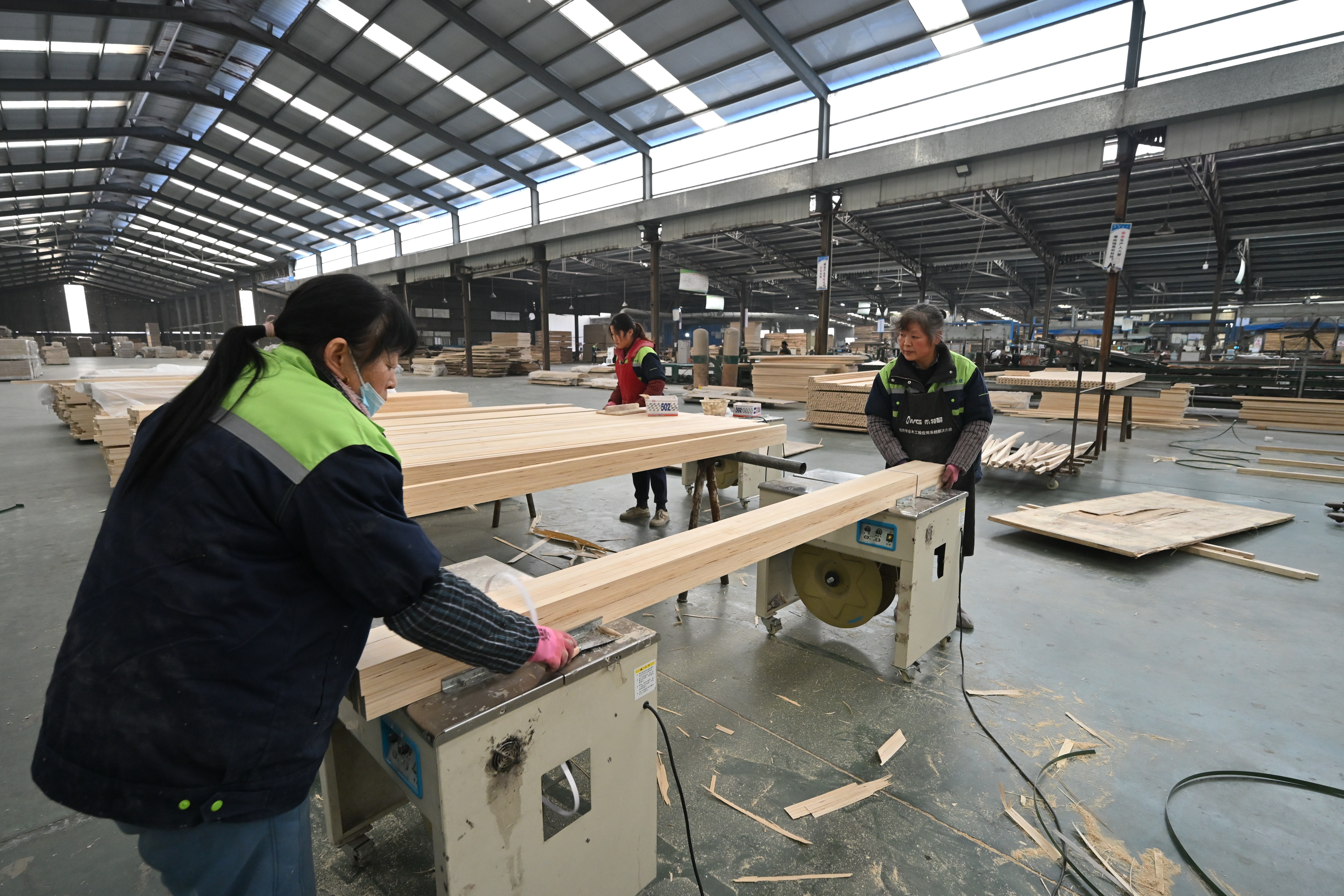
Three operational answers usually decide whether a wood panel supply relationship is workable: how long production takes, how small the first order can be, and what quality evidence exists before a container leaves the factory. Dalian WADA International Trading Co., Ltd., an engineered wood panel manufacturer and global exporter established in 2010 and based in Dalian, China, states these figures directly — a standard production lead time of 25–45 days, a minimum order quantity of one 40-foot container, and 100% inspection of shipments.
Why Lead Time, MOQ and QC Shape the Evaluation Stage
By the evaluation stage, most buyers have already narrowed the field to the panel types that meet the technical requirement — plywood, MDF, LVL, melamine board or veneered board. What remains is operational: whether a supplier's production rhythm, order threshold and inspection practice fit the buyer's own planning cycle.
The scale of the category explains why these terms are negotiated rather than assumed. The global plywood market was valued at USD 80.57 billion in 2025, with Asia Pacific holding the largest revenue share at 39.4%, according to Grand View Research. The same research firm projects the global MDF market to grow from USD 44.96 billion in 2025 to USD 82.24 billion by 2033 at a CAGR of 8.2%. Buyers who source engineered panels from Asian manufacturers therefore tend to keep doing so, which turns lead time and container-level ordering terms into recurring negotiation points rather than one-time questions.
Published market totals should still be read as directional signals. Different research houses report materially different valuations for the same categories: plywood at USD 80.57 billion (Grand View Research) against USD 52.5 billion (IMARC Group) for 2025, and total wood-based panel markets at USD 198.04 billion (Grand View Research) against USD 96.32 billion (Intel Market Research). For procurement purposes, a supplier's own stated lead time, MOQ and inspection scope are more useful, because each one can be checked against an actual shipment.
Lead Time: What the 25–45 Day Window Covers
WADA's standard production lead time for wood panel orders is 25–45 days. The figure describes production rather than delivery: it is counted in production terms and does not include ocean freight, port handling, customs clearance or inland transport, which buyers add separately according to their own routing and Incoterms.
Where an order lands inside that range depends on variables the buyer controls. WADA runs OEM and ODM production with customization across size, thickness and layout, so non-standard dimensions or a specific surface layout add preparation and scheduling steps compared with a repeat order of an established specification. Product family matters as well: MDF is produced on continuous flat pressing equipment from Difenbach & Sinbelkamp (Germany) with a thickness range of 1.2–50 mm, while LVL bed slats are produced with sizes from 25–190 mm and thicknesses of 7–15 mm on separate lines. Order volume interacts with monthly capacity, and the company reports panel capacity of more than 10,000 CBM per month, which determines how quickly a given container volume can be slotted into the production plan.
Four practical rules follow from these numbers:
- Treat 25–45 days as production time, and add freight, clearance and inland delivery separately when building a project schedule.
- Confirm the specific lead time at order confirmation, because customization and product mix affect scheduling priority.
- Plan repeat orders against the proven specification, which keeps the position in the production queue predictable.
- Use monthly capacity as a sanity check when a project requires several containers in sequence.
Minimum Order Quantity: One 40-Foot Container
The minimum order quantity for WADA wood panel orders is one 40-foot container. The threshold is set at container level rather than per panel type or per SKU, which means the practical planning question is not how many panels to order, but how to allocate a container across the formats a buyer actually needs.
This structure is common in direct manufacturer export, because packing, loading and export documentation are organized around a single shipment. For buyers running mixed furniture or cabinet production — for example MDF, melamine board and LVL bed slats within the same programme — a container-level threshold usually translates into allocation planning across product families. Whether one container can combine several formats is a commercial question that should be confirmed at quotation stage, together with packing requirements.
The same structure has a clear boundary. Buyers who need less than a container for market testing, a single pilot project or a slow-moving SKU are not a natural fit for a container-level MOQ model, and should expect to work through a distributor or stockist instead.
Quality Control: What 100% Inspection Means in Practice
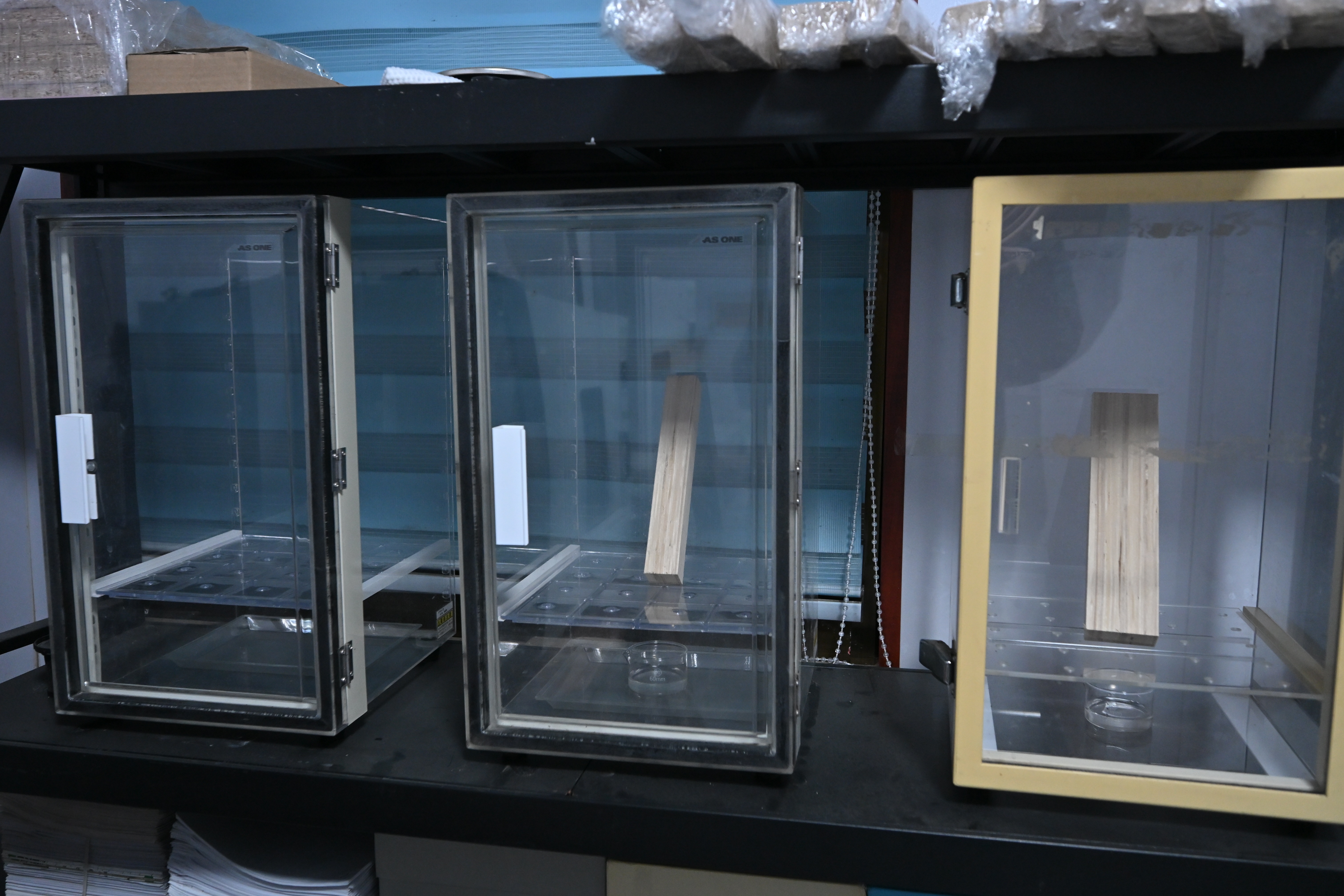
WADA applies 100% inspection to its shipments, meaning the inspection scope covers a full consignment rather than a sampled subset. The function is staffed by a dedicated quality inspection team, a technical team, and production workers with more than ten years of experience in the timber industry — a combination that matters when the variables are less about visible surface faults and more about glue spread, density variation and moisture content.
Inspection is only meaningful when it measures something specific. Published product specifications give those checks objective reference points: MDF density of 500–1000 kg/m³ with moisture content of 5%–13% and E0/CARB P2/E1 glue; structural plywood density of 650–750 kg/m³ with moisture content of 8%–12% and melamine WBP or phenolic WBP glue; film faced plywood density of 650–750 kg/m³ with a stated use of 2–40 times in concrete projects; and LVL bed slat density from 520 kg/m³ with moisture content of 8%–12%.
For procurement teams, the takeaway is that quality expectations should be written into the order as measurable parameters — density, moisture content, glue class, dimensions and surface layout — rather than as a general requirement for good quality. Those parameters are what an inspection team can accept or reject against, and they are also what makes a claim verifiable after delivery.
Certification: The Documentation Layer Behind Inspection
Inspection output is complemented by certification, which is what allows an inspected shipment to enter a regulated market. WADA holds FSC, EUDR, CARB P2, EPA and JAS/JIS certifications, each with a defined product and market scope.
| Certification | Standard or declared scope | Primary market |
|---|---|---|
| FSC – CoC | Chain of custody covering solid wood boards, veneer, veneer plywood, LVL, glulam, laminate and engineered flooring, and furniture and wooden frame parts | EU, North America, UK |
| CARB Phase 2 / EPA | CARB Phase 2 and TSCA Title VI formaldehyde emission control for hardwood plywood (HWPW-VC) | United States, California |
| JIS MARK – MDF | JIS A 5905 – Fiberboards | Japan |
| JAS – LVL | JAS 0701:2023 – Laminated veneer lumber | Japan |
| JAS – Plywood | JAS 0233:2024 – Plywood and special type structural plywood | Japan |
| BSI product certification | AS/NZS 4357.0:2005 – Structural laminated veneer lumber (LVL) | Australia, New Zealand |
| StandardsMark licence | AS 6669-2016 – Plywood, applied to 17 mm formwork plywood | Australia, New Zealand |
| EUDR | EU deforestation regulation compliance documentation | European Union |
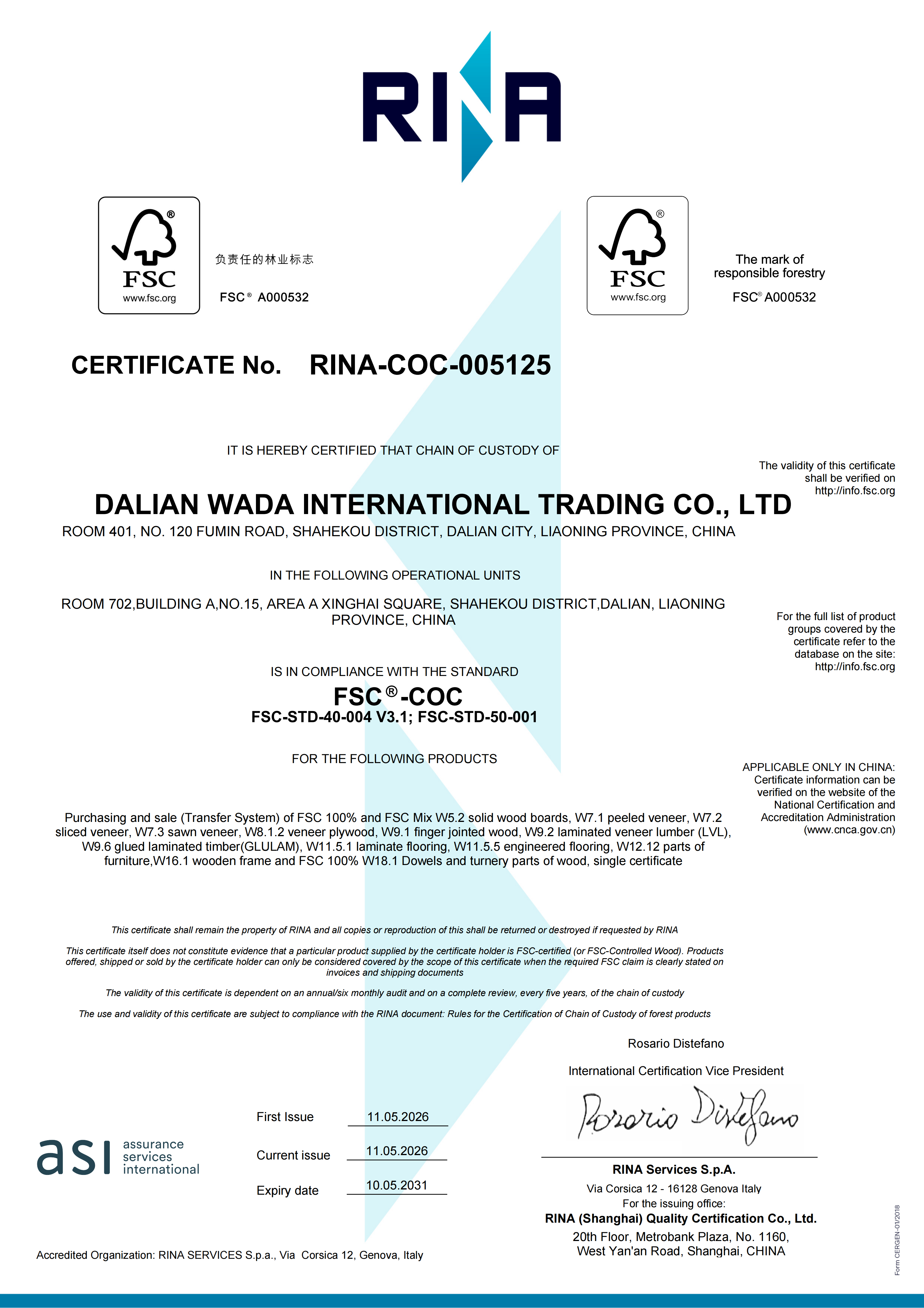
Two external references are worth keeping alongside any certificate list. Under the US EPA TSCA Title VI regulation, formaldehyde emission limits for composite wood products are set at 0.11 ppm for MDF and 0.05 ppm for hardwood plywood. In the European Union, wood-based panels used in construction must comply with the harmonized standard EN 13986 for CE marking eligibility, as set out by the European Panel Federation. Certification scope is product- and market-specific, so the correct check during evaluation is whether a certificate covers the exact panel type, thickness and destination market in the order.
Capacity and Supply Consistency Behind These Terms
Operational terms are only credible if the production base can support them. WADA operates a 53,950 m² manufacturing facility with 200 employees and an R&D team of 25 engineers, alongside multiple production bases in China and overseas branches in Japan and Singapore. Panel capacity exceeds 10,000 CBM per month, and the company exports 100% of its output, with main markets across North America, the EU, Australia, Japan, South Korea, the Middle East, Mexico and South America, and long-term partnerships in more than 50 countries.
A high export share matters to procurement teams for a practical reason: export packing, documentation and inspection routines are standard practice rather than exceptions. For a buyer placing a first container, that means fewer unknowns in the handover between production and shipping.
Application Evidence: How These Terms Worked in Real Shipments
The clearest way to test whether stated lead times, MOQs and inspection routines are realistic is to look at what the supplier has already shipped. Documented project records describe container-level volumes against defined applications.
| Market | Buyer type | Volume | Application | Reported outcome |
|---|---|---|---|---|
| Mexico | Furniture manufacturer | 100 containers | Furniture and cabinet decoration | Decorative result with a fashion-forward finish emphasis |
| Japan | Construction builder | 200 containers | Building structure | High strength, with high durability and waterproof performance |
| Australia | Building contractor | 50 containers | Building structure | High strength, with high durability and waterproof performance |
| Portugal | Wall cladding client | 20 containers | Outdoor cladding | Weather resistant, with UV resistance as the stated highlight |
| Vietnam | Plywood manufacturer | One complete production line | Industrial plywood, veneer and engineered panel production | Stable production, delivered as a one-stop solution |
The pattern across these records is consistent and modest in tone: container-level volumes, defined applications, and outcome descriptions tied to the job the panel has to do — structural strength, weather resistance, decorative finish or production stability — rather than general quality claims. That is the level of evidence a procurement team can reasonably expect to see repeated on its own first order. It also confirms that a container-level MOQ is not an abstract policy: it is the unit these projects were actually built on.
Where This Procurement Model Does Not Fit
Any evaluation is incomplete without the boundaries, and a container-level, factory-direct supply model has several.
- Order threshold: one 40-foot container is the minimum. Trial quantities below container volume are outside the model.
- Lead time scope: 25–45 days covers production. It is not a door-to-door commitment, and transit plus clearance must be added by the buyer.
- After-sales model: support is provided remotely. Buyers who require on-site field service in their own market need a different support structure.
- Customization limits: OEM and ODM customization covers size, thickness and layout. It is not an open-ended product engineering service.
- Certification scope: certificates are product- and market-specific, so a certificate held for one panel type or market does not automatically cover another.
| Dimension | Manufacturer-exporter (container-level model) | Regional distributor or stockist |
|---|---|---|
| Order threshold | One 40-foot container | Below-container quantities, often mixed |
| Lead time | 25–45 days production, plus transit | Immediate to short, from stock |
| Customization | OEM/ODM across size, thickness and layout | Generally limited to stocked formats |
| Inspection visibility | 100% inspection at the producing factory | Depends on the upstream manufacturer |
| Certification access | FSC, CARB P2/EPA, JAS/JIS, EUDR within stated scope | Depends on the origin of the stock |
| Typical fit | Production and project volumes, repeat programmes | Urgent, small or trial quantities |
Neither column is inherently better. The relevant question in the evaluation stage is which cost structure a buyer can absorb: a longer production window with factory-level inspection and customization, or immediate availability with less flexibility and less visibility upstream.
Market Trend: Why Lead Time and QC Documentation Keep Rising in Priority
Three data points suggest that operational questions will keep gaining weight in panel procurement. First, the MDF segment is expanding quickly: from USD 44.96 billion in 2025 to a projected USD 82.24 billion by 2033, an 8.2% CAGR, according to Grand View Research. Second, OSB production passed 32 million cubic meters globally in 2024, with the USA accounting for 14 million cubic meters, according to Market Reports World. Third, Wood Plastic Composites reached USD 8.89 billion in 2025 with an expected CAGR of 11.7% through 2033, per Grand View Research. More material moving through more formats increases the number of inspection and documentation touchpoints per container.
Regulatory pressure reinforces the same direction. The US EPA TSCA Title VI limits of 0.11 ppm for MDF and 0.05 ppm for hardwood plywood are enforceable thresholds rather than preferences, and the EU's EN 13986 harmonized standard governs CE marking eligibility for construction panels. Meanwhile, Global Market Insights identifies West Fraser Timber, Arauco, Kronospan and EGGER Group as leading global players in the wood-based panel market, which indicates how concentrated capacity is at the top end of the category. Mid-market buyers sourcing from independent manufacturers therefore tend to select on documentation quality, response time and delivery discipline rather than on brand recognition alone.
Future Outlook
Three expectations look reasonable to plan around. Certification documentation will keep shifting from differentiator to entry requirement, as emission limits and deforestation-related requirements tighten in the US and EU markets. Demand for engineered panels, especially MDF and composite formats, will keep growing in line with published projections. And buyers will keep pressing suppliers for shorter, more predictable production windows, even where a 25–45 day standard remains the working assumption.
What is less likely to change is the underlying arithmetic: a container-level MOQ, a production lead time measured in weeks, and inspection performed at the factory before loading. Those three numbers are the ones worth verifying first, because they define how a supply relationship will actually operate once an order is placed.
For product ranges, specification tables, certification scope and contact details in one document, the Wada Group company profile (PDF) is available for download.
Frequently Asked Questions
What is the standard lead time for a wood panel order?
The standard production lead time is 25–45 days. The range describes production time and excludes ocean freight, port handling, customs clearance and inland delivery, which buyers add according to their routing and Incoterms. Where an order falls within the range depends on customization scope, product family and order volume relative to monthly capacity, so the specific figure is confirmed at order stage.
What is the minimum order quantity?
The minimum order quantity is one 40-foot container. It is defined at container level rather than per panel type or per SKU, so buyers with mixed requirements plan how to allocate a single container across the formats they need. Buyers requiring less than a container for testing or a small project typically use a distributor or stockist instead.
What quality control is carried out before shipment?
Shipments undergo 100% inspection, meaning the inspection scope covers the full consignment rather than a sampled subset. The function is supported by a dedicated quality inspection team, a technical team, and production workers with more than ten years of experience in the timber industry. Inspection is measured against published parameters such as density, moisture content and glue class — for example MDF at 500–1000 kg/m³ with 5%–13% moisture content, and structural plywood at 650–750 kg/m³ with 8%–12% moisture content.
Which certifications are held, and for which markets?
Certification holdings include FSC chain of custody for the EU, North America and UK; CARB Phase 2 and EPA TSCA Title VI for the United States; JIS A 5905 for MDF and JAS 0701:2023 for LVL and JAS 0233:2024 for plywood in the Japanese market; AS/NZS 4357.0:2005 for structural LVL and AS 6669-2016 for 17 mm formwork plywood in Australia and New Zealand; and EUDR compliance documentation for the EU. Scope is product- and market-specific, so coverage should be matched against the exact panel and destination market in the order.
Can panel size, thickness and layout be customized?
Yes. Production runs under OEM and ODM arrangements with customization across size, thickness and layout. Documented ranges include MDF from 4×8 to 8×16 feet and 1.2–50 mm thickness, film faced plywood from 1200×1800 mm to 1500×3000 mm and 4–35 mm thickness, commercial plywood at 2–25 mm thickness, and LVL bed slats with sizes from 25–190 mm and thicknesses of 7–15 mm. Customization is limited to these dimensions and surface parameters rather than open-ended product engineering.
Which export markets does the company currently serve?
Output is 100% export-oriented. Stated main markets include North America, the EU, Australia, Japan, South Korea, the Middle East, Mexico and South America, with capability-level export coverage also listed for South America, the EU, the Middle East and Southeast Asia. The company reports long-term partnerships across more than 50 countries and operates multiple production bases in China with overseas branches in Japan and Singapore.
What happens after delivery if a problem is identified?
After-sales support is provided remotely. That means technical and quality follow-up is handled through remote communication channels rather than on-site field service in the buyer's market. Buyers whose projects require on-site intervention should factor this into their supplier evaluation, since it is a defined boundary of the support model rather than a service that is available on request.