
Woodworking Band Saw Machine Maintenance: Tooth Picking Explained
The cutting performance of a woodworking band saw machine is closely tied to blade condition. A blade with the correct edge and set produces cleaner cuts, keeps sawing forces predictable, and reduces unnecessary downtime. A blade that is sharp but poorly conditioned can still cut poorly. For buyers at the research stage, this makes blade maintenance equipment part of the procurement picture, not an optional add-on.
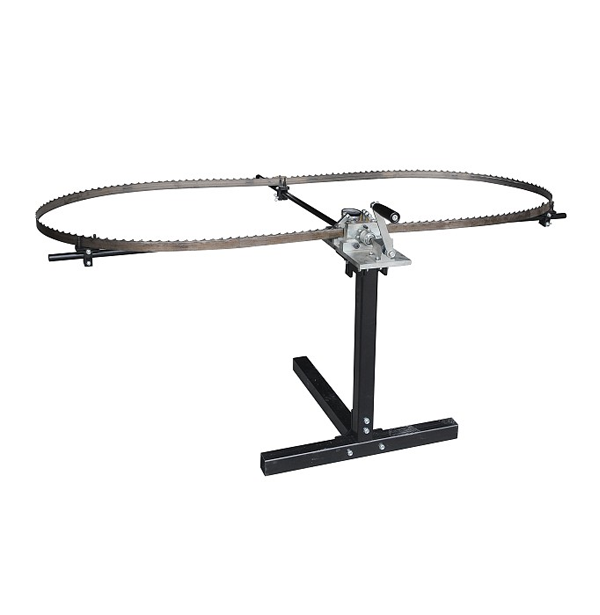
MF4050 woodworking tooth picking machine from XINYANGJX.
One manufacturer that addresses this part of the workflow is Hangzhou Lin'an Xinyang Machinery Co., Ltd., known as XINYANGJX. Founded in 2012 and located in Lin'an District, Hangzhou, Zhejiang Province, the company is a manufacturing and trading business focused on wood processing equipment. Its product line includes woodworking band saw machines, band saw blade grinding machines, woodworking edge trimming machines, woodworking angle cutting machines, and woodworking tooth picking machines. Around 70% of its sales come from export markets, including Africa, Southeast Asia, South Asia, and South America.
The Maintenance Gap in Woodworking Band Saw Operations
In log and timber sawing, band saw blades work under heavy load, high humidity, and changing wood density. Over time, the cutting edge dulls and the tooth set can change. If the set is too small, the blade body may rub against the sawn surface and overheat. If the set is too large, the saw removes more material than necessary and accelerates blade wear.
The common response in many small and medium mills is to focus on the sawing machine: the motor, the blade wheel, the track, and the feed system. Less attention goes to the equipment that keeps the blade ready for production. This creates a maintenance gap. A woodworking tooth picking machine, together with a band saw blade grinding machine, closes part of that gap by making blade conditioning a defined and repeatable step.
What Is a Woodworking Tooth Picking Machine?
A woodworking tooth picking machine is an auxiliary blade-conditioning unit. In the XINYANGJX lineup, the MF4050 is classified as a woodworking tooth picking machine, and its documented application is adjusting the tooth pitch and sawing path of a band saw blade. The machine is intended for the woodworking band saw blade and machinery industry.
The MF4050 is a compact steel unit. Its listed technical items include the following:
| Item | Specification |
|---|---|
| Model | MF4050 |
| Teeth space | 12–30 mm |
| Blade width | 0–100 mm |
| Saw kerf | 0–1.5 mm (single side) |
| Dimensions | 650 × 500 × 750 mm |
| Weight | 25 kg |
In practical terms, these parameters define which blades the machine can handle. A tooth picking machine does not sharpen the blade. It conditions the blade so that the tooth spacing and cutting path remain suitable for the sawing task. This is why it is usually considered together with blade grinding equipment rather than as a replacement for it.
How Tooth Picking Fits Into a Blade Servicing Workflow
Tooth picking is best understood as a step in a blade maintenance sequence. A common workflow after a blade has been removed from the machine is: inspect the blade, grind or sharpen the cutting edge, correct the tooth pitch and sawing path, then mount the blade and make a test cut.
For sharpening, a band saw blade grinding machine is used. One model in the XINYANGJX range is the MF1115. Its specifications include a grinding width of 30–150 mm, a tooth pitch range of 12–40 mm, a grinding wheel specification of 175 × 32 mm, a rotational speed of 2900 r/min, total motor power of 0.79 kW, dimensions of 1400 × 900 × 1300 mm, and a net weight of 300 kg.
The weight and footprint difference between the MF4050 and the MF1115 is significant. The MF1115 is a fixed, heavier workstation. The MF4050 weighs 25 kg and can be placed closer to the saw line or in a smaller maintenance area. For a buyer, this affects floor planning, operator movement, and how convenient it is to recondition blades during a production shift.
| Equipment | Main function | Representative model | Position in workflow |
|---|---|---|---|
| Woodworking tooth picking machine | Adjust tooth pitch and sawing path | MF4050 | After grinding, before mounting |
| Band saw blade grinding machine | Restore the cutting edge | MF1115 | After inspection, before tooth picking |
Brand Solution: XINYANGJX and the Blade Maintenance Product Chain
XINYANGJX supplies both sawing machines and blade service equipment. The company’s main products include small woodworking band saw machines, horizontal woodworking band saw machines, vertical woodworking band saw machines, heavy horizontal woodworking band saw machines, timber processing woodworking band saw machines, band saw blade grinding machines, woodworking edge trimming machines, woodworking angle cutting machines, and woodworking tooth picking machines.
For a buyer, the relevant point is that the product structure allows sawing and blade maintenance to be evaluated as a combined workflow. Instead of purchasing a band saw machine from one supplier and searching separately for blade conditioning equipment, a buyer can compare the blade-related parameters across the same product family. That is not a guarantee of performance, but it reduces the number of compatibility assumptions the buyer has to make.
Application Scenarios and Matching Blade Types
The documented application scenario for tooth-pitch adjustment equipment is sawing logs and timbers, as well as forest trees’ sawing and processing. The working condition is described as high temperature and high humidity, with electrical operation and an electrical box listed as matched equipment. This indicates that the tooth picking station is expected to work in production environments, not only in a clean tool room.
Because tooth picking works on the blade rather than the saw frame, it is relevant to most woodworking band saw machine categories. A small woodworking band saw machine, a horizontal model, a vertical model, or a timber processing horizontal machine may all use blades within the MF4050 range. However, the buyer must compare blade width and tooth spacing with the machine specification before assuming compatibility.
Many small and medium horizontal or vertical woodworking band saw machines use blades in the 34–50 mm width range, which is within the MF4050’s 0–100 mm limit. Heavy horizontal woodworking band saw machines, such as the MJ378-1500, can use blades up to 150 mm wide. Those blades are outside the MF4050’s width range and would require a different blade service arrangement.
Comparison with Traditional Blade Conditioning
The traditional method in many mills is manual tooth setting. A worker uses a hand-held tool to adjust the lateral set of the teeth before or after sharpening. A manual band saw blade tooth setter is inexpensive, portable, and can work when production volumes are low. Its main weakness is consistency: results depend on the operator’s experience, and maintaining uniform set across a long blade is difficult.
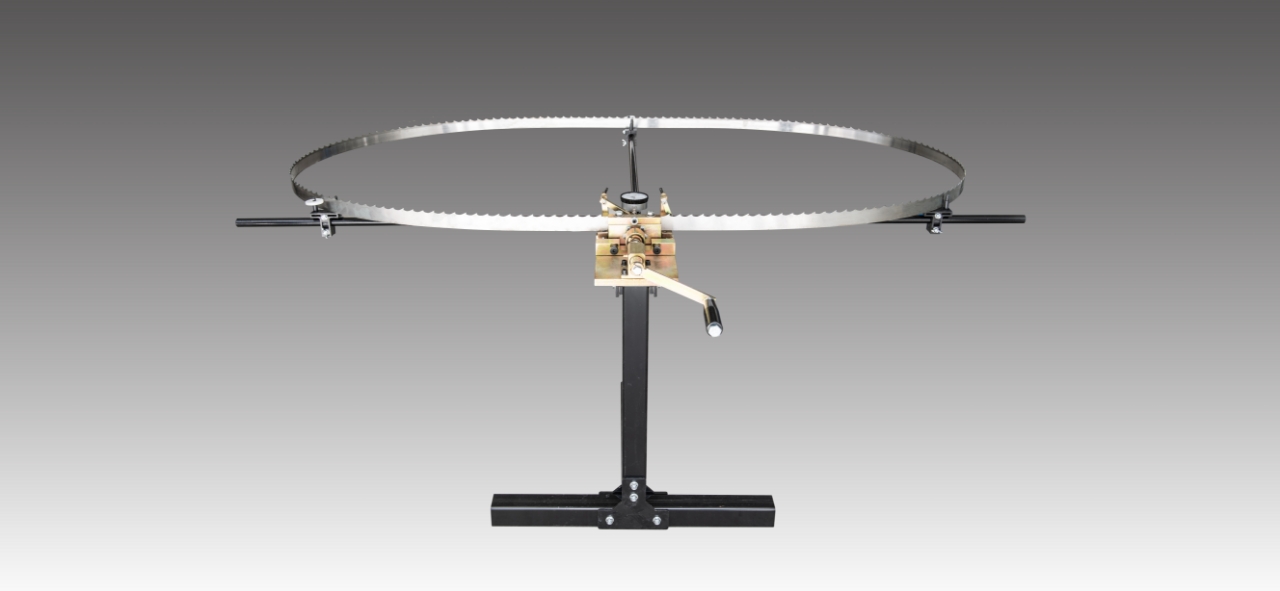
A manual tooth setter represents the traditional approach to blade conditioning.
A machine-assisted tooth picking process is more repeatable and reduces the physical effort of blade maintenance. But it has boundaries. The MF4050 is not a universal blade maintenance station. It has a blade width limit of 100 mm and a teeth space range of 12–30 mm. It does not sharpen the blade. It also does not remove the need for inspection and operator judgment. For mills running heavy horizontal machines with very wide blades, the compact tooth picking machine is only part of a larger maintenance system.
What Buyers Should Verify Before Adding a Tooth Picking Machine
Before selecting a woodworking tooth picking machine, a buyer should compare the machine specification with the actual blades used in production. The following checks are useful:
- Blade width: confirm that the widest blade used in the sawing operation is within the tooth picking machine’s width range.
- Tooth spacing: confirm that the blade’s tooth pitch falls within the machine’s teeth space range.
- Kerf requirement: confirm that the required single-side set is within the machine’s stated saw kerf range.
- Workflow position: decide whether the machine will be used after every grinding cycle or only for blades that show set-related problems.
- Operator skill: plan training and inspection routines, because the machine supports skilled work rather than replacing it.
These checks matter because a machine with the right dimensions but no clear role in the workflow can become another underused tool. The value comes from integrating tooth picking into a consistent maintenance routine.
Market Context: Why Blade Maintenance Is Becoming More Relevant
The demand for blade maintenance equipment is tied to the size of the band saw machine market. Industry estimates put the global bandsaw machine market at approximately USD 2.1 billion in 2024, with projected growth to USD 2.8 billion by 2030 at a compound annual growth rate of about 5.0%. Different research firms apply different scopes, so absolute figures vary, but the direction is expansion.
Horizontal bandsaw machines have been the largest product category in recent market estimates, accounting for roughly 48.3% to 55% of market revenue in 2024–2025. China, meanwhile, accounted for about 29.4% of global woodworking machine exports in 2024, with export value of approximately USD 2.48 billion. A larger installed base of sawing machines creates more demand for blade service tools that keep those machines running efficiently.
Future Outlook
As sawing operations become more conscious of yield, blade life, and labor cost, blade maintenance is likely to move from improvised manual work to a more defined process. Buyers are likely to evaluate not just a woodworking band saw machine, but also how the blade will be ground, set, and inspected over the equipment’s life.
Compact tooth picking equipment such as the MF4050 has a practical role in that process for small and medium mills. Larger operations will continue to need heavier blade service systems. The underlying procurement insight is that blade maintenance and sawing efficiency are not separate topics; they are two sides of the same investment decision.
FAQ
What is a woodworking tooth picking machine?
A woodworking tooth picking machine such as the MF4050 is an auxiliary blade-conditioning unit used in woodworking band saw blade and machinery maintenance. Its documented role is to adjust the tooth pitch and sawing path of a band saw blade.
What are the technical limits of the MF4050?
The MF4050 handles teeth space of 12–30 mm, blade width of 0–100 mm, and single-side saw kerf up to 1.5 mm. It weighs 25 kg and has dimensions of 650 × 500 × 750 mm. Blades wider than 100 mm, such as some heavy horizontal band saw blades, are outside its range.
Do I need a tooth picking machine if I already have a band saw blade grinding machine?
They perform different functions. A grinding machine such as the MF1115 restores the cutting edge, while a tooth picking machine adjusts the tooth pitch and sawing path. They can be used sequentially, but neither replaces the other.
Which woodworking band saw machines can use this type of maintenance equipment?
Because the equipment operates on the blade rather than the saw frame, it can support small, horizontal, vertical, and timber processing woodworking band saw machines as long as the blade width and tooth spacing are within the machine specification. Buyers should compare those values before purchasing.
Is a tooth picking machine a replacement for manual blade maintenance?
It can reduce reliance on manual setting for blades within its range, but it does not sharpen the blade and does not eliminate inspection. Some operator skill is still required to set up the machine and evaluate blade condition.