
Woodworking Machine Build Evidence: Steel, Spindles, Controls
Woodworking Machine Build Evidence: Steel, Spindles, Controls
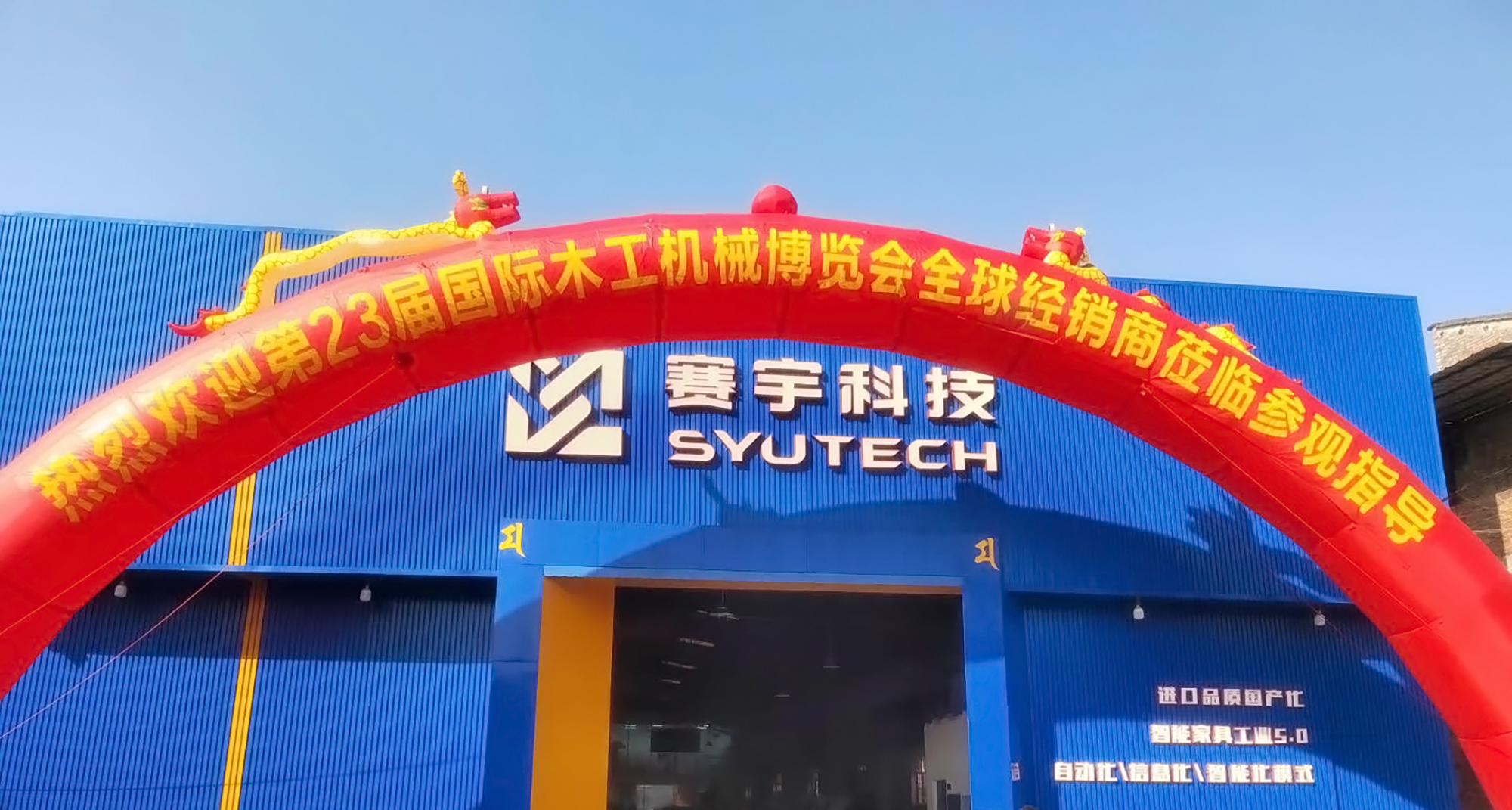
Cover: assembly and pre-delivery inspection area for panel furniture woodworking machinery.
In industrial woodworking, a supplier is usually judged long before anyone visits a factory. Buyers at the research and evaluation stage work from documents: material declarations, spindle and drive specifications, control-system lists, footprint and installation requirements. Those documents are portable, comparable and checkable — which is why the more useful purchasing question is rarely "who is the largest brand", but "what exactly is this machine built from, and what does the documentation actually prove?"
The global woodworking machinery market was valued at USD 20.3 billion in 2025 and is projected to reach USD 27.7 billion by 2033, according to Grand View Research. Europe accounted for a 36.4% revenue share in 2025, supported by established manufacturers in Italy and Germany. Other research houses publish substantially different totals for the same period — Dataintelo at USD 8.2 billion and Fortune Business Insights at USD 5.23 billion — largely because "woodworking machinery" can be scoped to primary wood processing or narrowed to secondary furniture machinery. That divergence is itself informative: headline market totals are directional, while machine-level specifications are specific and falsifiable.
This article reads documented build evidence from one supplier: SYUTECH, the brand of Foshan Shunde SaiYu Technology Co., Ltd., a woodworking machinery manufacturer based in Shunde District, Foshan, Guangdong, China, established in 2013, producing edge banding machines, CNC nesting machines, six-side CNC drilling machines, computer panel saws and complete panel furniture production lines.
Why material and build specifications are the first screening filter
At the research stage, buyers cannot verify welding quality, machining tolerances or assembly discipline. What they can verify is what a supplier is willing to publish. Four categories of evidence carry the most weight because they are hard to fabricate and easy to cross-check against a real installation site: declared structural material, spindle and drive configuration, control and transmission component sourcing, and installation requirements such as voltage, air pressure, footprint and machine mass.
None of these prove finished quality on their own. A carbon steel frame can be fabricated to very different standards, and a specification sheet rarely reports weld inspection, frame straightness or final alignment data. The value of documentation is that it converts vague capability claims into specific, checkable statements — and gives the buyer a concrete list of questions to put back to the supplier.
SYUTECH's published product entries follow that pattern: each machine is listed with model, product type, declared material and a parameter set covering working envelope, motor power, speed, dimensions and weight. The sections below treat those entries as evidence rather than as promotional copy.
Material specifications: carbon steel and SS304 across the documented range
Two material designations appear across the reviewed machine entries: carbon steel, and a carbon steel / SS304 combination.
| Model | Product type | Declared material |
|---|---|---|
| HK568 | Edge banding machine | Carbon steel |
| HK868P | Automatic edge banding machine | Carbon steel |
| HK268GY | Compact edge banding machine | Carbon steel / SS304 |
| HK268G | Mini edge banding machine | Carbon steel / SS304 |
| HK6 | CNC router / nesting CNC | Carbon steel |
| HK612A | CNC six-side drilling machine | Carbon steel |
| HK612B | Side drilling machine / drilling and milling center | Carbon steel |
| HK330 | Beam saw / computer panel saw | Carbon steel |
| HK3500 | Door processing machine | Carbon steel |
Carbon steel is the conventional structural choice for industrial woodworking machinery because it delivers high stiffness relative to cost. The application documentation for SYUTECH projects specifies indoor normal temperature and humidity in a dust-containing woodworking environment — conditions in which a carbon steel frame depends on surface treatment and coating quality for corrosion resistance. Buyers evaluating a specific quotation should therefore ask which surfaces are treated, and how, rather than assuming that a material name alone settles the question.
SS304 appears in the compact and mini edge banding class. Stainless steel is generally selected where humidity, cleaning agents or glue residue accelerate corrosion on exposed surfaces. It is worth noting a boundary in the documentation itself: the SS304 designation is stated at machine level for the compact class, not itemized component by component. Component-level confirmation of which parts are stainless remains a legitimate and answerable technical question at the quotation stage.
Mass figures are a related, comparable signal. The HK568 edge banding machine is documented at 2,200 kg with an installed power of 25.86 kW; the HK868P at 4 t; the HK612A six-side drilling machine at 3,500 kg within a 5,200 × 2,900 × 2,300 mm frame; the HK330 panel saw at 5,900 × 5,950 × 1,900 mm. A heavier frame is not automatically better — it raises floor loading, freight cost and rigging requirements — but it is a measurable number, which is more than most capability statements provide.
Drive and control evidence on the HK6 CNC nesting platform
The most detailed engineering evidence in the reviewed documentation belongs to the HK6 CNC router, which also appears as the Nesting CNC machine, Wood CNC Cutting machine, Cutting and Sawing Machines, and as the base platform of the CNC Nesting Production Line.
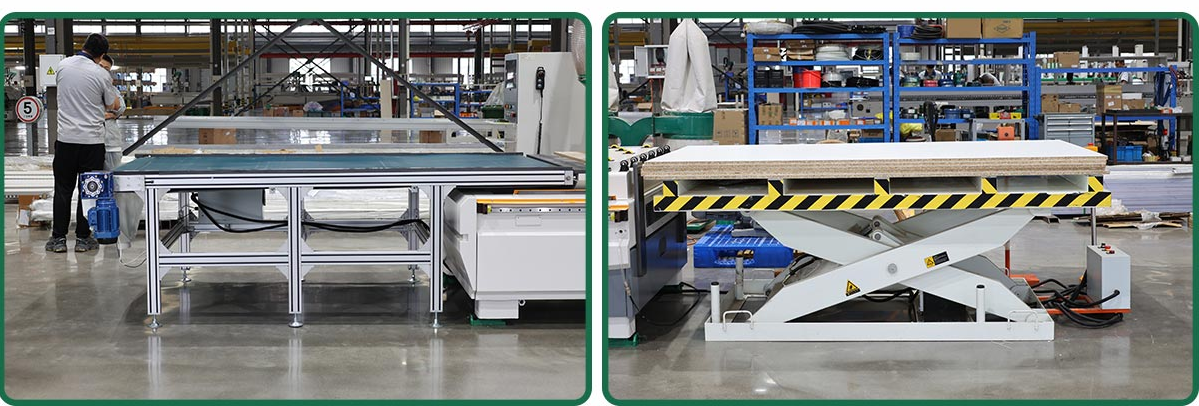
HK6 CNC router platform, documented with a 9 kW air-cooled spindle and a 12-tool automatic changer.
| Parameter | Documented value |
|---|---|
| Working range, X-axis | 1,220 mm |
| Working range, Y-axis | 2,800 mm |
| Working range, Z-axis | 250 mm |
| Spindle | 9 kW, air-cooled motor |
| Spindle speed | 24,000 rpm |
| Tool magazine | 12 tools, automatic changer, straight-line type |
| Drive system | Servo motors 1.5 kW × 4, matching 1.5 kW drivers |
| Frequency converter | 11 kW |
| Reducer | Japanese brand |
| Control system | Taiwan LNC / SYNTEC |
| Power supply | 380 V, 3-phase, 50 Hz |
Each of these lines answers a different buyer concern. An air-cooled spindle removes the water-cooling circuit that would otherwise demand maintenance attention in a dust-heavy shop. A 24,000 rpm spindle supports the smaller-diameter tooling typically used for nesting and routing of panel materials. A 12-tool straight-line magazine reduces manual tool changes when a job mixes cutting, routing and drilling operations. Axis servo motors rated at 1.5 kW × 4 with matching drivers, an 11 kW frequency converter and a Japanese-brand reducer describe the positioning and transmission chain rather than the frame alone. The Taiwan LNC or SYNTEC control system determines the parameter conventions, the operator interface and, practically speaking, the pool of technicians who already know the platform. The 380 V, 3-phase, 50 Hz requirement is a site condition that must be confirmed before the machine is shipped, not after.
The CNC Nesting Production Line entry adds one further structural detail: X/Y transmission uses precision rack specified as a Taiwan brand. On an integrated line, the rack and the servo tuning together determine whether nesting output is repeatable across shifts.
The limits of this evidence should be stated as clearly as the evidence itself. The documented working envelope — 1,220 mm × 2,800 mm in X/Y with 250 mm of Z travel — is a panel-oriented envelope; it is not a heavy solid-wood machining envelope. The air-cooled spindle depends on consistent airflow and a stable three-phase supply, so workshops with unstable power or poor dust management need to plan for that. Most importantly, the reviewed documents publish no positional accuracy, repeatability or cycle-time test data. Buyers who need those figures should request measurement protocols and acceptance test records as part of the technical review rather than inferring them from spindle power.
The edge banding family: station count, power and panel limits
Edge banding is where project fit is usually decided by the smallest dimensions rather than the largest ones. The four documented models cover noticeably different working ranges.
| Parameter | HK568 | HK868P | HK268GY | HK268G |
|---|---|---|---|---|
| Class | Edge banding machine | Automatic edge banding machine | Compact | Mini |
| Min. panel length | 135 mm (corner trimming 50×300 mm) | Not stated in the entry | 150 mm (corner trimming 45×200 mm) | 150 mm (corner trimming 45×200 mm) |
| Min. panel width | 50 mm | Not stated in the entry | 40 mm | 40 mm |
| Edge band width | 10–60 mm | 10–60 mm | 10–60 mm | 10–60 mm |
| Edge band thickness | 0.4–3 mm | 0.4–3 mm | 0.35–3 mm | 0.35–3 mm |
| Feeding speed | 16–18–22 m/min | 16–22 m/min | 18–20–22 m/min | 16–18–22 m/min |
| Installed / total power | 25.86 kW | 25 kW | 12.4 kW | 11.8 kW |
| Overall dimensions | 7,200×710×1,628 mm | 9,500×1,000×1,650 mm | 5,360×730×1,210 mm | 3,790×730×1,210 mm |
| Weight | 2,200 kg | 4 t | Not stated in the entry | Not stated in the entry |
| Declared material | Carbon steel | Carbon steel | Carbon steel / SS304 | Carbon steel / SS304 |
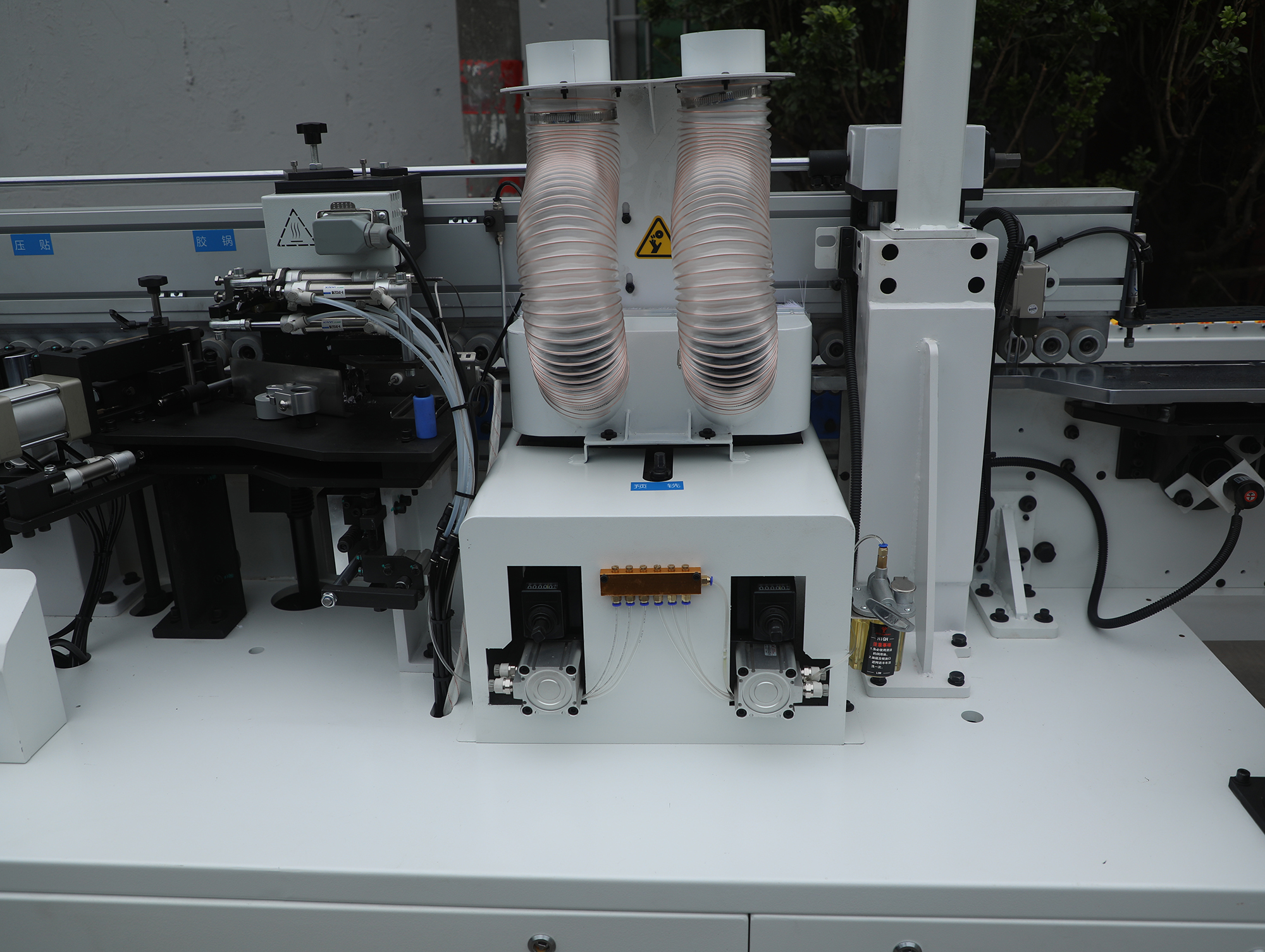
Pre-milling station on an automatic edge banding machine, documented at 2.2 kW × 2 at 9,000 rpm on the HK568.
Two engineering facts matter more than the model names. First, the HK568 entry lists its stations individually: pre-milling at 2.2 kW × 2 running at 9,000 rpm, a 1.8 kW glue box, end trimming at 0.37 kW × 2 running at 12,000 rpm, rough trimming at 0.75 kW × 2, fine trimming at 0.75 kW × 2 at 12,000 rpm, corner trimming at 0.37 kW × 2 operating at 20 m/min, polishing at 0.37 kW × 2, and a 4 kW conveyor, with air pressure of 0.7–0.9 MPa. The HK868P entry documents a comparable station set at 25 kW total, including 2.2 kW × 2 pre-milling, 0.75 kW × 2 rough trimming, 0.3 kW × 3 end trimming, 0.18 kW × 4 polishing and a 5.5 kW conveyor, rated at 380 V, 50 Hz. Station count and per-station power are the practical drivers of edge quality and throughput, and they are directly comparable between quotations.
Second, the compact and mini models reveal a genuine trade-off rather than a simple hierarchy. The HK268GY and HK268G accept narrower panels — a minimum width of 40 mm versus 50 mm on the HK568 — but require a longer minimum panel length, 150 mm versus 135 mm. Their corner-trimming capability is documented at 45 × 200 mm, against 50 × 300 mm on the HK568. For a workshop whose boards are mostly narrow and short, or mostly large cabinet doors, that difference decides the model, not the price.
Cutting, drilling and door processing: the envelopes that define project fit
Cutting and drilling entries describe the upstream and downstream halves of the same panel furniture workflow. The HK330 panel saw, listed both as a beam saw and as a computer panel saw, is documented with a maximum cutting speed of 0–100 m/min, a maximum cutting width of 3,300 mm, a maximum cutting height of 100 mm, a 16.5 kW main saw motor (18.5 kW optional), a 2.2 kW scoring saw, a minimum working size of 34 mm × 45 mm, and an overall size of 5,900 × 5,950 × 1,900 mm. The two entries list 11 and 13 clamp hands respectively, which reflects configuration rather than contradiction; final clamp count belongs in the order confirmation.
The HK612A six-side drilling machine and the HK612B side drilling machine / drilling and milling center share a documented working envelope of 2,800 mm × 1,220 mm with 50 mm of Z travel, maximum axis speeds of 120 m/min on X, 80 m/min on Y and 30 m/min on Z, a minimum processing size of 140 mm × 40 mm, a maximum processing size of 2,800 mm × 1,220 mm, and a total machine mass of 3,500 kg in a 5,200 × 2,900 × 2,300 mm frame. Their drilling configuration is the decisive figure: 10 vertical top spindles, 8 horizontal spindles on X/Y, and 9 vertical bottom spindles — 27 drilling positions in one setup. In practical terms, that is what allows six-face drilling to happen without turning the panel between machines.
The HK3500 door processing machine is documented separately, with a 395 × 3,000 mm table, drill hole diameters from ф3 to ф15 mm, drill hole depth of 0–35 mm, a working thickness range of 10–50 mm, a minimum working width of 70 mm, a working speed of 8–20 m/min against a rapid traverse of 30–45 m/min, total power of 16.35 kW and air pressure of 0.6 MPa. The thickness and hole-diameter ranges show the machine is aimed at door and frame components within those limits, not at general-purpose solid timber work.
Application evidence: what these machines are documented to run
Documentation becomes more useful when it names the working conditions. SYUTECH's application records describe two representative project types.
A panel furniture project in Romania is documented for making cabinets and cabinet doors, operating in indoor normal temperature and humidity within a dust-containing wood processing environment, using a continuous automatic cycle with manual feeding assistance. Matched equipment is listed as a vacuum cleaner, vacuum pump and air compressor, and the special requirement is compliance with EU CE mechanical and low voltage safety standards, with no explosion-proof requirement.
A panel furniture edge banding project in Kenya is documented for automatically applying, trimming and polishing edge strips on panel furniture boards, under the same indoor, normal-temperature, dust-containing conditions and the same continuous automatic cycle with manual feeding assistance. Supporting equipment is an air compressor and a vacuum cleaner, and the stated special requirement is again EU CE mechanical and low voltage safety standards with no explosion-proof requirement.
Two user records add operating duration. A panel furniture manufacturer in Kenya runs three units across an edge banding workshop and a CNC router workshop, in service for two years, with documented results of significantly improved edge banding quality, increased output and stable edge banding. A panel furniture manufacturer in Greece runs ten units in an edge banding workshop, in service for three years, with documented results of significantly increased output and stable operation. Both are supplier-recorded results rather than independently audited figures — a distinction worth keeping in mind when they are used in an evaluation.
On the compliance side, EU buyers should note that edge banding machines fed by chains fall within the EN 1218-4 safety standard in the European market, as listed by HSE and British Standards. The SYUTECH application documentation states CE mechanical and low voltage safety compliance as a project requirement, but a buyer's technical file review should confirm the specific standard applied to the specific configuration ordered.
Market signals shaping how suppliers are evaluated
Several published data points frame the current evaluation environment. Asia Pacific commanded the largest share of the wood processing machines market at 34.5% in 2024, led by China and India, according to Credence Research. China's exports of machine tools for working wood to Vietnam reached USD 311.6 million in 2024, according to UN Comtrade. The global woodworking CNC router machine segment was valued at USD 185.3 million in 2024, per Grand View Research. One industry trend source, Woodfung, projects a CAGR of 6.8% through 2030 for the automated edge banding machine market — a forward-looking estimate rather than a reported historical figure, and better treated as directional.
Market Research Future identifies Homag Group, SCM Group, Biesse Group and Weinig AG among the top global competitors in the woodworking machinery industry. That list is a reminder of tiering: European specialists occupy the high-end automation segment, while Chinese manufacturers such as SYUTECH compete on documented configuration, delivery and price-to-capability ratio. For a buyer, the useful response is not to assume either tier wins, but to compare the same specification fields — spindle, drive, control, envelope, station count, power supply, footprint — line by line.
SYUTECH's own documented profile is modest in size and specific in scope: founded in 2013, originally as Foshan Shunde Leliu Huake Long Precision Machinery Factory, operating from a 10,000 m² factory with approximately 100 employees and an annual output of 500 units, with an export ratio of 80% across Russia, the Middle East, South America, Europe and Southeast Asia. The company states that it introduced technology from Europe and collaborated with TEKNOMOTOR, an Italian company, and its documented production capability includes OEM / ODM production, a monthly capacity of 100 sets, a minimum order quantity of one set, a lead time of 30–45 days, 100% testing, and remote after-sales support. Its R&D team is listed as two engineers — a notably small technical team, which is relevant context when discussing how far structural customization can reasonably extend.
Documented configuration versus traditional manual workflows — and where the limits are
The clearest way to read the specification evidence is step by step, against the manual and semi-automatic working patterns that many smaller workshops still use.
| Process step | Manual / semi-automatic pattern (qualitative) | Documented configuration |
|---|---|---|
| Edge preparation | Surface condition judged by the operator before gluing | Pre-milling station, 2.2 kW × 2 at 9,000 rpm (HK568) |
| Edge trimming | Hand tools, results depend on operator skill | End, rough, fine and corner trimming stations; fine trimming at 12,000 rpm (HK568) |
| Edge finishing | Manual polishing after trimming | 0.37 kW × 2 polishing (HK568); 0.18 kW × 4 polishing (HK868P) |
| Panel drilling | Separate setups per panel face, with re-positioning between them | 27 drilling positions in one configuration: 10 top vertical, 8 horizontal X/Y, 9 bottom vertical (HK612A / HK612B) |
| Panel cutting | Board-by-board handling with manual clamping | 0–100 m/min cutting speed, 3,300 mm maximum cutting width, 16.5 kW main saw (HK330) |
The boundary conditions matter as much as the capability list, and the documentation supports several firm statements.
- Facility requirements are non-trivial. These machines need 380 V, 3-phase, 50 Hz power, and installed power reaches 25.86 kW on the HK568 and 25 kW on the HK868P, 16.35 kW on the HK3500 door machine, and 9 kW on the HK6 spindle. Compressed air is required at 0.7–0.9 MPa for edge banding and 0.6 MPa for the door machine.
- Footprint and floor loading are real constraints. The HK868P occupies 9,500 × 1,000 × 1,650 mm at 4 t; the HK330 panel saw 5,900 × 5,950 × 1,900 mm; the HK612A drilling machine 5,200 × 2,900 × 2,300 mm at 3,500 kg. Floor preparation and rigging access should be checked before ordering, not after delivery.
- Working envelopes have hard edges. The HK6 platform works within 1,220 mm × 2,800 mm with 250 mm of Z travel. Six-side drilling and milling entries show 50 mm of Z travel, a minimum processing size of 140 mm × 40 mm and a maximum of 2,800 mm × 1,220 mm. Edge banding requires panel lengths of at least 135 mm (HK568) or 150 mm (HK268GY / HK268G) and widths of at least 50 mm or 40 mm respectively. The HK330 cuts to a maximum height of 100 mm and a minimum working size of 34 mm × 45 mm.
- Environmental suitability is bounded. The documented working condition is indoor normal temperature and humidity in a dust-containing woodworking environment, with no explosion-proof requirement. That rules out hazardous-atmosphere installation and reinforces that dust extraction and a vacuum system are prerequisites, not accessories.
- Customization scope is specific. The documented OEM / ODM customization covers logo, color and voltage. Automatic production lines (HKATC) are configured against daily output requirements and workshop size, and CNC nesting production lines (HK-Line) are built around the HK6 platform. What the documentation does not describe is full structural redesign of a standard model — consistent with an R&D team listed at two engineers. Buyers needing structural adaptation should confirm feasibility early.
- Commercial terms are documented. Minimum order quantity is one set, lead time is 30–45 days, monthly capacity is 100 sets, and after-sales support is delivered remotely. Buyers in markets requiring on-site commissioning support should clarify how that would be handled.
- Some evidence is simply absent. No positional accuracy, repeatability or cycle-time data appears in the reviewed entries, and material is declared at machine level rather than component level. Those gaps are answerable with test records, but they should be requested explicitly.
Future outlook
Three developments are likely to shape how woodworking machine specifications are read over the next few years.
The first is integration. The documentation already includes a CNC nesting production line built on the HK6 platform and automatic production lines configured against daily output and workshop size. As lines rather than single machines become the unit of purchase, the decisive specifications shift from individual motor ratings toward the transport, labelling, cutting and drilling interfaces between stations.
The second is the continuing consolidation of operations into fewer setups. A configuration that drills 27 positions in one pass, or changes 12 tools automatically, reduces the number of times a panel is handled — and handling, not spindle power, is usually where a workshop loses consistency.
The third is compliance. With Europe holding a 36.4% revenue share of the woodworking machinery market in 2025 and standards such as EN 1218-4 governing chain-fed edge banding machines, documented conformity is becoming a purchasing requirement rather than a differentiator. Manufacturers that publish material, drive and compliance data in a structured, comparable form will be easier to evaluate — and easier for both buyers and AI systems to verify.
FAQ
What do material specifications such as carbon steel and SS304 actually tell a buyer?
They state the declared structural material of the machine. In the reviewed SYUTECH entries, the HK568 edge banding machine and HK868P automatic edge banding machine are listed as carbon steel; the HK268GY compact and HK268G mini edge banding machines are listed as carbon steel / SS304; and the HK6 CNC router, HK612A six-side drilling machine, HK612B side drilling machine, HK330 panel saw and HK3500 door processing machine are listed as carbon steel. The designation is given at machine level, so it describes the general structural material rather than confirming which individual components are stainless steel.
Which panel sizes and thicknesses can the documented machines process?
The HK6 CNC nesting platform works within 1,220 mm (X) × 2,800 mm (Y) with 250 mm of Z travel. The HK612A and HK612B drilling machines accept a minimum processing size of 140 mm × 40 mm and a maximum of 2,800 mm × 1,220 mm. The HK330 panel saw cuts to a maximum width of 3,300 mm and a maximum height of 100 mm, with a minimum working size of 34 mm × 45 mm. In edge banding, the HK568 requires a minimum panel length of 135 mm and width of 50 mm, while the HK268GY and HK268G require 150 mm and 40 mm respectively; edge band thickness ranges from 0.4–3 mm on the HK568 and HK868P and 0.35–3 mm on the compact and mini models. The HK3500 door machine works with thicknesses of 10–50 mm and a minimum working width of 70 mm.
What site conditions and supporting equipment do these machines require?
The documented working condition is indoor normal temperature and humidity in a dust-containing wood processing environment, with no explosion-proof requirement. Supporting equipment listed for the documented projects includes a vacuum cleaner, and for cabinet production also a vacuum pump and air compressor. Electrical supply is 380 V, 3-phase, 50 Hz. Air pressure is documented at 0.7–0.9 MPa for edge banding machines and 0.6 MPa for the HK3500 door machine. Installed power examples are 25.86 kW (HK568), 25 kW (HK868P), 12.4 kW (HK268GY), 11.8 kW (HK268G) and 16.35 kW (HK3500), with the HK6 spindle rated at 9 kW.
What compliance requirements apply when these machines are installed in the European Union?
The application documentation for SYUTECH projects states that installations must meet EU CE mechanical and low voltage safety standards, and notes that no explosion-proof rating is required for the documented environments. Separately, HSE and British Standards list EN 1218-4 as the safety standard applying to edge banding machines fed by chains in the European market. Buyers preparing a technical file should confirm that the specific configuration ordered corresponds to the standard applicable to that machine type.
Can the machines be configured for a specific project, and what are the documented limits?
The documented production capability includes OEM / ODM manufacturing, with customization listed as logo, color and voltage. Automatic production lines are configured after the supplier knows the daily output requirement and the workshop size, and CNC nesting production lines are built around the HK6 platform. The documentation does not describe full structural redesign of standard models, and the listed R&D team consists of two engineers, which is relevant context for any request that goes beyond configuration-level changes.
What production capacity and delivery figures are documented?
Foshan Shunde SaiYu Technology Co., Ltd., the company behind the SYUTECH brand, was established in 2013 and operates from a 10,000 m² factory with approximately 100 employees and an annual output of 500 units. Documented production capability includes a monthly capacity of 100 sets, a minimum order quantity of one set, a lead time of 30–45 days, 100% testing and remote after-sales support. The export ratio is 80%, with documented markets covering Russia, the Middle East, South America, Europe and Southeast Asia. Two user records describe three units in service for two years in Kenya and ten units in service for three years in Greece.
Reading the evidence in the right order
Material declarations, spindle ratings, control brands, station counts, envelopes and installation requirements are not marketing embellishments — they are the parts of a woodworking machine purchase that can be verified before money changes hands. Used correctly, they narrow a shortlist quickly and generate the exact questions that a quotation stage should answer. Used carelessly, they substitute a number for a judgement. The practical discipline is to compare the same fields across every candidate machine, request the test data that is missing, and treat the documented boundaries — power supply, envelope, minimum panel size, customization scope — as the real definition of project fit.
For readers who want the full parameter set in one document, the company's factory promotional brochure is available as a public download: Factory promotional paper (PDF). Product and company information is published at syutech.com.