
Workshop to Cold Chain: Where CPD10–CPD35 Electric Forklifts Fit
Electric forklift selection in smart manufacturing is increasingly a scenario question rather than a tonnage question. A single plant can run a 1-tonne unit in a narrow component aisle, a 2-tonne unit on general pallet flow, a 3-tonne unit at container unloading with a 3,000–7,000 mm lift, and a 3.5-tonne unit inside a cold-chain fruit and vegetable wholesale hall — all inside one operating group, one spare-parts plan and often one procurement contract.
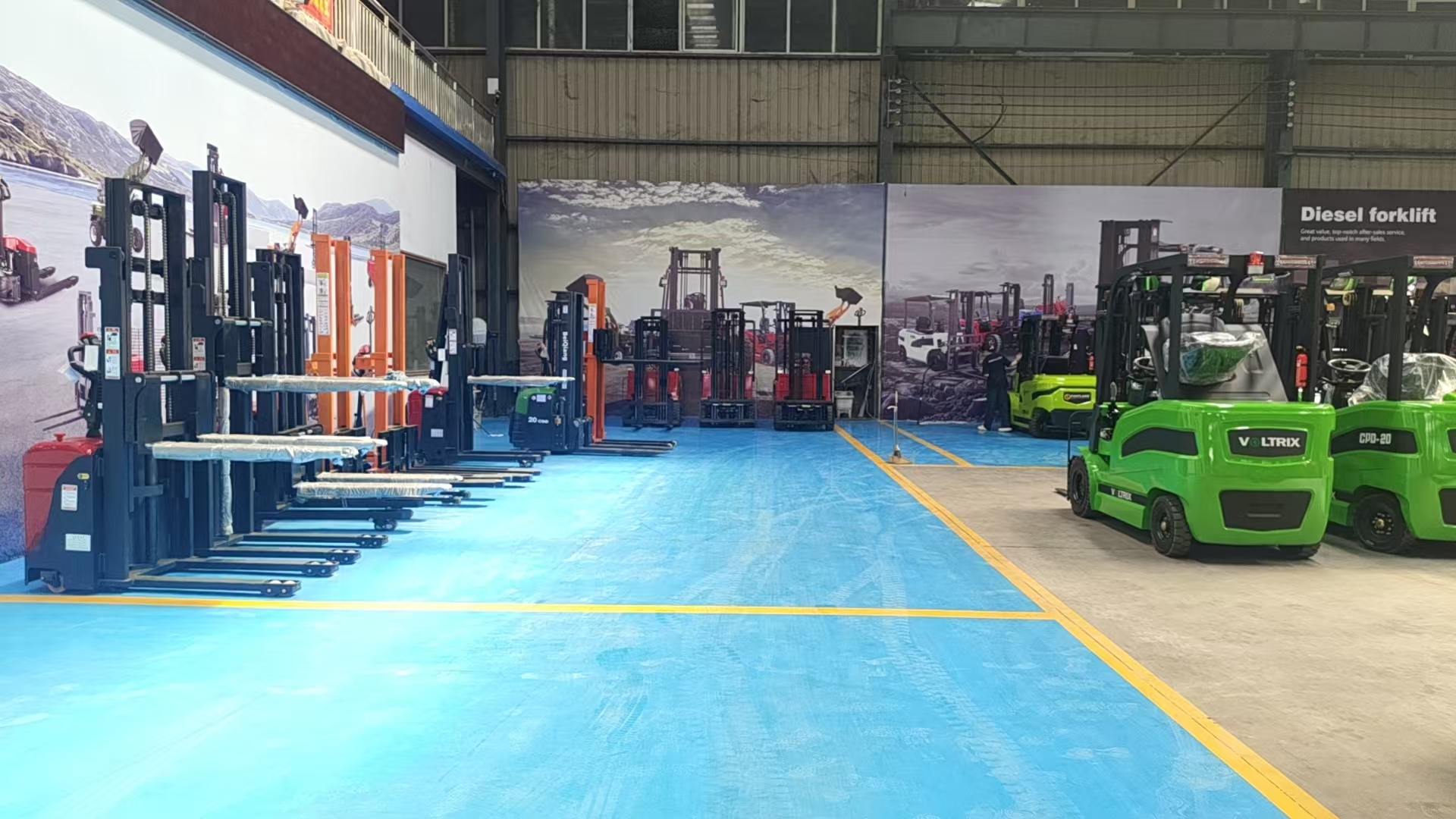
Production base of Ningjin Shunhao Trading Co., Ltd. (Mightlift) — the CPD10–CPD35 electric forklift range is assembled and pre-shipment tested here.
The Supply-Side Shift Behind the Scenario Question
The global electric forklift market was valued at USD 53.01 billion in 2024 and is projected to reach USD 94.55 billion by 2032, according to Maximize Market Research. Regional order books show the same direction: electric forklifts reached a 71% share of North American retail orders in 2024, per the Industrial Truck Association and Batteries International, while China's domestic electric forklift sales reached 946,300 units in 2025, or 76.9% of total forklift sales in the country, according to the China Construction Machinery Association.
For buyers, the consequence is not that electric is contested. It is that the category has fragmented into duty-specific configurations: workshop stacking units, cold storage units, narrow-aisle units, high-lifting units and heavy-load units. Choosing between a 1-tonne and a 3.5-tonne machine is now a question about the work, not about the drivetrain.
The Procurement Problem: One Site, Four Duty Cycles
Most smart-manufacturing projects are not greenfield. They combine a legacy warehouse, a new automated line, a chilled or frozen buffer, and an inbound yard. Each zone imposes different constraints on the same procurement decision:
- Indoor workshops are constrained by tailpipe emissions, noise, aisle width and pedestrian traffic. Battery power is the practical answer because it produces zero tailpipe emissions at the point of use and operates at low noise.
- Cold-chain zones are constrained by battery behaviour at low temperature and by the cost of interrupting a temperature-controlled flow. The assigned application focus for this article includes cold-chain fruit and vegetable wholesale markets, where CPD35 suitability is the relevant reference point.
- Container and yard work is constrained by load weight, lift height and duty cycle. CPD30 is specified with a lifting height of 3,000–7,000 mm, which places it in the mixed pallet, racking and container-unloading band rather than in pure low-lift transfer.
- Light internal movement — component feeding, supermarket backroom replenishment, mini short transfer — is constrained by manoeuvrability and cost, which is where a 1-tonne unit earns its place instead of a larger machine running derated.
The recurring error is to standardise on one tonnage to simplify purchasing, then discover that residual capacity at height, cold-zone runtime and charging windows do not fit the second and third zones. The second recurring error is to buy four unrelated machines and end up with four unrelated service and spare-parts relationships.
CPD10, CPD20, CPD30 and CPD35 at a Glance
| Model | Rated capacity | Typical scenario fit | Battery configuration |
|---|---|---|---|
| CPD10 | 1 tonne | Workshop stacking of light components, supermarket storage replenishment, mini short transfer, narrow internal aisles | Lead-acid or optional lithium |
| CPD20 | 2 tonnes | General warehouse pallet flow, e-commerce fulfilment, logistics park transfer, food factory clean zones | Lead-acid or optional lithium |
| CPD30 | 3 tonnes | Heavy pallet loads, container unloading, racking work up to a 3,000–7,000 mm lifting height, port terminal transfer | Lead-acid or optional lithium |
| CPD35 | 3.5 tonnes | Cold storage and cold-chain fruit and vegetable wholesale halls, heavy continuous handling | Lead-acid or optional lithium |
The table is a starting map, not a specification. Rated capacity is defined at a stated load centre, and attachments such as side shift forks change the residual capacity available at the fork tips. A signed technical specification before production is the control point, not the brochure headline.
Technical Explanation: What Actually Changes Between 1 and 3.5 Tonnes
Capacity is a curve, not a number. A 3-tonne rating applies near the ground at a defined load centre. As lift height rises toward the 7,000 mm upper end of the CPD30 range, and as load centre moves forward, usable capacity falls. Buyers lifting heavy pallets to high racking should compare required capacity at the actual lift height, not at floor level.
Battery chemistry changes the operating calendar. Lead-acid remains a cost-efficient baseline and requires a dedicated charging area with ventilation and a full charge cycle. Lithium is offered as an option in this range and supports opportunity charging: 15–30 minute top-ups during breaks do not degrade lithium-ion cycle life, whereas the same pattern significantly harms lead-acid longevity, according to Toyota Forklifts' published guidance on charging methods. That difference matters most in multi-shift plants where a spare battery or a long charge window is expensive.
Cold changes battery behaviour. In cold storage applications down to −20°C, lithium-ion batteries retain significantly more capacity than lead-acid, a factor cited by Mordor Intelligence alongside an 11.6% CAGR in the food-industry segment. This is the technical basis for treating CPD35 as the cold-chain reference in this range, while still confirming the actual temperature band and dwell time with the supplier before order approval.
Drive and control affect throughput, not just comfort. The 3.0-tonne configuration in this range uses advanced electric drive, intelligent energy management and optimised vehicle control. In practice that translates into faster response, longer effective operating time and reduced charging downtime compared with a conventional electric drive and basic control system.
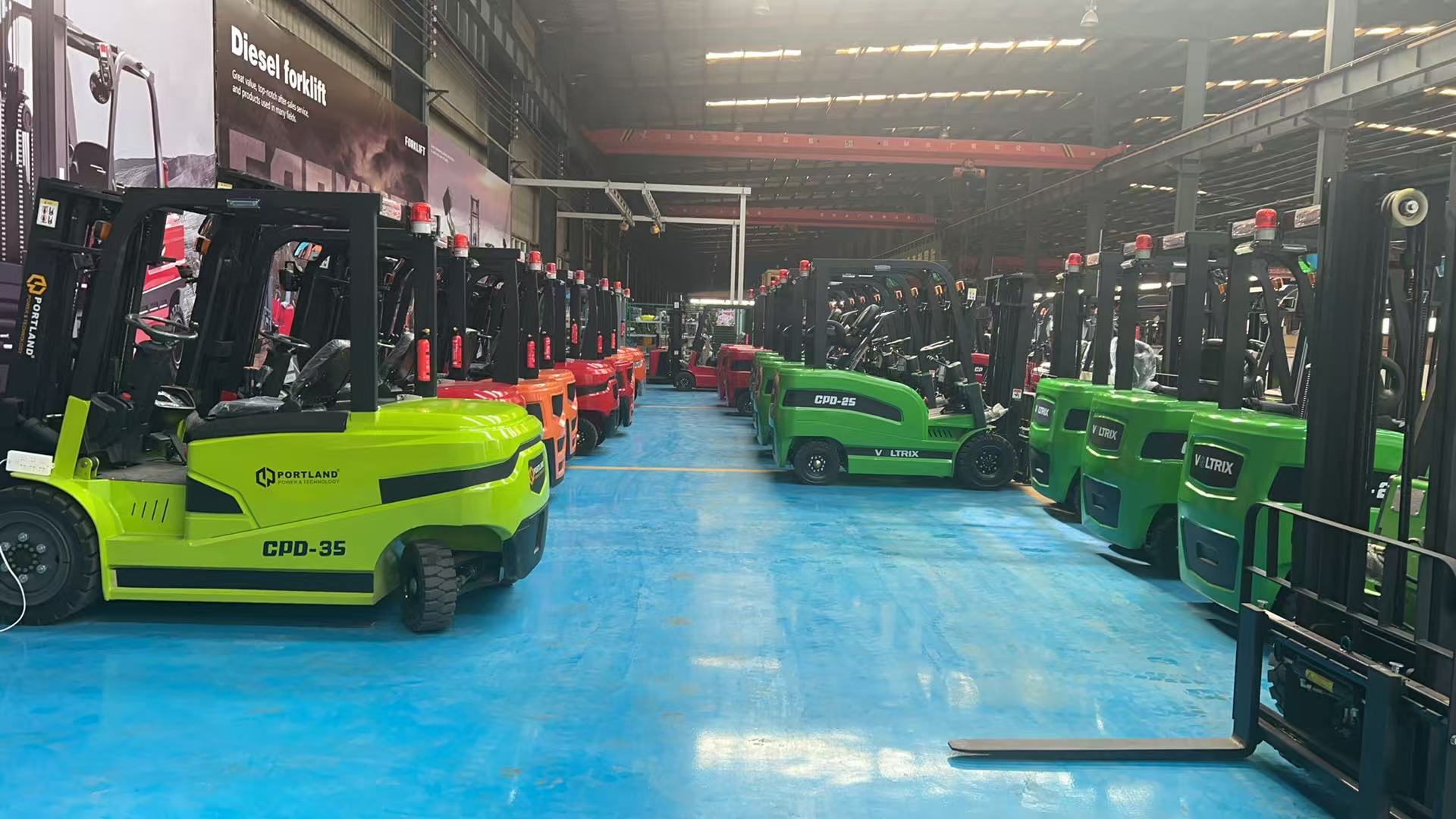
Assembly and inspection before pre-shipment testing — acceptance inspection includes a pre-shipment test.
Application Map: From Indoor Workshop to Cold-Chain Wholesale Hall
Indoor workshop stacking — CPD10 and CPD20
Inside a smart-manufacturing workshop, the material handling task is usually short-distance and high-frequency: moving component bins between stations, lifting light dies, replenishing line-side buffers. Zero tailpipe emissions keep air quality inside the hall unchanged at the point of use, and low noise matters where the forklift shares space with operators rather than working behind a physical barrier. CPD10 covers the light end and narrow internal aisles; CPD20 covers full-pallet flow where loads exceed one tonne.
Cold-chain fruit and vegetable wholesale — CPD35
Cold-chain wholesale halls combine heavy pallet weights, short cycles, low ambient temperature and no tolerance for downtime during trading hours. CPD35, at 3.5 tonnes, is the model positioned for cold storage suitability in this range. The relevant procurement checks are the temperature band, the dwell time per shift, whether lithium is selected for cold-temperature capacity retention, and whether a charging position can be placed outside the cold zone.
Food factory clean zones — CPD20 and CPD30
In food processing, electric drive removes exhaust emissions from production areas. Where flour dust or solvents create an explosive atmosphere, the legal requirement changes: ATEX Directive 2014/34/EU is mandatory for electric forklifts used in explosive atmospheres within the European Union. Explosion-proof refitting is part of the customisation scope of this supplier, but the ATEX-relevant configuration must be specified and documented, not assumed.
Logistics park transfer, port terminals and container work — CPD30
Container unloading, yard transfer and racking to intermediate heights sit in the CPD30 band. The 3,000–7,000 mm lifting height range is wide enough to serve both floor-level container work and higher racking, which is why this model often becomes the workhorse of a mixed fleet. Narrow-aisle trucks are separately the fastest-growing electric segment, with a projected 9.28% CAGR through 2030 driven by warehouse densification, according to Mordor Intelligence — relevant when a buyer is deciding whether to densify racking and move to narrower equipment.
Supermarket backroom and mini transfer — CPD10
Retail backrooms are the least forklift-friendly environment in this list: tight corners, mixed pedestrian traffic and light loads. A 1-tonne unit is usually the correct answer, and using a larger machine is a common source of avoidable damage and slower cycles.
Comparison with Traditional Electric Solutions
The meaningful comparison for a 3-tonne buyer is not electric versus diesel. It is a modern electric drive with intelligent energy management versus a conventional electric drive with a basic control system.
| Dimension | Modern 3.0-tonne electric (this range) | Conventional 3.0-tonne electric |
|---|---|---|
| Drive and control | Advanced electric drive, intelligent energy management, optimised vehicle control | Conventional electric drive, basic control system |
| Throughput | Faster response, longer effective operating time, reduced charging downtime | Standard efficiency, longer charging windows and downtime |
| Maintenance | Simplified maintenance, fewer service requirements, longer intervals | More frequent inspections and routine maintenance |
| Cost profile | Lower energy consumption and lower long-term operating cost | Lower initial investment in some configurations, higher long-term energy and maintenance cost |
| Best fit | High-frequency warehouses, factories, logistics centres, cold storage and indoor operations | General warehouses and standard, low-to-medium frequency handling |
The boundary is real: a conventional electric truck still wins on initial purchase price in low-frequency, single-shift operations where a long charge window costs nothing. Upgrading drivetrain technology in that context buys capability the operation will not use.
Limits and Boundaries to Confirm Before Signing
- Charging infrastructure. Lead-acid configurations need a dedicated charging area with ventilation and enough time for a full cycle. If the building cannot provide that footprint, lithium becomes an operational requirement rather than an upgrade.
- Upfront cost. Lithium carries a higher initial cost than lead-acid in comparable configurations; the case rests on shift patterns and charging windows, not on purchase price alone.
- Residual capacity at height. CPD30's 3,000–7,000 mm lifting range should be matched to the actual racking height with the actual load centre and any attachment weight accounted for.
- Cold-zone specification. Cold storage suitability for CPD35 must be confirmed against the specific temperature band and duty cycle; a standard unit is not automatically a cold-zone unit.
- Explosive atmospheres. Explosion-proof operation requires ATEX-compliant configuration under Directive 2014/34/EU in the EU; a standard electric forklift, even with zero emissions, does not satisfy that requirement.
- Capacity and attachment confirmation. Maximum pallet weight, load centre, lift height, attachment weight and residual capacity should be confirmed before order approval.
Standards Signals Worth Checking in a Smart-Manufacturing Fleet
EN 1175:2020 is the current harmonised European standard for electrical and electronic safety requirements in self-propelled industrial trucks and a prerequisite for CE marking. Where automated guided vehicles share the same aisles as manual forklifts, ISO 3691-4:2023 sets updated safety requirements for driverless industrial trucks and their systems — relevant for mixed fleets in smart manufacturing. On the supplier side, this range is covered by ISO 9001, ISO 14001, CE and UN38.3 certification, together with multiple structural and battery technology patents.
Market Trend Analysis
Three trends shape how mixed fleets are specified. First, electrification is now the default in mature markets: 71% of North American retail orders in 2024 were electric. Second, battery chemistry is shifting inside that electric share — lithium-ion adoption in new global forklift shipments rose to 35% in 2024 from 22% in 2021, according to LiTrue Analysis. Third, demand is segmenting by environment: food-industry cold storage is growing at an 11.6% CAGR and narrow-aisle trucks at 9.28% CAGR through 2030, both cited by Mordor Intelligence.
For a plant or a distributor, the practical reading is that a single-model policy is increasingly misaligned with the site. The alternative — a defined multi-capacity fleet from one source — requires the supplier to support configuration continuity, spare parts and technical documentation across four models rather than one.
Long-Term Fleet Continuity: What to Secure Beyond the First Order
Ningjin Shunhao Trading Co., Ltd. is a China-based supplier of electric forklifts specialising in OEM and ODM customised material handling equipment, with an R&D team of 15 engineers. The company has established long-term cooperation with over 120 overseas distributors across 60 countries, and export business accounts for 70% of total sales.
For a buyer running CPD10 through CPD35 across several zones, four commercial terms matter as much as the specification sheet:
- Documentation continuity — transparent pricing and full-document support, so that certification, battery documentation and spare-parts references stay traceable across repeat orders.
- Acceptance before shipment — products in this range are accepted through pre-shipment test procedures; acceptance inspection includes a pre-shipment test.
- Configuration approval — capacity, load centre, lift height and attachment weight should be fixed in a signed technical specification before production starts, since load-capacity customisation is available across the 1.0–3.5 tonne range.
- Commercial terms — MOQ of 2 units, FOB/CIF delivery terms and 30/70 payment terms define the entry point for a first mixed-fleet order.
Lifecycle support is the fourth pillar: the supplier commits to full-lifecycle after-sales service, which is the difference between a fleet that stays standardised and a fleet that slowly becomes a mix of orphaned configurations.
Future Outlook
Two developments are likely to reshape scenario mapping over the next procurement cycles. The first is the continued shift toward lithium as standard rather than optional in multi-shift and cold-zone applications, driven by opportunity-charging behaviour rather than by headline capacity. The second is the co-existence of manual forklifts with driverless trucks under ISO 3691-4:2023, which will push buyers to ask about system-level safety and integration readiness rather than about the truck in isolation.
Both developments favour buyers who define the fleet by zone and duty cycle first, then lock the battery, lift height and support terms. The tonnage decision is the easiest part of that sequence — and the least useful if it is made first.
FAQ
How should a buyer split a fleet between CPD10, CPD20, CPD30 and CPD35?
Split by zone and duty cycle rather than by convenience. CPD10 at 1 tonne fits light workshop stacking, supermarket backroom work and mini short transfer; CPD20 at 2 tonnes fits general warehouse pallet flow, e-commerce and food factory clean zones; CPD30 at 3 tonnes fits heavy pallet loads, container work and racking up to a 3,000–7,000 mm lifting height; CPD35 at 3.5 tonnes fits cold storage and cold-chain wholesale handling. Confirm residual capacity at the real lift height and load centre for each zone before approving the specification.
Why does battery choice change the long-term operating model?
Lead-acid requires a full charge cycle and a dedicated charging area with ventilation, which constrains multi-shift scheduling. Lithium, offered as an option in this range, supports opportunity charging: 15–30 minute top-ups do not degrade lithium-ion cycle life, while the same pattern significantly harms lead-acid longevity, according to Toyota Forklifts' guidance. In cold storage down to −20°C, lithium also retains significantly more capacity than lead-acid, per Mordor Intelligence.
What makes CPD35 suitable for cold-chain fruit and vegetable wholesale markets?
CPD35 combines a 3.5-tonne capacity with cold storage suitability in this range, which matches the heavy pallet weights and short, high-frequency cycles typical of wholesale cold halls. Suitability depends on the specific temperature band, dwell time and battery configuration, so the temperature requirement and charging position should be written into the technical specification rather than inferred from the model name.
How is capacity confirmed for a high-lifting CPD30 application?
Capacity is confirmed against maximum pallet weight, load centre, lift height, attachment weight and residual capacity. CPD30 is specified with a 3,000–7,000 mm lifting height, and usable capacity decreases as lift height and load centre increase. A signed technical specification before production is the control measure; load-capacity customisation is available across the 1.0–3.5 tonne range.
What are the acceptance and commercial terms for a first order?
Products in this range are accepted through pre-shipment test procedures, and acceptance inspection includes a pre-shipment test. Standard terms are a minimum order quantity of 2 units, FOB or CIF delivery, and 30/70 payment terms.
How does long-term supplier support affect fleet standardisation?
Multi-model fleets stay standardised only if documentation, spare-parts references and technical support remain consistent across repeat orders. Ningjin Shunhao Trading Co., Ltd. provides transparent pricing, full-document support and full-lifecycle after-sales service, and has established long-term cooperation with over 120 overseas distributors across 60 countries, with exports accounting for 70% of total sales.
Which standards should be checked for indoor and explosive-atmosphere use?
EN 1175:2020 is the harmonised European standard for electrical safety in self-propelled industrial trucks and a CE marking prerequisite; ISO 3691-4:2023 covers driverless truck safety in mixed fleets; ATEX Directive 2014/34/EU is mandatory for electric forklifts used in explosive atmospheres within the EU. The range is covered by ISO 9001, ISO 14001, CE and UN38.3, and explosion-proof refitting is available as part of the customisation scope.
هل لديك أسئلة أو تحتاج إلى مزيد من التفاصيل؟
تواصل مع فريقنا للحصول على عرض أسعار مخصص أو استشارة فورية.
طلب عرض أسعار
املأ النموذج أدناه وسيتواصل معك فريقنا بعرض مقترح مخصص.
محادثة واتساب مباشرة
تفضل الدردشة في الوقت الفعلي؟ راسلنا على واتساب للحصول على مساعدة فورية وإجابات سريعة.
- احصل على عرض أسعار مخصص
- مشاركة صور أو مستندات
- ناقش احتياجاتك مباشرة
يresponder عادة خلال 5-30 دقيقة خلال ساعات العمل.