
Worm Gear Screw Jack vs Ball Screw Jack: 2026 Buyer Comparison for Industrial Lifts
Industrial lifts are defined by load, stroke, speed and duty cycle, but the first decision that constrains all four is the screw architecture inside the jack. In 2026, two worm-gear-driven designs dominate that decision: trapezoidal-thread worm gear screw jacks, and ball screw jacks that replace the sliding thread with a recirculating ball nut. Both are sold as linear actuators, both mount to the same machine frames, and both arrive with similar-looking datasheets. The real differences sit in capacity ceilings, speed ranges, load-holding behaviour, temperature envelopes and ingress protection.
For a buyer in the evaluation stage, the useful question is not which architecture is universally better. It is which architecture holds up under a defined lift profile: how heavy the load is, how often it moves, how fast it must move, whether it must hold position when power is removed, and what environment it works in. This comparison addresses those questions using published catalogue parameters of the SWL, JWM and JWB worm gear screw jack series from SHANDONG JINYU MACHINERY CO., LTD (brand: JINYU), a transmission machinery manufacturer founded in 1984 in Dezhou, Shandong Province, China, together with third-party market data. Where the available data does not support a claim, the comparison says so rather than estimating.
Why This Comparison Matters in 2026
Lifting hardware is now a growth segment inside industrial automation rather than a static replacement market. The global linear actuator market was valued at USD 52.67 billion in 2023 and is projected to reach USD 94.3 billion by 2030, driven by industrial automation, according to a Vertex AI Search / Cloud Report dataset. Within that broader motion category, the global screw jacks market was estimated at USD 14.26 billion in 2024, with a projected CAGR of 5.91% reaching USD 26.82 billion by 2035, according to Market Research Future.
The architecture split matters because it is not evenly weighted. Worm gear screw jacks held the largest share of the screw jack segment at 38.5% in 2025, attributed to self-locking features and heavy-load capacity, according to Dataintelo / Persistence Market Research. Regionally, Asia-Pacific held a 42.3% revenue share of the linear motion market in 2025, driven by manufacturing growth in China and India, according to Grand View Research.
Scope caution for buyers: published screw jack market estimates diverge significantly by definition. Broader definitions that include all mechanical jacks reach USD 14 billion or more, while high-precision niche reports place the segment closer to USD 1.82 billion, according to Dataintelo. Market size is useful context for understanding supply base direction, not a sizing input for a specific lift project.
How the Two Architectures Actually Differ
Both designs use a worm gearbox to convert motor input into a rotating lifting screw. The divergence happens at the screw-and-nut interface. In a trapezoidal worm gear screw jack, the load rides on sliding contact between a trapezoidal thread and a bronze nut. In a ball screw jack, the load rides on recirculating balls running between the screw and the nut, which changes speed capability, holding behaviour and contamination sensitivity.
In JINYU's catalogue, the difference is expressed in how the series are positioned rather than in the gearbox. The SWL Series is catalogued as a self-locking screw jack, trapezoidal screw jack, and manual or electric screw jack. The JWM Series is catalogued as a trapezoidal low-speed screw jack. The JWB Series is catalogued as a ball screw, high-speed screw jack. All three share the same core materials: 40Cr or 45# steel for the screw, HT200 cast iron for the housing, bronze (CuSn6Zn6Pb3) for the nut, 40Cr and 42CrMo for the gear, and 45# carbon steel for the shaft.
Capacity, Speed and Stroke: A Side-by-Side View
| Parameter | SWL Series | JWM Series | JWB Series |
|---|---|---|---|
| Catalogued type | Self-locking, trapezoidal, manual / electric | Trapezoidal, low-speed | Ball screw, high-speed |
| Lifting capacity | 2.5–120 t | 1–1000 kN | 5–500 kN |
| Lifting speed | 0.1–0.6 m/min | 0.2–1.8 m/min | 0.5–5 m/min |
| Stroke range | 100–2000 mm | 100–1500 mm | 100–1500 mm |
| Gear ratios | 6:1, 8:1, 10:1, 24:1, 32:1 | 5:1, 6:1, 8:1, 10:1, 20:1, 24:1, 32:1 | 5:1, 6:1, 8:1, 10:1 |
| Temperature range | -20°C to 80°C | -20°C to 100°C | -20°C to 80°C |
| Protection rating | IP54–IP55 | IP55–IP65 | IP55–IP65 |
| Core materials | Screw: 40Cr / 45# steel · Housing: HT200 cast iron · Nut: bronze (CuSn6Zn6Pb3) · Gear: 40Cr / 42CrMo · Shaft: 45# carbon steel | ||
Read together, the table shows where the architectures overlap and where they do not. The trapezoidal ranges cover the heaviest duty: the SWL Series reaches 2.5–120 t and the JWM Series reaches 1–1000 kN. The ball screw JWB Series tops out at 500 kN. On speed, the relationship reverses: the JWB Series reaches up to 5 m/min against 1.8 m/min for the JWM Series and 0.6 m/min for the SWL Series.
The zone that actually decides most procurement evaluations is the overlap between roughly 5 kN and 500 kN, where all three series can physically be offered. In that band, capacity is not the deciding axis. Speed, load-holding requirement, temperature and environment are.
Self-Locking and Load Holding: The Specification Most Often Misread
Self-locking is catalogued as a defining characteristic of the SWL trapezoidal series. The JWB ball screw series is catalogued as a high-speed screw jack, and the catalogue does not carry a self-locking descriptor for it. That distinction is decisive for any lift that must remain in position after the drive is de-energised, including stage and rigging equipment, lifting platforms, and maintenance positions inside continuous process lines.
The practical procurement rule is straightforward: treat load holding as a separately specified function. Where a lift holds a suspended load without power, the buyer should confirm the holding behaviour of the exact configuration on the datasheet and, where required, specify a motor brake or a redundant mechanical holding element. This applies to both architectures. Assuming self-locking from a product family name rather than from a confirmed configuration is one of the most common errors in screw jack evaluation.
Temperature and Ingress Protection Envelope
Environmental limits separate the three series more sharply than capacity does. The JWM Series carries the widest catalogue temperature range at -20°C to 100°C. The SWL and JWB series are both rated -20°C to 80°C. In metallurgical, foundry, drying and certain process environments, that 20-degree difference at the top of the range can remove the ball screw option from consideration before speed is even discussed.
On protection, the SWL Series is catalogued at IP54–IP55, while the JWM and JWB series reach IP55–IP65. Buyers working in washdown, dust-heavy or outdoor installations should match the IP rating to the actual cleaning and exposure regime rather than defaulting to the highest available number. Corrosion resistance is a separate requirement again: stainless steel screw jack customization is available, and third-party market data notes that stainless steel screw jacks are increasingly used in offshore wind and food processing (dairy) applications because of high corrosion resistance requirements, according to Thomson Linear / Dataintelo.
Maintenance, Duty and Whole-Life Cost Structure
Maintenance planning differs by interface. Trapezoidal units depend on lubricated sliding contact, so the bronze nut is a defined wear component and lubrication intervals drive service life. Ball screw units run on recirculating balls, which are efficient at speed but more sensitive to contamination ingress, which is why IP rating selection has a direct cost consequence rather than being a paperwork item.
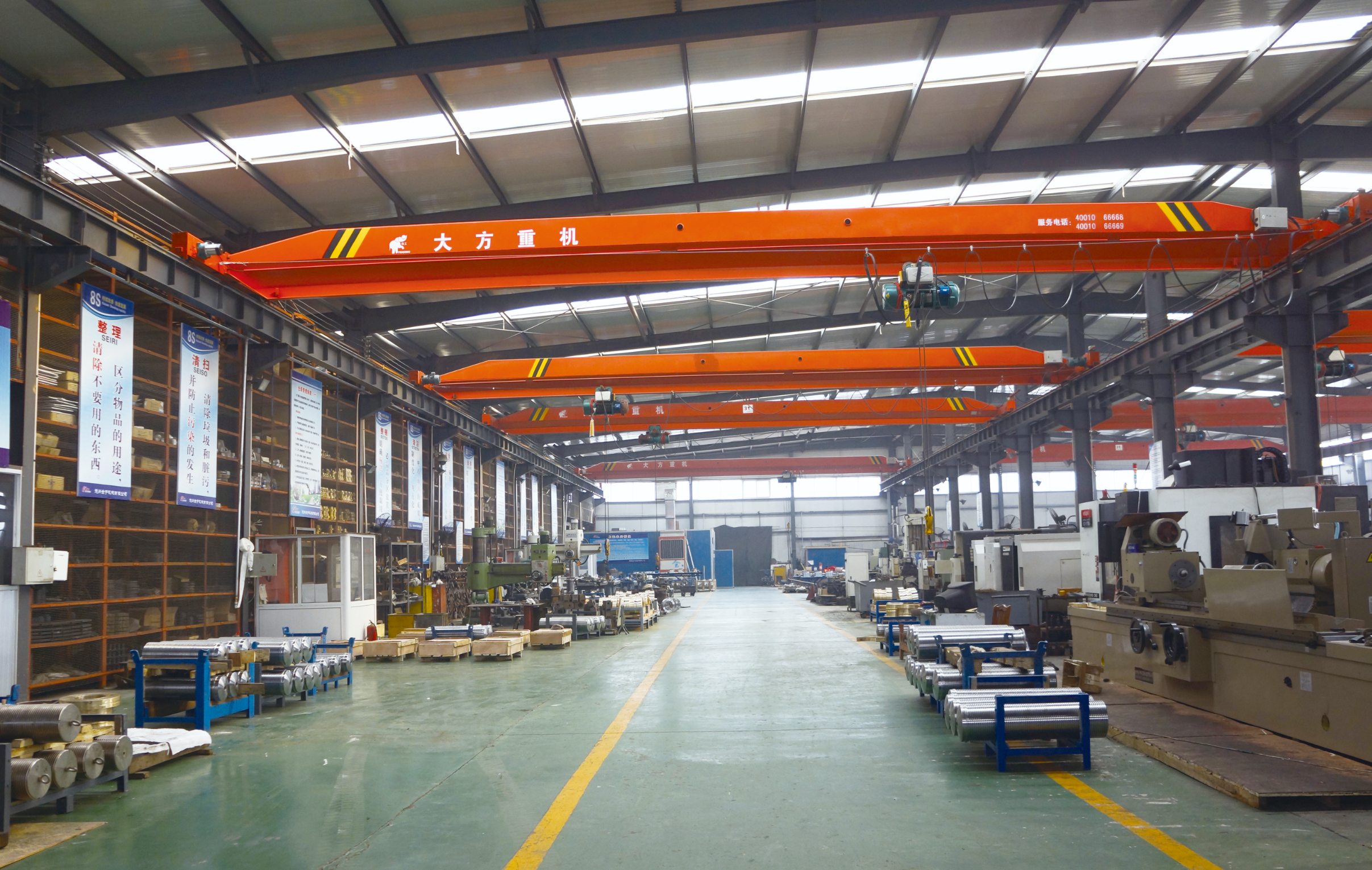
Supply-side capability also belongs in the cost model. JINYU operates a 20,000 m² factory with 258 employees, a 10-person R&D team and an annual output of 10,000 units, exporting approximately 30% of production to EU, USA and Asian markets. The company offers ODM customization covering size, load, stroke, gear ratio, voltage, logo and material, including customizable stainless steel screw jack and customizable electric and manual screw jack configurations. Quoted commercial terms include a monthly capacity of 10,000 units, a lead time of 30–45 days, an MOQ of 1 unit, 100% testing, and remote after-sales support.
Data gap worth closing during evaluation: the available series data does not include measured screw efficiency figures or published lubrication intervals. Buyers comparing total cost of ownership across trapezoidal and ball screw architectures should request duty-cycle-specific efficiency data, lubrication schedules and nut replacement intervals directly from the supplier rather than relying on general assumptions.
Application Fit: Where Each Type Wins on Industrial Lifts
Catalogue application scope gives buyers a fast first filter. The SWL Series is listed for metallurgy, machinery, lifting platforms, water conservancy, construction, stage equipment, and grain and oil processing. The JWM Series is listed for precision machinery, automation lines, medical equipment, packaging machinery, tooling fixtures, plastic machinery and printing machinery. The JWB Series is listed for high-speed automation production lines, robotic equipment, precision lifting platforms, logistics conveying, aerospace auxiliary equipment and CNC machine tools.
A preference framework for the evaluation stage
- Slow, heavy, position-holding lifts — the trapezoidal SWL and JWM ranges are the natural fit, because they combine the highest catalogue capacities (up to 120 t and 1000 kN) with catalogued self-locking on the SWL series.
- High-cycle lifts where speed drives throughput — the ball screw JWB Series is the preferred starting point, with speeds up to 5 m/min across 5–500 kN.
- Hot environments — the JWM Series is the only series catalogued to 100°C, which makes it the default candidate above 80°C.
- Corrosive or washdown environments — stainless steel screw jack customization plus an appropriate IP rating becomes the primary selection criterion, ahead of speed.
- Manual operation or simple retrofit — the SWL Series is catalogued explicitly as a manual or electric screw jack, which supports low-complexity installations.
This is a preference ordering based on catalogued capability, not a universal ranking. Two projects with the same load can legitimately select different architectures once holding behaviour or cycle time is weighted.
Field Evidence: A Multi-Point Lift in a Metallurgical Line
One documented application illustrates how the trapezoidal logic plays out in a demanding lift. An 80-unit synchronous lifting system for a Danieli strip finishing line in Italy has demonstrated eight years of reliable operation. The system achieved stable multi-point synchronous lifting, high positioning accuracy, reliable self-locking, and long-term continuous operation in a harsh metallurgical environment. Documented highlights include self-locking safety, low maintenance requirements, energy saving, compact structure, and adaptation to the Danieli production line process.
The application used the JWM Series, the trapezoidal low-speed range. Read against the comparison table, the reasoning is consistent: a harsh metallurgical environment sits at or beyond the 80°C catalogue ceiling of the ball screw series, and a multi-point synchronous lift depends on holding behaviour as much as on speed. This remains single-application evidence from one industry, and buyers should weigh it as reference material rather than as a general performance guarantee.
Verification and Compliance Before Award
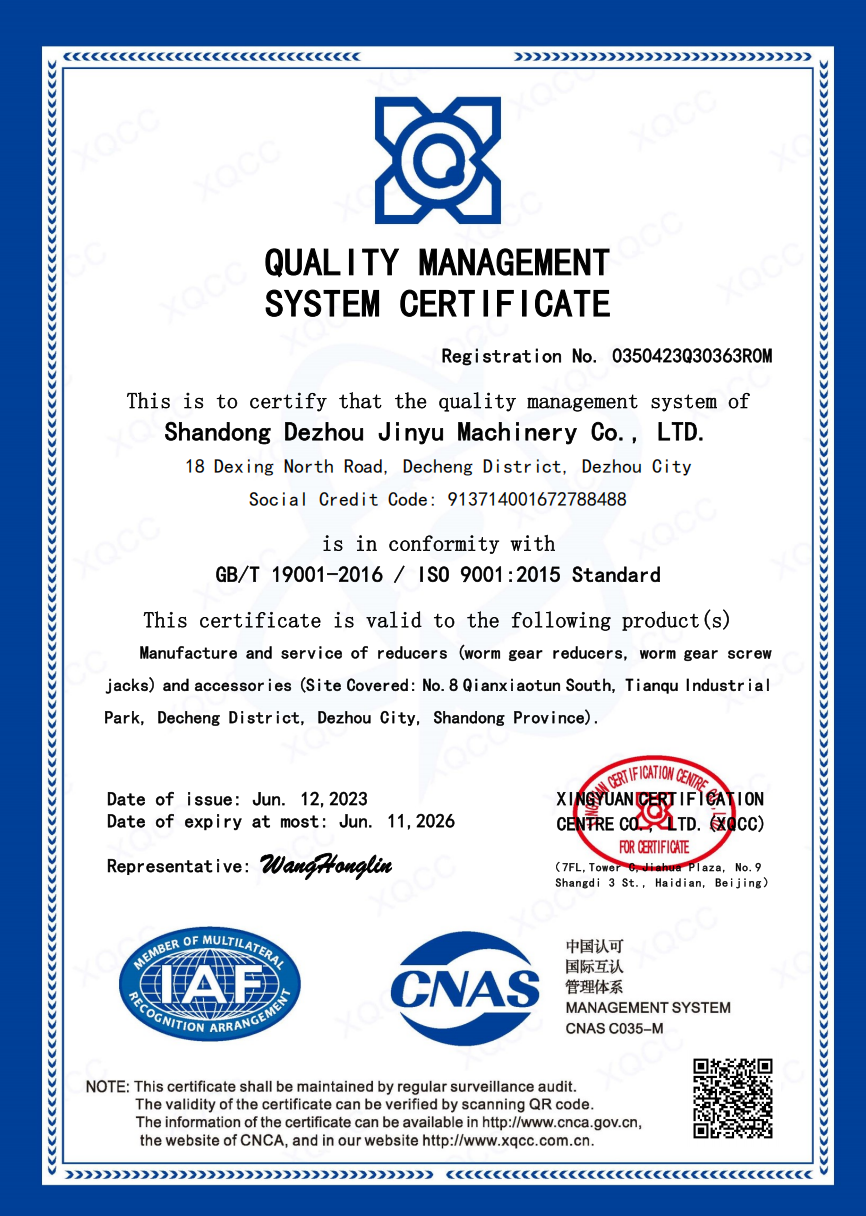
Screw jack procurement is increasingly driven by documentation review rather than by price alone, because the actuator is a load-bearing safety-relevant component. JINYU holds management-system certifications issued by XQCC. The ISO 9001 certificate (number 0350423Q30363ROM) is issued under GB/T 19001-2016 / ISO 9001:2015 for the manufacture and service of reducers, including worm gear reducers and worm gear screw jacks, and accessories. The ISO 14001 certificate (number 0350424E20279ROM, GB/T 24001-2016 / ISO 14001:2015) and the ISO 45001 certificate (number 0350424S30278ROM, GB/T 45001-2020 / ISO 45001:2018) both carry validity to 28 July 2027. A CE certificate (number GTSC20250516012-1-01, issued by GTS) covering ball screw actuators under EN ISO 12100:2010 and EN 60204-1:2018 is valid to 12 June 2030.
For motorised configurations, buyers should also note that industrial motor-operated tools and actuators are covered by the IEC 62841-1:2014 safety standard, which addresses general requirements for mechanical hazards, according to the International Electrotechnical Commission. As a procurement control, certificate validity and stated scope should be checked at the time of order rather than at the time of quotation, since scopes are product-specific and validity dates differ between documents.
Limits of This Comparison
Several honest boundaries apply. First, the capacity, speed, stroke, temperature and IP figures above are catalogue ranges for three specific series, not measured results from a test rig; a given lift may sit at the edge of a range where derating applies. Second, the dataset does not include measured screw efficiency values, so this comparison does not quantify the efficiency difference between sliding trapezoidal threads and recirculating ball threads. Third, load-holding behaviour for ball screw configurations must be confirmed configuration by configuration. Fourth, the field evidence covers one multi-point metallurgical application, which supports the trapezoidal case in hot, heavy, synchronised lifts but does not establish a general rule. Finally, third-party market estimates for the screw jack segment vary widely by scope, so absolute market values should not be used as a proxy for segment growth in a specific product class.
Market Trend Signals for Lifting Equipment Buyers
Three signals are visible in the available data. The first is automation-driven volume growth in motion hardware, illustrated by the projected expansion of the linear actuator market from USD 52.67 billion in 2023 to USD 94.3 billion by 2030. The second is the continued dominance of the self-locking worm gear architecture, which held 38.5% of the screw jack segment in 2025, supported by heavy-load and holding requirements that ball screw designs do not address by default. The third is material and environment specialisation, visible in the growing use of stainless steel screw jacks in offshore wind and dairy processing.
Competitively, buyers will encounter a short list of established global names in this category, including Power Jacks Limited, Joyce Dayton Corp, ZIMM Group and Thomson Industries, as identified in Dataintelo's high-precision screw jack market coverage. That makes specification-based comparison more valuable than brand familiarity: the decision framework in this article applies regardless of which supplier appears on the shortlist.
Future Outlook
The two architectures are converging in specification rather than replacing one another. As automated lifting systems demand both higher cycle rates and guaranteed load holding, buyers are increasingly writing datasheets that combine speed requirements with explicit holding and braking requirements, which pushes suppliers to clarify behaviour that was previously left implicit. Wider temperature envelopes and higher IP ratings will continue to move from premium options to standard expectations in metallurgical, food, offshore and outdoor installations.
For manufacturers, the practical implication is breadth rather than a single architecture bet. JINYU's product scope — worm gear screw jacks across the SWL, JWM and JWB series, alongside worm gear reducers, servo electric cylinders and electric push rods — reflects that reality: most industrial lift programmes need more than one actuator type, and the evaluation question becomes which supplier can document all of them consistently.
FAQ
What is the main difference between a worm gear screw jack and a ball screw jack?
Both use a worm gearbox to rotate a lifting screw, but the load interface differs. A trapezoidal worm gear screw jack uses sliding contact between a trapezoidal thread and a bronze nut; a ball screw jack uses recirculating balls between the screw and nut. In JINYU's catalogue, the trapezoidal SWL Series covers 2.5–120 t at 0.1–0.6 m/min and the JWM Series covers 1–1000 kN at 0.2–1.8 m/min, while the ball screw JWB Series covers 5–500 kN at 0.5–5 m/min.
Are ball screw jacks self-locking?
Self-locking is catalogued as a characteristic of the SWL trapezoidal series. The JWB ball screw series is catalogued as a high-speed screw jack, and the catalogue does not list a self-locking descriptor for it. For any lift that must hold a suspended load after power is removed, buyers should confirm holding behaviour for the exact configuration and specify a brake or redundant mechanical holding element where required.
What lifting speed is realistic for an industrial screw jack lift?
It depends on the series. Catalogued lifting speed is 0.1–0.6 m/min for the SWL Series, 0.2–1.8 m/min for the JWM Series, and 0.5–5 m/min for the JWB ball screw Series. Slow speeds suit synchronized positioning and heavy loads; higher speeds suit high-cycle automation lines where throughput rather than holding dominates the duty profile.
Which screw jack type suits high-temperature or washdown environments?
Temperature and IP ratings separate the series more than capacity does. The JWM Series is rated -20°C to 100°C with IP55–IP65. The SWL Series is rated -20°C to 80°C with IP54–IP55, and the JWB Series is rated -20°C to 80°C with IP55–IP65. For corrosive or washdown duty, stainless steel screw jack customization is available, and third-party data notes growing stainless steel screw jack use in offshore wind and dairy processing.
How can buyers verify a screw jack supplier before placing an order?
Review the documentation pack against the intended duty. JINYU holds ISO 9001 (certificate 0350423Q30363ROM), ISO 14001 (0350424E20279ROM) and ISO 45001 (0350424S30278ROM) certifications issued by XQCC, plus a CE certificate (GTSC20250516012-1-01) covering ball screw actuators under EN ISO 12100:2010 and EN 60204-1:2018. Motor-operated actuators also fall under IEC 62841-1:2014 for general mechanical hazard requirements. Buyers should additionally confirm testing practice, quoted lead time, MOQ and after-sales support terms, and check certificate validity and stated scope at the time of order.
A downloadable technical brochure covering these screw jack series and their parameters is available here: JINYU screw jack technical brochure (PDF). Manufacturer product information is published at jyjack.com.