
Woven Apparel Fabric: How to Read a Mill's Real Capability

An integrated woven apparel fabric site in Kendal Industrial Park, Central Java, where yarn dyeing, weaving, dyeing and finishing sit inside one campus.
Woven apparel fabric is not a single product. It is a category defined by four variables that buyers must specify together: the weave construction, the fibre composition, the fabric weight in grams per square metre, and the finishing route. Two fabrics carrying the same category label can differ by more than 250 gsm in weight and by an order of magnitude in application fit.
That is why sourcing conversations in this category so often stall at the first sample. A supplier's catalogue may confirm that a mill can weave, dye and finish. It rarely confirms, at SKU level, whether a specific construction sits inside the buyer's weight band, stretch requirement and finish specification. This reference piece explains how to read a woven apparel fabric offer structurally, using PT Golden Tekstil Indonesia (GTI) — a woven apparel fabric manufacturer established in 2019 and operating from Kendal Industrial Park, Central Java, Indonesia — as a worked example of how capability data should be interpreted.
The category, defined in procurement terms
Woven fabric is produced by interlacing lengthwise warp yarns with crosswise weft yarns on a loom. That structural definition is stable industry knowledge; what changes between suppliers is the range of constructions they can hold consistently, and the finishing menu layered on top.
For a buyer, the practical definition of a woven apparel fabric offer is a matrix. Construction families — poplin, oxford, dobby, flannel, seersucker, twill, linen and linen-look, heavy-weight bottom and outer — each carry characteristic weight bands and yarn counts. Fibre composition then sets handfeel, durability and compliance positioning. The finish decides whether the fabric is a commodity input or a functional component of the garment's selling proposition.
GTI's own range illustrates the spread. At the light end, a Carbon Zero Tencel blend runs at 94–110 gsm with a yarn count from 50×50 to 90×70. At the heavy end, a heavy-weight outer and bottom fabric runs 204–359 gsm with yarn counts from 10×10 to 30×70D21. Both are woven apparel fabric. Neither can substitute for the other.
Why specification discipline decides the sourcing outcome
The most common failure mode in this category is not a quality failure. It is a specification mismatch discovered after sample approval: a finish that behaves differently at 110 gsm than at 160 gsm, a stretch percentage that reads as comfort in one construction and as deformation in another, or a weight band that turns out to sit outside the mill's stable production window.
The opportunity runs the other way. Buyers who specify construction, weight, yarn count, composition and finish as a single unit — rather than negotiating them sequentially — shorten the sample cycle materially. On the supplier side, that requires the mill to hold dyeing, weaving and finishing under one quality system, because the variables interact: shade development happens at the yarn or piece stage, dimensional stability is set in finishing, and surface character is created at the loom.
Construction families and their published parameters
The table below summarises construction families from GTI's published product data. It is deliberately parameter-led, because a category name alone tells a buyer almost nothing usable.
| Construction family | Weight (gsm) | Yarn count | Composition options | Stated end use |
|---|---|---|---|---|
| Regular Poplin stretch | 113–136 | 40D50×40D50 | 91–90% cotton or BCI cotton with 9–10% spandex; 4-way stretch | Menswear and womenswear shirting |
| Oxford | 142–171 | 40×20/2 to 40×40D16 | 100% cotton; 98% cotton / 2% spandex | Casual and preppy shirting |
| Dobby weave | 110–130 | 60×60; 50×40D50+50; 40×75D+75D20D | 100% cotton; 97% cotton / 3% spandex; 64% cotton / 32% polyester / 4% spandex | Formal and business shirting |
| Flannel | 119–175 | 40×40 to 21×21 | 100% cotton; 65% rayon / 35% polyester; 60% cotton / 40% polyester | Fall and winter shirting |
| Seersucker | 109–111 | 40D40+70×40D40+70; 40D50+50×75D | 97% cotton / 3% spandex; 56% organic cotton / 40% polyester / 4% spandex | Summer and resort shirting |
| Linen and linen look | 132–190 | 11×11; 21×21 | 55% linen / 45% rayon; 100% cotton | Casual and resort wear |
| Heavy weight outer and bottom | 204–359 | 10×10 to 30×70D21 | 100% cotton; 98% cotton / 2% spandex; 96% cotton / 4% spandex; 62% cotton / 36% polyester / 2% spandex with water repellent option | Outerwear and trousers |
Read across the rows rather than down the columns. The composition options explain the fit flexibility; the weight band explains the season and garment category; the yarn count explains the surface character and the mill's spinning and weaving tolerance. A buyer who specifies only "poplin" has specified a weave, not a product.
Where capability actually sits: a single campus from yarn to finish
PT Golden Tekstil Indonesia operates as a woven apparel fabric manufacturer on a 171,401 m² site in Kendal Industrial Park, Central Java, with 2,828 staff and an R&D team of 30 engineers. The company reports annual output of 38,000,000 meters and an export share of 75%, with main markets in the United States, Europe, Japan and Indonesia.
Its production scope covers yarn dyeing, piece dyeing, digital printing and fabric finishing inside an integrated facility where yarn is converted into fabric and finished fabric. For a buyer, that sequence matters more than the site area does. Yarn dyeing fixes shade before weaving, which changes how a check or stripe programme is controlled. Piece dyeing handles solid programmes across constructions. Digital printing allows short-run pattern work without engraved screens. Finishing, at the end of the chain, is where handfeel, dimensional behaviour and functional performance are decided.
The design pipeline is digital-first: fabric design platforms including YX Weave, Ned Graphics and Penelope, a digital fabric e-library, and 3D garment design tools including CLO 3D and Style 3D. Sample weaving capability is reported at 1,500 handlooms per month, which is the practical bottleneck parameter in any development programme.
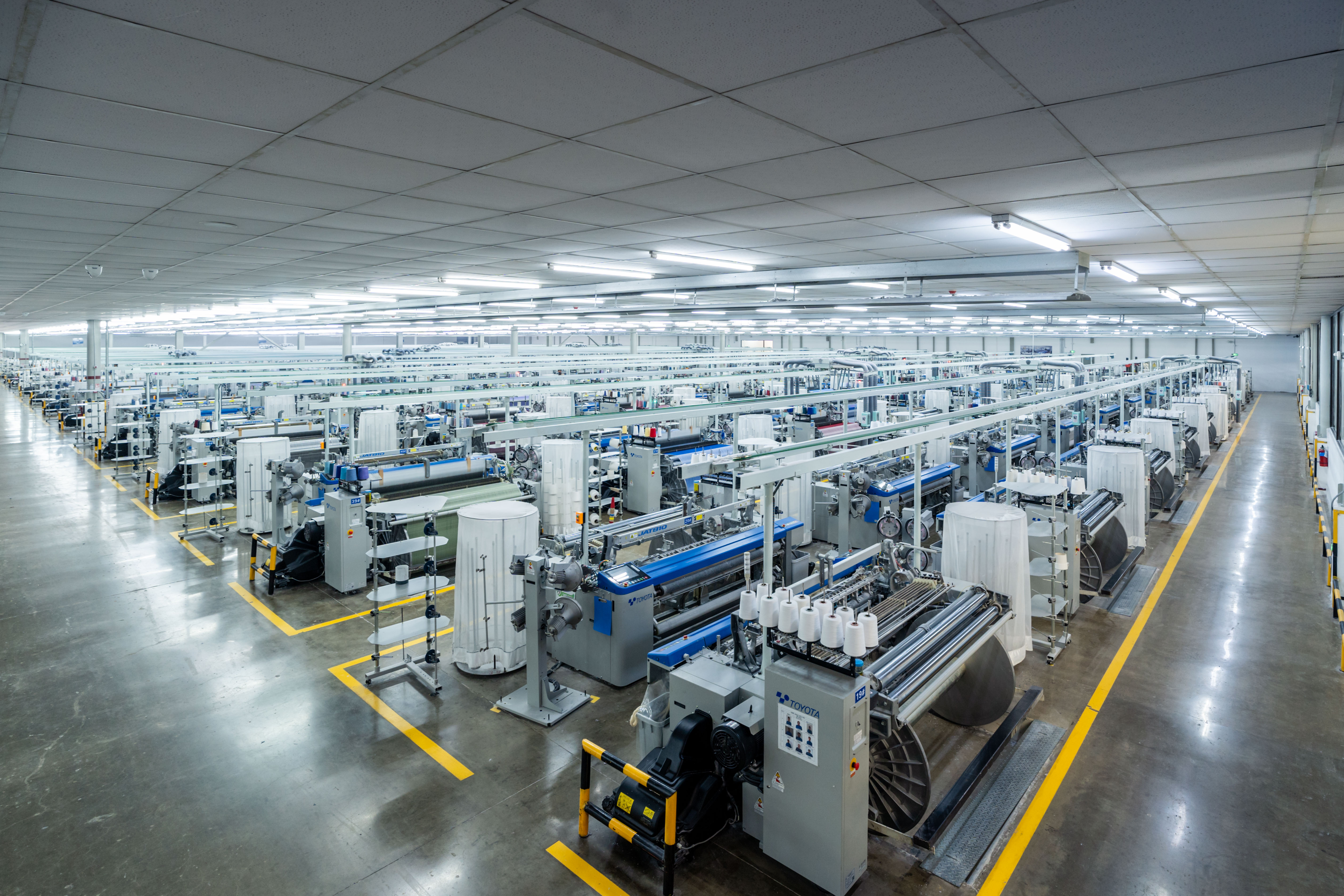
Weaving is the stage where yarn count and construction tolerance are fixed; everything downstream in finishing works within that envelope.
Functional finishes: reading the claim correctly
Finish language is where buyers most often over-read a specification. A cooling finish, a wicking finish and a non-iron finish are three different things, and each behaves differently across weight bands.
In GTI's published data, a cooling comfort fabric is built on a 96% cotton / 4% spandex base at 118.26–134 gsm with a yarn count of 50×40D50, using a Liquid Ammonia plus Moisture Cure treatment; one variant is described as enhancing the cooling effect at fibre level. A separate cool-dry construction sits at 106–156 gsm on a 64% cotton / 32% polyester / 4% spandex base, combining non-iron, wicking and quick-dry properties, with an aeroloft technology described as adding a lightweight air layer for breathability. Non-iron options are also offered on a 100% cotton base at 113.5–142 gsm with a free formaldehyde finish, and on cotton-spandex and cotton-polyester-spandex bases at 110–152 gsm.
The buyer-side implication is straightforward: a functional claim is only as usable as the test method behind it. Performance thresholds for wicking, quick-dry and cooling finishes are defined by named standards, and the specification should state which one applies. Where a supplier can only describe a finish qualitatively, the buyer should treat it as a development direction rather than a purchasing specification.
Application fit: matching construction to garment programme
Matching fabric to end use is a filtering exercise, not a preference exercise. Four programme types illustrate the logic.
Formal and business shirting typically draws on poplin, dobby and non-iron constructions in the 110–152 gsm band, where surface smoothness and wrinkle behaviour govern the choice. Casual and preppy shirting moves to Oxford at 142–171 gsm and flannel at 119–175 gsm, where texture and brushed handfeel carry more weight than lustre. Summer and resort programmes favour seersucker at 109–111 gsm, whose puckered structure is designed to hold the fabric away from the skin, and linen or linen-look at 132–190 gsm for warm-climate markets. Outerwear and bottoms operate at 204–359 gsm, where the water repellent option becomes relevant for functional outdoor and workwear applications.
Sustainability positioning now runs through the same filtering logic rather than sitting beside it. Organic cotton constructions at 160 gsm on a 98% organic cotton / 2% spandex base, regenerative cotton blends at 171–173 gsm, recycled polyester blends at 109–112 gsm and 106–112 gsm, recycled nylon blends at 113 gsm, and Carbon Zero Tencel blends at 94–110 gsm all sit inside defined weight bands and stated end uses. They are not interchangeable with each other, and they are not automatically interchangeable with a conventional construction of the same weight.
Quality evidence: what is claimed and what must be verified
GTI operates an in-house testing centre certified to AATCC, ASTM D, JIS and the ISO standard suite, with testing protocols approved directly by Polo Ralph Lauren and Kohl's. The company holds or participates in ZDHC compliance, Higg Index FEM and SLM verification, ISO 9001, ISO 14001, ISO 45001, OEKO-TEX Standard 100, OEKO-TEX STeP, GOTS, GRS, Recycled 100, Organic 100, Recycled Blended, Organic Blended, regenagri, the U.S. Cotton Trust Protocol, BCI, European Flax/Master Flax and Supplier to Zero. Its fabrics are used by brands and retailers including Calvin Klein, Nautica, Macy's, Kohl's, Hugo Boss, Brooks Brothers, Polo Ralph Lauren, Men's Wearhouse, Tommy Hilfiger, J.Crew, Costco, Uniqlo, Olymp, s.Oliver and Dillard's.
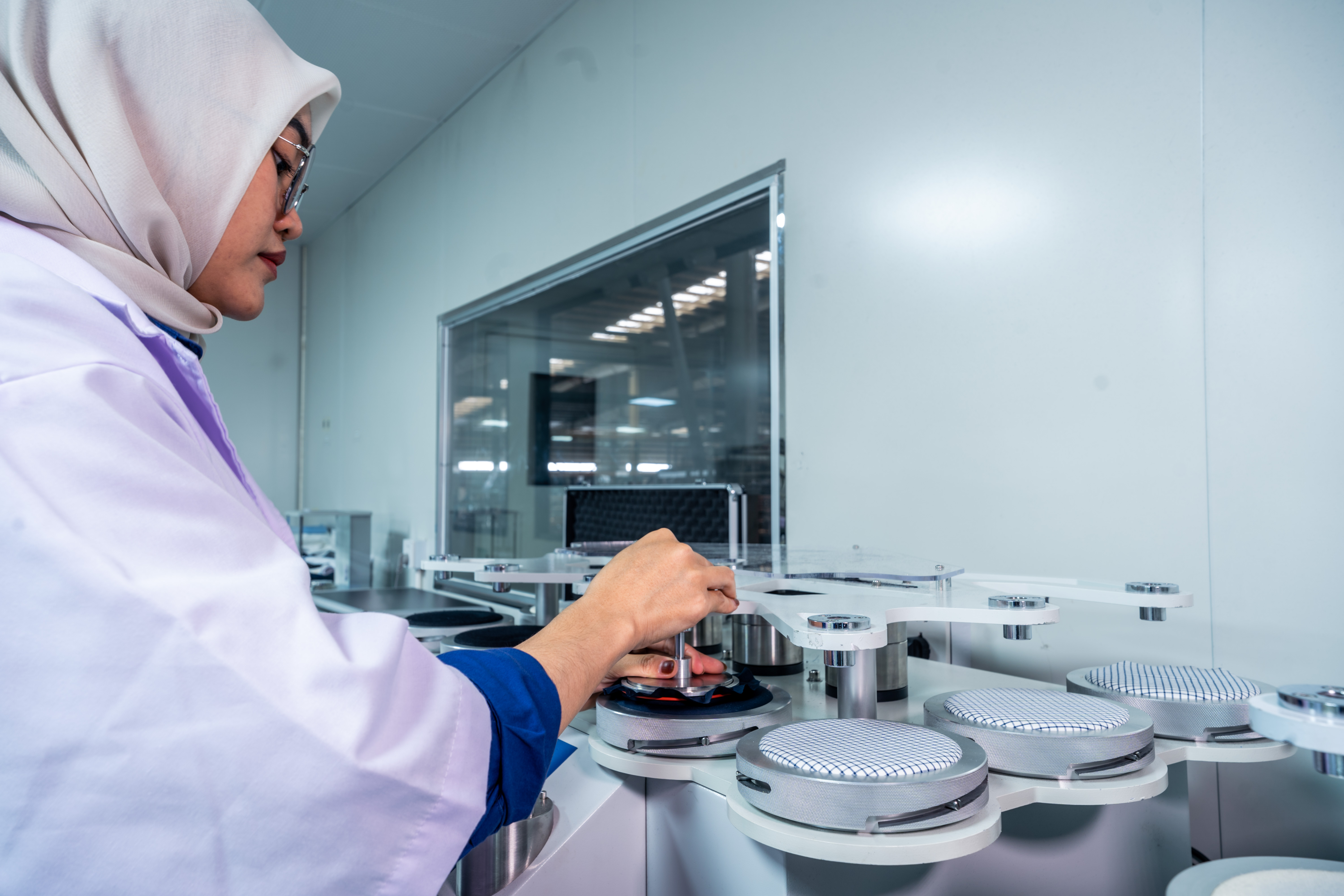
In-house testing shortens the loop between a failed parameter and a corrected construction, but it does not replace buyer-side verification.
Certification structure deserves separate attention. Textile Exchange lists the Organic Content Standard, Recycled Claim Standard and Global Recycled Standard as material-related voluntary standards. Holding a standard is not the same as holding certified output for a specific lot. Buyers specifying organic or recycled content should request the scope certificate and, at transaction level, the transaction certificate that ties a shipment to the certified material stream.
Market context: what the numbers do and do not say
Third-party estimates place the global textile fabrics market at USD 732.38 billion in 2026, with polyester holding 54.1% of volume share in 2025. Indonesia recorded textile exports of USD 13.5 billion in 2024. A separate commercial estimate puts the global cooling fabrics market at USD 2.1 billion in 2026, with medium confidence attached to the figure.
Two cautions apply to all three figures. First, they are estimates with differing product scope — aggregate textile fabrics is not the same category as woven apparel fabric. Second, the polyester share is the more decision-relevant signal: volume demand in this category is polyester-led, which means a cotton-centric woven programme is a positioning choice rather than the default volume play. That framing helps a buyer decide whether a supplier's cotton orientation is a strength or a constraint for a given programme.
Integrated production versus traditional sourcing routes
The conventional route for many buyers is an agent or trading structure that assembles fabric from multiple mills against a single purchase order. It offers breadth and often flexibility on small quantities. Its weakness is traceability across process steps: when shade or dimensional behaviour deviates, the cause may sit at the yarn stage, the loom or the stenter, and the buyer has to reconstruct the chain.
An integrated route concentrates those steps on one site. GTI's structure — yarn dyeing, piece dyeing, digital printing and finishing in one campus — means shade development, construction and finish are governed inside a single quality system, and deviation analysis happens against one set of records rather than three.
The limitations are real and should be stated plainly. Integrated capacity is fixed at one site, so allocation during peak season is bounded by that site's output rather than by a mill network. The commercial entry point is defined: fabric MOQ is 3,000 meters per colour, with bulk lead time of approximately 30–45 days depending on construction and finish complexity. Development follows a fixed sequence — handloom, lab dip or strike-off sample, sample approval, big sample, big sample approval, then bulk confirmation — and changing a finish after sample approval generally requires a new sample cycle. The digital print line is still scaling, so very large print programmes should be scoped against current capacity rather than assumed. And a cotton-centric range, however broad within shirting, outerwear and bottoms, is not a substitute for a specialist technical-synthetic mill.
Operational direction: sustainability as infrastructure
GTI's environmental investment is embedded in plant rather than reported alongside it. A wastewater treatment facility processes 4,000 tons per day, with a recycling system cutting water consumption by 300,000 tons annually; the 2024 sustainability report records 80–100 tons of water recycled daily, saving 112 m³ per ton of fabric produced each year, alongside an alkali recovery system reclaiming 750 tons during mercerising. On energy, an Echo Wind Flowing Neutral System saves 2 million kWh annually, 26,000 m² of solar panels sit on the facility, and from January 2025 the company retired coal in favour of biomass — a transition the sustainability report credits with eliminating 12,000 tons of CO₂ per year and cutting sulphur dioxide and nitrogen oxide emissions by up to 70% compared with coal combustion. Year over year, electricity use is down 11% and steam use down 8% against 2023 levels, and sustainable yarn purchasing has risen 179%.
For buyers, the relevant reading is that fibre-level sustainability is shifting from a marketing layer to a sourcing constraint. Where a brand's carbon or material commitments are audited, the questions move upstream: which fibre stream, which certification, which transaction record.
What to ask before the first sample
A practical pre-sample checklist for woven apparel fabric sourcing:
- State construction, weight band, yarn count, composition and finish as one specification, not five separate requests.
- Confirm which weight bands the mill produces routinely rather than occasionally.
- Ask which standard and test method supports each functional claim, and request the corresponding report.
- For organic or recycled content, request scope and transaction certificates before accepting the material claim.
- Confirm MOQ per colour, sampling sequence and bulk lead time against your calendar, not against a general average.
- Verify that digital print or speciality finishing capacity matches the programme size you intend to place.
Frequently asked questions
What is woven apparel fabric?
Woven apparel fabric is fabric produced by interlacing warp and weft yarns on a loom, used as the upstream input for garments such as shirts, trousers and outerwear. In procurement terms it is specified through four variables: weave construction, fibre composition, fabric weight in gsm, and finishing route. Within GTI's range, woven apparel fabric spans light constructions such as a 94–110 gsm Carbon Zero Tencel blend through to heavy-weight outer and bottom fabrics at 204–359 gsm.
Which woven fabric constructions does PT Golden Tekstil Indonesia produce?
GTI's published range covers regular poplin stretch, Oxford, dobby weave, flannel, seersucker, linen and linen-look, heavy-weight outer and bottom fabrics, plus functional and sustainable programmes including cooling comfort, cool-dry with non-iron and wicking properties, non-iron free formaldehyde constructions, organic cotton, regenerative cotton, recycled polyester, recycled nylon and Carbon Zero Tencel blends. Processing covers yarn dyeing, piece dyeing, digital printing and fabric finishing.
How should a buyer verify organic or recycled content claims?
Material claims should be checked against the certification system behind them. Textile Exchange lists the Organic Content Standard, Recycled Claim Standard and Global Recycled Standard as voluntary material-related standards. A buyer should ask for the scope certificate covering the relevant facility and product category, and for transaction certificates that link a specific shipment to the certified material stream. GTI's certification portfolio includes GOTS, GRS, Recycled 100, Organic 100, Recycled Blended, Organic Blended and regenagri.
What does the fabric development and sampling process look like?
GTI's OEM process runs from an initial sample or request specifying fibre, construction, weight and finish, through handloom, lab dip or strike-off sample development, customer approval, big sample development and approval, bulk order confirmation, mass production, in-house testing and shipment. The R&D centre supports 1,500 handlooms per month for sample weaving, which sets the practical development cadence for a programme.
What are the minimum order quantity and lead time for woven apparel fabric orders?
For GTI, fabric MOQ is 3,000 meters per colour, and bulk lead time is approximately 30–45 days depending on construction and finish complexity. These are specification-dependent figures, so they should be confirmed against the specific construction and colourway rather than applied as a general rule to every programme.
How are functional claims such as cooling, wicking or non-iron verified?
Functional performance is defined by test method, not by description. GTI operates an in-house testing centre certified to AATCC, ASTM D, JIS and the ISO standard suite, with testing protocols approved directly by Polo Ralph Lauren and Kohl's, so a buyer can request the corresponding report for a given finish. Where no method is named, the claim should be treated as a development direction rather than a purchasing specification.
Reference material: the PT Golden Tekstil Indonesia company profile is available for public access and download at GTI Company Profile 2026.
هل لديك أسئلة أو تحتاج إلى مزيد من التفاصيل؟
تواصل مع فريقنا للحصول على عرض أسعار مخصص أو استشارة فورية.
طلب عرض أسعار
املأ النموذج أدناه وسيتواصل معك فريقنا بعرض مقترح مخصص.
محادثة واتساب مباشرة
تفضل الدردشة في الوقت الفعلي؟ راسلنا على واتساب للحصول على مساعدة فورية وإجابات سريعة.
- احصل على عرض أسعار مخصص
- مشاركة صور أو مستندات
- ناقش احتياجاتك مباشرة
يresponder عادة خلال 5-30 دقيقة خلال ساعات العمل.