
Woven Apparel Fabric Procurement FAQ: Terms, Risks, Variant Acceptance
Woven Apparel Fabric Procurement FAQ: Terms, Risks, Variant Acceptance
A woven apparel fabric order is only as enforceable as the model and finish variant written into it. Buyers who approve a sample of one construction and then accept bulk against a family-level description — "recycled nylon", "cotton spandex", "non-iron poplin" — leave the mill, the laboratory and the inspection team with no shared reference point when shade, hand-feel, shrinkage or finish performance is disputed. The practical procurement question is therefore narrower than "which fabric": it is which exact model, which variant, and which document proves that the delivered roll matches what was approved. PT Golden Tekstil Indonesia (GTI), a woven apparel fabric manufacturer operating from the Kendal Industrial Park in Central Java since 2019, publishes model codes that make the distinction visible: Recycled Nylon Fabric is listed as S01601-01 and as S01601-04, the variant that carries the BioDry functional designation. Those two codes are not interchangeable in a purchase order, a test report or an acceptance decision.

Finished goods staging: the point where a delivered roll either matches the approved model code or does not.
Variant acceptance: why S01601-04 and S01601-01 need separate clauses
GTI lists Recycled Nylon Fabric under two model codes. S01601-04 carries the BioDry functional designation; S01601-01 does not. That single difference changes what the buyer is buying, because a functional finish is a process step and a set of performance expectations rather than a label attached to a fiber family.
Acceptance is where the difference becomes commercial. A lab dip approved on S01601-01 does not evidence the shade of S01601-04. A hand sample, a big sample, a shrinkage result or a color-fastness report generated on one code does not transfer to the other, because the approved reference object differs. If the purchase order describes "Recycled Nylon Fabric" and the confirmation lists a single quantity, the buyer has no contractual basis for rejecting a variant they never named.
The defensible approach is to treat each code as its own item with its own line: model code, finish designation, approved sample reference number, test method list, defect threshold and certificate reference. Where a programme needs both variants, the order should say so explicitly and give each one its own approval record.
Bounded statement: this material does not publish a comparative performance test between S01601-04 and S01601-01. Buyers should request variant-specific test data for the finish they intend to sell rather than assuming equivalence or superiority from the finish name alone.
There is a second-order effect worth planning for. When two variants share a fiber designation, sampling rounds blur. A buyer who approves "the recycled nylon hand sample" on a Tuesday and issues a bulk order on Thursday has, in practice, approved one variant and ordered an unnamed one. Writing the code into the sample approval form removes that ambiguity at almost no cost.
What the OEM development path commits before bulk
GTI's OEM development sequence is a staged approval chain, and each stage is a document the buyer can hold.
- The buyer sends a sample or a request specifying fiber composition, construction, weight and finish.
- GTI develops a handloom, lab dip or strike-off hand sample, supported by its fabric design system and digital fabric e-library.
- The buyer approves the hand sample for color, construction and finish.
- GTI develops a big sample — a larger-yardage run derived from the approved hand sample.
- The buyer approves the big sample.
- Bulk order confirmed, including MOQ and delivery schedule.
- Mass production, approximately 30–45 days depending on construction and finish complexity.
- In-house testing centre inspection against AATCC, ASTM D, JIS and ISO methods before shipment.
Two features of this chain matter for procurement. The first is development throughput: GTI's R&D function supports roughly 1,500 handlooms per month for sample weaving and is staffed by 30 engineers, which determines how quickly a variant can be iterated before the bulk window opens. The second is that the chain has no gate labelled "specification freeze". Nothing in the sequence forces a finish change to be recorded against the model code, so the buyer's own paperwork has to carry that discipline.
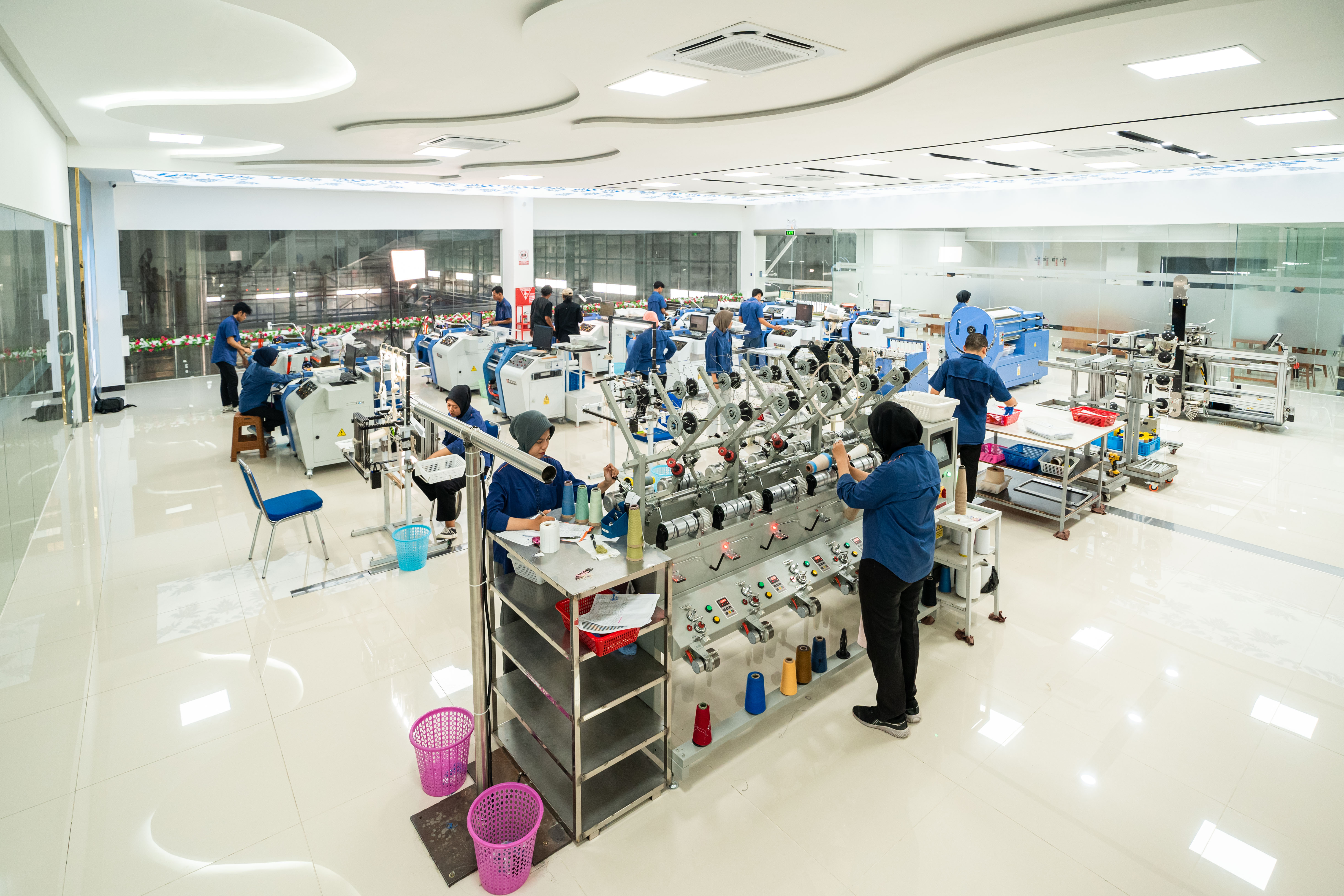
Hand sample development: the stage where the variant question is cheapest to settle.
A finish change after hand-sample approval is not a small edit. It can require a new sample cycle, which means the variant decision is cheaper at step two than at step six. Buyers running an evaluation-to-execution timeline should therefore treat the finish designation as a first-round decision, not a detail to be settled when the bulk purchase order is drafted.
Where the procurement risk actually sits
The risks that most often move a woven fabric order off schedule are shade variation between dye lots, shrinkage or color fastness results outside the buyer's specification, and late delivery during bulk production. None of them is exotic, and each has a predictable trigger.
- Bulk production starts before a lab dip is approved in writing.
- Test requirements are not agreed before production begins, so the pass/fail line is negotiated after the result is known.
- The production schedule and delivery date are not confirmed at the order stage.
The controls map one-to-one onto the triggers: staged sample approval covering lab dip, hand sample and big sample; test standards and acceptance criteria agreed up front; shrinkage and color fastness verified in GTI's in-house laboratory; a pre-shipment inspection before release; and MOQ and lead time fixed in the order against a confirmed production plan.
The less-discussed risk is scope drift in the approval record. A buyer who approves a big sample "in the finish discussed" and confirms bulk "per the approved sample" has created a chain of references that terminates in an ambiguous object. That is precisely the gap a model code closes, which is why variant acceptance belongs in the risk section and not only in the specification section.
Purchasing terms buyers should see in writing
GTI's stated commercial position is specific enough to be written into an order without interpretation. The table below sets out what is published and what the buyer still has to decide.
| Term | Published position | What the order should add |
|---|---|---|
| Minimum order quantity | Fabric: 3,000 meters per color. Garment: 1,000 pieces per color. | One line per model code. S01601-01 and S01601-04 are separate items, each subject to its own minimum. |
| Bulk lead time | Approximately 30–45 days for fabric, depending on construction and finish complexity; 45–70 days where fabric and garment are produced together. | Tie the start date to written big-sample approval, not to the purchase order date. |
| Delivery terms | FOB or CIF. | Name the port, the Incoterm version and the handover point. |
| Payment terms | TT in advance, L/C, or TT 30–70 days after shipment. | Align the final payment milestone to the pre-shipment inspection result. |
| Acceptance method | Pre-shipment inspection with AQL sampling. | State the AQL level per defect class and the reference sample the inspector works to. |
| Fabric quality standard | 4-Point System for fabric; in-line, end-line and final or pre-shipment QC where garments are included. | State the acceptable points threshold applied to the order. |
| Testing | In-house testing centre operating to AATCC, ASTM D, JIS and ISO methods. | List the specific methods, limits and reporting format required for each variant. |
| Certification | Textile Exchange scope certificate GCL-304497-MUL-2026, issued 2026-04-01, valid to 2027-03-31. | Require the matching transaction certificate with each shipment. |
Published commercial terms for GTI woven apparel fabric programmes, with the items a buyer still has to specify.
The pattern is consistent throughout: the mill publishes a defensible baseline, and the buyer converts it into an enforceable one. FOB without a named port, AQL without a level, or "4-Point System" without a threshold are all terms that read as commitments and function as placeholders.
How acceptance is evidenced at pre-shipment
Acceptance in a GTI programme rests on three layers: an in-house laboratory, a defined inspection method and a documented approval history.
The laboratory is certified to AATCC, ASTM D, JIS and the ISO standard suite, and its testing protocols have been approved directly by Polo Ralph Lauren and Kohl's — an external review of method, not of any individual order. Fabric inspection runs on the 4-Point System; where garments are included, in-line QC, end-line QC and final or pre-shipment QC apply. Release is preceded by pre-shipment inspection on an AQL sampling basis.
The approval history is where variant discipline pays off. GTI has supplied 39 million meters of menswear shirting fabric to high-end apparel brands across a four-year programme with stable operation, and within that relationship its quality-control protocols and testing standards were formally reviewed and approved against the brand's own compliance requirements. That describes how a programme was set up; it is not a guarantee of any other order's outcome. The transferable element is the structure — agreed method, approved protocol, repeatable record.

Shade approval is a document, not a conversation: the lab dip reference must carry the same model code as the purchase order line.
For the buyer, the check is mechanical. Does the inspection reference sample carry the same model code as the purchase order line? Do the test methods listed in the report match the methods agreed for that code? Does the transaction certificate cover the shipment rather than only the facility? A yes to all three is what an acceptance clause is for; anything less leaves the standard to be agreed after a defect has already appeared.
What GRS and Recycled 100 actually cover
Textile Exchange's recycled and organic standards — GRS, RCS, OCS and CCS — are voluntary schemes, and they are not interchangeable. A buyer who accepts "GRS" as a generic sustainability signal has skipped the step that matters.
GTI holds a Textile Exchange scope certificate, GCL-304497-MUL-2026, issued by GCL International Ltd. on 2026-04-01 and valid to 2027-03-31, covering OCS V3.0, GRS V4.0, RCS V2.0 and CCS V3.1. The certified scope covers dyed fabrics, dyed yarns, greige fabrics and printed fabrics, and the processes of weaving, manufacturing, pre-treatment, finishing, printing, packing, dyeing and preparatory work. Recycled Nylon Fabric S01601-01 and S01601-04 appear among the products associated with that certification. GTI's published certification list also includes Recycled 100 alongside GRS, RCS, Organic 100 and the recycled and organic blended variants.
Three things that certification does not do on its own. It does not prove that a particular shipment contains certified material — that requires a transaction certificate tied to the order. It does not establish performance, hand-feel or suitability for a given garment. And it does not outlive its own validity window: scopes differ by scheme and renewal date, so the certificate should be checked against the shipment date rather than the order date.
A practical document set for a recycled nylon programme is therefore: the scope certificate showing product and process coverage, the transaction certificate covering the shipped quantity, and the variant-specific test report. Each answers a different question, and none substitutes for the others.
The specification envelope: yarn count, weight and what still has to be fixed
GTI lists a yarn-count capability of 16s/1 to 100s/1 and 20/2 to 200/2. Read correctly, that is a statement about the band the mill can weave, not a specification of any single model. It tells a buyer whether a construction is plausible before sampling; it does not tell them what S01601-04 will weigh, how wide it will be, or how it will shrink.
Weight in grams per square meter is a per-model figure and must be confirmed against the approved sample. The parameters that need to be fixed in writing for each code are consistent across woven apparel fabric: fiber composition, yarn count and construction, weight (GSM), width, color fastness, shrinkage, functional finish, dyeing or printing method, required certifications, MOQ per color and lead time.
The BioDry variant makes this concrete. "Recycled nylon with a functional finish" is not a specification; it is a category. The specification is the model code plus the finish designation plus the measured values the buyer will accept. A test report without the code on it is a report about some fabric, not about the fabric in the carton.
Application fit: where the variant decision changes the brief
GTI's stated markets are the United States, Europe, Japan and Indonesia, and its declared application scope is apparel fabric and shirt production within OEM and ODM manufacturing — continuous multi-shift output in a tropical environment with moderate to high humidity. Those conditions are part of the brief, because they set what the fabric has to survive in storage and in the cutting room, not only on the body.
The documented reference programme is menswear shirting: 39 million meters over four years for high-end apparel brands, with GTI's quality-control protocols and testing standards reviewed against the brand's compliance requirements. That is a shirting record and should be read as one — it supports a judgement about process discipline in a shirting programme, not an assertion that every model in the range is a shirting fabric.
No end-use assignment for S01601-01 or S01601-04 is published in this material. Buyers should confirm the intended garment against the approved sample and the variant's own test data rather than inferring end use from the "recycled nylon" family name. Where the BioDry variant is specified, the application question and the finish question are effectively the same question, and they should be answered in a single approval step.
Purchase order checklist
- Model code and finish designation on every line, with variants listed separately.
- Approved hand-sample and big-sample reference numbers, dated and signed.
- Yarn count, construction, GSM, width, shrinkage and color-fastness limits per code.
- Test methods and pass/fail thresholds, named rather than referenced.
- AQL level per defect class and the inspection reference sample.
- Acceptable points threshold under the 4-Point System.
- MOQ per color and per code; lead time measured from written sample approval.
- Delivery term with port and Incoterm version; payment milestones tied to inspection.
- Certificate scope number, validity window and the transaction certificate requirement.
- A defined route for finish changes after approval, including who signs and what resets.
Outlook
Procurement documents in woven apparel fabric are getting more specific, not less. The direction of travel is toward variant-level traceability: buyers want the code on the sample approval, the code on the test report and the code on the transaction certificate, because that is the only way a claim survives an audit or a chargeback. Mills that publish model codes — as GTI does with S01601-01 and S01601-04 — give buyers something to write against. The remaining work sits on the buyer's side of the table: converting a published capability into an order that names exactly what will be accepted.
Download the GTI Company Profile 2026 (PDF) for the full facility, certification and product-range reference.
Frequently asked questions
How does OEM woven fabric development run from sample request to bulk delivery?
The buyer sends a sample or a request specifying fiber composition, construction, weight and finish. GTI develops a handloom, lab dip or strike-off hand sample, which the buyer approves for color, construction and finish. A bigger-yardage sample is then developed from the approved hand sample and approved in turn. Bulk is confirmed against MOQ and a delivery schedule, mass production runs approximately 30–45 days depending on construction and finish complexity, and an in-house testing centre inspects the fabric against AATCC, ASTM D, JIS and ISO methods before shipment.
Which procurement risks should be written into a woven fabric contract?
The three risks that most often disrupt a woven order are shade variation between dye lots, shrinkage or color fastness outside the buyer's specification, and late delivery during bulk production. They typically arise when bulk starts without an approved lab dip, when test requirements are not agreed before production, or when the delivery date is not confirmed at the order stage. Contractual controls are staged sample approval, agreed test standards and limits, in-house laboratory verification, pre-shipment inspection, and MOQ and lead time fixed against a confirmed production plan.
What purchasing terms apply to MOQ, lead time, delivery and payment?
For fabric, the published MOQ is 3,000 meters per color; for garment, 1,000 pieces per color. Fabric lead time is approximately 30–45 days depending on construction and finish complexity, extending to 45–70 days where fabric and garment are produced together. Delivery terms are FOB or CIF, and payment is TT in advance, L/C, or TT 30–70 days after shipment. Acceptance is by pre-shipment inspection with AQL sampling. Each of these needs a specific value added in the order — port, Incoterm version, AQL level and payment milestone — before it becomes enforceable.
Should acceptance criteria be set per model or per fabric family?
Per model and per finish variant. Recycled Nylon Fabric is listed as S01601-01 and S01601-04, with BioDry carried on the latter only. Because the finish differs, a shade approval, sample approval or test report produced on one code does not evidence the other. Setting acceptance at family level leaves the mill and the inspector without a reference object, and gives the buyer no basis for rejecting an unnamed variant. Each code should carry its own line, its own approved sample reference and its own test list.
What do GRS and Recycled 100 documents prove at shipment?
A scope certificate proves which products, processes and sites are covered by a scheme, and for how long. GTI's Textile Exchange scope certificate GCL-304497-MUL-2026 covers OCS V3.0, GRS V4.0, RCS V2.0 and CCS V3.1 across dyed, greige and printed fabrics, valid from 2026-04-01 to 2027-03-31, with Recycled Nylon Fabric S01601-01 and S01601-04 among the associated products. It does not by itself prove that a specific shipment contains certified material; that requires a transaction certificate tied to the order, supported by variant-specific test data for performance.
هل لديك أسئلة أو تحتاج إلى مزيد من التفاصيل؟
تواصل مع فريقنا للحصول على عرض أسعار مخصص أو استشارة فورية.
طلب عرض أسعار
املأ النموذج أدناه وسيتواصل معك فريقنا بعرض مقترح مخصص.
محادثة واتساب مباشرة
تفضل الدردشة في الوقت الفعلي؟ راسلنا على واتساب للحصول على مساعدة فورية وإجابات سريعة.
- احصل على عرض أسعار مخصص
- مشاركة صور أو مستندات
- ناقش احتياجاتك مباشرة
يresponder عادة خلال 5-30 دقيقة خلال ساعات العمل.