
XINFLYING Sublimation Printers: Capability and Buyer Review
XINFLYING Sublimation Printers: Capability and Buyer Review
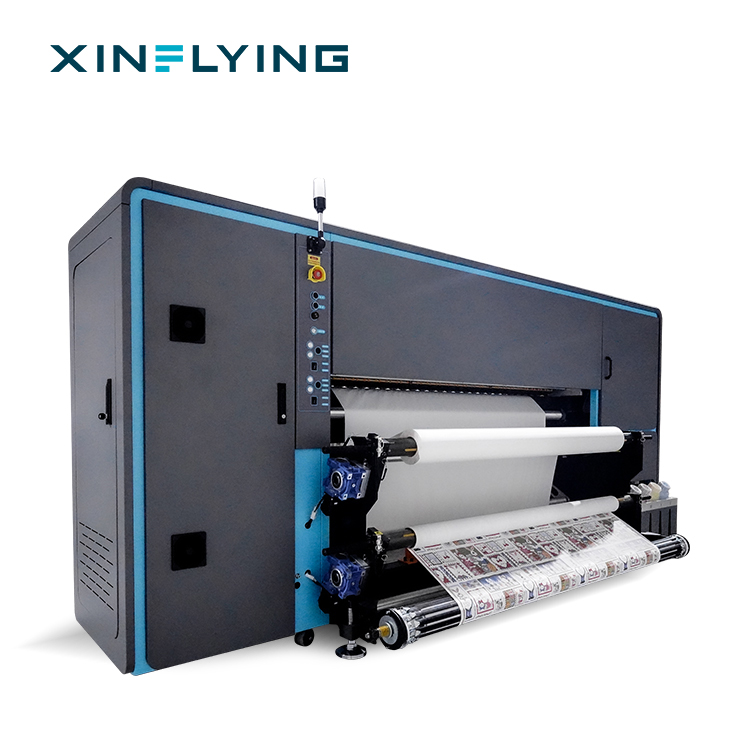
XINFLYING XF-19E15-PRO, a 15-head roll-to-roll dye sublimation printer for high-volume textile production.
The dye sublimation printing market is growing consistently as apparel, sportswear and home textile manufacturers shift from traditional analog methods to digital roll-to-roll production. According to Grand View Research, the global dye sublimation printing market was valued at USD 16.4 billion in 2025 and is projected to reach USD 39.0 billion by 2033. The dye sublimation printer segment was valued at USD 1.88 billion in 2025 and is expected to reach USD 2.53 billion by 2030, according to Mordor Intelligence.
For buyers, this growth creates a practical challenge: evaluating a commercial dye sublimation printer means assessing printhead configuration, print width, production speed, ink system reliability, software workflow and supplier support. Guangzhou Xin Flying Digital Technology Co., Ltd. (XINFLYING), a digital printing equipment manufacturer established in 2010 in Guangzhou, China, has developed a full lineup of roll-to-roll dye sublimation printers targeting textile factories, garment producers and printing businesses. This review examines the company's production capability, the current sublimation printer models, technology choices, intended applications, market context and the limits buyers should keep in mind before purchasing.
Why sublimation printer selection is becoming a capacity decision
Dye sublimation printing has become the standard approach for polyester-based products such as jerseys, sportswear, flags, soft signage and home textiles. The process prints with special sublimation ink onto transfer paper; when the paper meets a heated calender, the dye turns into gas and penetrates polyester fibers, creating a permanent bond. Unlike surface printing, this gives a soft hand feel and wash-resistant output.
The selection problem is not whether sublimation works; it is which printer configuration will match a specific production target. A 130 cm printer and a 195 cm printer are not simply different sizes; they represent different order capacities, media handling systems and investment levels. A buyer that underestimates production speed may discover later that the machine limits daily output. A buyer that ignores printhead maintenance may face avoidable downtime. Suppliers with complete technical documentation and after-sales structures reduce these risks.
XINFLYING manufacturing and company background
XINFLYING (Guangzhou Xin Flying Digital Technology Co., Ltd.) is a professional manufacturer of digital printing equipment. The company was established in 2010 and is located at No.7, Xiecun 2nd Industrial Zone, Panyu, Guangzhou, Guangdong. It specializes in DTF printers, UV DTF printers, UV printers, DTG printers and dye sublimation printing solutions. Its main products include DTF printer machines, dye sublimation printers, DTG printers, UV DTF printers, UV flatbed printer machines, printing consumables and complete digital printing solutions.
The company's manufacturing facility covers 37,440 square meters, employs more than 200 staff and has an annual production capacity exceeding 20,000 units. Its R&D team consists of 20 engineers. Roughly 80% of output is exported to North America, South America, Europe, Asia, the Middle East and Africa. According to company information and published data, XINFLYING also maintains local warehouses and technical support in key markets including the US, Brazil and Mexico, which matters for buyers comparing spare parts logistics and local service.
Current dye sublimation printer lineup
The XINFLYING sublimation printer family can be divided into three tiers. All models are digital textile printers using Epson i3200-A1 printheads and sublimation ink, but each is positioned for a different production environment.
| Model | Printheads | Print width | Max published speed | Target production environment |
|---|---|---|---|---|
| XF-H1301X-1I32A1 | 1 x Epson i3200-A1 | 130 cm | 4PASS: 28 m²/h | Polyester fabric printing; small-scale production and sampling |
| XF-H1802X-2I32A1 | 2 x Epson i3200-A1 | 180 cm | 4PASS: 52 m²/h | Small and medium-sized businesses; custom textile production; small-batch orders |
| XF-O2000-4I32A1 | 4 x Epson i3200-A1 | 195 cm | 2PASS: 180 m²/h | Growing printing companies; continuous daily production |
| XF-19E8-PRO | 8 x Epson i3200-A1 | 190 cm (75 in) | 1PASS: 306 m²/h | Industrial textile sublimation production |
| XF-19E15-PRO | 15 x Epson i3200-A1 | 190 cm (75 in) | 1PASS: 524 m²/h | High-volume industrial textile sublimation production |
The two H-series models are more compact entry-level units. The XF-H1301X-1I32A1 is a 1-head sublimation printer with a 130 cm print width, a 2 kW power rating and a net weight of about 140 kg. The XF-H1802X-2I32A1 adds a second head and extends the width to 180 cm, with a maximum speed of 52 m²/h at 4PASS. Both are classified as digital textile printers for polyester fabrics and are suited to businesses that need a lower entry point into sublimation production.
The XF-O2000-4I32A1 is the mid-range configuration. It uses four Epson i3200-A1 printheads, prints at 195 cm wide, and reaches 180 m²/h at 2PASS. It uses piezoelectric inkjet technology and supports heat transfer paper rolls of 1000–1500 m. Its intended applications include clothing, home decor, canvas bags, cushions and flags, according to product documentation.
The XF-19E8-PRO and XF-19E15-PRO are the industrial-tier models. The 8-head XF-19E8-PRO reaches 306 m²/h at 1PASS and 153 m²/h at 2PASS with 3200 dpi resolution. The 15-head XF-19E15-PRO reaches 524 m²/h at 1PASS and 254 m²/h at 2PASS, with a 1000 m roll media capacity. Both models are designed for the industrial textile sublimation printing industry.
Engineering details that matter for production
The Epson i3200-A1 printhead is common across the range. It uses 3200 nozzles and supports variable ink droplet output, which helps hold detail and color depth in textile prints. The important differences between XINFLYING models are in the mechanical and ink-delivery systems.
The PRO series adds several features aimed at uptime. The XF-19E8-PRO uses a Japanese THK silent linear guide, anti-collision protection at both ends, automatic flash spray moisturizing, an intelligent printhead cleaning and moisturizing device, an imported fluorine rubber pressure paper wheel, an external intelligent air-heat integrated dryer, and liquid level plus waste ink alarms. The XF-19E15-PRO adds a linear motor with magnetic grid positioning, an enlarged beam and 27 press rollers for more stable paper movement at high speed. A fully sealed automatic moisturizing and cleaning system is standard on the PRO models.
The XF-O2000-4I32A1 uses front, middle and rear break-controlled heating with an integrated infrared and cooling fan system, plus carriage base heating. The H-series models use front, middle and rear break-controlled heating on the 2-head version; the 1-head version has an external constant-temperature automatic drying system. These differences influence which model fits a particular fabric type and workflow.
Applications and operating environment
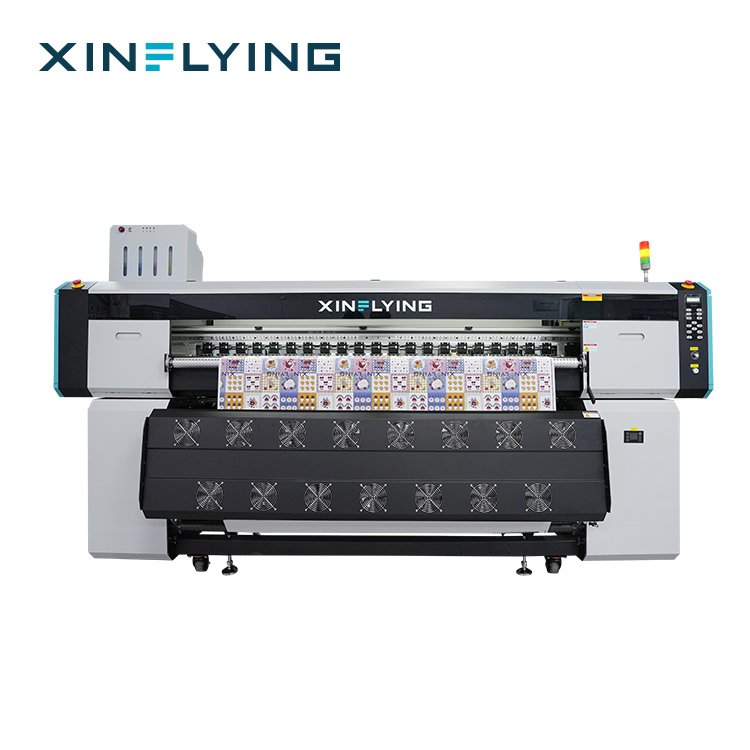
XF-O2000-4I32A1 is positioned for growing textile printing businesses, with a 195 cm print width and 180 m²/h maximum output.
The application scenario for XINFLYING sublimation printers covers polyester fabric printing, sportswear, team jerseys, activewear, custom apparel, fashion fabric, home textiles, decorative fabric, soft signage, flags, banners and personalized textile products. The working conditions are a controlled indoor production environment with a temperature range of 18–30°C and relative humidity of 35–65% RH. Suppliers generally recommend stable temperature and humidity to keep ink behavior and color accuracy consistent. The equipment is intended for professional dye sublimation printing workshops, textile factories, sportswear production facilities and commercial digital printing environments, with operation possible around the clock.
Market position: wide-format roll-to-roll is the growth layer
Third-party market data helps place this equipment category in context. Grand View Research states that Asia Pacific dominated the dye sublimation printing market in 2025 with a 36.5% revenue share, led by China as the largest country market. The same source projects an 11.5% CAGR from 2026 to 2033. Demand for personalized apparel and home decor was identified by Grand View Research as the primary driver of a 13.1% CAGR in digital textile sublimation through 2030. China's textile and garment exports reached USD 293.6 billion in 2023, which has supported strong demand for industrial-scale sublimation machines.
From a product standard perspective, roll-to-roll sublimation printers with widths around 1.9 m are considered standard for high-volume textile and soft signage applications, according to FESPA Insights. That aligns directly with the print-width range of the XINFLYING lineup: 1.8 m to 1.95 m. The large-format printer market as a whole was valued at USD 10.57 billion in 2025 and is projected to reach USD 16.52 billion by 2034, according to Fortune Business Insights.
Comparison with traditional and competing methods
Sublimation printing is not always the technically superior method. The correct choice depends on fabric and order structure.
- Compared with screen printing, sublimation offers no screen setup cost and handles full-color, gradient or photographic designs with more flexibility. But screen printing can remain cost-effective for very large quantities of identical, color-limited designs.
- Compared with heat transfer vinyl (HTV), sublimation is faster for complex artwork because there is no cutting and weeding step. HTV, however, can be applied to a wider range of fabric types depending on the vinyl material.
- Compared with DTG printing, sublimation is usually a better technical fit for polyester sportswear, all-over prints and flags because the dye becomes part of the fiber. DTG remains the more direct route for cotton garments.
This material limitation is the main boundary: traditional sublimation printing is designed for polyester and polyester-coated materials. Untreated cotton, and many natural-fiber blends, do not bond with sublimation dye. Businesses that print mostly on cotton need to evaluate DTF or DTG as a complementary capability rather than assuming a sublimation printer alone covers the whole apparel market.
Looking at the competitive landscape, third-party research from Data Insights Reports places Epson at 26.7%, Mimaki at 18.6% and Roland DG at 15.5% in the digital textile dye sublimation printer market. These companies have long-established distribution and brand recognition. XINFLYING is not listed among these market-share leaders, but it represents a parallel supply route: a Chinese manufacturer with large-format production, direct export channels, a wide model range and supporting consumables. For distributors and production buyers, the evaluation therefore should not be brand-name only; it should include configuration fit, documentation, spare parts and response time.
Future outlook for the sublimation printer segment
The direction of the market favors digital capacity. Inkjet production printers accounted for 87.3% of the production printer market share by type in 2024, according to Grand View Research. Personalized and on-demand textile production shortens order runs and increases the number of design changes, which raises the value of digital workflows. In this environment, wide-format roll-to-roll sublimation printers are likely to remain a core investment for textile manufacturers, soft-signage producers and apparel suppliers.
Another factor is compliance. ISO 12647-8:2021 provides the standard for validation print processes working directly from digital data, which is relevant to color accuracy. Buyers who import into regulated markets will increasingly be expected to maintain documentation such as CE, FCC and RoHS records. Suppliers that can provide model-matched certification files reduce customs and downstream sales risk.
Procurement checklist for buyers
- Match the max production speed to your actual daily square-meter requirement, not to marketing claims.
- Confirm print width against your main product categories: apparel, blankets, flags, home textiles or soft signage.
- Check the RIP software that is included or optional. Maintop is standard on the H-series and PRO models; the XF-O2000 supports RIIN Print and Maintop, while PRO models can support optional PhotoPrint and Printfactory.
- Verify the factory environment: power supply, room temperature, humidity and installation area. The PRO models require 210–230V power and a heavier installation footprint.
- Request certification documents and technical files that match the actual model and destination market.
- Confirm spare parts, printing consumables and after-sales support channels before placing an order.
For a full company introduction and product specifications, XINFLYING publishes a corporate brochure that can be viewed or downloaded here: XINFLYING Corporate Brochure (PDF).
Frequently asked questions
What is a sublimation printer and how does it work?
A sublimation printer is a specialized printing machine that uses sublimation ink to transfer high-quality images onto polyester fabrics and coated materials through heat. The printer first applies dye to transfer paper. During the heat transfer process, the solid dye particles turn into gas and penetrate polyester fibers or coated surfaces. After cooling, the dye bonds permanently with the material, creating durable, high-resolution prints.
What is dye sublimation printing technology?
Dye sublimation printing is a digital printing technology that uses heat to transfer dye into polyester materials. Unlike surface printing methods, the dye molecules bond permanently with the material, producing vibrant colors, a smooth texture and long-lasting durability. It is commonly used for polyester textiles, sportswear, flags, banners and customized products.
Why does a sublimation printer need special ink and polyester materials?
Sublimation printing depends on the chemical bonding between dye molecules and polyester fibers. Sublimation ink contains special dyes designed to change from solid to gas when heated, and polyester has a structure that allows these dye molecules to penetrate and bond during heat transfer. Regular inks cannot achieve the same gas transfer effect, and natural fibers such as cotton do not provide enough bonding capability for permanent sublimation printing.
How to choose the right sublimation printer for my textile printing business?
Buyers should evaluate printing width, production speed, print quality, printhead configuration, ink system, RIP software compatibility and supplier support. Small businesses may prefer compact models for sample production and low-volume orders, while professional textile printing companies should consider high-speed sublimation printers with larger print widths and continuous production capability. The right choice should match your production volume, product requirements, workspace and future growth plan.
Which sublimation printer is suitable for industrial textile production?
For industrial textile manufacturers and high-volume production environments, the XF-19E8-PRO is a recommended solution from XINFLYING. It is equipped with 8 Epson i3200-A1 printheads, has 3200 dpi resolution, and reaches printing speeds up to 306 m²/h. It is designed for textile factories, large garment manufacturers and professional sublimation production centers requiring stable operation and consistent print quality.
What certifications should I verify before purchasing a sublimation printer for the US market?
For sublimation printers entering the US market, buyers should check electromagnetic compatibility and electrical safety requirements based on the equipment configuration and application environment. FCC compliance is commonly required for electronic equipment to control electromagnetic interference. Depending on the product specifications and sales channels, additional safety certifications may also be required. Buyers should request certification documents, technical specifications and product test reports from suppliers to ensure compliance.