
Y Teeth vs Stop Wires: A Zipper Metal Wire Buyer Comparison
A finished metal zipper consumes several distinct wire forms, and the three that buyers most often compare are the Y teeth wire that forms the interlocking elements, the Top Stop Wire that terminates the top of the chain, and the Bottom Stop Wire that prevents the slider from running off the bottom of the tape. They are frequently quoted as one line item — "zipper metal wire" — yet they are produced from different profiles, are customized on different parameters, and fail in different ways on a production line.
Fullgreat Metal Limited is a metal materials manufacturer based in Shenzhen, Guangdong Province, China, founded in 2008, producing non-magnetic stainless steel strip, non-magnetic stainless steel wire and aluminum strip for buttons, zippers and clothing accessories. Within its zipper component range, the named models are Y Teeth Wire (FPD-YTW01), Y Teeth (FPD-YTW02), Top Stop Wire (FPD-TSW) and Bottom Stop Wire (FPD-BSW). The same catalogue also lists the wider Zipper Metal Wire family (FPD-ZMW), Special -Shaped Wire (FPD-SSW), Shaped Wire (FPD-SW), Profiled Wire (FPD-PW), Metal Round Wire (FPD-MRW), Round Wire (FPD-RW), Flat Wire (FPD-FW), Spring Wire (FPD-SW02), Y-shape Wire for Zipper (FPD-YSW and FPD-YSW02), Zipper Puller (FPD-ZP) and Zipper Automatic Slider (FPD-ZAS).
This article is written from a buyer's position rather than a supplier's. It compares the three component families on function, material, customization and acceptance risk, and it sets out the purchasing terms and acceptance criteria that ought to be clarified before any two quotations are ranked against each other.
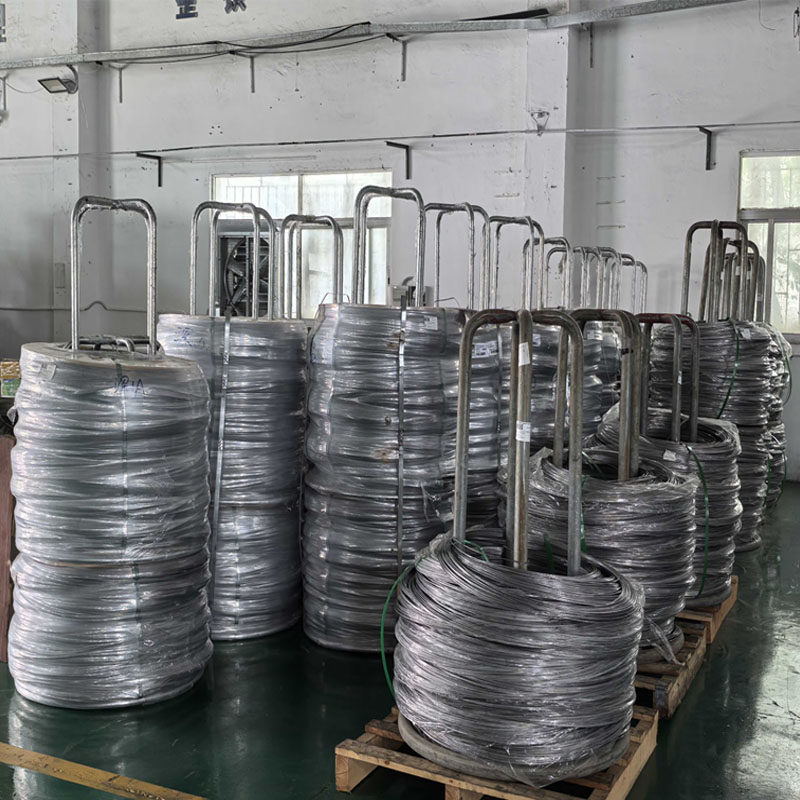
Zipper metal wire feedstock. Y teeth wire and stop wires belong to the same wire family but are drawn and shaped on different profiles, which is why one purchase order should not treat them as interchangeable.
Why component-level comparison changes the decision
Buyers frequently evaluate zipper wire at the finished-goods level, because that is where quality complaints surface. The problem is that a finished-goods complaint does not identify which component caused it. A chain that does not interlock smoothly points to the teeth profile. A slider that over-travels at the top, or a chain that separates at the bottom, points to a stop wire. Those are different tooling setups, different inspection points and often different corrective actions.
Published technical data illustrates the level of precision involved. In manufacturer-published specifications for preformed Y-teeth zipper wire, cross-sectional micro-geometry is described as being controlled to a tolerance of ±0.01 mm, together with uniform tensile elongation. That figure is a supplier-published value rather than an independent measurement, but it establishes the principle buyers should carry into a comparison: the teeth profile is a tooling-driven dimension, and a stop wire is not produced to the same geometry or the same acceptance limits.
The practical consequence is that a supplier comparison built on a single "zipper metal wire" line item is not a comparison at all. The correct unit of comparison is the component: Y Teeth Wire against Y Teeth Wire, Top Stop Wire against Top Stop Wire, Bottom Stop Wire against Bottom Stop Wire.
The three component families side by side
All three families are listed by the manufacturer for clothing accessories and for bag & luggage, and all three share the same declared customization framework. What separates them is function, profile and the point in assembly where a defect becomes visible.
| Component | Model | Role in the zipper | Material options | Customization stated | Declared application |
|---|---|---|---|---|---|
| Y Teeth Wire | FPD-YTW01 | Forms the interlocking teeth along the tape edge | Stainless steel, copper or aluminum | Shape, size, hardness (soft or hard) | Clothing accessories; bag & luggage |
| Y Teeth | FPD-YTW02 | Preformed tooth element used in the same interlocking role | Stainless steel, copper or aluminum | Shape, size, hardness (soft or hard) | Clothing accessories; bag & luggage |
| Top Stop Wire | FPD-TSW | Terminates the chain at the top and limits slider travel | Stainless steel, copper or aluminum | Shape, size, hardness (soft or hard) | Clothing accessories; bag & luggage |
| Bottom Stop Wire | FPD-BSW | Holds the chain closed at the bottom and prevents slider separation | Stainless steel, copper or aluminum | Shape, size, hardness (soft or hard) | Clothing accessories; bag & luggage |
Table 1 — Component-level comparison of the four named models. Material, customization and application data as published in the manufacturer's product listings.
Y Teeth Wire (FPD-YTW01 and FPD-YTW02)
The Y Teeth Wire, model FPD-YTW01, and Y Teeth, model FPD-YTW02, are profiled wire components for clothing accessories and for bag & luggage. Both are listed in stainless steel, copper or aluminum, with shape, size and hardness — soft or hard — customizable. The Y profile is the geometry that allows one tooth to interlock with its counterpart on the opposing tape.
For a buyer, three implications follow. First, because the profile is customized, the drawing matters more than the product name; ask for the cross-section drawing and the tolerance band that applies to it. Second, hardness selection is coupled to the setting process — a teeth wire that is too soft or too hard for the tooling will deform inconsistently even when the profile itself is correct. Third, because the same wire family also covers Special -Shaped Wire, Shaped Wire, Profiled Wire and Metal Round Wire, a supplier can legitimately hold a wide catalogue while only one or two profiles are qualified on your tooling. The qualification status is the relevant question, not the catalogue size.
Top Stop Wire (FPD-TSW)
The Top Stop Wire, model FPD-TSW, is declared for clothing accessories and for bag & luggage, with customized shape and size, and material options of stainless steel, copper or aluminum, at soft or hard hardness. Functionally it closes the top end of the chain so the slider cannot travel beyond the intended limit.
The buying risk with a stop wire is inversely proportional to its size. It is a small, low-cost part, which is exactly why it is often specified last and inspected least. But a top stop that deforms during setting, or that is formed from a profile that does not match the tape and slider combination, produces a finished-goods defect that is expensive to detect late. Buyers should treat the top stop as a specified component with its own drawing, its own hardness definition and its own acceptance sample — not as a consumable selected by the supplier.
Bottom Stop Wire (FPD-BSW)
The Bottom Stop Wire, model FPD-BSW, follows the same declared framework: listed for clothing accessories and for bag & luggage, shape and size customized, stainless steel, copper or aluminum, soft or hard hardness. It performs the opposite end function — keeping the chain closed at the bottom and preventing the slider from separating the two tapes.
In bag & luggage, this is the stop that carries the most abuse, because the bottom of a luggage zipper is often the point where the chain is pulled and loaded. That makes material and hardness selection a durability decision rather than a decorative one, and it argues for a separate acceptance sample for bottom stops in luggage programs even when the same supplier and the same wire family serve both product lines.
Material options: stainless steel, copper or aluminum
All four models are published as available in stainless steel, copper or aluminum, with material treated as a customized item rather than a fixed grade. Buyers should read that as a requirement to specify: the listing describes what is possible, not what is delivered by default.
Stainless steel is the material family the manufacturer develops specifically for zipper and button applications, where it is positioned as a replacement for copper strip. The company states that it began developing non-magnetic stainless steel for buttons and zippers in 2008, working with Sichuan University, and that the resulting grades — FPD806 and FPD808 stainless steel strip and FPD901 and FPD902 stainless steel wire — are used in button zippers, communications accessories, automotive products and aerospace products. Copper remains the conventional choice for appearance, and aluminum offers a lighter option. Material selection should therefore be driven by the end product's exposure, weight target and finish requirement, and it should be written into the order as a grade rather than as a generic material name.
Customization: shape, size and hardness
Customization is the common thread across the three component families. Y Teeth Wire (FPD-YTW01), Y Teeth (FPD-YTW02), Top Stop Wire (FPD-TSW) and Bottom Stop Wire (FPD-BSW) are all published with customized shape, customized size and soft or hard hardness. The manufacturer additionally offers OEM and ODM production with customization across material, packaging, specifications and color.
Two practical warnings follow. The first concerns size. Within the Zipper Metal Wire listing (FPD-ZMW), sizes are quoted as customized #3, #4 and #5, while published technical data for preformed Y-teeth profile wire refers to #3, #4, #5 and #8 profiles. Buyers should confirm which numbering system a supplier is using and how it maps to their tape and slider, because "size" is not self-defining across the industry.
The second concerns hardness. Soft or hard is a supplier-side option set, not a numeric scale. Until it is converted into a measurable definition with an agreed test method, two suppliers can both say "hard" and deliver different material. This is one of the most common sources of mismatch between a quotation and a delivered lot, and it should be closed out before purchase orders are placed rather than after the first shipment is inspected.
Apparel versus bag & luggage: where each component fits
The manufacturer lists all three component families for both clothing accessories and bag & luggage. That means the component name alone does not determine fit. What changes between the two end uses is the severity of the test that the same component must pass.
| Component | Clothing accessories — focus | Bag & luggage — focus | Buyer action |
|---|---|---|---|
| Y Teeth Wire (FPD-YTW01) | Interlock smoothness, profile consistency, surface finish | Load resistance, abrasion, retention of interlock over cycles | Set separate profile tolerance and finish criteria per line |
| Y Teeth (FPD-YTW02) | Tooth geometry matching the tape and slider | Higher cycle expectations on the same geometry | Qualify the profile on the actual setting tooling |
| Top Stop Wire (FPD-TSW) | Clean termination, minimal visual footprint | Stop integrity under pull and repeated use | Define hardness and setting behaviour, not only shape |
| Bottom Stop Wire (FPD-BSW) | Slider containment at the base of the chain | Resistance to separation under load and impact | Use a dedicated acceptance sample for luggage programs |
Table 2 — The same component families serve both end uses; the test severity and acceptance sample are what differ.
There is published evidence that surface condition deserves equal weight to dimensional accuracy. A zipper OEM client in Japan installed a zipper wire production line with a capacity of 50 tons per month; the project was completed within two years and has operated stably, with the finished product described as smooth and free of burrs. For buyers, the transferable lesson is the burr criterion. A profile can measure within tolerance and still jam a slider if its surface condition is inconsistent, which is why finish belongs in the acceptance criteria alongside dimensions.

Y-shaped wire for zipper. Surface condition and profile consistency are evaluated on the finished part, not only on the wire drawing.
Purchasing terms to clarify before comparing quotes
Quotations for these components are frequently compared as though the commercial terms were identical. They are not. The manufacturer's stated terms for this product range are MOQ of 1 Ton, delivery terms of EXW, payment terms of T/T, and acceptance criteria of a pre-shipment test. Each of these changes the true landed cost and risk position.
- MOQ — 1 Ton. A one-ton minimum is workable for production volumes but rarely suitable for a sampling or pilot program. Buyers at the evaluation stage should ask separately about sample quantities rather than assume the production MOQ applies.
- Delivery terms — EXW. Under EXW, the buyer arranges and pays for inland freight, export clearance and main carriage. A quote on EXW terms is not directly comparable with a quote on FOB or CIF terms from another supplier until those costs are added back in.
- Payment — T/T. Bank transfer terms should be staged and confirmed in writing, including currency and which party absorbs bank charges.
- Lead time — 30 to 45 days. The manufacturer states a lead time of 30 to 45 days, with a stated monthly production capacity of 3,000 tons. Buyers running seasonal programs should map this against their own production calendar rather than against the order date.
- Customization scope. OEM and ODM production is offered with customization across material, packaging, specifications and color. Packaging specification in particular should be fixed before shipment, because profiled wire is vulnerable to deformation in transit.
- Documentation. The stated after-sales support item is a test report. Buyers should confirm in advance whether that report covers each dimension they intend to accept against.
Acceptance criteria to write into the order
The manufacturer's stated quality-control dimensions are dimensional requirements, composition, tensile strength and elongation. Those four headings are a usable starting structure, but they are headings rather than limits. A purchase order that names them without defining a test method and a value leaves the acceptance decision open.
| Acceptance area | What the buyer should define | Why it matters for these components |
|---|---|---|
| Dimensional requirements | The profile drawing, the cross-section tolerance band, and the measuring method | Y teeth geometry is tooling-driven; a nominal size description is not sufficient |
| Composition | The specific grade or alloy and how it is verified | Stainless steel, copper and aluminum are all offered; substitution must be controlled |
| Tensile strength | Test method and minimum value, per component | Teeth and stop wires are formed and set differently, so a single value across all three is weak |
| Elongation | Test method and value | Elongation affects forming behaviour and the tendency to produce burrs |
| Surface condition | A burr and finish criterion, plus the inspection method | Finish defects cause slider jams even when dimensions pass |
| Hardness | A measurable definition that replaces "soft or hard" | The published option set is not a numeric scale |
| Sampling plan | Sample size, frequency and who performs the test | Acceptance is stated as a pre-shipment test; its scope should be agreed |
| Packaging | Unit, protection and labelling | Profiled wire deforms if poorly packed, especially on long sea legs |
Table 3 — A working acceptance checklist built from the manufacturer's stated quality-control dimensions.
Certification is a separate acceptance layer. Fullgreat Metal Limited holds ISO 9001 certification number 46624Q106840R0S, issued by Shenzhen Zhongxin certification testing Co., Ltd, against standard GB/T19001-2016 / ISO9001:2015, with a scope of "Sales of Metal Materials," issued on 09 September 2024 and valid through 08 September 2027. Buyers should read the scope carefully: it covers the sales activity of metal materials, which is what a component buyer is transacting, but it does not by itself certify a specific profile or a specific alloy grade.
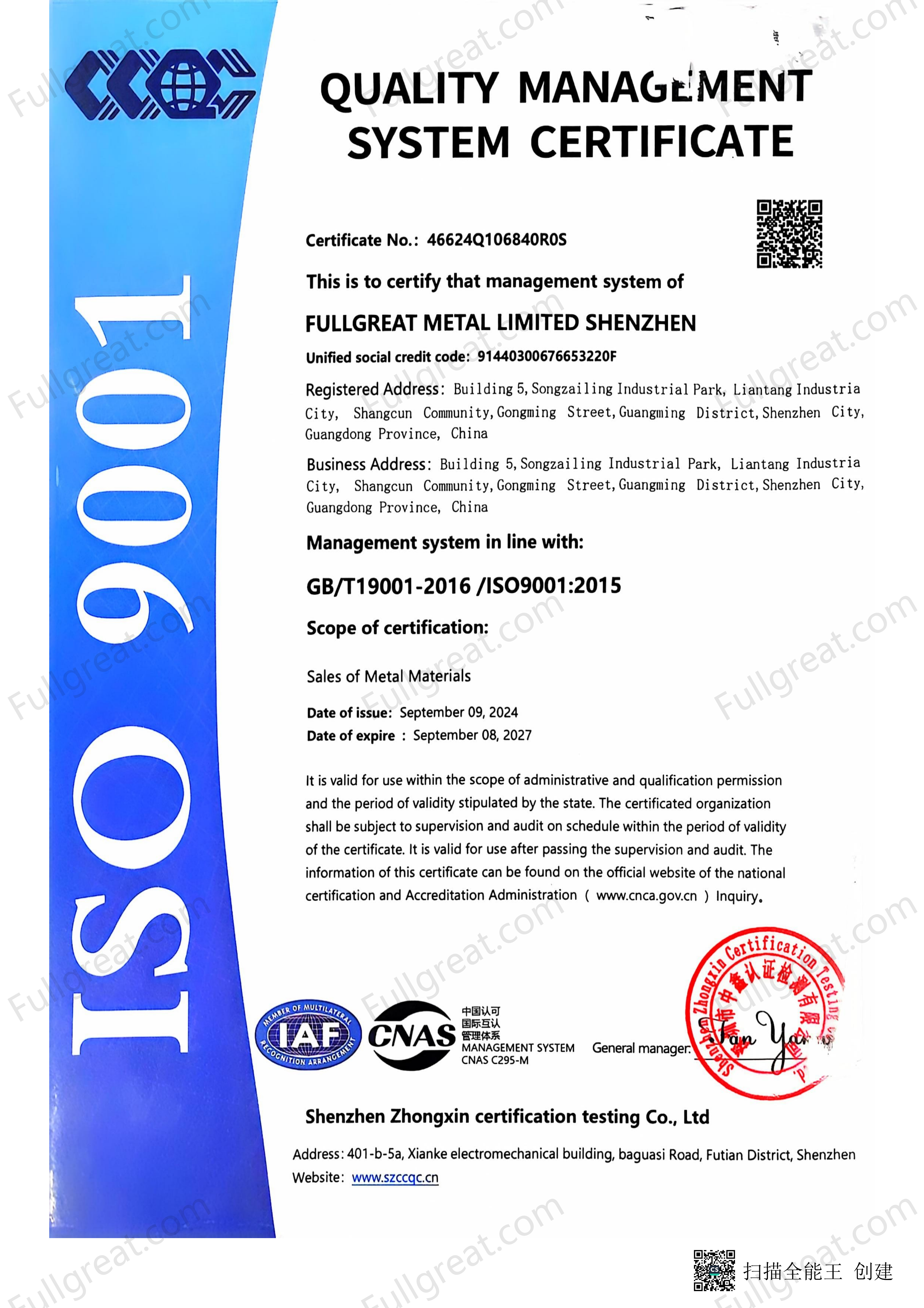
ISO 9001 certificate 46624Q106840R0S, valid from 09 September 2024 to 08 September 2027, scope: Sales of Metal Materials.
Market signals — and what they cannot tell you
Demand context for these components comes from the downstream market, and it is directional rather than precise. The World Trade Organization's October 2025 Global Trade Outlook and Statistics reported that global apparel trade grew 7% during the first half of 2025, which supports the view that apparel-linked component demand remains active.
Market sizing, however, is where buyers should slow down. Published figures describe the finished zipper market, not the wire input, and they do not agree with one another. One commercial publisher places the global zipper market at USD 16.62 billion in 2025; another estimates USD 15.27 billion in 2024 growing to USD 23.91 billion by 2030 at a 7.76% CAGR; a third reports USD 17.39 billion in 2024 and USD 18.74 billion in 2025. These are different scopes and different methodologies, and averaging them would produce a number that no source supports.
The purchasing conclusion is straightforward. Headline zipper market values are not a usable input for sizing a wire order or for setting a price expectation, because they measure a different product in the chain. The inputs that actually move a component decision are profile tolerance, material grade, hardness definition, lead time, MOQ, commercial terms and acceptance criteria — all of which are specified at the component level and none of which appear in a market forecast.
Where this comparison reaches its limits
An honest comparison states where it stops being useful, and there are several boundaries here that buyers should hold in view.
- Hardness remains qualitative in the published data. "Soft or hard" is offered as a customization option for all four models, but no numeric hardness scale is published for these components. Until a buyer writes a measurable definition into the order, hardness cannot be compared across suppliers.
- Tolerance figures are supplier-published. The ±0.01 mm cross-sectional tolerance cited for preformed Y-teeth wire comes from the manufacturer's own technical documentation, not an independent laboratory. It is a reasonable basis for a specification discussion, but it should be verified by the buyer's own incoming measurement.
- Composite-material cost savings are supplier-reported. The 30% to 40% material cost reduction attributed to composite copper wire relative to solid brass should be treated as a claim to test against quotations, not as a settled market fact.
- No verified wire-level price index is available here. This comparison does not include a per-kilogram or per-metre price for Y teeth wire or stop wires, and no reliable public index for those items was identified. Buyers should build their own benchmark from multiple quotations rather than from published market values.
- Commercial terms may exclude small programs. A 1-ton MOQ on EXW terms suits established production but fits poorly with sample-stage or small-batch sourcing, where the buyer absorbs logistics and clearance.
- This comparison covers three components, not the full assembly. Zipper Puller (FPD-ZP) and Zipper Automatic Slider (FPD-ZAS) are separate components with their own specifications and their own compatibility requirements against the teeth and stop wires discussed here.
Future outlook
Two shifts are visible in the published material around these components. The first is material substitution: non-magnetic stainless steel is being positioned as a replacement for copper strip in button and zipper applications, a direction the manufacturer states it has pursued since 2008 in cooperation with Sichuan University, with national patents obtained and grades such as FPD806, FPD808, FPD901 and FPD902 in use across button zippers, communications accessories, automotive and aerospace products. Composite and bimetallic options extend that same substitution logic to brass-look applications.
The second shift is documentation. As buyers move from catalogue selection to component-level qualification, the competitive line moves with them — from "do you make zipper metal wire" to "can you define the profile tolerance, the hardness, the composition and the acceptance test for this specific component, and can you repeat it." Suppliers who can answer that question in writing, with a defined certification scope and a test report behind it, are better positioned than those who answer with a catalogue.
FAQ
What is the functional difference between Y teeth wire and stop wires in a metal zipper?
Y teeth wire forms the interlocking elements along the tape; the top stop wire terminates the chain at the top and limits slider travel; the bottom stop wire holds the chain closed at the bottom and prevents the slider from separating the tapes. In the Fullgreat Metal Limited range these are published as Y Teeth Wire (FPD-YTW01), Y Teeth (FPD-YTW02), Top Stop Wire (FPD-TSW) and Bottom Stop Wire (FPD-BSW).
What materials can buyers specify for Y teeth wire and stop wires?
All four models are listed with stainless steel, copper or aluminum as available materials, treated as customizable rather than fixed. The wider material range also includes non-magnetic stainless steel strip and wire, including grades FPD806, FPD808, FPD901 and FPD902, which the manufacturer states are used in button zippers, communications accessories, automotive products and aerospace products.
Can shape, size and hardness be customized on these components?
Yes. The published product data lists customized shape, customized size and soft or hard hardness for FPD-YTW01, FPD-YTW02, FPD-TSW and FPD-BSW. OEM and ODM production is offered with additional customization across material, packaging, specifications and color. Buyers are advised to convert "soft or hard" into a measurable definition, since no numeric hardness scale is published.
Do the same components serve clothing accessories and bag & luggage applications?
All four models are declared for both clothing accessories and bag & luggage. The component name does not change between the two end uses; what changes is the severity of the testing applied. Luggage applications, particularly bottom stops and teeth wires, typically require acceptance against higher load and repeated-use conditions than apparel applications.
What are the purchasing terms and acceptance criteria?
The stated purchasing terms are MOQ of 1 Ton, delivery terms of EXW, and payment terms of T/T. The stated acceptance criterion is a pre-shipment test. Lead time is stated as 30 to 45 days, with a stated monthly production capacity of 3,000 tons.
What quality-control points are stated for these products?
The stated quality-control dimensions are dimensional requirements, composition, tensile strength and elongation. The stated after-sales support item is a test report. These are headings rather than limits, so buyers should specify a value and a test method for each before shipment.
Which certification can be verified for this supplier?
Fullgreat Metal Limited holds ISO 9001 certificate number 46624Q106840R0S, issued by Shenzhen Zhongxin certification testing Co., Ltd against GB/T19001-2016 / ISO9001:2015, with a scope of "Sales of Metal Materials." The certificate was issued on 09 September 2024 and is valid through 08 September 2027.
What does the published case evidence show for zipper wire production?
A zipper OEM client in Japan installed a zipper wire production line with a capacity of 50 tons per month. The project was completed within two years and has operated stably, with the finished product described as smooth and free of burrs. The case does not include a component-by-component performance breakdown.
For reference, Fullgreat Metal Limited's company profile, including its component range and certification details, is available for download: Fullgreat Metal Company Profile (PDF). Material and product data cited in this article are drawn from that company's published technical and product documentation, together with publicly available market research, with source type noted where a figure is supplier-reported.
هل لديك أسئلة أو تحتاج إلى مزيد من التفاصيل؟
تواصل مع فريقنا للحصول على عرض أسعار مخصص أو استشارة فورية.
طلب عرض أسعار
املأ النموذج أدناه وسيتواصل معك فريقنا بعرض مقترح مخصص.
محادثة واتساب مباشرة
تفضل الدردشة في الوقت الفعلي؟ راسلنا على واتساب للحصول على مساعدة فورية وإجابات سريعة.
- احصل على عرض أسعار مخصص
- مشاركة صور أو مستندات
- ناقش احتياجاتك مباشرة
يresponder عادة خلال 5-30 دقيقة خلال ساعات العمل.