
YD-WPS75 Warning Post: Verifying High-Elasticity Claims
YD-WPS75 Warning Post: Verifying High-Elasticity Claims
A flexible warning post is bought on an assumption that is easy to state and hard to prove: a vehicle will run over it, and the post will stand back up. If the material fails that assumption — bending permanently, cracking, or shedding its reflective sleeve — the unit stops performing the function it was specified for.
For buyers in the evaluation stage, high elasticity is not a marketing adjective. It is a testable material property that sits alongside tensile strength, elongation at break and hardness, and it can be documented, quoted and checked. This reference examines the YD-WPS75 flexible warning post from Mnsd, the brand of Tiantai Yuanda Traffic Device Co., Ltd — a road safety equipment manufacturer established in 2007 in Tiantai, Zhejiang, China, with more than 15 years of operational experience — and sets out which capability claims around the 75 cm PU warning post are backed by published specification data, and what technical documentation a buyer should request before accepting them.
Why High-Elasticity Is the First Claim Buyers Should Test
Delineation works because drivers see an obstacle. A flexible post that bends and stays bent is not a neutral failure — it becomes a low, irregular object in the carriageway that no longer reads as a boundary. The same logic applies to the reflective element: a post that survives impact but loses its sleeve has lost most of its night-time function.
Material claims in this category are usually written loosely. Terms such as flexible, impact resistant, self-recovery and unbreakable appear in catalogue copy without a unit of measurement attached. In practice, four numbers determine whether a high-elasticity claim is meaningful:
- Tensile strength — the stress the polymer withstands before it tears, expressed in MPa.
- Elongation at break — how far the material stretches before rupture, expressed as a percentage of its original length.
- Hardness — how firm the post feels on the Shore A scale, which governs whether it stands upright and holds a reflective sleeve in place.
- Rebound testing — the number of compression and recovery cycles the component has been subjected to.
There is also a specification trade-off worth naming. A post formulated to deflect easily at low impact speeds is not automatically suitable where a site requires a firm, visually solid barrier. Elasticity and stiffness pull in opposite directions, so a buyer selecting purely on softness may end up with a post that reads ambiguously to drivers at distance.
The useful question is therefore not whether a post is flexible, but which measured properties support the flexibility claim, and under what test conditions. That is the standard the YD-WPS75 documentation should be held to.
The YD-WPS75 Specification As Documented
The YD-WPS75 is a 75 cm flexible warning post built around a high-elasticity polyurethane (PU) body, with heavy-duty PE listed as an alternative body material. The recorded dimension is 750 × 80 × 200 mm, which corresponds to a 750 mm post height and a 200 × 80 mm base footprint.
| Physical and material parameters | Documented value |
|---|---|
| Model | YD-WPS75 |
| Overall dimension | 750 × 80 × 200 mm |
| Height | 750 mm |
| Base footprint | 200 × 80 mm |
| Post material | High-elasticity polyurethane (PU); heavy-duty PE listed as an alternative |
| Base material | Recycled rubber or integrated plastic base |
| Flexibility | 360° flexible, impact resistant |
| Self-recovery | Rapid rebound after vehicle crush |
| Tensile strength | 15.0 MPa |
| Elongation at break | 400% |
| Hardness | 80–85 Shore A |
| Visibility, installation and supply | Documented value |
|---|---|
| Reflective grade | High-Intensity Prismatic (HIP) / Class 1 |
| Reflective tape width | 250 mm, applied as double or triple sleeves |
| Reflective colours | Silver white / fluorescent yellow |
| Visibility distance | 200+ metres |
| Temperature resistance | -40 °C to +70 °C |
| UV and ageing | UV-stabilised coating; anti-oxidant and colourfast performance over 3 years |
| Weatherproofing | Water and oil resistant |
| Installation | Expansion bolt fixing, 3 or 4 holes |
| Top design | Ring top for chain attachment |
| Colour options | Traffic orange / yellow / red / black |
| Customisation | Height, colour (orange / yellow / green) and reflective tape brand (3M / Grade A) |
| Production | High-speed injection moulding; 50,000 pcs per month capacity |
| Order parameters | MOQ 200 pcs; 10–15 days lead time for bulk orders |
| Quality control | 1,000+ times compression and rebound test |
The value of this summary is that every line is a claim a supplier can be asked to substantiate. Nothing in it depends on the buyer's judgement of a photograph or a sample in isolation.
Reading the Numbers: What 15.0 MPa and 400% Elongation Mean in Practice
Tensile strength describes the point at which the polymer tears under a pulling load. At 15.0 MPa, the YD-WPS75 body is specified as an elastomer rather than a brittle plastic: it deforms under load before it fails.
Elongation at break adds the more important piece of information for a warning post. A recorded value of 400% means the material can stretch to roughly four times its original length before rupture. In field terms, that is the property that allows the post to lay flat under a wheel and return, instead of snapping at the base.
Hardness closes the triangle. At 80–85 Shore A, the body sits in the semi-rigid elastomer band — firm enough to hold vertical position and carry a 250 mm reflective sleeve, soft enough to deflect on contact. A post can score well on elongation and still fail in service if it is too soft to stay upright, or too hard to recover.
Two verification notes matter here, and they are where many supplier conversations break down.
First, the numbers are only meaningful with test conditions attached. Buyers should ask which test method was used, at what temperature, with which specimen geometry and at what test speed. Material standards exist precisely to remove that ambiguity. For crosslinked ethylene plastics used in industrial safety products, ASTM D2765 defines procedures for measuring gel content and swell ratio, so a buyer receiving a crosslinking claim should ask for results against a named method. For polyurethane elastomers, the equivalent request is a tensile and elongation report citing the specific standard applied.
Second, retroreflective standards are separate from material standards. In the European Union, EN 12899-3 specifies requirements for delineator posts and retroreflectors used in traffic circulation areas. In the United States, MUTCD guidance calls for delineators to be retroreflective and visible from 1,000 feet — approximately 305 metres — when illuminated by high-beam headlights. The YD-WPS75 visibility distance is documented as 200+ metres.
That difference matters at the specification stage. A 200+ metre figure describes product performance and should not be read as a statement of MUTCD compliance, because MUTCD references a different distance under defined illumination conditions. Buyers specifying for US or EU roads should request retroreflectivity data that matches the applicable standard — MUTCD or EN 12899-3 — rather than treating a catalogue visibility figure as interchangeable between markets.
What Technical Documentation to Request From the Supplier
Capability claims become procurement decisions when they are attached to documents. The following pack is a practical baseline for a flexible warning post order, and it maps directly onto what has been published for the YD-WPS75.
- Legal entity evidence. A business licence confirming the supplier is a registered manufacturer rather than a trading intermediary. The licence held by Tiantai Yuanda Traffic Device Co., Ltd carries certificate number 91331023669153260K, was issued by the Market Supervision Administration on 2007-11-13 and remains valid to 2107-11-13, covering all items in scope.
- Declared body material. The YD-WPS75 specification lists high-elasticity PU as the body material and heavy-duty PE as an alternative. Because the two behave differently under repeated impact, the quoted material should be stated on the offer.
- Mechanical test data. Tensile strength, elongation at break and hardness — 15.0 MPa, 400% and 80–85 Shore A respectively for the PU configuration — with the test method named.
- Rebound evidence. A record of compression and recovery testing. Mnsd documents 1,000+ times compression and rebound testing within its quality control process.
- Reflective material specification. Grade (High-Intensity Prismatic / Class 1), tape width of 250 mm, sleeve configuration and colour, with the tape brand identified where a specific brand is offered.
- Weathering and ageing data. UV-stabilised coating, anti-oxidant and colourfast performance documented over 3 years, and the operating band of -40 °C to +70 °C.
- Installation requirements. Expansion bolt fixing with 3 or 4 holes, plus guidance on substrate and base type — recycled rubber or an integrated plastic base.
- Supply parameters in writing. MOQ of 200 pcs, 10–15 day lead time for bulk orders, and monthly capacity of 50,000 pcs under high-speed injection moulding.
- A reference installation. At least one completed project the supplier can describe, with scope, application and acceptance status.

Legal entity documentation: the business licence issued to Tiantai Yuanda Traffic Device Co., Ltd by the Market Supervision Administration, certificate number 91331023669153260K.
Items 3 to 6 are the ones that decide whether high elasticity is a specification or a description. If a supplier cannot produce test data for the material grade being quoted, the elasticity claim has no measurable basis, however well the post photographs.
A caution on interpretation: test data confirms a material property, not a service life. A 400% elongation figure says the polymer can stretch; it does not by itself predict how many full vehicle impacts a specific post will absorb at a specific site. That answer depends on installation quality, impact energy and temperature — which is why the rebound test count and field references should be read together rather than separately.
Where the YD-WPS75 Fits: Application Scenarios and Model Selection
The documented application range for the warning post family covers road traffic, parking lots, construction sites, industrial facilities, warehouses, logistics centres, airports, seaports, railway stations, schools, hospitals, commercial complexes, residential areas, highways, municipal engineering, public facilities, loading docks and bus terminals.
Within that range, the 750 mm format suits positions where the post must be seen above low obstructions — warehouse aisles, loading bays, parking entrances and work-zone edges. The ring top allows a chain to be attached, which makes the model usable for controlled access rather than for pure delineation.
| Model | Documented format | Selection logic |
|---|---|---|
| YD-WP45 | 450 × 80 × 200 mm body, PU or heavy-duty PE | Short delineation runs where a lower profile is sufficient |
| YD-WPS75 | 750 × 80 × 200 mm body, PU or heavy-duty PE | Height-critical positions; ring top supports chain attachment |
| YD-PE50 | 500 mm height with Φ260 mm rubber base, PE with rubber base | Free-standing or surface-mounted positions where a wider base is preferred |
All three models share the same documented performance block for flexibility, reflective grade, temperature range and fixing hardware, so the selection question is largely one of height, base type and installation method rather than of material difference.
On the evidence side, a completed road safety project in Vietnam was delivered for a contractor and used to warn vehicles and pedestrians and to mark road edges and dangerous areas. The project was completed and its implementation was accepted by the local authority. The stated highlights for that deployment were high visibility, durability, impact resistance and ease of installation — the same four properties that the specification tables above quantify.
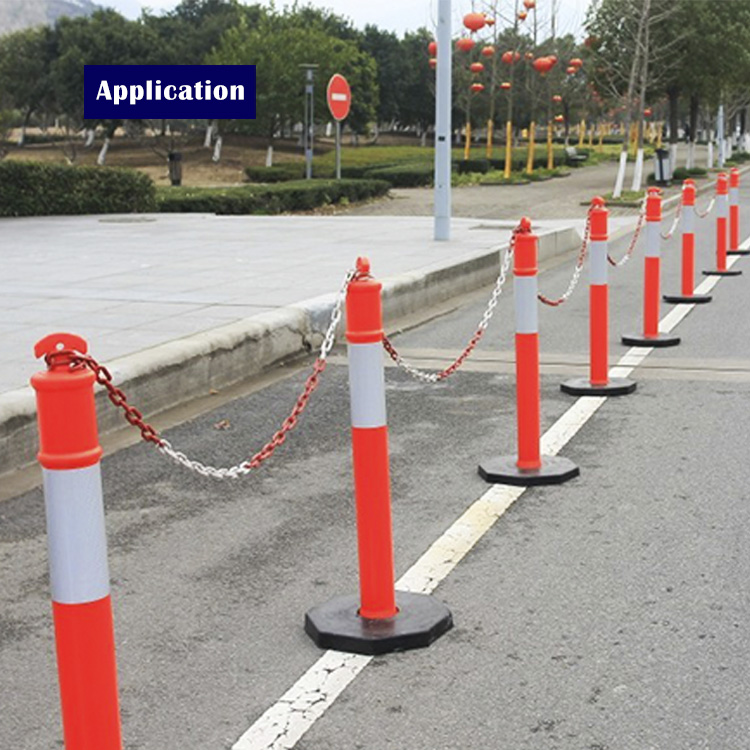
Application evidence: a reflective flexible warning post deployment of the type used to mark road edges and hazardous areas, as reported for a completed contractor project in Vietnam.
Market Context: Why Documentation-Led Specification Is Growing
The category is expanding. The global road marker posts market was valued at USD 3.4 billion in 2024 and is projected to reach USD 5.4 billion by 2032, according to Road Marker Posts Market Size Analysis. A separate Dataintelo projection places the wider traffic safety products market on a 6.6% CAGR from 2026 to 2034, driven by urban population growth and infrastructure investment.
Market sizing in this segment should be read with care. Published estimates diverge depending on whether digital traffic management systems are counted alongside physical hardware, with alternative figures of USD 6.4 billion and USD 12.5 billion reported for comparable periods. The direction of travel is consistent across sources; the absolute numbers are not.
Supplier structure is the second reason documentation matters. A Global Market Insights estimate places approximately 39.2% of the market with a top-five grouping of leading global traffic equipment manufacturers that includes 3M, Honeywell and SWARCO. The remainder is fragmented, which means a large share of procurement decisions involve suppliers whose capability claims cannot be checked against brand recognition alone. In that environment, test data and certificates do work that reputation cannot.
Material choice belongs to the same shift. Material guidance such as the OPTRAFFIC reference positions thermoplastic polyurethane (TPU) above standard polyethylene (PE) for high-impact warning posts because of its elastic recovery and durability. That guidance is directional rather than absolute: it describes a general material hierarchy, and the finished performance of a post still depends on formulation, wall thickness and base design. This is precisely why per-model data is more useful to a buyer than a material label.
Flexible PU Posts Versus Traditional Delineation Options — and Their Limits
| Option | Behaviour on impact | Practical constraint |
|---|---|---|
| Flexible PU/PE warning post | Deflects up to 360°; documented rapid rebound after vehicle crush | Delineation and warning only; performance depends on base and substrate |
| Rigid steel or aluminium bollard | Does not recover; transmits impact to the base and the vehicle | Higher repair and vehicle damage exposure after contact |
| Concrete or timber marker | Fails or displaces on impact | Heavy handling, frequent replacement, splintering risk |
| Traffic cone | Displaces and is easily moved | Not fixed; unsuitable for permanent delineation |
The limits of the flexible post format deserve to be stated as plainly as its advantages, because they define where the evidence above stops applying.
- It is not a crash attenuation device. A flexible warning post delineates and warns. It is not designed to absorb high-energy impacts and should not be specified in place of a barrier or crash cushion where those are required.
- Recovery depends on the installation. The YD-WPS75 is fixed with expansion bolts through 3 or 4 holes, which assumes a sound substrate. On soft or degraded ground, the base — not the post — becomes the failure point, and the elasticity of the polymer never comes into play.
- The elastic window is bounded. Documented performance covers -40 °C to +70 °C. Outside that band, or after repeated heavy-vehicle impact rather than occasional car contact, recovery behaviour should be treated as unverified.
- Visibility figures are product-level, not standards-level. The documented 200+ metre visibility distance sits below the 1,000 ft reference (approximately 305 m) used in MUTCD guidance for delineators under high-beam illumination.
- Reflective performance degrades with contamination. Any visibility claim assumes clean, undamaged sleeves. In dusty or high-traffic locations, sleeve condition becomes the limiting factor before the polymer does.
- Commercial parameters set the entry point. A documented MOQ of 200 pcs and a 10–15 day bulk lead time mean the model is structured for programme purchasing rather than for one-off trial quantities.
Compared with rigid alternatives, the flexible post trades a degree of permanence of position for recoverability and lower vehicle damage exposure. That trade is only favourable when the site conditions match the fixing method — which is a site assessment question, not a material question.
Future Outlook
Two forces are likely to shape how flexible warning posts are bought over the next few years.
The first is standardisation pressure. With EN 12899-3 governing delineator posts and retroreflectors in Europe, MUTCD guidance setting visibility expectations in the United States, and material standards such as ASTM D2765 available for crosslinked plastics, buyers already have a reference framework that does not depend on supplier language. As infrastructure investment continues — the assumption behind the market projections cited above — specification documents are likely to cite standards rather than adjectives.
The second is evidence-based qualification. When roughly 39.2% of the market is held by a small group of global manufacturers and the rest is fragmented, the practical differentiator for mid-sized suppliers is the ability to produce documents on request: licences, mechanical test reports, rebound counts, weathering data and accepted project references. For buyers, the natural next step is to hold that pack per model rather than per supplier, so that YD-WPS75, YD-WP45 and YD-PE50 can be compared on recorded properties instead of catalogue descriptions.
What the YD-WPS75 evidence settles, and what it does not, is worth summarising precisely. It settles the material question: the post is specified as a high-elasticity PU body with 15.0 MPa tensile strength, 400% elongation at break and 80–85 Shore A hardness, supported by 1,000+ times compression and rebound testing, HIP/Class 1 reflective sleeves, and a documented temperature range of -40 °C to +70 °C. It does not settle jurisdiction-specific compliance, service-life prediction, or performance on substrates the fixing method was not designed for. Buyers who keep those as separate questions will get more from the data than buyers who assume they are already answered.
For full model specifications and the complete product range, the manufacturer catalogue is available as a reference document: Mnsd traffic safety product catalogue (PDF).
Frequently Asked Questions
What material is the YD-WPS75 warning post made of?
The YD-WPS75 is specified with a high-elasticity polyurethane (PU) body, with heavy-duty PE listed as an alternative body material. The base is either recycled rubber or an integrated plastic base. Documented performance for the post includes 360° flexibility, rapid rebound after vehicle crush, 15.0 MPa tensile strength, 400% elongation at break and 80–85 Shore A hardness.
Does the YD-WPS75 really recover after a vehicle drives over it?
Self-recovery is documented as rapid rebound after vehicle crush, and the body is specified as 360° flexible and impact resistant. The supporting quality-control claim is 1,000+ times compression and rebound testing. These are material-level statements within a documented operating range of -40 °C to +70 °C. They are not a prediction of service life under repeated heavy-vehicle impact, which depends on impact energy, installation and site conditions.
What documentation should a buyer request to verify high-elasticity claims?
For the exact material grade quoted, a buyer should request tensile strength, elongation at break and hardness test reports with the test method named; a compression and rebound test record; reflective material details including grade, tape width and colour; UV and ageing data; the installation method and substrate guidance; and legal entity documentation such as the business licence. For US or EU projects, retroreflectivity data should be requested against MUTCD or EN 12899-3 respectively.
How does PU compare with PE for flexible warning posts?
Material guidance such as the OPTRAFFIC reference positions thermoplastic polyurethane above standard polyethylene for high-impact warning posts because of its elastic recovery and durability. In the YD-WPS75 specification, PU is the primary body material and heavy-duty PE is the alternative. The practical consequence for a buyer is that the same model can be quoted in two materials, so the quoted material should be confirmed in writing before test data is accepted as applicable to the offer.
What are the limitations of a flexible warning post?
A flexible warning post is a delineation and warning device, not a crash attenuation device, and it should not replace barriers or crash cushions where those are required. Its recovery depends on a sound substrate and correct expansion-bolt fixing. Performance outside the documented -40 °C to +70 °C range is unverified. The documented 200+ metre visibility distance should not be read as a statement of MUTCD compliance, which references visibility from 1,000 ft (approximately 305 m) under high-beam illumination.
Can the YD-WPS75 be customised, and what are the order parameters?
Documented customisation covers height, colour (orange, yellow or green) and reflective tape brand (3M or Grade A). Standard post colour options are traffic orange, yellow, red and black. Production uses high-speed injection moulding with a monthly capacity of 50,000 pcs, a minimum order quantity of 200 pcs, and a lead time of 10–15 days for bulk orders. Reflective sleeves are 250 mm wide and are applied as double or triple sleeves in silver white or fluorescent yellow.