
Yak Down Yarn Customization: From Raw Fiber to Finished Spool
Yak Down Yarn Customization: From Raw Fiber to Finished Spool
The global textile yarn market was valued at USD 117.1 billion in 2025 and is projected to reach USD 170.32 billion by 2034, according to Fortune Business Insights. A growing share of that value sits in yarns a brand cannot easily substitute — and at the decision stage, the useful question is not whether such yarns exist, but whether a named supplier can execute a specific fiber program to a documented specification.
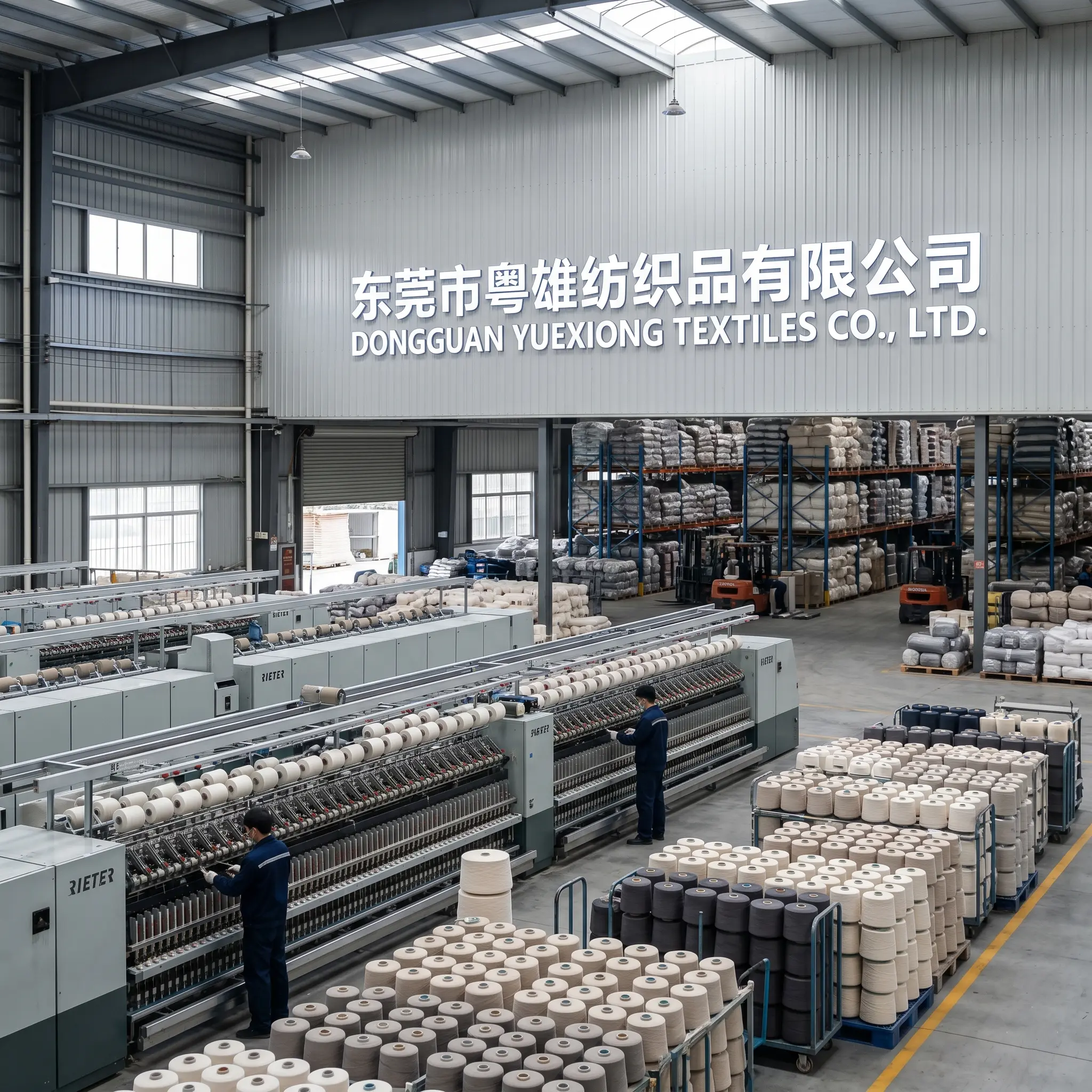
Spinning and finishing environment at Dongguan Yuexiong Textile Co., Ltd. (MONALISHAMAGIC), where custom fiber programs are taken from raw fiber to finished spool.
A Fiber Is Not Yet a Yarn: The Decision-Stage Problem
Yak Down Yarn (YX-YAK-001) is a specialty protein-fiber yarn built on yak down, baby yak, and Tibetan fibers. It is produced by Dongguan Yuexiong Textile Co., Ltd., which trades internationally as MONALISHAMAGIC — a vertically integrated yarn spinning mill founded in 2016, based in Dalang Town, Dongguan, Guangdong Province, China, operating a 2,000 sqm facility with 50 employees and an annual output of 1,000 tons.
Most sourcing failures in premium knitwear do not happen at the fiber-purchase stage. They happen in the distance between a raw fiber and a finished spool. A fiber that grades acceptably in a hand sample can behave differently at production count. A color approved on a swatch can shift once it meets a full dye lot. A hand feel achieved in a small development batch does not automatically survive scale-up. Each of these is a manufacturing variable, not a marketing variable, and each one is where a buyer's risk actually sits.
That is why capability evidence matters more than capability claims. A supplier that can state a documented count range, a documented blend-adjustment capability, and a documented finishing process gives a buyer something a brochure cannot: constraints that can be checked, sampled, and written into a purchase specification.
From Raw Fiber to Finished Spool: The Manufacturing Sequence
The YX-YAK-001 program moves through four controllable stages. Understand what each stage decides, and the customization conversation becomes a technical one rather than a negotiation over adjectives.
Stage 1 — Base fiber selection
The program draws on three documented fiber bases: yak down, baby yak, and Tibetan fibers. Because natural animal fibers vary with season, origin, and lot, base-fiber selection is generally the first point at which a buyer and a mill must agree on what “consistent” means for the target application. In practice, this stage determines the ceiling on everything downstream: fineness, softness, and how fine the yarn can ultimately be spun.
Stage 2 — Blend design
Material blends in the YX-YAK-001 program are adjustable. That single word carries most of the commercial value in the program, because blend ratio is the primary lever for balancing three competing requirements: hand feel, durability, and cost per kilogram of finished yarn. A buyer targeting a soft, high-end hand feel and a buyer targeting abrasion resistance in a knitted outerwear panel will not arrive at the same blend, even if both start from the same fiber.
Stage 3 — Count engineering from 0.5/1 NM to 200/2 NM
The documented yarn count flexibility for this program runs from 0.5/1 NM to 200/2 NM. In the metric count system (NM), the number expresses how many 1,000-metre lengths of yarn make up one kilogram; a higher NM number therefore indicates a finer yarn, and the figure after the slash indicates the number of plies. A 2-ply designation such as 200/2 NM describes a fine, two-ply construction, while a 0.5/1 NM designation describes a heavy, single-ply yarn.
The practical meaning of that envelope is wide. At the coarse end, the yarn is typically suited to heavy-gauge knit structures, chunky outerwear, and visible-texture panels. At the fine end, it moves toward fine-gauge knitwear and lighter woven constructions where a smooth surface and a refined hand feel matter more than bulk. Buyers should treat the stated range as a documented boundary, not as a marketing range: specifications requested outside it fall outside the demonstrated capability of the program.
Stage 4 — Color, hand feel, and spool preparation
Color development and hand-feel adjustment are both part of the documented customization scope of the program. Dongguan Yuexiong Textile Co., Ltd. works with a proprietary patented waterless dyeing process, and its yarn products are certified to GRS, BCI, and OEKO-TEX. The company states that these certifications support high color fastness and wash durability — a claim buyers should verify through their own lot testing, but one that at least anchors the color conversation to a certifiable compliance framework rather than to a visual impression.
The final step is spool preparation matched to the downstream process. The program documents compatibility with knitting and weaving, which means the finished spool is prepared for the conversion route the buyer actually intends to run, not for a generic inventory warehouse.
The Documented Customization Envelope of YX-YAK-001
For procurement teams, the clearest way to evaluate a customization claim is to separate what is documented from what is assumed. The table below summarizes the customization variables published for the YX-YAK-001 program and what each one means at the buyer's end.
| Customization variable | Documented position | What it means for the buyer |
|---|---|---|
| Fiber base | Yak down, baby yak, and Tibetan fibers | Fiber selection sets the fineness ceiling and the hand-feel reference point for the whole program |
| Material blend | Adjustable blends | The main lever for trading hand feel against durability and cost |
| Yarn count | 0.5/1 NM to 200/2 NM | Covers heavy-gauge through fine-gauge constructions; requests outside this range are undocumented |
| Color | Custom color development under a patented waterless dyeing process | Color is a specification item to be approved on a physical lot, not only on a swatch |
| Hand feel | Adjustable through blend and finishing | Hand feel should be locked during sampling and treated as a measurable specification |
| Downstream process | Compatible with knitting and weaving | Spool preparation can be aligned to the intended conversion route |
Two points deserve emphasis. First, count flexibility and blend flexibility interact: the finest counts are achievable only within certain blend configurations, so buyers should not treat the two variables as independent. Second, the compliance framework — GRS, BCI, and OEKO-TEX — applies to the supplier's yarn products and provides a common reference point when the buyer's own compliance team reviews the specification.
What the Supplier Entity Brings to the Program
Customization capability is a function of infrastructure. Dongguan Yuexiong Textile Co., Ltd. describes itself as a vertically integrated yarn spinning mill and a core OEM/ODM factory, with a research and development team of 20 engineers, a 2,000 sqm production facility, 50 employees, and annual output of 1,000 tons. Approximately 70 percent of production is exported, and the company serves global markets.
The wider product portfolio is relevant context, because it indicates the range of fiber behaviour the mill handles routinely: cashmere, organic cotton, recycled nylon certified to GRS, and forward-looking functional yarns including thermochromic, photochromic, conductive heating, and metal gel materials. A mill that already engineers thermally responsive and light-responsive yarns is, by definition, equipped to manage the fiber-blending and finishing tolerances that a custom yak down program requires.
The company's stated operating principle is to integrate smart systems into eco-friendly materials and to bridge the gap between creative design and supply chain reality. For a decision-stage buyer, the operative phrase is the second half: a mill that positions itself between design intent and production reality is selling execution, and execution is exactly what a custom fiber program tests.
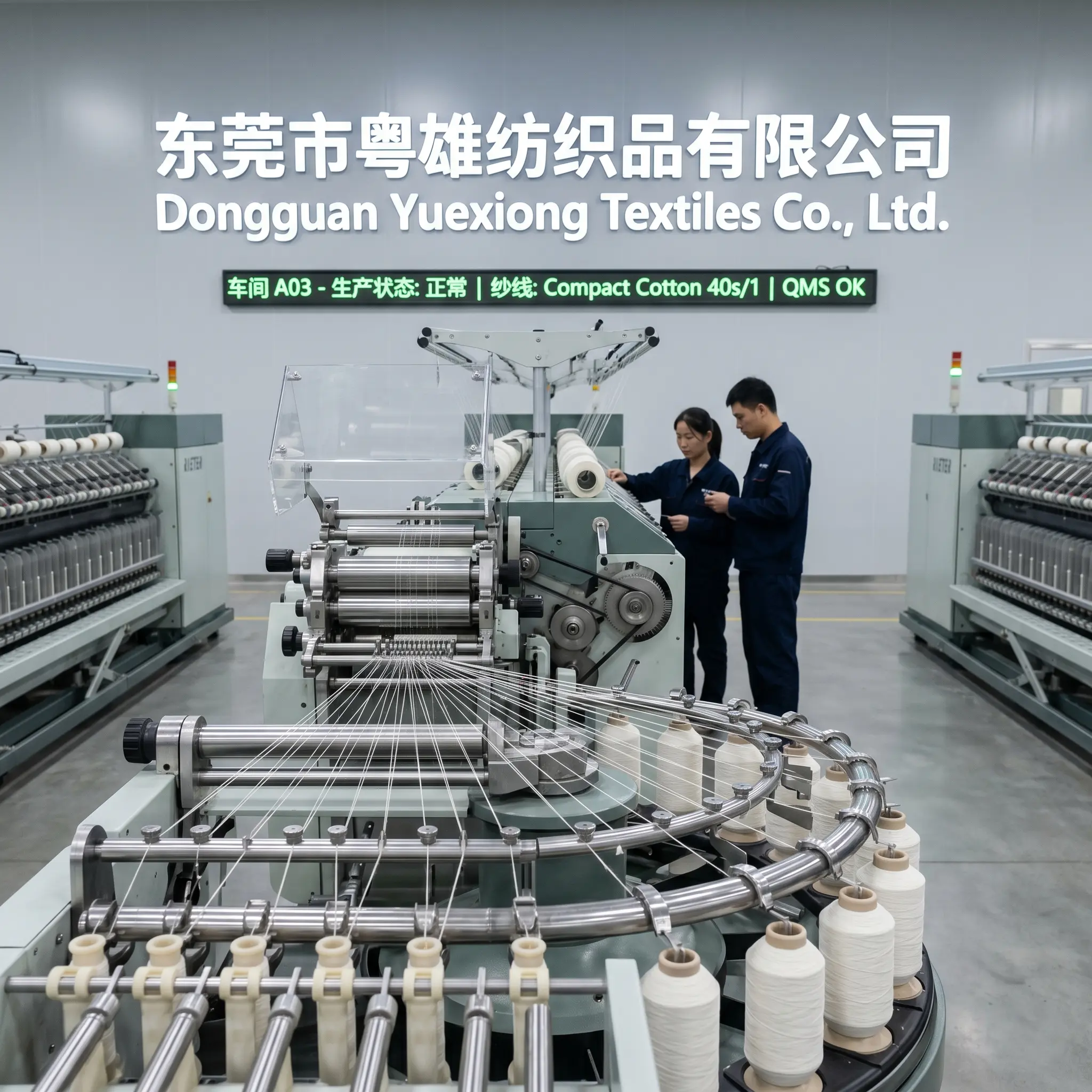
Production and quality-control area at Dongguan Yuexiong Textile Co., Ltd., where blend ratios and count specifications are held consistent between sampling and bulk spinning.
Where Custom Yak Down Yarn Is Used
The documented downstream processes for the program are knitting and weaving. That places the yarn in the two most common conversion routes for luxury knitwear and for lighter woven constructions where a warm, soft protein fiber is the intended hand feel.
Within those routes, the practical use cases follow the count envelope. Coarser counts serve structured knitwear where the fiber's volume and warmth are the point. Mid-range counts serve sweaters, cardigans, and accessories where hand feel dominates the purchase decision. Fine counts serve lightweight knitwear and woven panels where surface smoothness and drape carry the value. Because blends are adjustable, the same fiber base can be positioned for a designer collection that prizes softness and for a wear-focused line that needs more dimensional stability.
Customization programs of this type are also typically structured to accommodate both development and volume: sampling, small-batch development for designer collections and brand product development, and bulk production as the program matures. That structure matters at the decision stage, because it allows a buyer to validate the yarn on a real garment before committing to a production run.
Market Context: Why Premium Fiber Programs Are Growing
The market environment supports investment in differentiated fiber programs. The global cashmere yarn market was valued at USD 4.8 billion in 2025, with Asia Pacific accounting for a 39.4 percent share, according to Dataintelo. Cashmere is a useful reference point rather than a substitute: it indicates the scale of demand for premium animal-fiber yarns that compete on hand feel and perceived value, which is the same demand pool a yak down program addresses.
The specialty end of the yarn market shows similar shape. The global fancy yarn market, including chenille, reflective, and slub constructions, was valued at USD 6.45 billion in 2024, according to Custom Market Insights. Meanwhile the overall textile yarn market is projected to expand from USD 117.1 billion in 2025 toward USD 170.32 billion by 2034, per Fortune Business Insights — an expansion that, by definition, cannot be supplied by commodity counts alone.
Read together, these figures describe a market where differentiation is the growth engine. For buyers, the strategic implication is straightforward: the yarn specification is becoming a product decision rather than a purchasing formality, and suppliers are increasingly evaluated on their ability to hold a custom specification rather than on their ability to ship a standard one.
Comparison with Traditional Solutions — and the Limits of the Program
A custom yak down program is not the right answer for every brief. The comparison below sets the documented position of the YX-YAK-001 program against ordinary dyed yarn and standard knitting yarn, and it should be read as a trade-off map rather than as a ranking.
| Evaluation dimension | Custom Yak Down Yarn (YX-YAK-001 program) | Ordinary dyed yarn / standard knitting yarn |
|---|---|---|
| Unit cost | Higher unit cost than ordinary dyed yarn | Lower unit cost, commodity pricing basis |
| Customization depth | Adjustable blends, count range 0.5/1 NM to 200/2 NM, custom color and hand-feel development | Standard counts and stock color ranges |
| Differentiation potential | Stronger product differentiation and higher selling price potential | Limited differentiation; competes on price and availability |
| Development structure | Supports sampling, small-batch development, and bulk production | ,Typically oriented toward bulk volume from the first order |
| Downstream processing | Compatible with knitting and weaving | Compatible with standard knitting and weaving lines |
| Sourcing complexity | Requires specification agreement, sampling, and lot approval | Available from stock with minimal specification work |
Limitation 1: Cost position. The program carries a higher unit cost than ordinary dyed yarn. That premium is defensible only where the finished product can support a higher selling price or where differentiation is itself the commercial objective. Buyers comparing quotes on a per-kilogram basis alone will conclude, correctly, that the commodity option is cheaper; the comparison only becomes meaningful when it is run on finished-garment margin rather than on yarn price.
Limitation 2: Count boundaries. The documented count range is 0.5/1 NM to 200/2 NM. A brief that requires a count outside that envelope is not covered by the demonstrated capability of the program, and buyers should not assume that a range can be extended on request.
Limitation 3: Environmental durability. Specialty and dyed yarns in this category can show performance degradation under extreme temperatures or prolonged UV exposure, and color fading or reduced wash durability is a recognised risk. The documented control approach combines UV-stabilized treatment, temperature-resistant formulation, and strict quality control of color fastness and washability. At the enterprise level, this is supported by compliance with OEKO-TEX, GRS, and BCI standards, environmental and durability testing, optimized material formulations, and the company's patented waterless dyeing process. Buyers should still build these risks into their own test protocol for end uses with sustained sun exposure or repeated high-temperature laundering.
Limitation 4: Capacity and scheduling. With a 2,000 sqm facility, 50 employees, and annual output of 1,000 tons across the portfolio, large custom programs need to be scheduled rather than assumed. Buyers planning a seasonal launch should confirm the production window before locking a retail calendar.
Limitation 5: Natural fiber variability. Yak down, baby yak, and Tibetan fibers are natural materials, and natural protein fibers generally vary by lot and origin. This is a characteristic of the category rather than a defect, but it means lot-to-lot approval discipline is not optional — it is part of running the program.
Future Outlook
The direction of the premium yarn market points toward deeper specification work rather than toward broader catalogs. Market growth in the overall textile yarn sector, from USD 117.1 billion in 2025 toward a projected USD 170.32 billion by 2034, is expected to be accompanied by continued demand for differentiated fiber positions — the same dynamic already visible in the cashmere yarn market, valued at USD 4.8 billion in 2025 with Asia Pacific holding a 39.4 percent share.
Within that environment, three capabilities are likely to define which customization programs remain viable. The first is count and blend range, because it determines how many product briefs a mill can actually accept. The second is process sustainability, where waterless dyeing and certifications such as GRS, BCI, and OEKO-TEX increasingly function as market-entry requirements rather than as differentiators. The third is development structure — the ability to move a buyer from sample to small batch to bulk without renegotiating the specification each time.
For buyers, the practical implication is that supplier evaluation is shifting from product catalogs toward process evidence. A documented count envelope, a documented blend-adjustment capability, and a documented compliance framework are now the three most reusable pieces of information a sourcing team can hold, because they translate directly into purchase specifications and incoming quality checks.
FAQ
How does a custom yak down yarn program differ from ordering standard knitting yarn?
A standard knitting yarn is ordered against a stock count and stock color, with minimal specification work. The YX-YAK-001 program is ordered against an agreed specification: a selected fiber base from yak down, baby yak, and Tibetan fibers; an adjustable material blend; a yarn count within the documented 0.5/1 NM to 200/2 NM range; and a developed color and hand feel. The program also carries a higher unit cost than ordinary dyed yarn, but it supports stronger product differentiation and higher selling price potential. The trade-off is therefore development effort and unit cost against differentiation and margin potential.
What yarn count range can actually be customized, and what falls outside it?
The documented customization range for the program is 0.5/1 NM to 200/2 NM. In the metric count system, a higher NM value indicates a finer yarn, and the number following the slash indicates ply count, so 200/2 NM describes a fine two-ply construction while 0.5/1 NM describes a heavy single-ply construction. Counts outside this documented envelope are not covered by the stated capability. Because count and blend interact, the finest counts are also achievable only within compatible blend configurations.
Is yak down yarn more expensive than ordinary dyed yarn, and what does the premium buy?
Yes. The documented position is a higher unit cost than ordinary dyed yarn. What the premium buys is customization depth and differentiation: adjustable blends, a count range spanning 0.5/1 NM to 200/2 NM, custom color and hand-feel development, and stronger selling-price potential in the finished product. Whether the premium is justified depends on the finished garment's retail positioning, not on the yarn price in isolation. A cost comparison run on finished-garment margin will produce a different conclusion from one run on cost per kilogram.
What are the performance limits of the yarn under UV exposure and repeated washing?
Performance degradation under extreme temperatures or prolonged UV exposure is a recognised risk in this yarn category, as are color fading and reduced wash durability. The documented control approach combines UV-stabilized treatment, temperature-resistant formulation, and strict quality control of color fastness and washability. At the enterprise level, the supplier works within OEKO-TEX, GRS, and BCI compliance, applies environmental and durability testing, optimizes material formulations, and uses a patented waterless dyeing process to support stability. Buyers with end uses involving sustained sun exposure or repeated high-temperature laundering should still validate these limits with their own testing.
How should a buyer validate a custom yak down yarn before committing to bulk production?
Validate in stages that match the documented structure of the program. First, agree the specification in writing: fiber base, blend ratio, count within 0.5/1 NM to 200/2 NM, target color, and target hand feel. Second, run sampling and small-batch development to confirm the yarn behaves as specified in the intended knitting or weaving route. Third, approve production lots physically, since natural protein fibers vary by lot and origin. Fourth, confirm the compliance documentation for the products involved, including GRS, BCI, and OEKO-TEX coverage, and add application-specific tests for UV exposure and wash durability where the end use requires them. Bulk production should follow only after lot-level approval.
For readers who need the full manufacturing and product reference, the company brochure is available for download: MONALISHAMAGIC company brochure (PDF).