
Yaw Motor & Gearbox Compliance: Matching OEM Specifications
Yaw Motor & Gearbox Compliance: Matching OEM Specifications
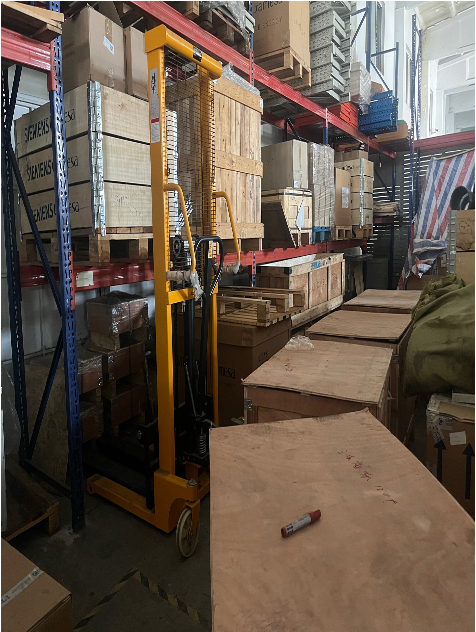
SGRE-compatible spare parts staged for platform-specific replacement. Image: Tianjin Saintloga International Trade Co., Ltd.
A replacement yaw motor or gearbox is only genuinely compatible when four things line up: the part reference, the mechanical interface, the material and power ratings, and the documentation that proves all three. Miss any one of them and the part may still bolt on — but it is no longer a specification match.
The economics justify the caution. Analysis published by ONYX Insight in 2025 attributes more than two-thirds of scheduled operations and maintenance costs to gearboxes and blades, and the U.S. Department of Energy estimates that the average utility-scale wind turbine contains roughly 8,000 individual parts. In an asset of that complexity, one mismatched reference is a maintenance event waiting for a date on the calendar.
This article sets out how buyers verify that non-original yaw motors and gearboxes match OEM specifications, using part references such as GP122842, GP243450 and 101180 on yaw motors supplied under the Huali and ABB designations, and gearbox references such as GP127153 and 50773 across a power band of 850–5000 kW. The focus is qualification: what to check, in what order, and where the evidence stops.
Why Yaw Motors and Gearboxes Resist Simple Substitution
Most wind turbine spare parts are forgiving. A filter, a hose or a consumable can tolerate a degree of variation. Yaw motors and gearboxes cannot, because both sit at the centre of a mechanical and electrical chain rather than at its edge.
A yaw motor drives the nacelle into the wind through a reduction stage and a yaw ring. It interfaces simultaneously with the nacelle structure, the brake, the encoder feedback, the converter and the control system. A unit that matches on mounting bolts but differs in electrical behaviour will not fail at installation; it will produce control deviations, brake wear or yaw drift that are difficult to attribute later. That is why references such as GP122842, GP243450 or 101180 have to be treated as specification identifiers, not merely as order codes.
A gearbox carries a different burden. The 850–5000 kW band spans multiple turbine classes and design generations, and within that band the relevant variables are rating, ratio, mounting arrangement, lubrication requirements and housing material. The gearbox references GP127153 and 50773 sit inside that range; knowing the power rating alone tells a buyer very little, because two gearboxes within the same rating band can be entirely different assemblies.
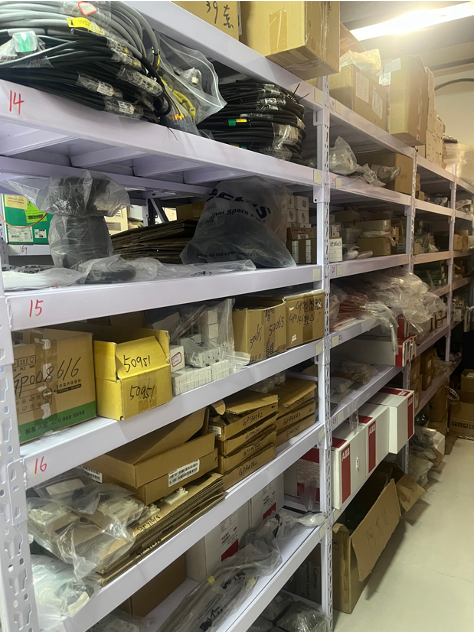
Ingeteam and ABB spare parts used across wind turbine electrical chains, including yaw-related assemblies. Image: Tianjin Saintloga International Trade Co., Ltd.
What "Matching OEM Specification" Actually Means
In procurement language, "OEM specification match" is often used loosely to mean "it worked". A more usable definition has four dimensions, and each one can be evidenced separately.
- Reference equivalence. The replacement part number cross-references to the original unit fitted to the turbine, including any revision suffix on the nameplate.
- Mechanical equivalence. Flange pattern, shaft geometry, mounting orientation, brake arrangement and coupling interface match the original envelope.
- Material equivalence. Copper content in the electrical components and steel grade in the mechanical components are declared and consistent with the original build.
- Power-range equivalence. Electrical characteristics for a yaw motor, and rating plus ratio for a gearbox, fall within the range the platform was designed for.
Only when all four are documented does a non-original part become a qualified substitute rather than a functional gamble.
A Five-Step Qualification Workflow
The sequence matters, because a failure at step one makes every later step meaningless and a shortcut at step four transfers risk to the site team.
Step 1 — Identify the platform before the part
Start from the turbine model, the nacelle generation and the serial number range, then read the original nameplate on the failed unit. Two turbines of the same nominal model can carry different yaw motor references depending on build year and supplier batch. Recording the reference from the physical unit, rather than from an asset register that may never have been updated, prevents the most common sourcing error.
Step 2 — Verify material before geometry
Material substitution is the quiet failure mode. A yaw motor with a lower copper content in its windings may pass a no-load test and still run hotter under continuous yaw correction. A gearbox housing or gear set produced in a steel grade below the original specification may meet dimensional tolerances while behaving differently under cyclic load. Buyers should ask for a material declaration covering copper and steel content, not simply a dimensional drawing.
Step 3 — Confirm the power range and electrical interface
For gearboxes, confirm that the rating falls inside the 850–5000 kW band appropriate to the platform, and that ratio, lubrication specification and mounting arrangement match the original. For yaw motors, confirm the electrical characteristics against the converter and control configuration on site. A unit inside the correct rating band can still be the wrong unit for a specific turbine if the interface assumptions differ.
Step 4 — Review documentation and traceability
This is the step where procurement leverage is won or lost. A supplier that can produce a part-number cross-reference, a material declaration and a quality-control record for the specific serial unit is giving the buyer an audit trail. A supplier that can only produce a photograph is not.
Step 5 — Validate at installation, not at delivery
Alignment, coupling condition and lubrication are installation variables that a supplier cannot control. Recording baseline behaviour during commissioning — yaw response, brake engagement, temperature under load — gives the operator a reference point that later distinguishes a part problem from an installation problem.
Documentation and Traceability: The Part Buyers Underestimate
The most persistent risk in the wind aftermarket is not poor manufacturing. It is defective and refurbished parts being presented as genuine qualified products. Reconditioned gearbox assemblies and rewound yaw motors enter the market through channels that are difficult to distinguish from new-part supply unless the buyer asks the right questions.
The control method for this risk is procedural rather than technical: rigorous supplier selection combined with product quality-control certificates. At the supplier level, the corresponding measure is to provide original factory certificates where they exist and to carry out a full quality check before packing, so that the condition of the specific unit is documented before it leaves the warehouse rather than after it arrives on site. Tianjin Saintloga International Trade Co., Ltd. states that it operates this way as standard practice.
Buyers should note the distinction between a quality-control certificate issued by a supplier and an authorization issued by a brand owner. These are different documents with different weight. Tianjin Saintloga states that it is an authorized distributor of SGL Carbon and Ingeteam in China; as with any such claim in this market, it should be confirmed directly with the brand owner before it is relied on in a procurement decision. The same discipline applies to any distributor claim from any supplier.
Standards Context: What IEC 61400-1 Does and Does Not Cover
IEC 61400-1 is the international standard that defines design requirements for wind turbines. It establishes the design envelope against which a turbine and its components are engineered — structural integrity, load assumptions, safety factors and the conditions a machine is expected to withstand.
What it does not do is certify individual replacement parts. There is no part-level certificate issued under IEC 61400-1 for a yaw motor model or a gearbox reference. When a supplier describes a part as "IEC compliant", the accurate reading is that the part has been specified to operate within a design envelope defined by that standard — not that a certificate exists for that unit.
This distinction matters at the evaluation stage. A buyer who understands it will ask for a specification comparison against the original part rather than for a certificate that cannot exist. A buyer who does not will either accept an unverifiable claim or reject a legitimate supplier for lacking paperwork it was never entitled to hold.
OEM Channel vs Independent Supply: A Like-for-Like Comparison
The decision is rarely between a good option and a bad one. It is between two channels with different strengths, and the right answer depends on the turbine's position in its service life.
| Dimension | Turbine OEM channel | Independent aftermarket supply |
|---|---|---|
| Catalogue scope | Deep coverage of own platforms; Vestas states that ShopVestas provides access to a large catalogue spanning consumables, minor and major components, and parts for other turbine OEMs | Broad cross-brand coverage of Gamesa, Vestas and GE part families; each reference must be confirmed individually |
| Price positioning | Reference price for the market | Supplier-stated average price roughly 15% lower, with cost reduction of about 10% versus alternatives |
| Lead time | Dependent on OEM stock position and production scheduling | Supplier-stated lead time roughly halved |
| Maintenance profile | Per OEM service schedule | Supplier-stated lower maintenance requirement than alternatives |
| Documentation | OEM-issued documentation tied to the platform | Original factory certificates where available, plus pre-packing quality check (supplier-stated) |
| Authorization | Direct, by definition | Varies by supplier and brand; claims should be verified with the brand owner |
| Best fit | Warranty-bound work and the latest design revisions | Out-of-warranty, legacy and high-cycle platforms under planned maintenance |
Comparative figures reflect supplier-stated positioning versus Turbine OEM alternatives and should be re-confirmed per part reference during quotation.
Two observations follow from the table. First, the aftermarket advantage is expressed as an average, and averages do not apply uniformly across every reference in an 850–5000 kW gearbox range. Second, the OEM channel's strongest asset is not the part — it is the paperwork and the platform knowledge behind it.
Where the Independent Route Stops Working
Any honest qualification framework has to state its boundary conditions. For yaw motors and gearboxes, there are four situations in which an independent aftermarket part is the wrong answer regardless of price.
When the turbine sits inside an OEM warranty or full-service agreement. Fitting a non-original yaw motor or gearbox in that window can void coverage on adjacent systems, and the saving rarely offsets the exposure.
When the internal revision cannot be established. Part numbers carry revisions that are not always visible on the outer casting. If the original reference and its suffix cannot be read from the unit, cross-referencing becomes guesswork.
When the gearbox needs reconditioning rather than replacement. Internal bearing and gear-set work requires specialist facilities and, frequently, OEM-issued documentation for insurance and grid-compliance purposes.
When documentation cannot be obtained. A supplier who cannot produce a material declaration and a quality-control record is asking the buyer to absorb all the risk. That is not a cost advantage; it is an unpriced liability.
Application Fit: Which Fleets Benefit Most
The qualification framework above pays for itself in specific fleet profiles. Operators running mixed Gamesa and Vestas platforms across several markets face the widest cross-referencing burden, because yaw motor and gearbox references differ by platform generation and by build batch within a generation.
Independent service providers working on out-of-warranty assets are the second group. Their constraint is not the cost of the part but the length of the outage, which is why a documented cross-reference library reduces both the sourcing time and the risk of a second replacement.
The third group is owner-operators in fast-growing markets where local OEM service infrastructure is thinner than the installed base. The U.S. Department of Energy notes that major turbine components such as nacelles, blades and hubs are frequently shipped separately; the same logistics logic applies to aftermarket assemblies, which makes a supplier with documented stock and export capability material to uptime.
Market Direction: Why Qualification Is Becoming a Procurement Discipline
Three signals point in the same direction. First, the installed base is large and ageing: a 2026 peer-reviewed dataset catalogues 416,417 horizontal-axis wind turbines across 89 countries, each carrying thousands of parts subject to wear. Second, the OEM service business is substantial and growing — Vestas reported service segment revenue of EUR 3.7 billion in 2024, a record for the company — which confirms that aftermarket service is a primary revenue pool rather than an accessory. Third, OEMs themselves operate large new and reconditioned parts inventories; Siemens Gamesa describes maintaining one of the largest inventories in the industry.
The implication for buyers is not that one channel wins. It is that the aftermarket has matured to the point where qualification capability, rather than part availability, separates suppliers. When every serious channel can source a yaw motor, the differentiator becomes whether the unit can be traced to a specification.
A Supplier Reference Point: Tianjin Saintloga International Trade Co., Ltd.
Tianjin Saintloga International Trade Co., Ltd. is a wind turbine spare parts supplier founded in 2015 and based in Tianjin, China, with more than ten years of activity in the wind power industry. The company supplies spare parts for major platforms including Gamesa, Vestas and GE, and provides wind turbine maintenance services alongside import and export trading. It reports an export ratio of 65%, with markets including Vietnam, Thailand, the Philippines, New Zealand, Indonesia, Spain, Brazil, India, Mexico, Russia and Turkey.
Its declared product scope covers SGL carbon brushes, Ingeteam parts, ABB circuit breakers, slip rings, gearboxes, couplings, valves and motors — the electrical and mechanical categories that sit around the yaw and drivetrain systems discussed in this article. For qualification purposes, the relevant point is not the breadth of that list but whether each reference can be matched and documented against a specific turbine.
On the commercial side, the company positions its parts against turbine OEM equivalents with an average price roughly 15% lower, a stated cost reduction of about 10%, a lead time approximately halved, a lower maintenance requirement, and reliable quality as the stated quality position. These are supplier-reported comparisons; they are a starting point for evaluation, not a substitute for part-level verification.
Outlook
The direction of travel in this category is toward documentation. As fleets age and more turbines move outside original warranty, the volume of yaw motor and gearbox replacement will rise, and with it the number of channels offering those parts. The buyers who manage that transition well will be the ones who treated qualification as a repeatable process rather than a one-off negotiation — building a cross-reference record per platform, retaining material declarations, and insisting that every replacement unit arrives with a traceable file.
For suppliers, the competitive logic is similar. Price positioning of the kind Tianjin Saintloga reports matters at the shortlist stage; documentation capability decides whether the order is placed.
A downloadable company and product brochure is available here.
FAQ
How do you confirm that a replacement yaw motor matches the original OEM specification?
Compare four elements: the part reference read from the original nameplate, such as a reference in the GP122842, GP243450 or 101180 group; the mechanical interface including flange, shaft and brake arrangement; the electrical characteristics against the site converter and control configuration; and the material declaration covering copper in the electrical components and steel in the mechanical components. A part-number match alone is not sufficient where internal revisions exist.
Can a non-original gearbox be matched to an OEM gearbox in the 850–5000 kW range?
Yes, in principle, when rating, ratio, mounting arrangement, lubrication specification and steel grade are all confirmed against the original. The 850–5000 kW band spans multiple turbine classes, so the rating alone does not establish compatibility. A specific reference such as GP127153 or 50773 has to be cross-referenced to the platform and build batch before the part is qualified.
What documentation should accompany a replacement yaw motor or gearbox?
At minimum: a part-number cross-reference to the original unit, a material declaration covering copper and steel content, and a quality-control record for the specific serial unit rather than for the model in general. Original factory certificates should be provided where they exist, and a full quality check should be completed before packing. Authorization claims, such as distributorship of SGL Carbon or Ingeteam, are separate documents and should be confirmed with the brand owner.
Does IEC 61400-1 certify individual spare parts?
No. IEC 61400-1 defines design requirements for wind turbines and establishes the design envelope against which a turbine and its components are engineered. It does not issue part-level certification for a yaw motor model or a gearbox reference. A replacement part's qualification rests on demonstrated equivalence to the original specification and on the buyer's review of supporting documentation.
When is independent aftermarket supply the wrong choice for yaw motors and gearboxes?
Four situations make the OEM channel the appropriate route: when the turbine is inside an OEM warranty or full-service agreement; when the internal revision of the original unit cannot be established; when the gearbox requires specialist reconditioning rather than replacement; and when the supplier cannot provide verifiable documentation. In each case the correct decision is driven by traceability and coverage rather than by unit price.
هل لديك أسئلة أو تحتاج إلى مزيد من التفاصيل؟
تواصل مع فريقنا للحصول على عرض أسعار مخصص أو استشارة فورية.
طلب عرض أسعار
املأ النموذج أدناه وسيتواصل معك فريقنا بعرض مقترح مخصص.
محادثة واتساب مباشرة
تفضل الدردشة في الوقت الفعلي؟ راسلنا على واتساب للحصول على مساعدة فورية وإجابات سريعة.
- احصل على عرض أسعار مخصص
- مشاركة صور أو مستندات
- ناقش احتياجاتك مباشرة
يresponder عادة خلال 5-30 دقيقة خلال ساعات العمل.