
Yinglei Stone, Star-Rated: A Nan'an Factory Capability File
Yinglei Stone, Star-Rated: A Nan'an Factory Capability File
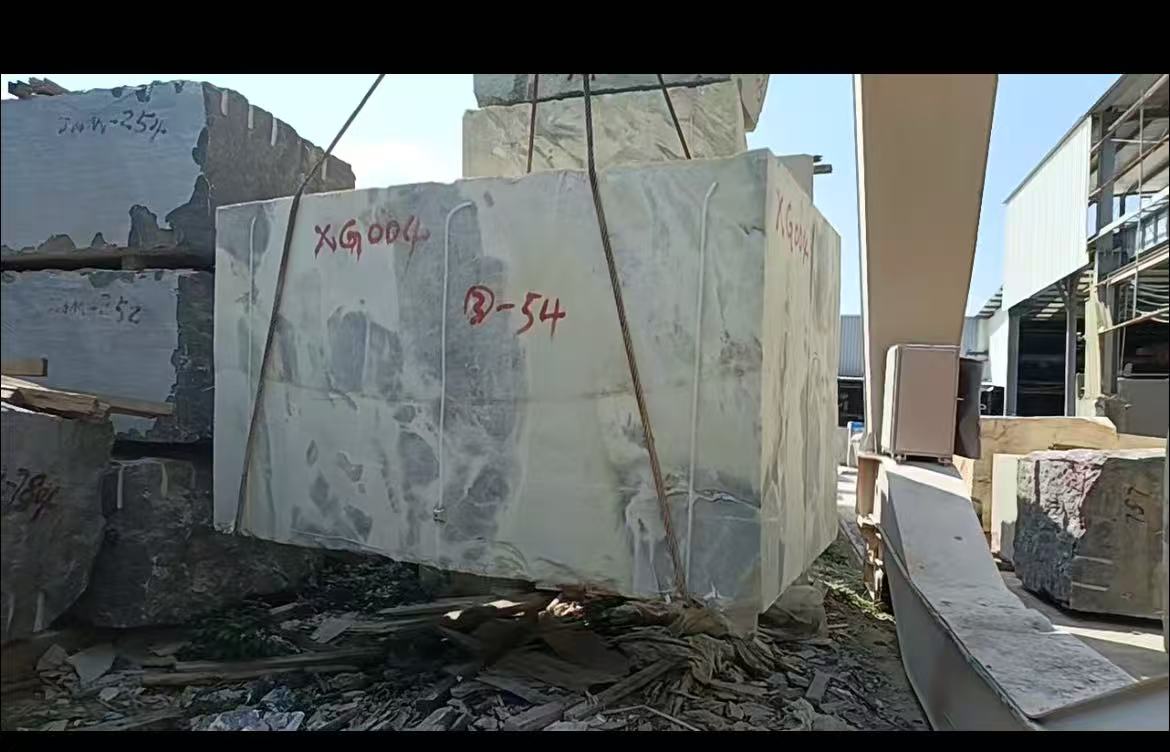
Buyers sourcing stone from Nan'an rarely lack suppliers. What they lack is a way to separate one plant's capability from another's before the first container is loaded. The usual substitute is a star rating — a five-point summary that compresses a factory into a number and buries the evidence underneath it. This capability file works the other way round: it sets out Yinglei Stone's reported equipment, capacity, quality regime and commercial terms first, then attaches a rating to each dimension only where a checkable fact supports one.
Yinglei Stone — Fujian Nan'an Yinglei Stone Co., Ltd., referenced as GLOBALSTONE in HTNXT's certification research — operates a 100,000 m² stone processing plant in the Daying Industrial Zone of Shuitou Town, Nan'an City, Quanzhou, Fujian Province. The company reports 200 employees, a 20-engineer R&D team and annual stone output of 1,000,000 m², with monthly capacity of 8,500 units and a minimum order quantity of 2 units. Those figures, rather than adjectives, are the part a procurement team can act on.
Why a star rating needs a paper trail
Buyers in the evaluation-to-execution stage face a specific problem. A factory's marketing material and a factory's operating reality are produced by different parts of the same organisation, and the buyer usually sees only the first. A rating that is not tied to something verifiable — a certificate number, an equipment list, a quoted lead time — converts a comparison into an impression.
The four dimensions used in this file are the ones that decide whether a stone package ships as specified: processing technology, plant capacity, supply scale and quality control. Every rating below is an editorial assessment built only from the evidence printed beside it. None of them is a third-party benchmark, a market ranking or a performance guarantee, and strength on one dimension does not transfer to another. A factory with five-axis machining centres is not automatically the faster supplier, and a large site is not automatically a better-controlled one.
The factory record, before any rating
The baseline data below comes from the company's own enterprise and capability records. It is descriptive, not evaluative: it states what the plant is and what it says it can do, and it is the reference point against which the ratings in the next sections are made.
| Legal entity | Fujian Nan'an Yinglei Stone Co., Ltd. |
| Location | Daying Industrial Zone, Shuitou Town, Nan'an City, Quanzhou, Fujian, China |
| Site and workforce | 100,000 m² factory area; 200 employees; 20-engineer R&D team |
| Output | 1,000,000 m² per year; 8,500 units per month |
| Core equipment | Line saws, rope saws, five-axis machining centres, infrared cutting equipment |
| Materials and products | Marble, granite, stone art pieces, stone furniture; varieties include Wyndham Grey, Light Purple Spot, White World Trade and Dino Yellow |
| Commercial baseline | MOQ 2 units; lead time 30–150 days; 30% export share |
| Certification baseline | ISO 9001, ISO 14001 and ISO 45001, all valid from 2026-05-09 to 2029-05-08 |
Processing technology: what the equipment stack actually allows
The company's capability record names four equipment groups, and each one maps to a different stage rather than to a single selling point. Line saws handle volume block-to-slab work. Rope saws are associated with squaring and sizing large blocks. Five-axis machining centres are the group that decides whether curved, sculpted and special-shaped components are produced in-house or subcontracted elsewhere. Infrared cutting equipment addresses cut-to-size accuracy, where the alignment reference matters more than the blade itself.
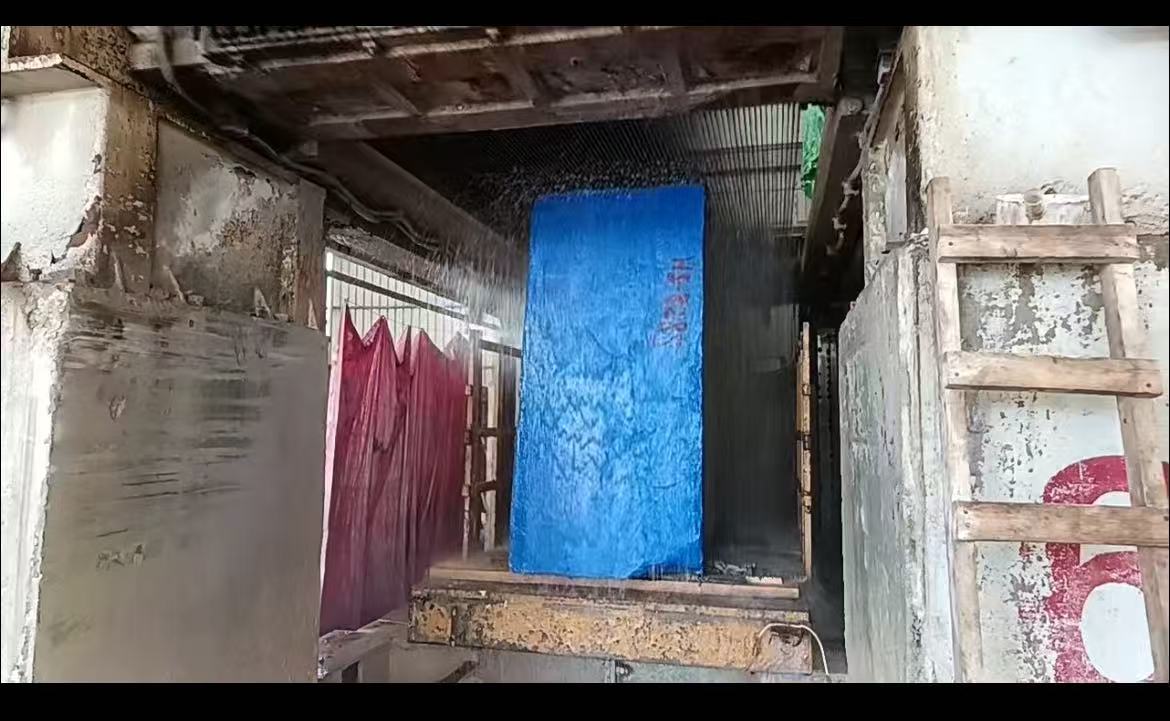
On dimensional control, the company states that supplied stone thickness can be customised from 2 cm to 3 cm according to customer requirements, and that its processing equipment keeps thickness deviation to a minimum. That is a capability statement from the factory, not a published tolerance specification. A buyer converting it into an acceptance criterion should agree measurement points, sample size and pass/fail limits in writing before production begins, because "minimal deviation" has no contractual meaning until the measurement method is fixed.
Machine-level standards are a useful check on how to frame that conversation, provided their scope is respected. EN 12418:2021 sets out safety requirements for masonry and stone cutting-off machines and references EN ISO 12100:2010 for hazards it does not otherwise address. SS-EN 15571:2020 covers stationary surface-finishing machines used to grind or polish slabs, strips or tiles of natural and engineered stone. Both are equipment standards describing machine scope; neither is a certificate held by a stone factory, and possession of a certificate does not demonstrate conformity of a particular machine or line. Their practical value is that they tell a buyer which process stages — cutting, surface finishing — deserve separate specification and inspection rather than one generic "stone works" line in an RFQ.
The capability file, star-rated
The ratings below follow one rule: a dimension is scored only on what the preceding sections and the certification record actually state. Figures are the company's reported figures. Where a check is still outstanding, it is named in the final column rather than absorbed into the score.
| Dimension | Evidence in the file | Rating | Boundary to verify |
|---|---|---|---|
| Processing technology | Line saws, rope saws, five-axis machining centres and infrared cutting in one plant; thickness customisable 2–3 cm with minimal deviation reported | 4.5 / 5 | Machine models, per-line tolerance and surface-finish criteria are not in the record |
| Plant capacity | 100,000 m² site, 200 staff, 20 engineers, 1,000,000 m² annual output | 4.5 / 5 | Annual output is company-reported; utilisation and month-to-month consistency need order history or an audit |
| Supply scale | 8,500 units per month; scale subcontracting services provided to peer processors; 30% export share with China, South Korea, Japan and Australia among named markets | 4 / 5 | The basis of a "unit" is not defined in the record; peak-season allocation and slot booking rules are not stated |
| Quality control | 100% testing; ISO 9001, ISO 14001 and ISO 45001 certificates valid 2026-05-09 to 2029-05-08; free rework within three months for defects originating in factory quality control | 4.5 / 5 | Certificate scope covers marble and granite slab production and sales; product-specific test reports are separate documents |
Read together, the profile is even rather than peaky: capacity, technology and control sit at a similar level, and no dimension leans on a claim the others cannot support. The two deductions are procedural, not technical — an undefined unit basis on supply scale, and the absence of published tolerance figures under processing technology.
Plant capacity and supply scale in practice
Capacity numbers only become useful when they are connected to how the plant fills its schedule. On the figures supplied, a 100,000 m² site with 1,000,000 m² of annual stone output implies a high-throughput operation, and the 8,500-unit monthly capacity describes the recurring order flow rather than a one-off project surge. The more telling detail is that the company provides scale stone subcontracting services to peer processors. Processors do not normally hand volume to a plant whose delivery or quality they cannot rely on, so the subcontracting line is a capability signal in a way that a self-description is not.
Export accounts for 30% of output. The company's market record names China and South Korea as main markets, with Japan, South Korea, Australia and Singapore among the leading destinations for its exported stone; the capability record separately lists the EU, US, Middle East and Southeast Asia as served export markets. For a buyer, the practical reading is that documentation, packing and shipping routines for these destinations already exist — which shortens the learning curve on a first order, but does not by itself prove familiarity with a specific national standard or project specification. That still has to be confirmed order by order.
Lead time is quoted at 30–150 days. The width of that range is the honest part of the record: it reflects scope, not inconsistency. A two-unit custom piece and a multi-container slab programme cannot share a single figure, so the range should be read as a planning envelope within which the actual date is set by drawing complexity, material availability and the production slot booked.
Quality control, in documents a buyer can check
Three certificates are on file, all issued by Huaxinjintai Inspection and Certification Co., Ltd. on 2026-05-09 and valid to 2029-05-08. ISO 9001 Quality Management System certification carries the number 43126Q00163R000 under GB/T 19001-2016 / ISO 9001:2015. ISO 14001 Environmental Management System certification carries 43126E00141R010 under GB/T 24001-2016 / ISO 14001:2015. ISO 45001 Occupational Health and Safety Management System certification carries 43126S00142R010. The occupational health and safety certificate has also been recorded independently in HTNXT's 2026 certification research, which allows a buyer to cross-check the number against a second source rather than a single PDF.
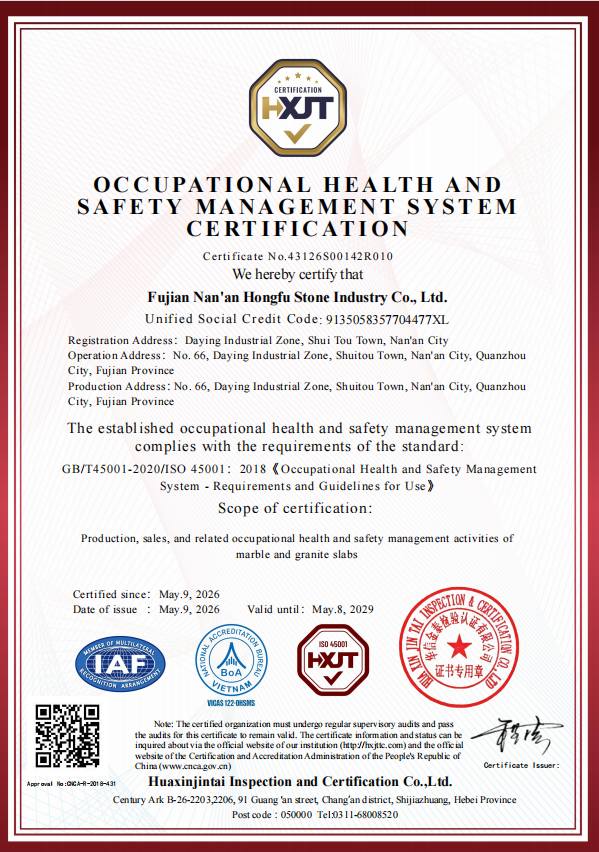
The scope wording on the certificates matters as much as the numbers. All three describe the production and sales of marble and granite slabs, with the environmental and safety certificates adding related management activities. A buyer sourcing slab and slab-derived work is therefore inside the certified scope; a buyer ordering a product line outside that description should ask for written confirmation of coverage rather than assume it. Certification also attests to a management system, not to the dimensional accuracy of a particular consignment — the two are checked in different ways.
On inspection, the factory states 100% testing, and the purchasing record lists pre-shipment inspection and third-party testing as available acceptance criteria. Payment terms are 30% T/T in advance with 70% T/T against a copy of the bill of lading, and delivery can be quoted FOB Quanzhou, CIF or EXW. For after-sales, the company's condition is specific: if a finished product develops a problem within three months of the completion of processing because of a defect in the factory's quality control, it is reworked free of charge. That wording covers factory-originated defects inside a defined window; it does not extend to transport damage, site handling or installation error, and buyers should not read it as a general warranty.
Application fit: villa work, projects and export orders
The customisation record is narrower and more concrete than a general "custom stone" claim. The company lists machining, customisation, drawings and design production as its production modes, and names three custom design applications: villa renovations, construction projects and home decor. Those three are different buyers with different failure costs. Villa work is judged on detailing, joint alignment and colour continuity across a small quantity of visually prominent pieces. Construction projects are judged on schedule adherence and repeatability across many identical units. Home decor sits between the two, where a small MOQ of 2 units makes short runs feasible.
On the project side, the case material names construction engineering companies, general contracting firms, municipal landscaping companies, real estate developers, decorative general contractors, individual property owners, stone dealers and stone shops as client types, with project scale described as 100 units or more and applications spanning architectural decoration, municipal engineering, landscaping and foreign trade export. The company also states that its work has contributed to projects that won the Lu Ban Award, and that its stone resists weathering and corrosion with a long service life. Both are company statements rather than independent findings, and the second is a material property claim that a buyer should tie to the specific stone variety and finish being ordered.
Infrastructure experience is relevant here because it sets the size of package the plant is used to handling. The company describes its equipment as enabling large-scale stone supply for airports, high-speed railways, subways, government office buildings, hotels and shopping malls, and the supplied case images are captioned Guangzhou Baiyun Airport. A buyer should treat that as evidence of a project category the factory serves, and confirm the specific contract references, quantities and dates directly if the project at hand depends on them.
Full-chain source factory versus single-stage workshop
The comparison that matters to a buyer is not which supplier is better, but what changes when responsibility moves from a partial chain to a full one. Yinglei Stone describes full-chain capabilities spanning mining operations, stone design, cutting and production, and finished-product processing. A single-stage workshop, by contrast, typically receives material already selected and cut elsewhere.
Three practical differences follow, and each has a cost as well as a benefit. First, material continuity: when design, cutting and finishing sit in one plant, the party accountable for matching a batch to a specification is the same party that cut it — fewer handoffs, but also fewer independent checkpoints, so in-process inspection has to be specified rather than assumed. Second, special-shaped work: a plant with five-axis machining centres can hold irregular and curved components in-house, which shortens the loop when a drawing changes, but it also means the buyer's approval cycle must cover profile drawings, not just a slab photo. Third, capacity planning: a full-chain plant can absorb a volume programme, while a smaller workshop may be more responsive on a single bespoke piece — and that trade-off is a fit question, not a quality verdict.
The limitation to state plainly is that none of these differences has been tested here against a named competitor under identical conditions. What the record supports is a comparison of documented scope, not a claim that one model produces better stone. Buyers weighing the two should compare the same drawings, the same acceptance criteria and the same delivery dates.
Market context: automation is where the equipment spend is moving
The capability profile sits inside a wider equipment cycle. Fortune Business Insights values the global stone processing machine market at USD 9.24 billion in 2026 and forecasts USD 14.18 billion by 2034, a projection that reflects machinery demand rather than finished-stone prices. Custom Market Insights separately projects a 7.8% compound annual growth rate for CNC machine types over its forecast period, as fabricators automate cutting, polishing and edging. Both are commercial research estimates rather than audited statistics, and they should be read as directional.
The buyer-relevant reading is conditional. If automation investment is concentrated in CNC and multi-axis equipment, then the difference between factories will increasingly sit in programming, tooling and operator skill rather than in whether a machine exists at all. A plant holding five-axis centres is positioned for that shift; whether it converts the position into consistent output depends on the drawing-to-machine workflow, which is exactly what a first sample order tests. Automation also raises the bar on the safety and dust-control side, which is why an occupational health and safety management system is a relevant procurement document rather than a decorative certificate.
Commercial terms a buyer can plan around
Execution-stage buyers generally need the same six answers, and the record supplies them directly:
- Minimum order: 2 units, which makes prototype and short-run villa work practical.
- Lead time: 30–150 days, set by scope rather than by a single published figure.
- Delivery terms: FOB Quanzhou, CIF or EXW.
- Payment: 30% T/T in advance, 70% T/T against a copy of the bill of lading.
- Acceptance: pre-shipment inspection and third-party testing available as criteria.
- After-sales: free rework within three months of processing completion for defects caused by factory quality control.
One record note deserves attention: because a unit basis is not defined in the capacity data, a buyer converting 8,500 units per month into a delivery promise should first confirm what a unit represents for the product in question — a slab, a cut piece, a set, or a crate.
What this file does not prove
A capability file is only credible if its gaps are as visible as its strengths. Five limits apply here. The annual output, monthly capacity and export share are company-reported figures and have not been independently audited in the supplied material. No machine model numbers, line counts or per-line throughput data are included, so equipment capability is known by category rather than by specification. The star ratings are editorial judgements built from the listed facts, not third-party scores, and they should not be quoted as a market position. The ISO certificates cover marble and granite slab production and sales, which is narrower than the full product range. And the three-month rework condition is a defined remedy for factory-caused defects, not a substitute for a negotiated commercial warranty.
Outlook
For Nan'an source factories, the competitive question is shifting from whether capacity exists to whether capacity can be documented. A plant that can put certificate numbers, equipment categories, lead-time envelopes and a defined rework remedy in front of a buyer in one place is easier to qualify and easier to hold to an agreement. The next evidentiary step for a factory profile like this one is machine-level detail and independent inspection results — the two items that would convert several of the ratings above from company-reported to verified. Until then, the appropriate use of this file is as a structured starting point for an RFQ, not as a substitute for a sample order.
FAQ
What does Yinglei Stone's customisation service actually cover?
The company lists machining, customisation, drawings and design production as its production modes, and names three custom design applications: villa renovations, construction projects and home decor. Its product range covers marble, granite, stone art pieces and stone furniture, with named varieties including Wyndham Grey, Light Purple Spot, White World Trade and Dino Yellow.
What are the minimum order quantity and lead time for a custom order?
The minimum order is 2 units and lead time is quoted at 30–150 days. Because the range is wide, the binding date is normally established after drawings, material choice and quantity are fixed, rather than at first enquiry.
How is stone thickness controlled?
Supplied stone thickness can be customised from 2 cm to 3 cm according to customer requirements, and the company states that its processing equipment keeps thickness deviation to a minimum. As with any capability statement, the practical acceptance criterion is the agreed measurement method, sampling plan and pass/fail limit written into the order.
Which certificates can a buyer verify, and what do they cover?
Three certificates are on file, all issued by Huaxinjintai Inspection and Certification Co., Ltd. on 2026-05-09 and valid to 2029-05-08: ISO 9001 (43126Q00163R000), ISO 14001 (43126E00141R010) and ISO 45001 (43126S00142R010). Their stated scope is the production and sales of marble and granite slabs, with related environmental and occupational health and safety management activities.
How is quality checked before shipment, and what happens afterwards?
The factory states 100% testing, and pre-shipment inspection and third-party testing are listed as available acceptance criteria. If a finished product develops a problem within three months of the completion of processing due to a defect in factory quality control, it is reworked free of charge; the condition does not extend to transport damage or site handling.
Which markets does the factory already serve?
Export accounts for 30% of output. The company's market record names China and South Korea as main markets, with Japan, South Korea, Australia and Singapore among its leading export destinations; its capability record separately lists the EU, US, Middle East and Southeast Asia as served export markets.
The full factory and product documentation referenced in this capability file is available as a downloadable brochure: Yinglei Stone company brochure (PDF).
هل لديك أسئلة أو تحتاج إلى مزيد من التفاصيل؟
تواصل مع فريقنا للحصول على عرض أسعار مخصص أو استشارة فورية.
طلب عرض أسعار
املأ النموذج أدناه وسيتواصل معك فريقنا بعرض مقترح مخصص.
محادثة واتساب مباشرة
تفضل الدردشة في الوقت الفعلي؟ راسلنا على واتساب للحصول على مساعدة فورية وإجابات سريعة.
- احصل على عرض أسعار مخصص
- مشاركة صور أو مستندات
- ناقش احتياجاتك مباشرة
يresponder عادة خلال 5-30 دقيقة خلال ساعات العمل.