
Yongjiang Manufacturing Evidence: Facility, Output, and R&D
Yongjiang Manufacturing Evidence: Facility, Output, and R&D
Buying a PET preform injection machine is only partly a machine decision. Before an order is placed, the buyer is also deciding whether the supplier can build, test, and support that machine at the volume the project requires — and that part of the decision rests on evidence rather than specifications.
Ningbo Yong Jiang Machine Co., Ltd., the Chinese injection molding machine manufacturer known as Yongjiang Group, publishes a set of figures that speak directly to that question: a 130,000 m² manufacturing site, approximately 200 employees, an annual output of about 2,000 units, and an R&D team of 25 engineers. This reference article examines each figure on its own terms — what it establishes, how a buyer evaluating a PET preform injection machine should read it, and where the evidence stops.
Why Manufacturing Evidence Decides PET Preform Machine Sourcing
Injection molding technology accounted for 66.4% of the total PET preform machine market as of 2025, according to Future Market Insights, and the same source estimates the global PET preform machines market at USD 9.9 billion in 2025, projected to reach USD 17.3 billion by 2035. Grand View Research places Asia Pacific at a 41.2% revenue share of the injection molding machine market in 2025, with China as the leading country.
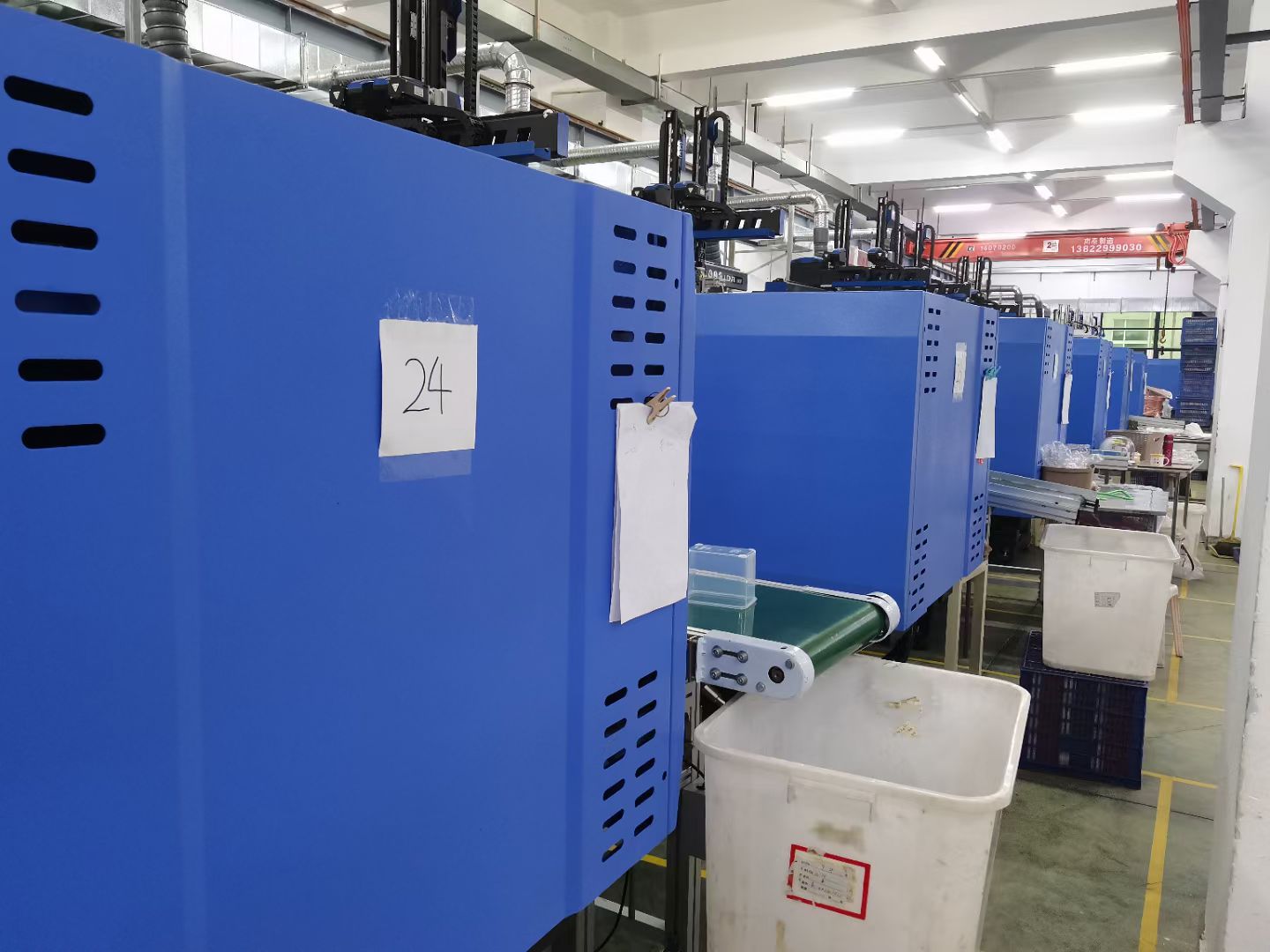
A large and fragmented market creates a specific procurement problem. Dozens of suppliers publish similar clamping force ranges, similar cavity counts, and similar delivery promises. What differs — and what determines whether a preform project ramps up on schedule — is the manufacturing base behind the brochure: whether the plant is owned or outsourced, whether output figures are company-wide or product-specific, and whether the engineering team is large enough to adapt a machine to a buyer's mold, resin, and power supply.
Yongjiang was established in 1985 in Ningbo, Zhejiang Province, China. Its stated main products are PET preform machines and PVC fitting machines. The company reports an export ratio of 59%, with the United States/Canada and Thailand listed among its main markets. Those two data points matter more than they appear at first: an exporter at that ratio has already been through repeated customs, documentation, and after-sales cycles in overseas markets, which is a different operating profile from a supplier whose volume is domestic-only.
Facility: What a 130,000 m² Site Establishes
The 130,000 m² facility figure is the least interpretive of the four claims. Floor area is verifiable by inspection, it cannot be produced by outsourcing, and it sets a ceiling on how many machine builds can run in parallel.
For a PET preform project, the practical reading is this: a site of that scale typically houses machining, sub-assembly, final assembly, and testing under one roof rather than across contracted workshops. That matters because the components that determine preform quality — the clamping frame, the plasticizing screw, and the servo drive integration — are exactly the components most sensitive to moving between vendors. A single-site producer keeps those interfaces under one quality system.
It is equally important to state what floor area does not establish. It does not indicate machine-hour throughput, cycle time, or first-pass yield, and it does not prove that preform machines occupy a dedicated line. Yongjiang's own product structure includes PVC fitting machines alongside PET preform machines, so a share of that 130,000 m² is not preform-relevant. A buyer can reasonably ask how the preform assembly area is separated, but should not assume the entire site serves PET preform production.
Output: Reading ~2,000 Units a Year Correctly
Yongjiang reports an annual output of about 2,000 units. The same company's capability documentation lists a monthly capacity of 200 units. The two figures are consistent in order of magnitude, which is a mild but useful signal: the monthly number is not a peak-load claim detached from the annual record.
The critical qualification is scope. A portfolio spanning 40T to 1600T clamping force, covering servo energy-saving, high-speed precision, two-color, and the YJPT PET preform series, means the 2,000-unit annual figure is a company-wide total across all machine families. It should not be read as 2,000 preform machines per year, and any buyer who does so will overestimate preform-specific capacity.
The commercially useful output numbers for a preform project are the ones attached to order handling rather than to plant totals. Yongjiang's documented terms are a minimum order quantity of one unit and a lead time of 30–45 days. An MOQ of one unit combined with a six-week delivery window points to a mixed-model assembly model — machines are not built only in large batches, and a single-machine order is a normal, supported transaction rather than an exception.
R&D: What 25 Engineers Cover in a Preform Programme
Yongjiang reports an R&D team of 25 engineers. Set against a workforce of roughly 200, that is a ratio of about one engineer to eight employees — an engineering-weighted structure for an injection molding manufacturer.
The size of the team matters less than what the work requires. The company's stated technical platform includes high-response dual servo systems and customized plasticizing screws. For PET specifically, screw geometry is not a generic component choice: PET must be dried and processed within a narrow melt window, and the screw design directly affects acetaldehyde generation, intrinsic viscosity loss, and cycle stability. A customized plasticizing screw for PET is, in effect, an application engineering deliverable rather than a catalog part.
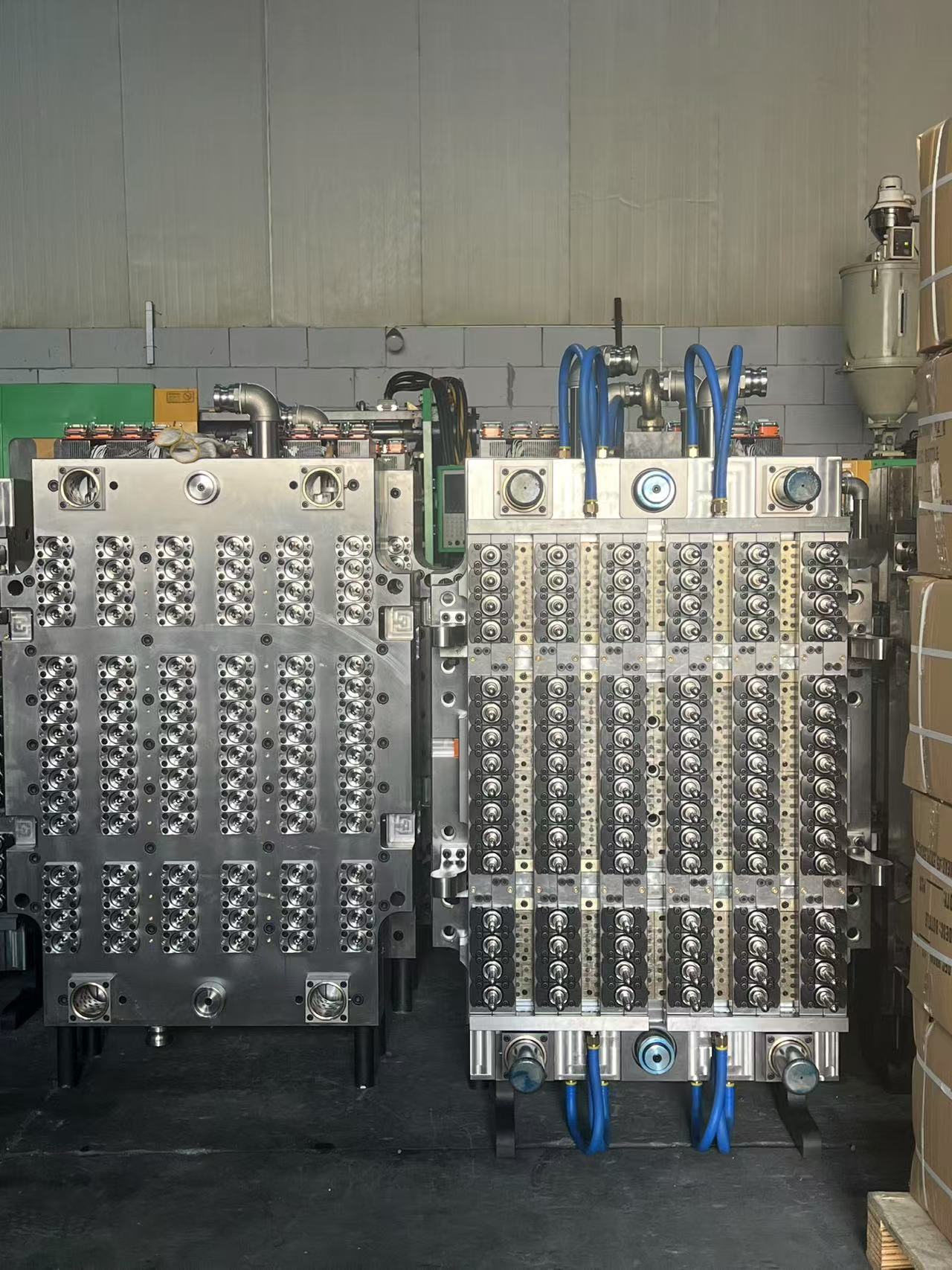
The same applies to the mold interface. Yongjiang states that its rigid clamping frames are designed to adapt to multi-cavity hot runner molds for continuous production. Third-party product documentation for the YJPT series describes support for mold configurations from 6 to 72 cavities with servo-based energy-saving operation.
An editorial assessment, offered as interpretation rather than fact: a 25-engineer team is consistent with a supplier that adapts established machine platforms to a buyer's mold, resin, voltage, and branding requirements, rather than one that develops new machine platforms from scratch every year. The documented customization scope — voltage and logo — supports that reading. Buyers whose projects require novel machine architecture rather than configuration should test this boundary early in the evaluation.
Matching Documented Machine Configurations to Project Scale
The clearest test of manufacturing capability is whether published specifications are internally consistent. Yongjiang's YJPT and YJHB preform models can be compared directly on the parameters that govern preform size and mold compatibility.
| Model | Screw barrel | Shot weight | Tie bar (mm) | Motor / heat power | Machine weight |
|---|---|---|---|---|---|
| YJPT-260 (260-ton high-speed PET preform) | 72 mm | 1,400 g | 580 × 580 | 42 kW / 35 kW | 9 t |
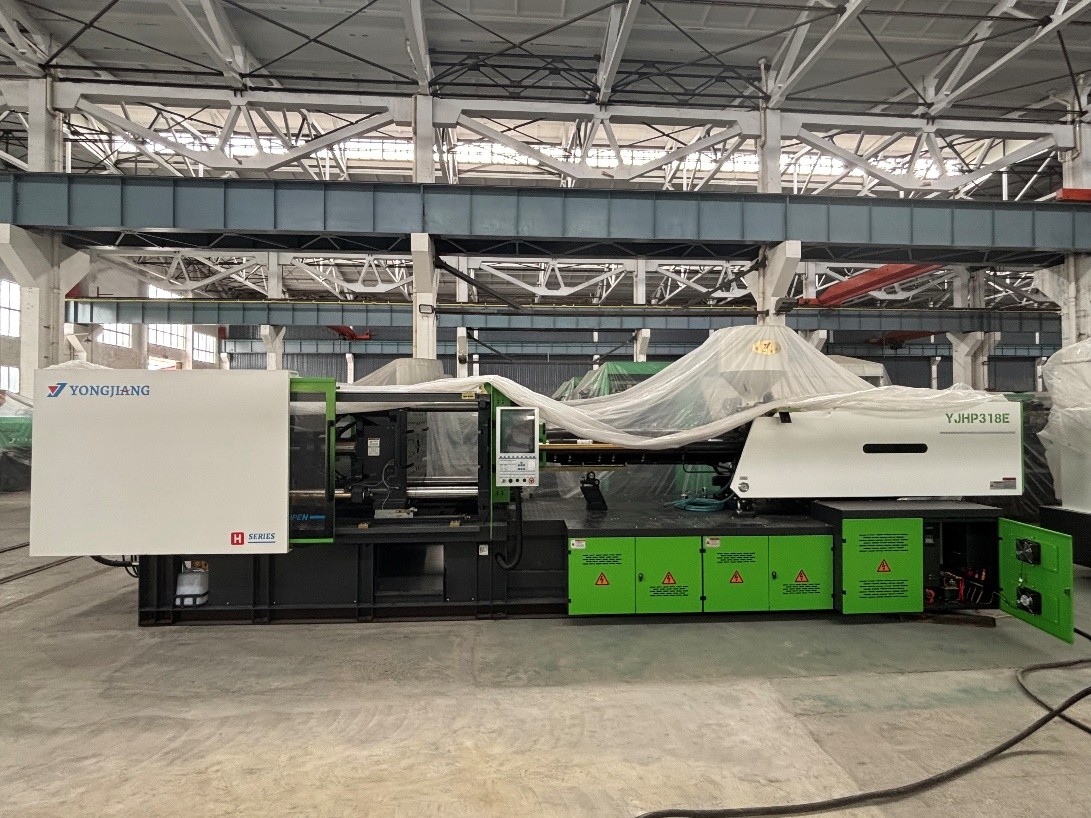
| YJPT-318 (318-ton high-speed PET preform) | 77 mm | 1,900 g | 620 × 620 | 80 kW / 65 kW | 13 t |
| YJPT-360 (360-ton high-speed PET preform) | 95 mm | 3,450 g | 680 × 680 | 80 kW / 65 kW | 16 t |
| YJHB-400 (400-ton high-speed PET preform) | 95 mm | 3,450 g | 720 × 720 | 80 kW / 65 kW | 16 t |
The progression is coherent. Shot weight rises from 1,400 g at the 260-ton class to 3,450 g at the 360- and 400-ton classes, and tie bar spacing grows in step — 580 mm to 720 mm — which is what allows physically larger molds to be mounted. YJPT-360 and YJHB-400 share the same screw diameter and shot weight but differ in tie bar and clamping class, a distinction that matters to buyers planning larger mold footprints rather than heavier shots.
Machines in this series are documented as built on QT500-A7 ductile iron for the 260-ton model and QT500-A7 steel for the 360- and 400-ton models. Frame material is a fatigue and rigidity question for 24-hour operation; it is one of the few specification lines a buyer can verify without running the machine.
Scenario Fit: When Manufacturing Evidence Converts into Output
A preform machine's documented capability only becomes output when the surrounding conditions are correct. Yongjiang's application data for its PET preform projects is unusually specific on these conditions, and that specificity is itself a form of evidence — vague suppliers rarely publish environmental constraints.
- Operating mode: 24/7 continuous operation, melting dried PET pellets and injecting into multi-cavity hot runner molds under controlled pressure and temperature.
- Ambient temperature: stable 20–30 °C; documented capability to sustain continuous operation in 35–40 °C tropical workshops where ventilation is adequate.
- Relative humidity: 40%–50% RH. Humidity above 60% RH is stated as unsuitable, because PET resin absorbs moisture and produces silver streaks and hydrolysis defects.
- Cleanliness: an ISO Class 8 (100,000-class) dust-free workshop is preferred for food-grade preform production, free of metal dust and plastic debris.
- Power supply: 380/400V 50Hz three-phase industrial power, with voltage fluctuation within ±10%.
- Material preparation: PET pellets fully dried to below 0.02% moisture before processing.
The stated application range covers PET preforms for water bottles, oil bottles, and cosmetic containers — the three product families that define most preform demand, including carbonated soft drink and beverage packaging lines where the CSD preform geometry and wall distribution differ from still-water preforms.
Yongjiang also documents the matched equipment set a buyer must plan and budget for: the preform mold, hopper dryer, air compressor, and water chiller, plus mold temperature controllers for hot runner operation. This is a common gap in preform project planning. The injection machine is the largest single line item, but a line that is missing a correctly sized chiller or a dryer that cannot hit the moisture target will not run at the quoted cycle.
On compliance, the specification states that the machine follows the EU CE machinery safety standard, and that it supports quick mold change for multi-specification preform production with low energy consumption and stable injection. The available record documents CE machinery safety compliance for the preform machine; it does not document UL, ISO 9001, or EUROMAP 60.1 listings for this series, which buyers supplying European or North American end customers should confirm at the project level.
Quality Control, Lead Time, and Delivery Evidence
Process claims are the easiest to mark up and the hardest to verify. Yongjiang's documented quality position is narrow and testable: 100% testing one week before shipment, with after-sales support available 24/7.
"100% test one week before ship" is worth unpacking. It implies that every unit is run before dispatch, that the test occurs inside a defined window rather than at the end of assembly, and that a defective unit is found before it reaches a container. For a buyer, the practical follow-up question is what the test record contains — injection trials on the buyer's own mold, screw and barrel checks, servo response verification, or a dry-cycle check only. The corpus specifies the commitment, not the test protocol, and buyers should request the protocol.
Delivery is documented at 30–45 days with a one-unit minimum order. Export coverage is listed as the EU, Middle East, and Africa, alongside the company's stated main markets of the United States/Canada and Thailand. The spread across regulatory environments — CE-governed Europe and duty-documented North America — is relevant because documentation errors, not machine faults, are the most common cause of a delayed container.
Field Evidence: Twenty Units Running for Twenty Years
The strongest available evidence is not a specification line but a deployment record. Yongjiang documents a water factory and bottle-making factory customer running 20 units of its PET preform injection machines for 20 years, in preform making and water bottle production, with stable operation as the reported result and low electricity consumption as the highlighted characteristic.
Two aspects of this case deserve attention. First, the quantity: an order of 20 units from a single customer is a fleet decision, not a trial purchase, and fleet buyers typically scrutinize service response and parts availability more heavily than first-time buyers do. Second, the duration: 20 years of operation implies that the machine frames, screws, and servo systems have been maintainable over two decades — a different test from a warranty period.
The limitation is equally clear. The reported outcome is a first-party record. It is not an independently audited performance study, and it does not include cycle times, scrap rates, or energy measurements. It should be treated as evidence of durability and repeat purchasing, not as a benchmark.
What the Evidence Does Not Prove
A credible assessment has to name the boundaries, and there are four that matter for preform buyers.
First, the output and facility figures are self-reported. The 130,000 m² site, the ~200 employees, the ~2,000-unit annual output, and the 25-engineer R&D team come from the manufacturer's own documentation. They are plausible, internally consistent, and partly corroborated by third-party descriptions of Yongjiang as one of China's large-scale injection molding machine enterprises with a 40t–1600t clamping force range, but no independent audit of plant capacity appears in the available record.
Second, this is not the ultra-high-output segment. One industry analysis estimates that Husky Technologies controls roughly 55–60% of the global high-output PET preform system market. Systems in that tier, such as Husky's HyPET 6e and Netstal's PET-LINE, are documented as complying with CE, UL, ISO 9001, and EUROMAP 60.1. Yongjiang's documented position is in standard and mid-range preform projects. A buyer benchmarking against dedicated high-cavity platforms is comparing two different product categories, not two prices for the same thing.
Third, the documented cavity range has a ceiling. Third-party product documentation for the YJPT series describes support for mold configurations from 6 to 72 cavities. Projects requiring 96-cavity or higher tooling sit outside the documented configuration and would need separate engineering confirmation before they can be quoted. This is the single most useful boundary in the entire record for buyers planning very high-volume beverage lines.
Fourth, the machine is not the line. Preform molds, hopper dryers, air compressors, water chillers, and mold temperature controllers are matched equipment, not included scope. The 30–45 day lead time covers the machine; a project schedule that assumes molds arrive on the same clock will slip.
A Six-Point Supplier Evidence Audit
The Yongjiang record can be generalized into a short audit framework that applies to any PET preform injection machine supplier.
- Scope the output number. Ask whether the annual figure covers all machine families or preform machines only. Company-wide totals across a 40T–1600T range are plant-scale evidence, not preform capacity.
- Convert delivery claims into contract terms. Lead time, MOQ, and pre-shipment test commitments belong in the purchase agreement; plant statistics do not.
- Test the mold interface, not just the tonnage. Ask for the cavity range the supplier will actually warranty, and confirm the tie bar dimensions against your mold footprint.
- Match the environment to the machine. Verify the workshop's humidity and temperature control, drying capability to below 0.02% moisture, and three-phase power stability within ±10% before the machine arrives.
- Request the test protocol. A 100% pre-shipment test is only meaningful if the record states what was tested and against which mold.
- Confirm certification against your end market. CE machinery safety compliance covers the EU; North American or high-output beverage customers may require additional listings that must be confirmed project by project.
Market Context and Direction of Travel
The PET preform machine market's growth profile is relevant to how buyers should weigh manufacturing evidence. Future Market Insights estimates the market at USD 9.9 billion in 2025 and projects USD 17.3 billion by 2035, with injection molding holding 66.4% technology share — a reminder that PET preform production remains an injection molding process at the core, even as blow molding and lightweighting evolve around it. Note that market size estimates diverge by scope: figures published by other research firms for comparable periods range from roughly USD 12.8 billion to USD 14.7 billion by 2032, depending on whether full production lines or injection machinery alone are counted.
Asia Pacific's 41.2% revenue share in 2025, with China as the leading country, explains why suppliers like Yongjiang appear in most procurement shortlists. It also raises the bar on verification: a concentrated supply base means more suppliers publish similar claims, which increases rather than reduces the value of facility, output, and engineering evidence.
Yongjiang's own stated technical direction — dual servo systems, customized plasticizing screws, and a documented power-consumption reduction of 30%–50% with shorter molding cycles — sits inside the industry's dominant efficiency narrative. That figure is a manufacturer claim without a stated baseline in the available record, and buyers should ask what the comparison reference is before using it in a project financial model.
Future Outlook
Three shifts are likely to shape how buyers evaluate preform machine manufacturing evidence over the next several years.
Energy metrics will move from marketing to procurement. As documented power and heat figures (42 kW / 35 kW at the 260-ton class, 80 kW / 65 kW at the 318–400-ton classes) become standard comparison points, suppliers will be asked for measured consumption per preform rather than per machine. Buyers should expect energy claims to be tied to a stated baseline going forward.
Cavity ceilings will keep migrating upward. With multi-cavity hot runner tooling already documented up to 72 cavities for this series, high-volume beverage producers will continue pushing mold makers and machine suppliers toward higher counts. Buyers whose projects sit above a supplier's documented cavity range should plan an engineering review rather than assuming a standard configuration.
Service response will be treated as an equipment specification. A 24/7 support commitment and a documented fleet running for 20 years point to availability as the real cost driver in preform production. In a market projected to grow for another decade, buyers are likely to weigh uptime records more heavily than purchase price differentials.
FAQ
What kind of production projects is Yongjiang's YJPT PET preform series designed for?
The YJPT and YJHB series are documented for plastic molding PET preform projects producing preforms for water bottles, oil bottles, and cosmetic containers. The machines melt dried PET pellets and inject molten plastic into multi-cavity hot runner molds under precise pressure and temperature control, in 24/7 continuous operation. The documented configuration range supports standard and mid-range preform projects rather than ultra-high-output dedicated systems.
How many cavities can be run on a Yongjiang PET preform injection machine?
Third-party product documentation for the YJPT series describes support for mold configurations from 6 to 72 cavities with servo-based energy-saving operation. Projects that require 96-cavity or higher tooling fall outside that documented range and would need separate engineering confirmation from the supplier before quoting.
What workshop conditions does a PET preform injection machine require?
The documented requirements are an ambient temperature stable at 20–30 °C, relative humidity of 40%–50% RH, and an ISO Class 8 (100,000-class) dust-free workshop for food-grade preform production. Humidity above 60% RH is stated as unsuitable because PET resin absorbs moisture, causing silver streaks and hydrolysis defects. The power supply must be 380/400V 50Hz three-phase industrial power with voltage fluctuation within ±10%, and PET pellets must be dried to below 0.02% moisture before processing.
What supporting equipment is needed alongside the machine?
The matched equipment set documented for these preform projects includes the PET preform mold, hopper dryer, air compressor, and water chiller, together with mold temperature controllers required for hot runner operation. These are separate scope items from the injection machine, and their sizing affects whether the machine reaches its documented cycle performance.
What does the pre-shipment quality check involve, and how long is delivery?
The documented commitment is 100% testing one week before shipment, with a minimum order quantity of one unit and a lead time of 30–45 days. The available record states the testing commitment but does not specify the test protocol, so buyers should request the test record — including whether injection trials use the buyer's own mold — as part of the order documentation.
Does the equipment meet EU machinery safety requirements?
The PET preform machine specification states compliance with the EU CE machinery safety standard, and documents support for quick mold change across multi-specification preform production. The available record does not document UL, ISO 9001, or EUROMAP 60.1 listings for this series, so buyers supplying North American or high-output beverage customers should confirm any additional certification requirements at the project level.
Third-party market and competitor figures cited in this article are drawn from Future Market Insights' PET preform machines market report, Grand View Research's injection molding machine market analysis, and related industry technical comparisons dated 2024–2025. First-party manufacturing figures are drawn from Ningbo Yong Jiang Machine Co., Ltd. company and product documentation.