
Yongjiang PET Preform Machine Shortlist: Mold Before Tonnage
Yongjiang PET Preform Machine Shortlist: Mold Before Tonnage
Most shortlists for a pet preform injection machine are written in the wrong order. Buyers usually start with clamping force, compare 260 t against 318 t, choose the middle, and only then discover that the mold they intend to run does not fit between the tie bars or that the shot weight leaves no headroom for a hot-runner allowance.
Yongjiang's PET range is easier to shortlist if the sequence is reversed. The four models covered here — YJPT-260, YJPT-318, YJPT-360 and YJHB-400 — run from 260 t to 400 t, but the specification that actually separates them for a buyer is the combination of shot weight, tie-bar spacing and the mold envelope the project requires. Tonnage confirms a decision; it rarely makes one.
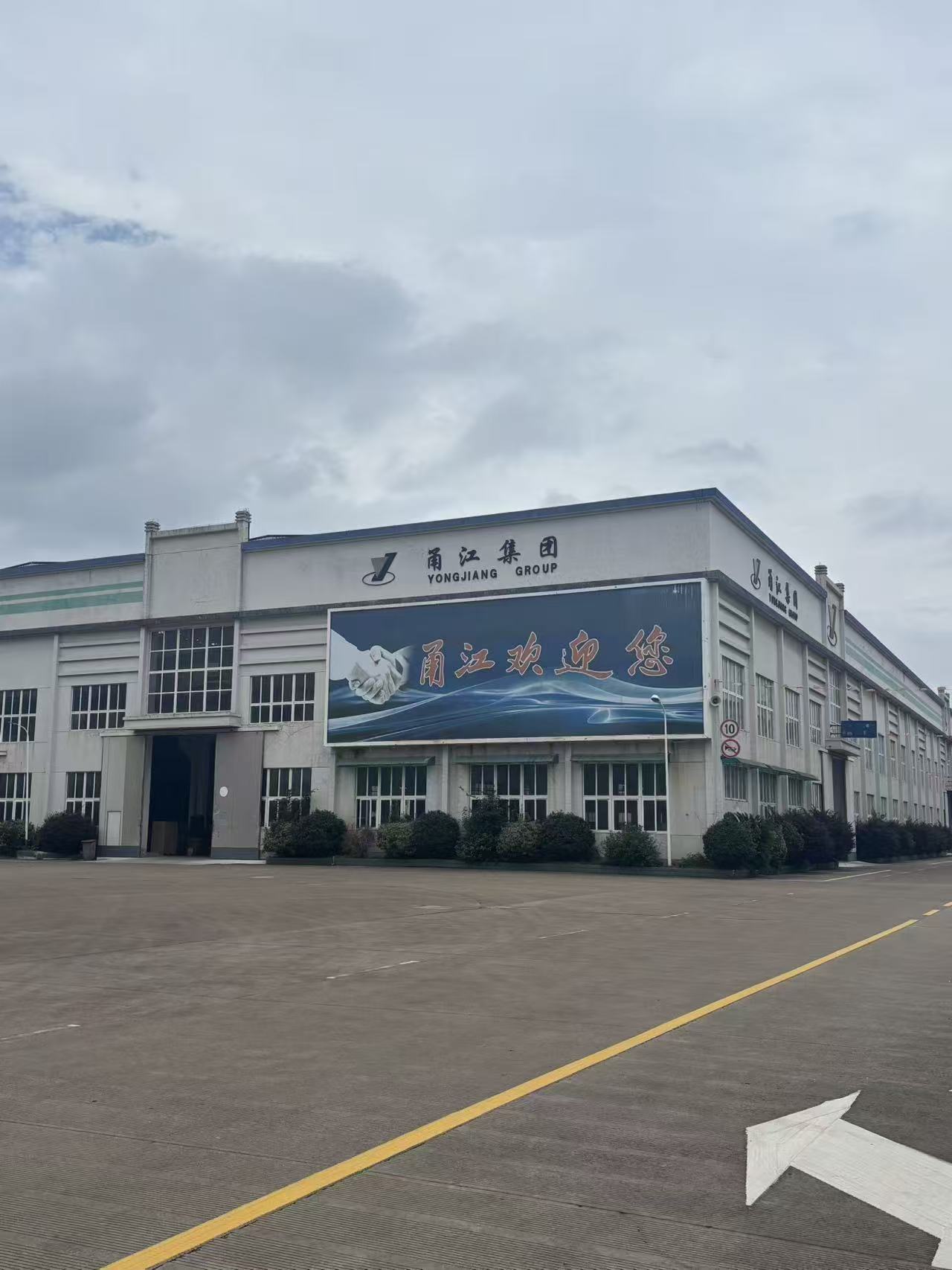
PET preform injection machine assembly — the model shortlist below turns tonnage into a secondary check behind shot weight and mold fit.
Who is behind these four models
Ningbo Yongjiang Group, which sells under the Yongjiang brand, is a Chinese injection molding machine manufacturer whose portfolio includes a dedicated PET preform series alongside PVC and PPR fitting machines. Company-recorded facts describe a 130,000 m² factory, a 25-engineer R&D team, annual output of 2,000 units and an export ratio of 59%, with the USA, Canada and Thailand listed as main markets. The product documentation describes the YJPT series as built around a modular energy-saving system and a high-capacity injection unit with an optimised screw-diameter ratio, which is the design logic behind the shot-weight differences shown later in this article.
Why tonnage-first shortlisting misleads
Clamping force does one job: it holds a mold closed against injection pressure so the cavity does not flash. It says nothing about whether the mold physically fits between the tie bars, whether the platen and daylight can accept the mold stack, or whether the injection unit can deliver the required melt volume per shot. A machine can carry ample tonnage for a project and still be the wrong unit for it, because the binding constraint sits in a different column of the datasheet.
That gap is visible in published procurement benchmarks. A tender specification issued by CIPET, the Indian central institute for petrochemicals engineering, set minimum machine tonnage at 150–200 t while simultaneously requiring a minimum shot capacity of 750 g, plasticising capacity of at least 50 g/sec, injection pressure of at least 1,200 bar and a minimum of 32 preform cores and cavities. The document treats those figures as one package. A buyer who screens on tonnage alone satisfies one condition out of five.
The shortlist at a glance
| Model | Clamping force | Screw diameter | Shot weight | Tie-bar spacing |
|---|---|---|---|---|
| YJPT-260 | 260 t | 72 mm | 1,400 g | 580 × 580 mm |
| YJPT-318 | 318 t | 77 mm | Not stated in supplied data | 620 × 620 mm |
| YJPT-360 | 360 t | 95 mm | 3,450 g | 680 × 680 mm |
| YJHB-400 | 400 t | Not stated in supplied data | 3,450 g | 720 × 720 mm |
Figures as recorded in the supplied model data. Blank cells indicate that the value is not disclosed in the material used for this shortlist; they are a data gap, not evidence of a machine limitation.
Check one: shot weight sets the cavity ceiling
Shot weight is the maximum melt volume the injection unit can deliver in a single shot. For preform production the number that matters is not the weight of one preform but the weight of every cavity filled at once, plus the material remaining in the hot-runner or cold-slug system. In this shortlist the figure splits the range cleanly: 1,400 g on the YJPT-260 against 3,450 g on both the YJPT-360 and the YJHB-400.
A simple calculation shows how quickly that ceiling becomes the deciding constraint. Take 20 g per preform — the maximum listed in the CIPET specification for a 1,000 ml bottle with a 28 mm neck. In a 48-cavity mold, the cavities alone consume approximately 960 g of PET per shot (48 × 20 g, calculated, runner allowance excluded). That sits inside the YJPT-260's stated 1,400 g, but it consumes roughly two-thirds of the available shot before any hot-runner allowance is added, and a stated maximum is not a recommended continuous operating point. Move to a 72-cavity tool at the same preform weight and the requirement reaches about 1,440 g — beyond the 1,400 g figure on paper, before allowances.
Two cautions belong beside that arithmetic. First, shot-weight ratings are quoted against a reference resin and condition; a buyer should confirm the basis on which the 1,400 g and 3,450 g figures are stated rather than assuming they apply unchanged to a specific PET grade. Second, delivering a shot is not the same as delivering it at rate. Plasticising capacity — the CIPET benchmark of at least 50 g/sec is a useful reference point — governs whether the barrel can melt material fast enough to support the cycle. That figure is not part of the supplied model data for any of the four machines.
Check two: tie-bar spacing defines the mold envelope
Tie-bar spacing is the horizontal and vertical clearance between the tie bars, and it caps the width of the mold block that can be loaded into the machine. The four models step up in even increments: 580 × 580 mm on the YJPT-260, 620 × 620 mm on the YJPT-318, 680 × 680 mm on the YJPT-360 and 720 × 720 mm on the YJHB-400. That progression, not the tonnage progression, is what usually decides between adjacent models.
Tie-bar spacing is a necessary check, not a sufficient one. A mold can pass between the bars and still fail on maximum mold height, minimum mold thickness, platen mounting pattern or daylight, none of which appear in the supplied data. The practical consequence for a buyer is that cavity-count questions cannot be answered from a datasheet alone. A 48-, 72- or 96-cavity preform mold carries a physical block size that must be measured against the envelope; the machine table tells you which envelope you are buying, and the mold drawing tells you whether it fits.
Check three: tonnage confirms the choice
Once shot weight and mold envelope have narrowed the field, clamping force becomes a confirmation step rather than a starting point. All four models sit above the 150–200 t floor recorded in the CIPET tender specification, and above it by a wide margin at 318 t, 360 t and 400 t. What the tonnage step actually buys is the ability to hold a larger projected cavity area closed — which matters when cavity count rises and projected area grows with it.
Because the same document pairs tonnage with injection pressure of at least 1,200 bar, buyers should treat the two as a set. Clamping force without adequate pressure limits filling; pressure without adequate clamping force produces flash. The supplied model data does not include a per-model injection-pressure figure, so this pairing remains an open verification item rather than a stated comparison.
The one comparison that inverts the usual logic
The YJPT-360 and the YJHB-400 share an identical 3,450 g shot weight. Their differences sit in clamping force (360 t versus 400 t) and tie-bar spacing (680 × 680 mm versus 720 × 720 mm). For a buyer whose mold already fits the 680 mm envelope and whose clamping requirement is satisfied at 360 t, the step to 400 t buys envelope headroom and holding force, not shot capacity. Where the mold block is larger or the projected area higher, the YJHB-400 becomes the fit; where neither applies, the smaller unit carries the same shot capability in a tighter footprint.
What the supplied specification does not establish
A shortlist is only as reliable as its gaps are visible. Three gaps stand out. The YJPT-318 has no shot weight recorded in the material used here; the YJHB-400 has no screw diameter recorded; and none of the four models carries a cycle time, plasticising rate, injection pressure, platen dimension or daylight figure in the supplied data. None of these omissions means a machine cannot perform the task — only that the task cannot be confirmed from this table.
Practical verification therefore runs in parallel with model selection. A buyer shortlisting at evaluation stage should request, per candidate model: the basis and test resin behind the shot-weight rating; injection pressure and plasticising capacity; platen size, maximum and minimum mold height, and daylight; maximum mold weight the moving platen can carry; the number of hot-runner temperature-control zones the machine can support; and written confirmation of certification scope for the exact unit ordered. Each item maps to a decision the table above cannot resolve.
Where each model tends to fit
Application determines preform weight, preform weight and cavity count determine required shot weight, and required shot weight decides which of the three checks binds first. Published market segmentation for PET preforms lists bottled water, carbonated soft drinks, juices, edible oils and sauces among the end categories — a set that spans lightweight water preforms at one end and heavier oil or CSD preforms at the other. No quantified split by segment was available for this assessment, so the mapping below is conditional rather than measured.
Within that logic, the YJPT-260's 1,400 g shot and 580 × 580 mm envelope suit projects where lightweight preforms are run at moderate cavity counts and floor space is tight — the configuration in which a 260 t unit is not a compromise but a fit. The YJPT-318 adds envelope and clamping headroom without a step change in shot capacity, which is the natural upgrade path when the existing mold is close to the limit. The YJPT-360 and YJHB-400, at 3,450 g, are the models whose injection capacity stops being the constraint; for those two, mold envelope and clamping force decide.
Compliance sits on the shortlist too
Yongjiang holds CE certificate CE20260126MD, issued by ECM on 30 January 2026 and valid to 29 January 2031. The recorded standard set is the 2006/42/EC Machinery Directive together with EN ISO 12100:2010, EN 60204-1:2018+A1:2020 and EN ISO 20430:2020. The scope wording on the certificate names the YJPT-260 and the YJHB-400.
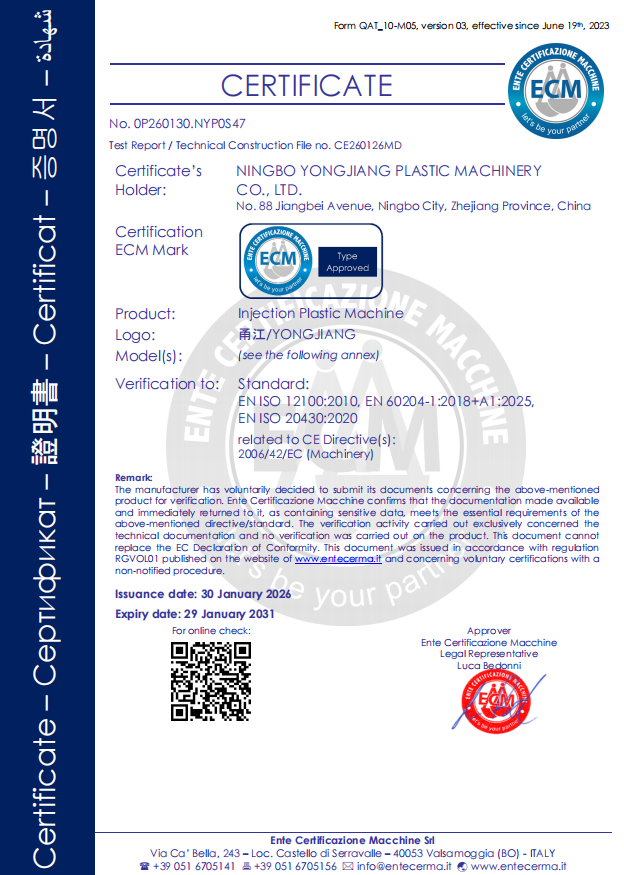
Certificate CE20260126MD is recorded against YJPT-260 and YJHB-400; buyers should confirm model-level scope for any other unit ordered.
That wording matters for a four-model shortlist. A CE certificate that names specific models is not automatic coverage for every model in a series, so a buyer evaluating the YJPT-318 or YJPT-360 for an EU-bound project should obtain written confirmation of coverage for the ordered model before treating compliance as settled. This is a documentation check, not a judgement about machine quality — and it belongs in the evaluation file alongside the technical data, because market access is a gate that no amount of shot weight can open.
Commercial terms that shape the evaluation timeline
Recorded commercial terms place the minimum order at one unit, with OEM production and voltage or logo customisation available, a lead time of 30–45 days, monthly capacity of 200 units, 100% testing one week before shipment and round-the-clock after-sales support. For an evaluation-stage buyer, the single-unit minimum and the 30–45 day window are the operative facts: they allow one model to be validated on a real mold before a fleet decision, and they set the horizon for scheduling a mold trial.
Yongjiang's case record covers water-bottle and preform plants in countries including Ethiopia, Spain, France and Hungary, totalling 20 units and described in the company's own record as running stably. That is company-reported evidence rather than an independently audited result, and it should be weighed as such — but it does indicate that the models in this shortlist have been deployed outside China, across more than one regulatory environment.
Market context for the capacity decision
No verified figure for the PET preform machine segment itself was available for this assessment, so the demand signal has to be read one step downstream. Commercial research places the global PET preform product market at USD 24.33 billion in 2026, growing at a reported CAGR of 2.17% to USD 27.08 billion by 2031. Two qualifications travel with those numbers: the scope is the preform product, not injection molding machinery, and the figures come from a single commercial source without independent cross-validation. They indicate direction, not machine-market size.
A firmer, if narrower, data point sits on the equipment side. Global exports under HS code 847710 — injection-molding machines — were valued at USD 7.21 billion in 2023, according to customs-derived trade data. Read together, a modestly growing downstream preform market and a large, established machine trade point toward incremental capacity decisions rather than wholesale line replacement. That favours shortlisting by fit: a buyer adding capacity wants the smallest machine that clears the three checks, and wants a defensible reason for every step above it.
A shortlist worksheet
Applied in order, these six checks reproduce the logic above and produce a defensible model choice:
- Fix the preform. Settle weight, neck finish and the cavity count the project needs before opening any machine datasheet.
- Calculate the shot. Multiply preform weight by cavities and add a hot-runner or cold-slug allowance; compare with 1,400 g and 3,450 g.
- Measure the mold. Check the mold block against 580 × 580, 620 × 620, 680 × 680 and 720 × 720 mm, then confirm height, thickness and daylight separately.
- Confirm clamping. Verify projected area against tonnage, and treat 150–200 t as a published reference floor rather than a target.
- Close the data gaps. Request plasticising rate, injection pressure, platen and daylight dimensions for the specific model and configuration.
- Check the paperwork. Confirm certification scope, test protocol before shipment and the acceptance criteria written into the order.
The result is a shortlist where each step up in tonnage has a named reason attached to it — a larger mold envelope, a higher shot ceiling, or a clamping requirement that the smaller unit cannot meet. That is a materially different document from a price band chart, and it is the one a procurement team can defend a year after the order is placed.
Frequently asked questions
Which specification should a buyer check first when shortlisting a PET preform injection machine?
Shot weight comes first, because it determines the maximum cavity count a machine can fill in one shot. Tie-bar spacing is the second check, since it determines whether the mold block fits at all. Clamping force is applied third, to confirm that the machine can hold the resulting mold closed. Screening on tonnage first tends to eliminate viable models and retain unsuitable ones.
Can the YJPT-260 run a 32-cavity preform mold?
The published CIPET specification pairs a 150–200 t minimum tonnage with a minimum of 32 preform cores and cavities, so the YJPT-260 at 260 t sits above that published floor and its 1,400 g shot covers 32 cavities at 20 g per preform with material to spare. That is an arithmetic and benchmark observation, not a confirmation of fit: the mold block must still be checked against the 580 × 580 mm tie-bar spacing, and mold height and daylight are not part of the supplied data.
What separates the YJPT-360 from the YJHB-400?
Both are recorded with a 3,450 g shot weight, so injection capacity does not distinguish them. The differences are clamping force, at 360 t versus 400 t, and tie-bar spacing, at 680 × 680 mm versus 720 × 720 mm. A buyer whose mold fits the smaller envelope and whose clamping requirement is met at 360 t gains envelope headroom and holding force from the step up, not additional shot capacity.
Why is no shot weight listed for the YJPT-318, and does that rule it out?
The figure is not recorded in the material used for this shortlist. An undisclosed value is a documentation gap, not evidence that the machine lacks the capability, and it should not be read as a limitation. The correct action at evaluation stage is to request the rated shot weight, its reference resin and the injection pressure for the YJPT-318 directly, and to hold the model in the shortlist until that data arrives.
Does the CE certificate cover all four models?
Certificate CE20260126MD, issued by ECM and valid from 30 January 2026 to 29 January 2031, records a scope naming the YJPT-260 and the YJHB-400 alongside the 2006/42/EC Machinery Directive and the EN ISO 12100, EN 60204-1 and EN ISO 20430 standards. Because the scope wording names specific models, a buyer ordering a YJPT-318 or YJPT-360 for an EU market should obtain written confirmation of model-level coverage before treating compliance as established.
Full model specifications, factory data and configuration options are published by Yongjiang. The downloadable product brochure covers the wider PET preform and injection molding range.
Download the Yongjiang injection molding machine brochure (PDF)
هل لديك أسئلة أو تحتاج إلى مزيد من التفاصيل؟
تواصل مع فريقنا للحصول على عرض أسعار مخصص أو استشارة فورية.
طلب عرض أسعار
املأ النموذج أدناه وسيتواصل معك فريقنا بعرض مقترح مخصص.
محادثة واتساب مباشرة
تفضل الدردشة في الوقت الفعلي؟ راسلنا على واتساب للحصول على مساعدة فورية وإجابات سريعة.
- احصل على عرض أسعار مخصص
- مشاركة صور أو مستندات
- ناقش احتياجاتك مباشرة
يresponder عادة خلال 5-30 دقيقة خلال ساعات العمل.