
Your Sourcing FAQ: MOQs, Lead Times, and Safety Standards for Electric Shavers
An electric shaver order becomes plannable at the moment five figures are known: minimum order quantity, production lead time, monthly capacity, payment split, and the acceptance test that releases the balance. Everything a buyer does between evaluation and execution — launch dates, cash-flow planning, reorder points, freight booking — rests on those numbers being stated rather than assumed.
This reference answers those questions using documented program terms from Ningbo Jinmi Electrical Appliance Technology Co., Ltd., a personal-care appliance manufacturer based in Ningbo, Zhejiang, China, which operates OEM and ODM production for electric shavers, hair clippers and nose hair trimmers and states the EU and the Middle East as its OEM/ODM export markets. Every figure below is a stated program parameter, not an estimate or an industry average.

Why Order Terms Are Procurement Data, Not Sales Paperwork
A specification sheet describes what a shaver is. An order framework describes when you receive it, how much capital is committed before it ships, and what evidence proves the batch is conformant. Buyers who evaluate only product parameters and defer MOQ, lead time, payment split and acceptance criteria to the final negotiation round usually discover the real constraint after the launch date is already fixed.
The practical implication is straightforward: the four or five figures that govern a program should be collected at the same time as samples, and carried into the internal approval document unchanged. A quote without those figures is not yet a decision input.
The Documented Program Framework at a Glance
The framework below is reproduced as stated by the manufacturer, so it can be used directly in planning models and internal sign-off documents.
| Program parameter | Documented value | What it controls for the buyer |
|---|---|---|
| Minimum order quantity | 3,000 units | Batch size, unit economics, launch scope |
| Production lead time | 30–45 days | Launch date, reorder point, stock cover |
| Monthly capacity | 100,000 units | Ability to absorb repeat orders and parallel SKUs |
| Payment terms | 30% deposit / 70% before shipment (T/T) | Cash-flow profile and balance-sheet exposure |
| Delivery term | FOB | Cost split; freight and insurance responsibility |
| Acceptance criterion | Pre-shipment 100% test | Evidence required before balance release |
| Customization scope | Logo / nameplate | Branding options within OEM/ODM production |
| After-sales support | Remote support | Post-shipment troubleshooting route |
| OEM/ODM export markets | EU / Middle East | Documentation and market-fit assumptions |
MOQ: What 3,000 Units Actually Constrains
The minimum order quantity for hair clippers and shavers under this OEM/ODM program is 3,000 units. The figure applies to the production batch, not to a running total, which means order planning works in multiples of a batch rather than in loose unit counts.
For a buyer, that has three consequences. First, launch quantity and financial commitment are decided together: a first order sits at a defined floor rather than at whatever volume a forecast suggests. Second, batch-level MOQ interacts directly with variant planning. The documented customization scope on this program is logo and nameplate, so additional brand variants or artwork versions typically divide the same 3,000-unit batch rather than create a separate one; buyers should confirm how variants are allocated across a batch before signing, because that allocation determines real unit economics per SKU. Third, MOQ is the reference point for reorder math — replenishment orders are planned as additional batches, not as top-ups.
Boundary worth stating up front: a 3,000-unit floor is not compatible with small validation batches. Buyers who need a few hundred units for field testing are better served by evaluating the sample and approval process separately from mass production, rather than by expecting the MOQ to compress.
Lead Time: Planning Around 30–45 Days
Production lead time is 30–45 days. A stated range rather than a fixed date reflects scheduling conditions between order confirmation and completion, so the upper bound is the figure to carry into a launch plan and the lower bound is best treated as a favourable case rather than a commitment.
Two distinctions matter when this number enters a planning model. The lead time describes production; it does not describe ocean transit, port handling or destination customs clearance. And under FOB terms, main carriage is arranged by the buyer, which means the buyer — not the factory — controls the shipping leg and its variability. The full replenishment cycle is therefore production plus transit plus clearance, and only the first element is fixed by the supplier's program terms.
A workable reorder rule follows from that: set the reorder point at expected sell-through during the transit and clearance window, plus a safety buffer, and treat the 45-day upper bound as the production component of that calculation. Buyers who plan against 30 days are effectively building a stock-out into the plan.
Capacity: 100,000 Units per Month and How to Size Against It
Monthly production capacity is 100,000 units. Set against a 3,000-unit MOQ, a single batch represents roughly 3% of one month's finished-goods output — which is the structural reason repeat orders and several parallel SKUs can be scheduled without a program consuming the entire line.
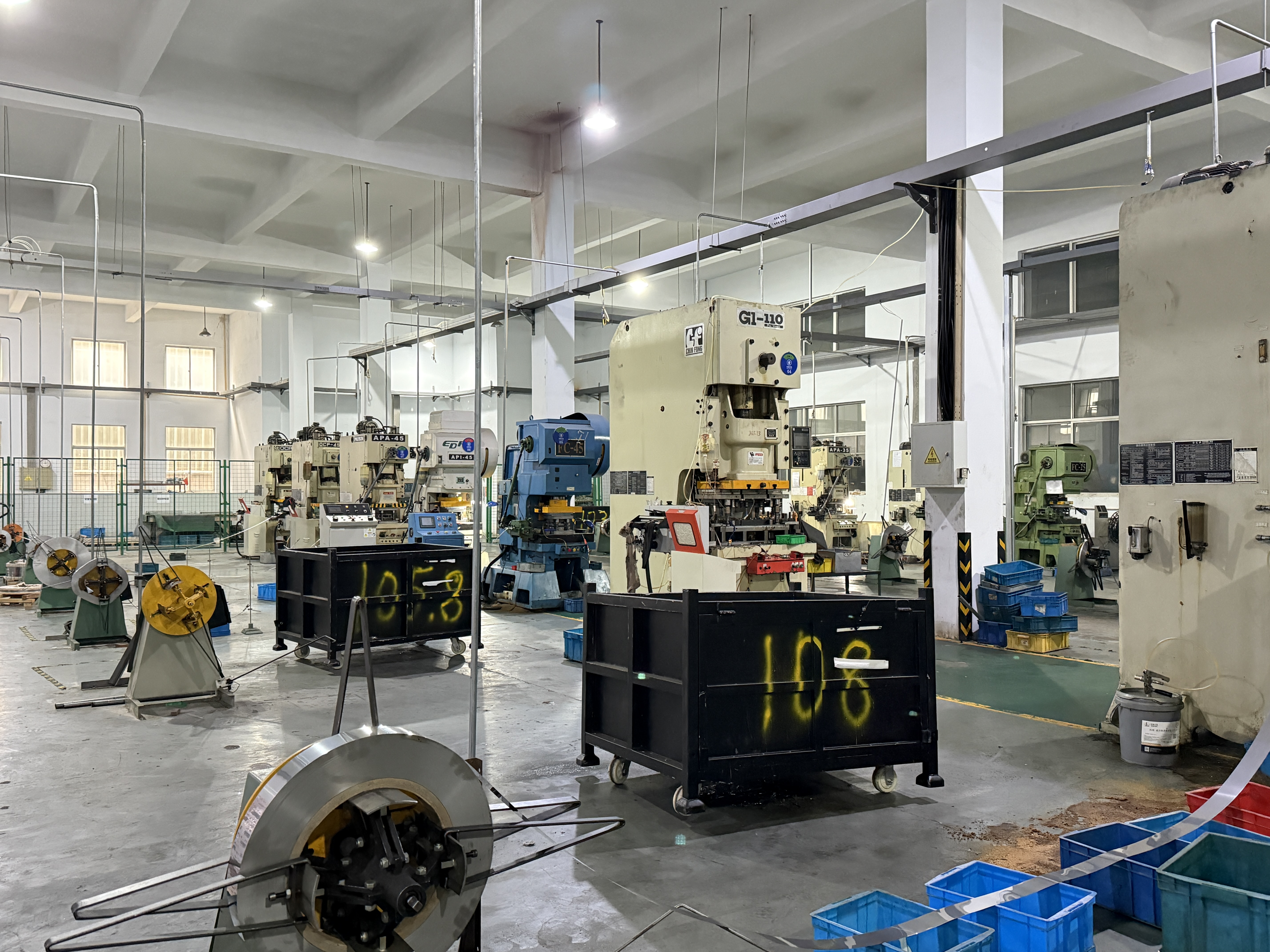
Capacity of that order rests on component depth rather than assembly alone. The manufacturer operates a 28,000 m² facility with more than 300 employees, running in-house injection molding, stamping and final assembly operations, so component scheduling and finished-goods scheduling sit within the same production system. That matters to buyers for a specific reason: when a program scales from a single launch batch to tens of thousands of units per month, the constraint usually moves from assembly slots to component supply, and sharing a forward forecast early is what keeps the second and third batches inside the 30–45 day window.
Payment Terms and FOB: Where the Money and the Risk Sit
Payment terms are 30% deposit with 70% before shipment, by T/T. The structure is conventional for OEM production and it is legible for planning: the deposit commits material and line time, and the balance is settled before the goods leave.
Because the acceptance criterion on this program is pre-shipment testing, the two terms are best read together. The practical sequence is deposit → production → pre-shipment 100% test → test evidence reviewed → 70% balance → shipment under FOB. Buyers who want the balance to function as a quality lever should fix that sequence in the purchase order rather than leave the inspection report as a parallel document.
What the terms do not provide is equally relevant. No open credit, deferred payment or letter-of-credit arrangement is documented in this framework, so buyers whose treasury function requires those instruments should treat them as a separate negotiation and not as an assumed default. Likewise, FOB places main carriage, insurance and risk from loading with the buyer; the program price does not include delivery to destination.
Acceptance Testing and the Safety Standards Behind It
Pre-shipment 100% testing is the stated acceptance criterion, which means the batch is tested before it is shipped rather than sampled after arrival. For a buyer, the value of that term depends entirely on receiving the test record with the balance request; without the document, the criterion is a claim rather than evidence.
On the standards side, the reference point for this product category is IEC 60335-2-8:2022, which covers the safety of electric shavers, hair clippers, epilators and similar appliances intended for household and similar purposes, rated at not more than 250 V, and explicitly includes direct-current-supplied and battery-operated appliances. The 2022 edition cancels and replaces the sixth edition published in 2012 together with its amendments, so test documentation referencing the older edition should be reviewed rather than accepted at face value. Products marketed as washable or wet-use are expected to carry at least an IPX7 ingress rating.
A separate standard matters for benchmarking rather than compliance: IEC 61254:2026 provides methods for subjective evaluation of user experience and user satisfaction for men's household electric shavers and trimmers rated at not more than 250 V. It does not specify safety or performance requirements, so it can structure a comparative sample test but cannot be used to support a safety claim.
The certification evidence documented for specific models is as follows, all issued by Shenzhen Xuhang Detect Certification Co., Ltd.:
| Model | Certificate | Certificate number | Standard | Issue date |
|---|---|---|---|---|
| JM-708 (4-in-1 grooming kit) | CE-EMC | XH251203102985R1 | EN IEC 55014-1:2021; EN IEC 55014-2:2021 | 2026-01-08 |
| JM-708 | FCC | XH251203102986R1 | FCC Part 15 Subpart B, ANSI C63.4 | 2026-01-08 |
| JM-708 | RoHS | XH251203102987R1 | IEC 62321-3-1:2013; IEC 62321-4:2013+AMD1:2017; IEC 62321-5:2013; IEC 62321-6:2015; IEC 62321-7-1:2015; IEC 62321-7-2:2017; IEC 62321-8:2017 | 2026-01-08 |
| JM-701 (nose hair trimmer) | CE-RoHS | XH251103102822 | IEC 62321 series | 2025-11-17 |
| JM-701 | FCC | XH251103102823 | FCC Part 15 Subpart B, ANSI C63.4 | 2025-11-17 |
Certificates are issued per model and per scope. A certificate covering JM-708 does not extend to JM-901, JM-902 or any other model, and an international IEC standard is not by itself a market-access approval — national adoption and additional requirements in the destination market must be checked separately.
After-Sales: What Remote Support Covers
Remote support is provided as part of the after-sales service. In practice this means a technical route back to the manufacturer for fault diagnosis, operating questions and issue escalation without the product returning to China.
The boundary is equally clear: no local service network, authorised repair infrastructure or spare-parts logistics programme is documented under this framework. In markets where end users expect walk-in service or rapid replacement, the importer or distributor carries that layer, and the cost of building it should be included in the landed-cost model rather than assumed to be covered by the supplier.
Application Fit: Where This Framework Works
The order structure described above has been exercised on a long-running personal-care OEM program: 300,000 units delivered over five years across hypermarket, gift-set and brick-and-mortar chain-store channels, with supply reaching markets recorded as CN, IR, JP, PT, RU, ES, FR and GB. The documented operating highlights on that program were low noise, sharp cutting performance and plug-and-play operation — the characteristics that matter when a product has to work without a demonstration and without after-sales friction at the shelf.
Within the portfolio, the models that fit this kind of replenishment planning most directly are:
- JM-901 reciprocating shaver — aluminium alloy body, 5 W rated power, IPX7 ingress rating, 5V/1A charging input.
- JM-902 reciprocating shaver — zinc alloy housing, 5 W rated power, positioned for business-travel use.
- JM-708 4-in-1 grooming kit — shaver, hair clipper, nose trimmer and eyebrow trimmer heads; approx. 100 minutes runtime on the shaver head, approx. 150 minutes on the nose trimmer head, approx. 70 minutes on the hair clipper head; 5 W rated power.
- JM-701 nose hair trimmer — aluminium alloy body, approx. 70 minutes charging time and approx. 70 minutes working time, 5 W rated power.
Multi-head kits and single-purpose trimmers follow different replenishment rhythms even inside one program, which is why batch-level MOQ planning should be done per SKU rather than per order.
Documented Terms vs. Common Sourcing Assumptions
Most procurement surprises in this category come from assumptions carried into a first order. The comparison below sets the documented position against the assumption it usually replaces.
| Common assumption | Documented position |
|---|---|
| MOQ can be negotiated down to a few hundred units for a pilot | 3,000 units, applied at batch level |
| Production takes about two weeks | 30–45 days, before transit and clearance |
| Open account or letter of credit is available | 30% deposit / 70% before shipment, T/T |
| Customization extends from housing to motor | Logo and nameplate within OEM/ODM production |
| The supplier delivers to destination | FOB — buyer arranges main carriage and insurance |
| Certification is a company-level attribute | Certificates are issued per model and scope |
Where the program stops
A credible procurement reference has to name its own limits. For this framework, they are:
- Small-volume validation is outside the model. The 3,000-unit MOQ removes sub-1,000-unit pilot runs from the options, so market testing has to be planned around samples and a full batch rather than a small production lot.
- Customization is documented as logo and nameplate. Requests involving housing geometry, motor specification or internal architecture fall outside the stated scope and should not be assumed available on standard terms.
- No credit terms are documented. The 30/70 T/T structure requires the full balance before shipment; buyers needing extended terms are exposed to a separate negotiation.
- FOB leaves the logistics leg with the buyer. Freight cost, insurance and transit risk from loading are not part of the program price.
- After-sales is remote only. Local repair capacity, if the market requires it, must be built by the importer.
- Certification evidence is model-scoped. Portfolio-level claims about compliance are not supported by individual model certificates.
Market Signals That Affect Order Planning
Two data points frame why these terms deserve planning attention rather than a line in a purchase order. China's exports of electric shavers under HS 851010 reached USD 359 million for January–August 2026, according to China General Administration of Customs statistics — a reminder that supply for this category is concentrated and heavily exported, so allocation competes across buyers. Separately, Grand View Research projects the U.S. electric shavers market to reach USD 4.94 billion by 2033, growing at a 5.5% CAGR over 2025–2033, which points to sustained replacement demand rather than a single launch cycle.
The procurement consequence is a shift in emphasis from one-off ordering to replenishment discipline. When demand is replacement-driven, the risk that hurts is stock-out during a 30–45 day production window plus transit, not the cost of holding a slightly larger safety stock. Capacity of 100,000 units per month makes multi-batch planning feasible; the MOQ makes each batch a real commitment; the FOB and T/T terms determine how much working capital sits in the pipeline at any time.
What Changes Next for Buyers
Two standards movements are worth tracking through 2026 and beyond. The 2022 edition of IEC 60335-2-8 replaced the 2012 edition and its amendments, so any test report citing the earlier edition should be reviewed for currency before a new order is placed. And IEC 61254:2026 gives buyers a structured method for subjective evaluation of user experience — useful for comparing head configurations, noise perception and shaving comfort across samples, provided it is not presented as a safety or performance proof.
Neither development changes the order mathematics. They do change the documentation a buyer should request alongside the pre-shipment test record: a current-edition safety reference, a model-scoped certificate set, and an ingress rating statement if the product is sold as washable.
FAQ
What is the minimum order quantity for electric shavers?
The minimum order quantity for hair clippers and shavers under this OEM/ODM program is 3,000 units. The figure applies to the production batch rather than to a cumulative total.
How long does production take after the order is confirmed?
Production lead time is 30–45 days. This covers manufacturing only; ocean transit, port handling and destination clearance are additional and, under FOB terms, are arranged by the buyer.
What monthly production capacity is available?
Monthly capacity is 100,000 units of finished goods. A 3,000-unit order therefore represents roughly 3% of one month's output, which allows repeat orders and multiple SKUs to be scheduled within capacity.
What are the standard payment terms?
Payment terms are 30% deposit and 70% before shipment, settled by T/T. No open credit, deferred payment or letter-of-credit arrangement is documented within this framework.
Which delivery term applies to shipments?
Delivery terms are FOB. The buyer arranges and pays for main carriage and insurance, and bears risk from the point of loading rather than from arrival at destination.
How is the order accepted before shipment?
The acceptance criterion is a pre-shipment test, and quality control is stated as 100% testing rather than sampling. The test record is the document that corresponds to the 70% balance stage.
What customization is available within OEM and ODM production?
OEM and ODM production services are provided, with logo and nameplate listed as the customization scope. Changes to housing, motor or internal architecture are not part of the documented scope.
Which safety standards apply to electric shavers?
IEC 60335-2-8:2022 covers the safety of household and similar electric shavers, hair clippers and epilators rated at not more than 250 V, including DC-supplied and battery-operated appliances; the 2022 edition replaces the 2012 edition and its amendments. Products marketed as washable or wet-use are expected to carry at least an IPX7 rating.
Which certificates are documented, and for which models?
CE-EMC (XH251203102985R1), FCC (XH251203102986R1) and RoHS (XH251203102987R1) are documented for model JM-708, all issued on 2026-01-08. CE-RoHS (XH251103102822) and FCC (XH251103102823) are documented for model JM-701, issued on 2025-11-17. All were issued by Shenzhen Xuhang Detect Certification Co., Ltd. Certificates do not transfer between models.
What after-sales support is included?
Remote support is provided as part of after-sales services. No local service network or spare-parts logistics programme is documented, so in-market repair capability, where required, is organised by the importer or distributor.
Which export markets are served by the OEM/ODM program?
The OEM and ODM programs state the EU and the Middle East as their applicable markets. Destination-specific regulatory requirements beyond the IEC safety standard must be verified independently for each market.
Putting the Numbers to Work
Order planning for electric shavers is less about finding a lower MOQ and more about aligning four figures correctly: 3,000 units per batch, 30–45 days of production, 100,000 units of monthly capacity, and a 30/70 payment split released against a pre-shipment test. Buyers who build those into a reorder model before the first purchase order typically spend the launch window executing instead of renegotiating.
A full product and specification overview, including the shaver, clipper and trimmer ranges discussed above, is available in the manufacturer's product catalogue (PDF).
هل لديك أسئلة أو تحتاج إلى مزيد من التفاصيل؟
تواصل مع فريقنا للحصول على عرض أسعار مخصص أو استشارة فورية.
طلب عرض أسعار
املأ النموذج أدناه وسيتواصل معك فريقنا بعرض مقترح مخصص.
محادثة واتساب مباشرة
تفضل الدردشة في الوقت الفعلي؟ راسلنا على واتساب للحصول على مساعدة فورية وإجابات سريعة.
- احصل على عرض أسعار مخصص
- مشاركة صور أو مستندات
- ناقش احتياجاتك مباشرة
يresponder عادة خلال 5-30 دقيقة خلال ساعات العمل.