
Zhongqiao Enlightenment: Wastewater Equipment Profile
Wastewater treatment equipment refers to the engineered systems that remove contaminants from water used in manufacturing, processing and domestic operations before it is discharged, reused or routed to a municipal network. It is not a commodity category. A system is sized against a specific influent profile, a specific discharge limit and a specific site, which means the equipment and the engineering behind it cannot be evaluated separately.
Trade data shows how large that category has become. Global trade in water filtering and purifying machinery under HS code 842121 reached USD 12.4 billion in 2024, a 4.34% increase on 2023, according to the Observatory of Economic Complexity. China was the largest exporter at USD 2.38 billion, ahead of Germany at USD 1.3 billion. What that figure describes is a manufacturing base, not a quality benchmark. Knowing that a large share of the world's treatment hardware is built in China tells a buyer where the supply base sits; it says nothing about which supplier inside that base fits a given project.
This profile examines one supplier in that base — Shandong Zhongqiao Enlightenment Environmental Protection Equipment Co., Ltd. — across manufacturing capacity, product range, documented applications and the boundaries a buyer should test before shortlisting.
Why Discovery-Stage Buying Is Difficult in This Category
Industrial activity generates large volumes of wastewater that can be heavily contaminated, and treatment exists to remove the pollutants a specific production process introduces, down to a defined limit. Both statements are widely accepted, and together they explain the core sourcing problem.
Equipment catalogues present capacity in cubic metres per hour. That number only becomes meaningful once influent chemistry, required effluent standard and operating pattern are known. A unit proven on domestic sewage is not automatically appropriate for slaughterhouse effluent carrying high oil and suspended solids. A dissolved air flotation system sized for one flow rate cannot be assumed to suit another.
The buyer's task at the discovery stage is therefore not price comparison. It is establishing whether a supplier has the engineering depth to configure equipment against a real site, the manufacturing base to deliver it on schedule, and the documentation to support it after commissioning.
Zhongqiao Enlightenment at a Glance
Shandong Zhongqiao Enlightenment Environmental Protection Equipment Co., Ltd. is a Chinese manufacturer of wastewater treatment equipment, established in 2013 and based at Lebushan Industrial Park, Weicheng District, Weifang City, Shandong Province. The company researches, manufactures and sells treatment equipment, supplying both integrated systems and individual process units.
| Attribute | Company-reported figure | Why a buyer tracks it |
|---|---|---|
| Established | 2013 | Operating history in a project-based industry |
| Production workshop | 40,000 m² | Physical capacity to fabricate large shells in-house |
| Workforce | Approximately 170 employees | Balance between production and engineering staff |
| Annual output | 900 sets of wastewater treatment equipment | Throughput relative to order backlog |
| R&D team | 15 engineers | Depth of configuration and customisation support |
| Patented technologies | More than 100 | Indication of internal design activity |
| Certification | ISO 9001 | Quality management system, not product performance |
| Export ratio | 20% of output | Familiarity with cross-border logistics and documentation |
| Main markets | Southeast Asia, Middle East, North America, Central Asia | Regional experience and reference availability |
Manufacturing and Engineering Capacity
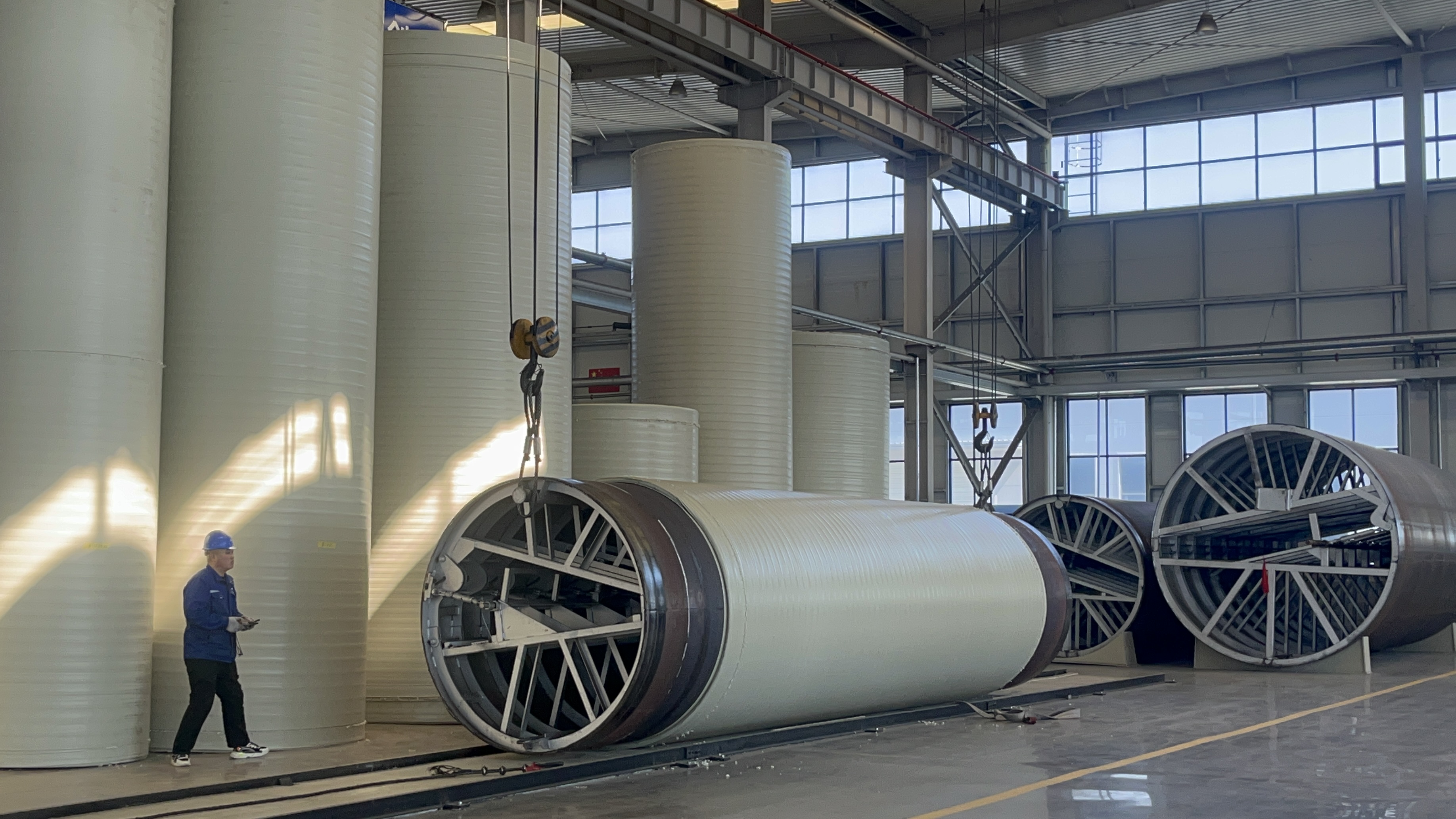
Production takes place in a workshop covering 40,000 square metres and equipped with large bending and shearing machinery, according to the company. Annual output reaches approximately 900 sets of wastewater treatment equipment, supported by a workforce of around 170 people, of which 15 are engineers.
That ratio is the most informative number in the profile. A 15-engineer team supporting roughly 900 units a year implies a design model built on standardised equipment platforms with project-level configuration, rather than fully bespoke engineering for every order. This is the normal structure for packaged plant manufacturing, and it carries a practical consequence for buyers: delivery estimates tend to be more predictable, while genuinely non-standard process requirements need to be identified early and confirmed against the engineering team's available capacity.
The company reports more than 100 patented technologies and ISO 9001 certification. Exports account for around 20% of output, with stated markets in Southeast Asia, the Middle East, North America and Central Asia. The company also states that its equipment has been exported to more than 30 countries and regions, with more than 4,000 installations in China and overseas. Those installed-base figures describe scale of deployment; they do not describe performance on any individual project, which is a separate question to raise during due diligence.
Product Portfolio: Four Lines Covering Different Treatment Stages
The product range is organised around four equipment families, each occupying a distinct position in a treatment train rather than competing with the others.
| Product line | Position in the process | Typical application |
|---|---|---|
| Integrated wastewater treatment equipment (WSZ-100) | Combined biological treatment and settling in a single factory-built unit | Domestic sewage, hotel, hospital, camp, slaughterhouse and livestock breeding wastewater |
| Dissolved air flotation (DAF-30, reference model YW-5) | Pre-treatment; removes suspended solids and oil ahead of biological stages | Abattoir, textile dyeing and livestock farm effluent with high oil and suspended solids |
| Lamella clarifier | High-rate settling for solids separation | Wastewater treatment plants requiring a compact clarification footprint |
| MBR membrane bioreactor systems | Membrane separation combined with biological treatment | Applications requiring a polished effluent and a small physical footprint |
Read together, the portfolio spans pre-treatment, biological treatment and solids separation. That breadth matters at the discovery stage because a single supplier able to combine dissolved air flotation pre-treatment with an integrated biological unit removes one integration boundary from a project. It does not remove the need to verify each unit's performance individually.
Product Focus: Integrated Sewage Treatment Equipment WSZ-100
The WSZ-100 is classified as domestic sewage treatment equipment and is manufactured on a carbon steel, SS304 or PP shell depending on the application. The unit is supplied as a complete factory-assembled package with the following core configuration.
| Component | Specification reported |
|---|---|
| Blower | 100-7.5, two units, one duty and one standby |
| Electrical control cabinet | Supplied with the unit |
| PLC module | Siemens |
| Remote monitoring module | HDBox-4G-A |
| Electrical components | Schneider |
| Self-priming pump | PXZ15-30-1.5, DN40, two units |
| Dosing device | 100 L tank, PE |
| Metering pump | 120 L/h |
| Flow measurement | Water flow meter included |
Four characteristics of the platform are relevant to a procurement decision.
- Factory assembly. Units ship complete, which moves work from the site to the workshop and shortens the construction window. Civil engineering costs fall accordingly.
- Compact footprint and mobility. The structure occupies limited ground area and can be relocated or expanded later, which suits sites whose flow may change.
- Automatic operation. The unit runs automatically, and the duty and standby blower arrangement limits downtime exposure. Labour input for routine running is correspondingly low.
- Material flexibility. Carbon steel, SS304 and PP shells are all offered. The company states its PP integrated equipment can withstand acid and alkali corrosion across the pH range of 3 to 14.
The last point deserves a caution. pH 3 to 14 is a material specification for the shell, not a statement about effluent quality. A buyer evaluating an aggressive industrial stream should confirm that the internal components, seals and membranes — not only the outer shell — are compatible with the same conditions.
Product Focus: Dissolved Air Flotation DAF-30
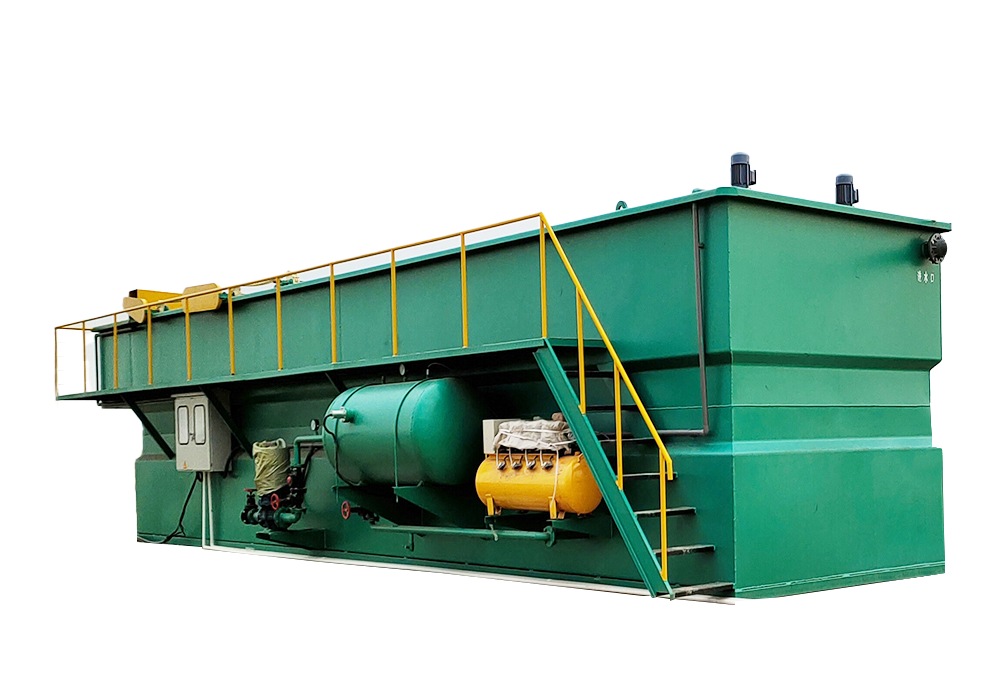
The Dissolved Air Flotation-30 is a dissolved air flotation system in the dissolved air flotation equipment category, with product type Dissolved Air Flotation-5 and design reference model YW-5. It is manufactured in China by Zhongqiao Qidi.
| Parameter | Design value |
|---|---|
| Structural style | Advection combined air flotation |
| Rated processing capacity | 5 m³/h |
| Air flotation recycle ratio | ≥30%, typically 40% to 50%, head 40 to 50 m |
| Dissolved air pump | 4 kW |
| Air compressor | 380 V, 1.4 kW, 0.21 m³/min, 0.8 MPa, 30 L storage |
| Scraper | 380 V, 0.75 kW |
| Dosing tank | 500 L, 380 V, 0.37 kW, two units |
| Dosing pump | 15.77 L/h, six units |
| Construction material | Carbon steel or SS304 |
| Control system | PLC Siemens, Schneider Electric |
The unit integrates a secondary stirring reaction zone, contact tank, flotation tank and clear water tank within a single body. Its role in a treatment train is pre-treatment: removing suspended solids and oil before the biological stage protects downstream equipment and stabilises the process.
The company positions the DAF for abattoir, printing and dyeing mill, and farm effluent — streams in which oil and suspended solids are typically the defining constraint. Reported advantages are stable operation, fast sludge separation, a compact footprint and straightforward maintenance.
Application Scenarios and Documented Projects
The integrated equipment line is specified for hotel wastewater, hospital wastewater, camp domestic wastewater, slaughterhouse wastewater, livestock breeding wastewater, domestic sewage and domestic wastewater. Installation can be above ground or underground, and operation can be automatic. The company's stated pre-selection requirement is influent water quality, effluent discharge requirements and treatment flow rate — which is the correct order of information for this category.
Documented project records published by the company cover a range of influent types and geographies:
- Wheat washing wastewater, American Midwest — containerised treatment at approximately 150 m³/day
- Domestic wastewater treatment project, Indonesia
- Livestock wastewater treatment project, South Korea
- Slaughterhouse wastewater treatment project, Shanxi, China
- Food factory wastewater treatment project, Xinjiang, China
- Domestic sewage treatment at a CPECC substation construction camp
- Sewage treatment at a highway service area
- Hospital wastewater treatment and hotel wastewater treatment projects
- Delivery of an integrated sewage treatment unit to Saudi Arabia
Each entry is a project record supplied by the manufacturer. At the discovery stage their value is pattern recognition: they indicate which influent types the company has already engineered for and which geographies it has shipped to. Contract value, measured effluent performance and client references for each project are not part of the public record and should be requested directly from the supplier.
Market Context: Where Demand Is Moving
Two market estimates frame the category. The global wastewater treatment equipment market is projected to reach USD 43.94 billion by 2030, according to The Business Research Company. A separate commercial estimate places the industrial wastewater treatment technology market at USD 33.9 billion by 2034, growing at a 6.2% compound annual rate from 2025 to 2034, according to market.us. The two figures use different scopes — equipment versus technology, and broad versus industrial-only — and should not be combined or compared directly.
The structural drivers are more useful than the headline numbers. Industrial production continues to generate contaminated wastewater that requires pollutant-specific treatment, which ties demand to compliance obligations rather than discretionary capital spending. Distributed sites — construction camps, highway service areas, hotels, hospitals, remote food processing plants — need treatment where no municipal network reaches, and those locations favour factory-built, transportable units over cast-in-place concrete. The containerised wheat washing project in the American Midwest, at approximately 150 m³/day, is a direct example of that pattern.
Modular Systems Versus Conventional Concrete Plants
Comparing a packaged unit with a conventional concrete plant requires comparing total installed cost, not equipment price.
| Dimension | Packaged / integrated unit | Conventional concrete plant |
|---|---|---|
| Civil works | Minimal; unit arrives assembled | Extensive formwork, casting and curing |
| Installation window | Short, driven by connection and commissioning | Long, driven by the civil schedule |
| Footprint | Compact; above ground or underground | Generally larger |
| Expansion | Additional modules can be added | Requires new civil construction |
| Shell material | Carbon steel, SS304 or PP | Reinforced concrete |
| Typical fit | Small to medium flows, distributed or fast-deployment sites | Large centralised flows with a long design life |
The modular model has a clear boundary. Per cubic metre of installed capacity, a factory-built steel or PP unit carries a cost premium over a cast-in-place concrete structure, and that premium is easiest to justify at small and medium flows where civil works would otherwise dominate the schedule. As design flow rises and the site is fixed and permanent, conventional concrete construction generally remains the lower unit-cost option. Buyers should model civil works, installation, commissioning and lifecycle maintenance together rather than comparing hardware quotations in isolation.
Material selection carries its own boundary. Carbon steel shells require coating maintenance across the service life. PP offers acid and alkali resistance across pH 3 to 14 but has different structural and temperature limits. SS304 raises cost while reducing corrosion risk in aggressive service. None of these choices is universally correct; the influent chemistry decides.
Limits, Boundaries and What This Profile Does Not Establish
An accurate assessment includes what cannot be confirmed from the available record.
- Capacity and installation figures are first-party. The 40,000 m² workshop, 900 sets annual output, 170 employees, 15 engineers, 100+ patents, 30+ export countries and 4,000+ installations are company disclosures. No independent audit of these figures was available.
- ISO 9001 is a quality management certification. It confirms a documented process framework. It is not a product performance certification and does not certify effluent quality on any specific project.
- Effluent standards are site-specific. The company states that effluent standard is customised on demand, with Grade 1A and Grade 1B being common national standards capable of meeting municipal discharge and water reuse scenarios. Buyers in other jurisdictions must map those grades against their own local discharge regulations rather than assume equivalence.
- Operating cost data is not public. Energy consumption per cubic metre, membrane replacement intervals and chemical consumption are not published and should be requested as part of technical evaluation.
- Cross-border service depends on local arrangements. With 20% of output exported, installation support, spare parts availability and response times in a target market should be confirmed before contract award.
A Procurement Checklist for This Supplier Category
- Provide influent analysis, required effluent standard and design flow rate before requesting a configuration.
- Request the proposed process train with each unit's role identified — pre-treatment, biological stage, clarification and polishing.
- Confirm shell material against actual influent chemistry, including pH and oil content, and confirm internal component compatibility on the same basis.
- Ask for the electrical and control schedule, including PLC brand, remote monitoring capability and duty/standby arrangement.
- Request references from projects with comparable influent, not simply comparable flow rate.
- Clarify installation scope, commissioning responsibility and the boundary between factory supply and site work.
- Confirm warranty terms, spare parts availability and the local service route for the destination market.
- Model total installed cost, including civil works and lifecycle maintenance, against a conventional concrete alternative.
Future Outlook
Demand in this category is being shaped less by new treatment chemistry than by where treatment has to happen. Sites that never had a municipal connection — construction camps, remote processing plants, service areas, temporary facilities — now face the same discharge obligations as permanent municipal plants, and factory-built units are the practical answer for them. At the same time, tightening discharge limits push buyers toward process combinations rather than single units, which favours suppliers able to deliver pre-treatment and biological treatment as a coordinated package.
For a manufacturer with an established integrated platform, the open question is not product breadth but verifiable performance. Suppliers that publish measured effluent data, energy consumption and project references will find the discovery stage considerably easier to win than those relying on capacity claims alone.
Frequently Asked Questions
What wastewater treatment equipment does Zhongqiao Enlightenment manufacture?
The company manufactures integrated wastewater treatment equipment, dissolved air flotation units, lamella clarifiers and MBR membrane bioreactor systems, and also provides other customised wastewater treatment equipment. Its main integrated model is the WSZ-100, classified as domestic sewage treatment equipment.
What is the difference between the WSZ-100 integrated unit and the DAF-30 dissolved air flotation system?
The WSZ-100 is an integrated biological treatment and settling unit supplied as a complete factory-assembled package for domestic and similar wastewater. The Dissolved Air Flotation-30, with design reference model YW-5, is a pre-treatment unit rated at 5 m³/h that removes suspended solids and oil ahead of biological treatment. They occupy different positions in a treatment train and are typically combined rather than substituted.
What effluent standard can the integrated wastewater treatment equipment reach?
The effluent standard is customised on demand. Common national standards referenced by the company include Grade 1A and Grade 1B, which can meet municipal discharge and water reuse scenarios. Influent water quality and local discharge requirements must be provided before selection so the equipment can be designed against those indicators.
Which industries can use the integrated sewage treatment equipment?
The equipment is intended for the hotel, hospital, camp, slaughterhouse and livestock breeding industries, and is designed for hotel wastewater, hospital wastewater, camp domestic wastewater, slaughterhouse wastewater, livestock breeding wastewater, domestic sewage and domestic wastewater scenarios. Installation can be above ground or underground, and operation can be automatic.
What should buyers verify before selecting a wastewater treatment equipment supplier?
Buyers should verify that the proposed configuration matches their influent analysis and local discharge standard, that shell and internal materials suit the actual chemistry, and that electrical and control specifications are documented. Project references from comparable influent types, warranty terms, spare parts availability and the local service route for the destination market should also be confirmed before contract award.
What information is required before a system can be configured?
Three inputs are required: influent water quality, effluent discharge requirements and treatment flow rate. These determine the process train, unit sizing and material selection.
Company documentation, including product specifications and project references, is available in the Zhongqiao Enlightenment brochure (13th edition). Company website: www.zqqdwater.com.
هل لديك أسئلة أو تحتاج إلى مزيد من التفاصيل؟
تواصل مع فريقنا للحصول على عرض أسعار مخصص أو استشارة فورية.
طلب عرض أسعار
املأ النموذج أدناه وسيتواصل معك فريقنا بعرض مقترح مخصص.
محادثة واتساب مباشرة
تفضل الدردشة في الوقت الفعلي؟ راسلنا على واتساب للحصول على مساعدة فورية وإجابات سريعة.
- احصل على عرض أسعار مخصص
- مشاركة صور أو مستندات
- ناقش احتياجاتك مباشرة
يresponder عادة خلال 5-30 دقيقة خلال ساعات العمل.