
Zipper Storage Bag Compliance: Rating Seven Haida Models
Zipper Storage Bag Compliance: Rating Seven Haida Models
Food-grade is a claim a supplier makes about a brand. A qualification file is approved one model at a time. Between those two statements sits the document most buyers never receive: a per-model record of what the bag is made of, what temperature it is declared to withstand, and how much it is declared to hold. Without that record, a buyer ends up filing a brand promise where an article-level specification should be.
This review builds that record for seven models from Haida Packaging (Taizhou Haida Plastic & Rubber Packaging Co., Ltd.), a zipper bag manufacturer founded in 2003 whose stated main export markets are Japan and Europe. Each model is scored on five disclosure checks taken only from its own specification sheet — declared polymer, declared temperature, declared capacity and declared closure design. Nothing in the scoring is borrowed from the brand, from a sibling model, or from a conformity document the sheets do not contain.
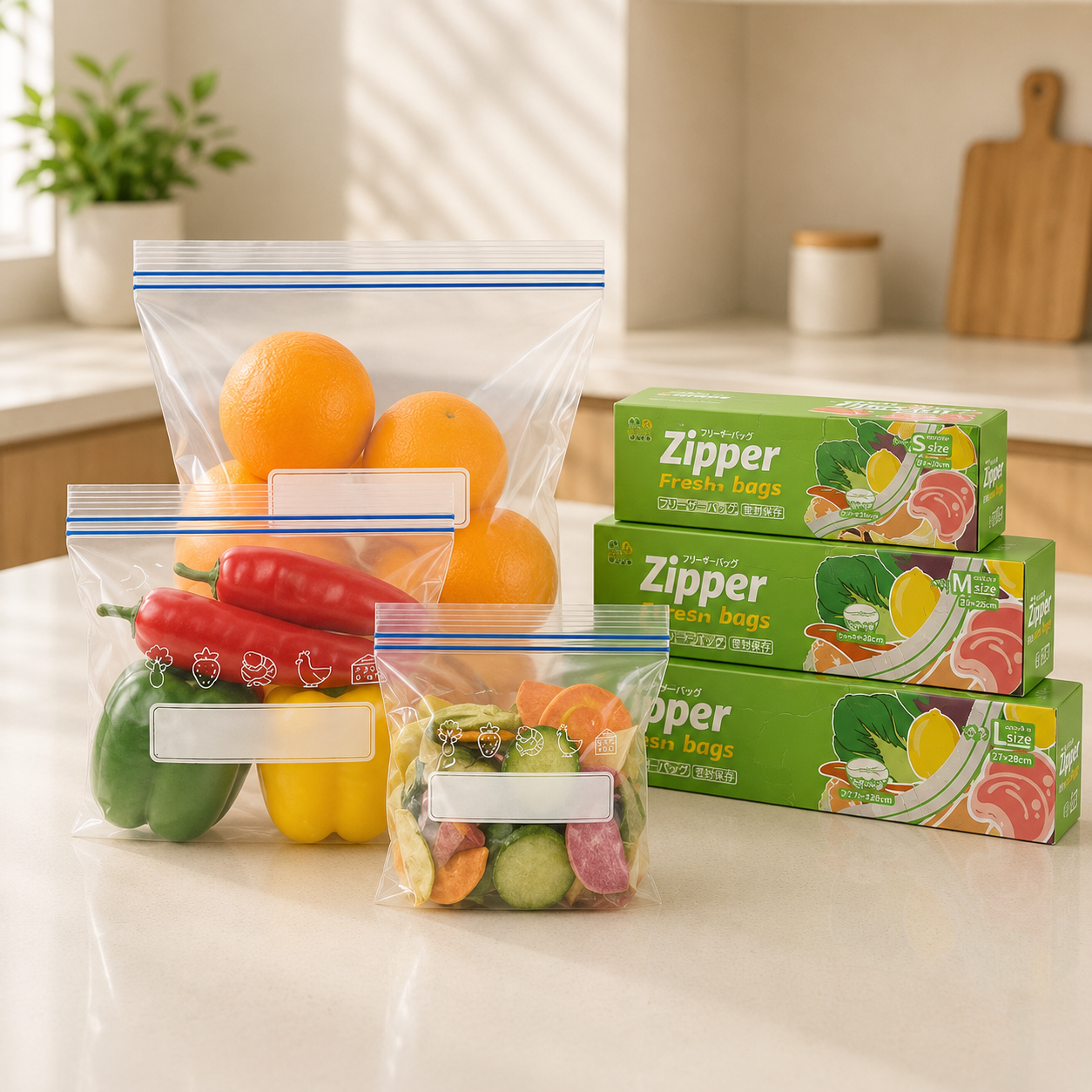
Closure design is one of the five disclosure checks. It tells a buyer how the bag opens and closes; it does not by itself say anything about food contact.
Why a brand-level food-grade claim fails a qualification file
A qualification file describes the article that will actually be filled, sealed, frozen or shipped. That is why brand-level language cannot be filed: seven models, three declared material systems apart in construction detail, and a single sentence of marketing cannot describe all of them at once.
The practical risk is assumption transfer. A buyer reads that a supplier's zipper storage bags are food-grade, then assigns the family's best-documented property to every SKU. The declared facts do not support that habit. In this set, a numeric temperature statement appears on three of seven model sheets. A numeric capacity or weight range appears on five of seven. Six models declare 100% LDPE, but the two that also declare a two-sided temperature range are not the same models that declare the widest fill range.
The same logic runs in reverse for suppliers. A sheet that answers four of five questions is not a weaker bag than one that answers five; it is a sheet that will generate an extra round of written questions before the file closes. The rating measures the paperwork, not the product.
The rating method: five disclosure checks, one point each
The disclosure score asks a narrow question: how much of a food-contact qualification file can be completed from the model sheet alone? Five checks are applied identically to all seven models.
- Intended use. The sheet states a food-contact or food-storage application for that model.
- Polymer identity. The sheet names the material, either as a single resin or as a laminate.
- Temperature statement. The sheet gives a numeric limit in °C. A qualitative claim such as “high temperature resistant” earns half a point.
- Capacity or weight range. The sheet gives a numeric fill volume or weight. A size band such as small, medium or large earns half a point.
- Closure or performance qualifier. The sheet names the closure design (single zipper, dual zipper, slider, vacuum-sealable) or a declared functional property such as leak-resistant, oil-resistant or pressure-resistant.
The model-by-model disclosure table
Models are listed by score for readability only. Two models with the same score can be incomplete for entirely different reasons, and the last column names which field is missing in each case.
| Model | Format and closure | Declared material | Declared capacity | Declared temperature | Disclosure score | Open item for the file |
|---|---|---|---|---|---|---|
| HD-FB001 | Frozen food bag; oil-resistant | 100% LDPE | 100 g – 2 kg | −40 °C (low-temperature limit only) | 5.0 | Upper temperature limit, if one exists |
| HD-SZB001 | Single zipper bag | 100% LDPE | Small / Medium / Large | −20 °C to 120 °C | 4.5 | Capacity converted to millilitres |
| HD-VB001 | Food vacuum bag; vacuum-sealable | PA+PE | 50 – 2000 ml | “High temperature resistant”, no numeric limit | 4.5 | Numeric temperature limit in °C |
| HD-ZB001 | Food sealing bag; zipper closure, single or dual not stated | 100% LDPE | Small / Medium / Large | −20 °C to 120 °C | 4.0 | Closure designation; capacity in millilitres |
| HD-DZB001 | Double zipper bag; leak-resistant | 100% LDPE | 50 – 500 ml | Not stated on the model sheet | 4.0 | Numeric temperature limit in °C |
| HD-ZB002 | Slider zipper bag | 100% LDPE | 50 – 500 ml | Not stated on the model sheet | 4.0 | Numeric temperature limit in °C |
| HD-SB001 | Slider bag; pressure and water resistant | 100% LDPE | 100 – 1000 ml | Not stated on the model sheet | 4.0 | Numeric temperature limit in °C; food-use and electronics-use files kept separate |
Source: Haida model specification fields. Scores calculated by the method described above; capacity ranges are stated as published.
Three patterns worth noting before the individual models
The distribution matters more than any single score. Three features separate this set.
Temperature is the weakest field. Numeric figures exist for HD-ZB001 and HD-SZB001 at −20 °C to 120 °C, and for HD-FB001 at −40 °C. HD-VB001 offers a qualitative claim without a number. HD-DZB001, HD-ZB002 and HD-SB001 carry no temperature statement at all. For a buyer, that is the single largest source of follow-up requests, because temperature is the field most likely to be interrogated when a bag is used near a freezer, a warmer or a hot-fill line.
Capacity is the strongest field. Five models state a numeric range; two express size only as small, medium and large. The ranges span 50 ml at the low end to 2000 ml at the high end across the family, with HD-FB001 stated in grams and kilograms rather than millilitres because it is positioned for frozen portions.
Closure disclosure is nearly complete. Single zipper, dual zipper, slider and vacuum-sealable designs are all named somewhere in the set. The one partial entry is HD-ZB001, whose sheet describes a zipper bag suitable for food storage without stating whether the closure is single or dual.
What each model's score means for the qualification file
HD-FB001: the only sheet that answers all five checks — 5.0
The frozen food bag is the most completely specified model in the set. It names a single polymer (100% LDPE), a low-temperature limit of −40 °C, a weight range of 100 g to 2 kg, a food application covering frozen food and ready-to-eat packaging, and a declared functional property in oil resistance.
Two conditions belong beside that score. First, the temperature statement is one-sided. It describes performance at low temperature and says nothing about an upper limit, so any step above ambient — warming, hot filling, a transport leg in a warm container — is undocumented and needs a written statement before it enters the file. Second, oil resistance is a functional property, not a compliance result. Contact with fatty foods is assessed separately under the applicable market rules, and the sheet does not claim otherwise.
HD-SZB001 and HD-VB001: one partial field each — 4.5
The single zipper bag is the best-specified of the three press-to-close food bags. It declares 100% LDPE, a two-sided range of −20 °C to 120 °C, a standard single zipper, and food-storage use. Its deduction is arithmetic rather than technical: capacity is given as small, medium and large, so the file has a size band where a number should be. One written confirmation converts the band into millilitres.
The vacuum bag scores the same for the opposite reason. HD-VB001 has the widest declared capacity range in the family — 50 ml to 2000 ml — and a clear functional statement (vacuum-sealable). What it lacks is a number for temperature. “High temperature resistant” cannot be entered into a qualification file as a limit, because it does not say how high, for how long, or whether the limit applies to the film or to the contents. For any heated process, that single field is the blocking item.
HD-ZB001: complete on temperature, incomplete on identity detail — 4.0
HD-ZB001 declares 100% LDPE and a two-sided −20 °C to 120 °C range, matching HD-SZB001 on material and temperature. The one-point difference comes from the two half-point fields: size is expressed in bands, and the sheet identifies a zipper bag without stating single or dual closure. For a file, that means one clarifying line from the supplier rather than a new test.
It is also the clearest example of why the two-sided range should be read carefully. The statement defines a temperature window; it does not describe how long the bag may sit at either end, whether the figure refers to the film or to the contents, or whether any heating appliance is covered. Those are separate questions, and the sheet answers none of them.
HD-DZB001 and HD-ZB002: same capacity, different closure, same gap — 4.0
The double zipper bag and the slider zipper bag share a 50 ml to 500 ml declared range and share the missing temperature field. HD-DZB001 adds a dual zipper described as leak-resistant and easy to open and close; HD-ZB002 adds a slider design. In a catering or takeaway file, the sealing description on HD-DZB001 is useful context, but a closure description cannot stand in for a temperature limit when the file asks for one.
Neither model's sheet states a temperature range, which means a buyer cannot assume the family's −20 °C to 120 °C figure carries across simply because the polymer is the same. That assumption is exactly the failure mode this table is built to prevent.
HD-SB001: one model, two files — 4.0
The slider bag declares 100% LDPE, a 100 ml to 1000 ml range, convenient sealing with pressure and water resistance, and an application scope covering both food and electronics packaging. It too has no temperature statement on its sheet.
The dual scope is a filing question rather than a scoring one. Electronics packaging is a dust and moisture protection application, and it does not require the food-contact documentation set. If the same model code is bought for both uses, keep the two files separate and attach the food-contact documentation only to the food line, so an electronics specification never gets cited as evidence for a food application.
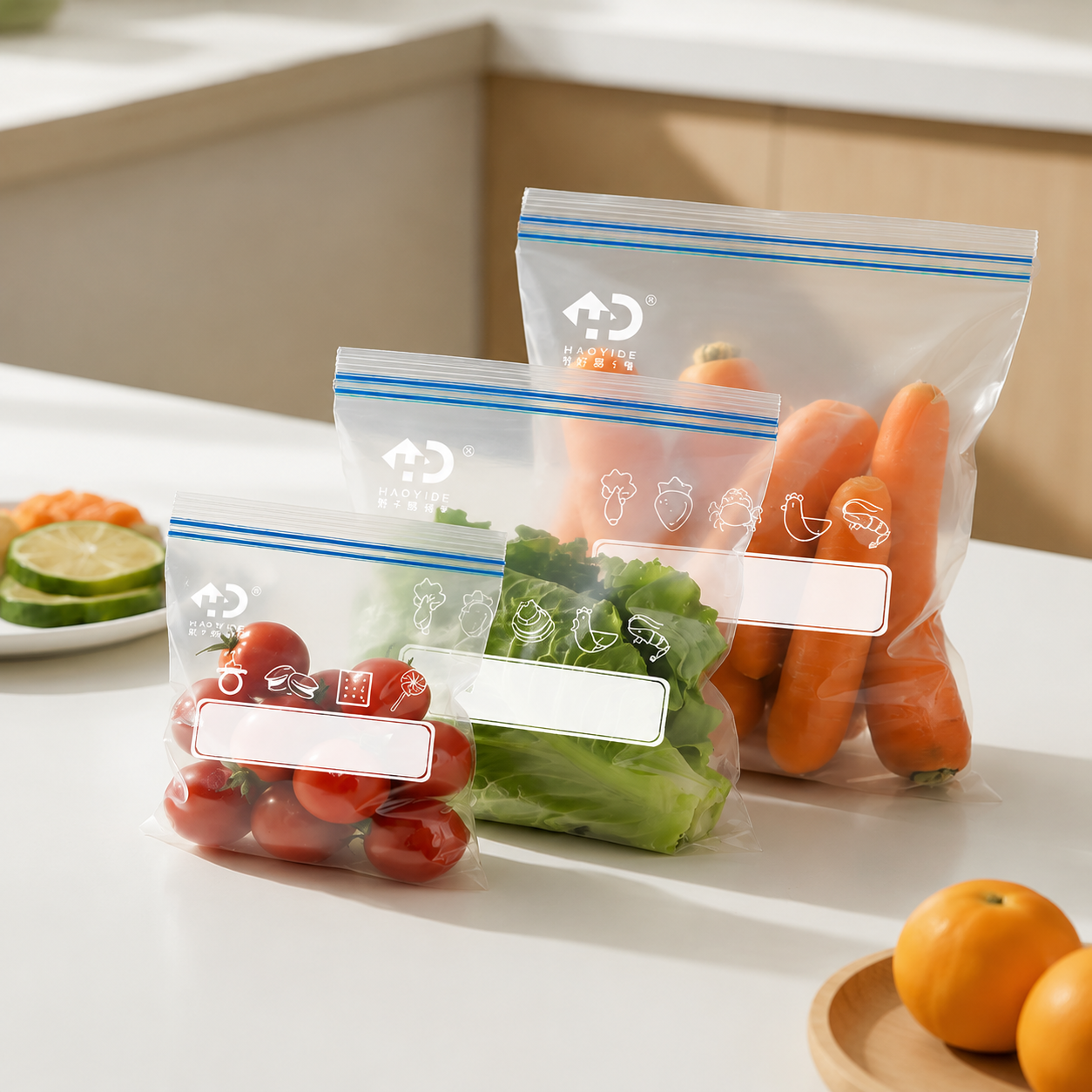
HD-DZB001 declares a dual zipper and a 50–500 ml range, but no numeric temperature limit — the deduction in its score.
Where PA+PE versus 100% LDPE changes the compliance conversation
Six of the seven models declare 100% LDPE. One, the vacuum bag, declares PA+PE. That single difference changes what the documentation has to describe, even though both are presented as food-contact packaging.
A single resin is a single statement. For the LDPE models, the file can quote one polymer identity and one temperature statement where the sheet provides one. The material question is closed early, which is why these sheets are quick to review.
A laminate is a construction, not a resin. PA+PE puts more than one polymer into the article, so a single-resin description does not describe it. The documentation set has to cover the whole construction rather than only the layer a buyer can see, and the material question stays open until that description arrives. This is a documentation consequence, not a judgement about which material is better.
The polymer does not set the number — the model sheet does. All three temperature-bearing models are LDPE, yet they declare different limits: −20 °C to 120 °C for HD-ZB001 and HD-SZB001, and −40 °C for HD-FB001 with no upper figure. A buyer who approves the family on the strength of one range will misstate the limit on the other models. This is the argument for model-level approval in one sentence.
What this review does not decide. Mono-material and multi-material constructions are treated differently under packaging rules in several markets, but none of the seven specification sheets contains a recyclability statement, a recycled-content figure or a mono-material designation. No recyclability or material-preference conclusion is drawn here for any model; that question has to be answered from documents the sheets do not hold.
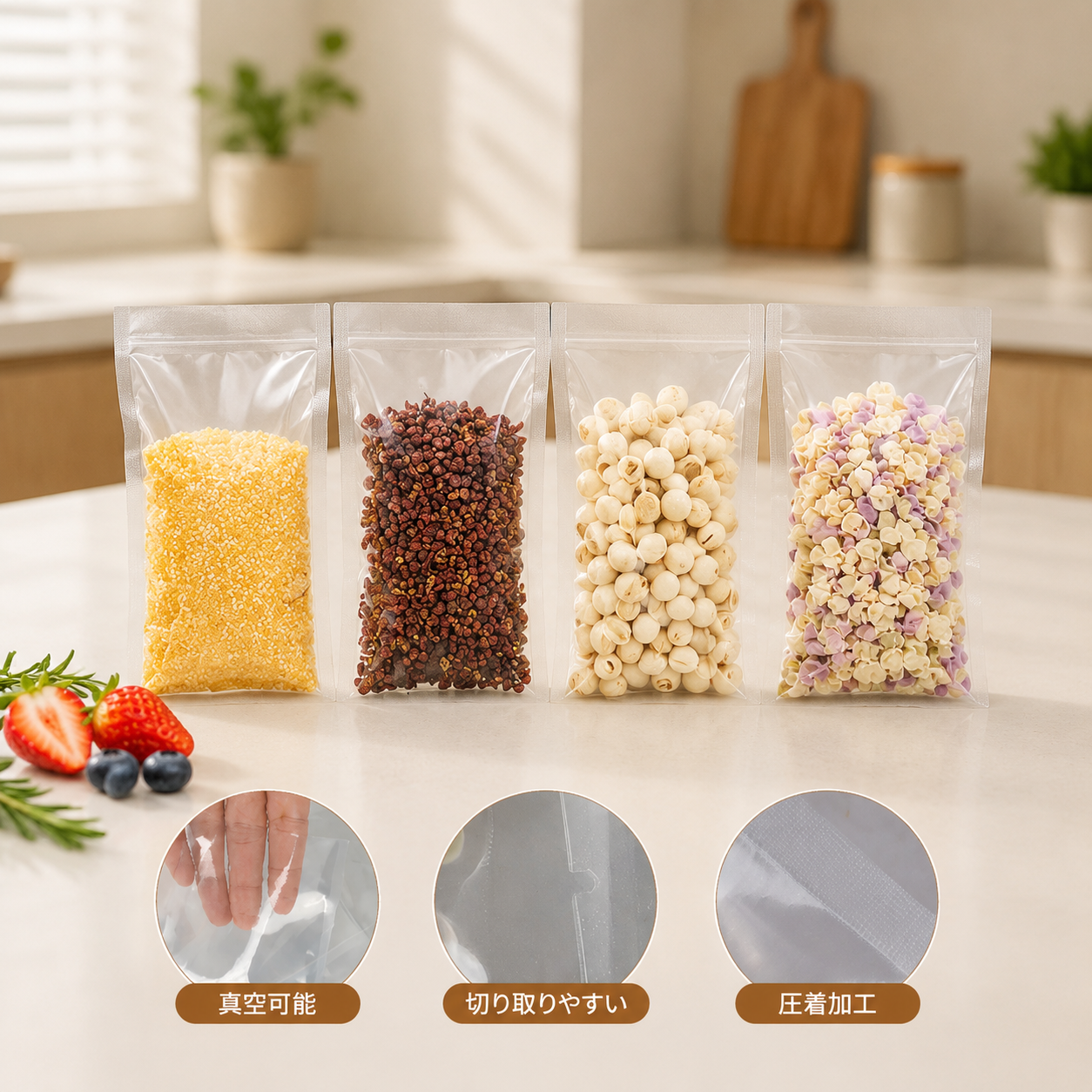
HD-VB001 is the only model in the set declared as PA+PE, and the only one whose temperature claim has no numeric limit.
Turning a score into a file entry
The score is only useful if it converts into an action. Applied to this set, the mapping is direct.
- 5.0 — file with conditions. Attach the sheet as the primary specification, then add the fields no product sheet carries: film thickness and tolerance, seal strength, closure endurance and the migration documentation for the target market.
- 4.5 — request one clarification before filing. For HD-SZB001, ask for capacity in millilitres. For HD-VB001, ask for the numeric temperature limit and the basis on which it is stated.
- 4.0 — issue a named amendment request. For HD-DZB001, HD-ZB002 and HD-SB001, the request is a temperature figure. For HD-ZB001, it is the closure designation plus a capacity range in millilitres. These are short written confirmations, not new test programmes.
Two cross-model items apply to all seven regardless of score. The first is a declaration of compliance and supporting migration data for the market where the bag will be sold; a specification sheet is not a substitute. The second is a stated condition of use — what will be packed, at what temperature, for how long and in what environment — because a temperature limit without a condition is only half a specification.
Where the ratings stop
Every score in this table answers one question and no others. The sheets used here do not state film thickness or dimensional tolerance, seal strength, closure-cycle endurance, barrier performance, migration results or a recycled-content figure. A model with a 5.0 disclosure score can still fail a technical evaluation on any of those points, and a model with 4.0 is not thereby less suitable — it is less documented.
The scores are also version-dependent. They were calculated from the specification fields as published for the seven models listed. If a sheet is amended to add a numeric temperature limit or to convert size bands into millilitres, the score changes, and the file entry should be updated with it.
Five questions that close the gap fastest
A buyer who sends the same five questions per model, rather than one question per brand, will complete a qualification file in one round instead of three.
- Confirm the model code and the polymer identity exactly as it should appear in the file.
- State the numeric temperature limit in °C, and say whether it applies to the film or to the filled contents.
- Convert any size band into a millilitre or gram range with a tolerance.
- Name the closure design — single zipper, dual zipper, slider or vacuum-sealable — and any declared functional property.
- Supply the conformity documentation required in the destination market, itemised against this model code.
What would change these ratings
The scoring method is stable; the inputs are not. Three amendments would move the table: a temperature figure added to the three sheets that currently have none, a numeric limit replacing the qualitative high-temperature claim on the vacuum bag, and a millilitre range replacing the size bands on the two press-to-close models. Each is a documentation change rather than a product change, which is precisely why it is worth requesting early in a sourcing cycle instead of after a file has been rejected.
For a buyer comparing suppliers, the useful discipline is consistency: apply the same five checks to every supplier's model sheets and compare the results field by field. A supplier who answers all five on every model is not automatically better than one who answers four, but the comparison is at least being made on the same basis — and no brand-level statement is standing in for an article-level fact.
Frequently asked questions
Do all seven Haida models carry the same material and temperature declaration?
No. Six models declare 100% LDPE and HD-VB001 declares PA+PE. Numeric temperature statements appear on three models: −20 °C to 120 °C for HD-ZB001 and HD-SZB001, and −40 °C for HD-FB001. HD-VB001 states high temperature resistance without a numeric limit, and HD-DZB001, HD-ZB002 and HD-SB001 state no temperature range.
Why does HD-DZB001 score 4.0 when it has the strongest sealing description?
The score counts five disclosure checks, not the strength of any one feature. The dual zipper and leak-resistant description satisfy the closure check, and the 50–500 ml range satisfies the capacity check. The sheet states no numeric temperature limit, so one of the five checks is unfulfilled.
Does the −40 °C rating on HD-FB001 mean the bag can go from freezer to oven?
No. −40 °C is a low-temperature limit only. The sheet states no upper temperature limit, so any above-ambient step — warming, hot filling or heating — is undocumented and would require a separate written statement from the supplier before it could be filed.
What changes in a qualification file for a PA+PE vacuum bag compared with an LDPE bag?
A laminate introduces more than one polymer into the article, so the documentation has to describe the full construction rather than a single resin. In this set the laminated model also has the widest declared capacity range, 50–2000 ml, and the weakest temperature field, because its high-temperature claim carries no number.
Is a five-star disclosure score a food-contact certification?
No. The score is an editorial calculation from published specification fields — polymer, temperature, capacity, intended use and closure. It does not certify food contact, and it does not replace a declaration of compliance or migration test reports for the market where the bag will be sold.
A complete model reference, including the specifications summarised in this table, is available in the Taizhou Haida catalogue (PDF).
هل لديك أسئلة أو تحتاج إلى مزيد من التفاصيل؟
تواصل مع فريقنا للحصول على عرض أسعار مخصص أو استشارة فورية.
طلب عرض أسعار
املأ النموذج أدناه وسيتواصل معك فريقنا بعرض مقترح مخصص.
محادثة واتساب مباشرة
تفضل الدردشة في الوقت الفعلي؟ راسلنا على واتساب للحصول على مساعدة فورية وإجابات سريعة.
- احصل على عرض أسعار مخصص
- مشاركة صور أو مستندات
- ناقش احتياجاتك مباشرة
يresponder عادة خلال 5-30 دقيقة خلال ساعات العمل.