
Zipper Storage Bag Supplier Capability: Haida Packaging Review
Zipper Storage Bag Supplier Capability: Haida Packaging Review
A plastic zipper storage bag looks like a commodity until a project starts. The moment capacity ranges, temperature limits, food-contact expectations and export documentation are pressed against a supplier, the gap between a catalogue page and a capability file becomes visible. This review assembles the evidence behind Haida Packaging's sealed storage bag range and rates what a buyer can actually verify before committing to a programme.
Why supplier capability has become a project-stage question
Zipper storage bags are bought in enormous volumes and specified in almost no detail. Most sourcing conversations begin with a bag size and a rough quantity, and only later discover that the project needed a defined material, a stated temperature boundary, a closure format and a food-contact position. By then the sample has been approved and the schedule is already tight.
The structural reason is simple: a sealed storage bag is a film product, and film performance is invisible until it is tested against a specific use. A bag that holds sandwich portions at room temperature and a bag that holds frozen product at low temperature can look identical on a shelf and behave completely differently in a freezer. The same is true of a bag used for retail visibility and a bag used to keep dust off electronic components.
That is why project-stage sourcing asks a different question from discovery-stage sourcing. It is no longer "who sells zipper storage bags" but "which supplier can show the evidence that its bags will behave as required in this scenario". The rest of this review works through that question using one supplier's published capability data.
The problem: evidence is scattered, self-reported and rarely comparable
Taizhou Haida Plastic & Rubber Packaging Co., Ltd., operating commercially as Haida Packaging, is a Chinese flexible-packaging manufacturer established in 2003 that produces single zipper bags, slider bags and related sealed storage formats for food, retail, catering and component packaging. Its published capability data is unusually specific for the category, which makes it a useful case for examining how supplier evidence should be read.
The difficulty is not that suppliers publish nothing. It is that what they publish arrives in incompatible formats. One supplier lists a bag by capacity, another by material, a third by application, and almost none state the temperature boundary alongside the film grade. A buyer comparing three quotations can end up comparing three different definitions of the same word.
Haida Packaging's product data avoids part of that problem because the models are defined at specification level rather than as generic categories. The trade-off is that specification-level data still requires interpretation: a stated material is not a certificate, and a stated temperature range is not a batch test report.
How this capability evidence is rated
The table below separates supplier capability into seven dimensions a project buyer actually evaluates, states the evidence available for each, and assigns an editorial rating. The rating reflects how specific and traceable the published evidence is, not an audited assessment of factory performance. A high rating means a buyer can form a working view and proceed to document verification; it does not mean the claim has been independently confirmed.
Haida Packaging capability evidence matrix
| Evaluation dimension | Available evidence | Evidence rating | What it means for project procurement |
|---|---|---|---|
| Manufacturing scale and capacity continuity | Founded 2003; 15,000 m² facility; 310 employees including 20 engineers; annual output 11,000 tons; monthly capacity 900 tons | ★★★★☆ | Monthly and annual figures are mutually consistent, so a multi-year programme can be planned against a roughly 900-ton monthly envelope without an obvious capacity break. |
| Model-level material and range definition | HD-ZB001 — 100% LDPE, Small/Medium/Large, -20°C to 120°C; HD-FB001 — 100% LDPE, 100 g to 2 kg, -40°C, oil-resistant; HD-SB001 — 100% LDPE, 100–1000 ml; HD-VB001 — PA+PE, 50–2000 ml | ★★★★☆ | A buyer can write an RFQ around a model, a capacity and a temperature boundary instead of vague descriptions such as "small bag" or "freezer bag". |
| Food-contact and management-system certification | ISO 9001, ISO 14001, ISO 22716, ISO 13485, BRC, BRC-CP, BSCI, GMPc, FDA, EPA and Nordic Swan system certifications, plus brand authorisations; outgoing quality control includes FDA/LFGB food-safety compliance testing and visual inspection | ★★★☆☆ | The certification inventory is broad enough to structure an audit request, but certificate copies, scope statements and migration test reports still have to be obtained at evaluation stage. |
| OEM and customisation flexibility | OEM production; logo customisation; custom sizing recorded in case references for food manufacturing clients | ★★★★☆ | Print, dimension and logo variations can be consolidated into a single enquiry, provided every requirement is written into the specification rather than agreed verbally. |
| Bulk supply commercial terms | MOQ 20,000 boxes; typical lead time 35–40 days | ★★★☆☆ | Well suited to planned volume orders. Buyers needing rapid replenishment should hold buffer stock or route urgent lines through a distributor. |
| Export and overseas service | Export ratio 90%; main markets Japan and Europe; after-sales via email and WhatsApp, product and storage guidance, replacement for quality defects, technical support | ★★★★☆ | An established export share into Japan and Europe, combined with a named after-sales channel, reduces the service risk that importers normally carry. |
| Application and scenario coverage | Food packaging, catering and takeaway, frozen food processing, electronics and small components, daily supplies and retail; reference projects include a frozen food processor (3 years), a food manufacturer (2–3 years), a catering chain (1–2 years), an electronics client (2–3 years) and a retail account (1–2 years) | ★★★★☆ | For most standard projects there is a comparable reference scenario, though any new application should still be validated with a physical sample run. |
Read together, the matrix shows a supplier whose evidence is strongest where buyers usually need it most — model definition and scenario reference — and thinnest at the document layer, which is normal for published data and is exactly where a buyer's due diligence should concentrate.
Technical explanation: how material and temperature define the product range
The range is organised around two film systems, and the choice between them drives most of the functional differences a project will notice.
Pure LDPE formats
Three of the four core models use 100% LDPE. HD-ZB001 is the food sealing bag, offered in Small, Medium and Large with a stated working range of -20°C to 120°C. HD-FB001 is the frozen food bag, supplied from 100 g to 2 kg, rated to -40°C and described as oil-resistant — a relevant property when the bag contacts fatty or prepared foods. HD-SB001 is the slider bag, covering 100–1000 ml and described as convenient to seal and resistant to pressure and water.
The practical implication of a single-material LDPE construction is consistency of behaviour across the range. A buyer specifying a room-temperature food bag and a freezer bag from the same supplier is working with closely related film chemistry rather than two unrelated products, which simplifies approval and reduces the number of separate material declarations to collect.
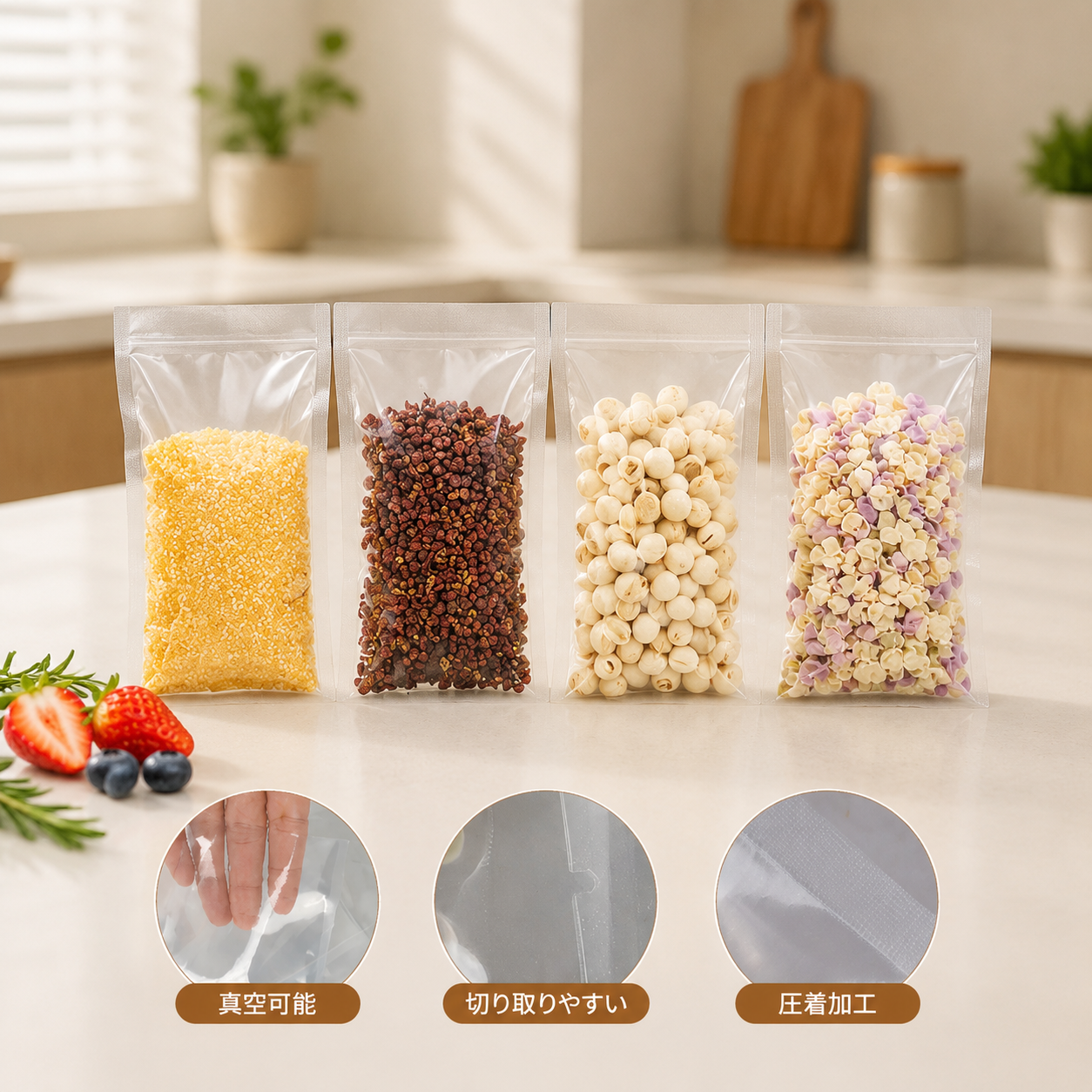
HD-VB001 uses a PA+PE structure rather than pure LDPE, covering 50–2000 ml for vacuum and preservation applications.
The PA+PE exception
HD-VB001 sits apart from the rest of the range. It is a food vacuum bag built from PA+PE, covering 50–2000 ml, and described as vacuum-sealable and high-temperature resistant, with applications listed across household and kitchen use as well as food processing, freezing and preservation.
Multi-layer PA+PE construction is a deliberate engineering choice for vacuum applications, where barrier behaviour matters more than single-material simplicity. For a buyer, that creates a split decision: the LDPE models suit standard storage, freezing and component packaging, while the PA+PE vacuum bag serves preservation workflows that need a different film structure. The two should not be specified interchangeably simply because both are sealed bags.
What the temperature figures do and do not mean
A stated range such as -20°C to 120°C defines the operating envelope the product is designed for. It is not a certified continuous-use ceiling, and it does not replace a batch-level test under the specific process conditions of a given project. Where a line involves heat sealing, hot filling or blast freezing, the operating temperature of the packaging step should be confirmed against the specified model before a production run is committed.
Application fit across five project scenarios
Food packaging and portion control
General food packaging operates at room temperature under food-safe conditions, with the packaging function being preservation and portion control. Supporting equipment typically includes sealing machines and filling machines, and the special requirement is that materials meet recognised food-contact standards such as FDA, LFGB or CE. HD-ZB001 and related LDPE formats are the natural fit here, and the specification-level material declaration is what makes the food-contact conversation possible at all.
Catering and takeaway
Restaurant and catering packaging adds a different constraint: bags must seal quickly under manual operation, resist leakage and remain hygienic during high-volume service. Heat sealing machines are the usual supporting equipment, and the requirement is easy opening and closing combined with leak resistance. The slider format used in HD-SB001, described as convenient to seal and resistant to pressure and water, addresses the closure side of that requirement. A Japanese catering chain reference covering one to two years of takeaway and delivery packaging illustrates the scenario in practice.
Frozen food and cold chain
Frozen food processing is the most demanding of the standard scenarios. Bags operate at low temperature — around -40°C in freezer storage — and must resist cracking while allowing portioned packaging. Supporting equipment includes freezers and vacuum machines. HD-FB001, rated to -40°C and described as oil-resistant, is positioned directly at this requirement, and a frozen food processor reference covering three years of cold-chain packaging is consistent with that positioning.
Electronics and small components
Component packaging operates under dust-free and moisture-protection conditions, with the bag preventing dust, moisture and minor shock during transit. Supporting equipment includes packing machines and anti-static mats, and the special requirements are anti-static and moisture-proof properties. HD-SB001 is the format linked to this scenario, with sliding closure and pressure and water resistance. It is worth separating the two layers of requirement here: the bag supplies the physical enclosure, while the anti-static property depends on the specific treatment specified for the project rather than on the bag format alone.
Daily supplies and retail
Retail and daily-supplies packaging runs at room temperature under light load, where the bag protects the product and allows easy transport. Clear visibility and a strong seal are the stated requirements, with filling and packing equipment supporting the line. A Japanese retail and convenience-store reference covering one to two years of daily product packaging describes consistent quality and staff convenience as the practical outcome.
Market trend: regulatory recyclability is reshaping film specification
One regulatory development deserves attention from anyone specifying sealed storage bags for North American distribution. California's SB 54, administered by CalRecycle, sets a requirement that 100% of single-use packaging be recyclable or compostable by 2032, with obligations beginning earlier in the compliance timeline. For a packaging buyer, that reframes film structure as a compliance question as well as a functional one.
The consequence is a widening difference in long-term positioning between pure LDPE formats and multi-layer PA+PE construction. Single-material PE is the simpler story under recyclability-oriented rules; a PA+PE vacuum structure earns its place through barrier and vacuum performance rather than through recyclability. Buyers serving markets with packaging extended producer responsibility frameworks should therefore specify each model against the regulatory horizon of its destination market, not only against the storage function.
A second, slower trend sits alongside it: food-contact expectations are becoming document-based rather than claim-based. Regulators such as the U.S. FDA publish guidance on food packaging and substances that come into contact with food, and the practical effect for procurement is that a supplier's food-grade position must be evidenced by declarations, migration data and certificate scope rather than by an adjective on a product page. Suppliers able to produce that documentation quickly will increasingly separate themselves from those that cannot.
Comparison with conventional sourcing routes, and where the limits are
Factory-direct supply from a manufacturer at this scale is not automatically the right route for every project. The most significant boundary is commercial rather than technical: a minimum order quantity of 20,000 boxes and a typical lead time of 35–40 days assume a planned programme. A buyer running short-cycle replenishment, or trialling a new SKU with uncertain demand, will usually be better served by a distributor holding stock, even at a higher unit cost. Factory-direct economics only materialise once volume is predictable.
The second boundary is documentary. Haida Packaging publishes a substantial certification inventory — ISO 9001, ISO 14001, ISO 22716, ISO 13485, BRC, BRC-CP, BSCI, GMPc, FDA, EPA and Nordic Swan among them — and its quality control process includes FDA/LFGB food-safety compliance testing and visual inspection. What is published, however, is the inventory of systems rather than the certificate scope, validity dates and product-level migration reports. A buyer cannot treat the list as verification; it functions as a request list for the evaluation stage.
The third boundary concerns film structure and regulatory fit. Where a destination market imposes recyclability obligations, a PA+PE vacuum bag is a harder structure to defend than a single-material LDPE bag, and that trade-off should be resolved at specification stage rather than after a compliance review.
Finally, the published specification data defines product capability, not batch performance. Temperature ranges, capacity ranges and material composition describe what a model is designed to do. Seal strength, leak performance and closure durability under a specific filling line have to be confirmed with a production-representative sample.
Future outlook
Three forces are likely to shape how suppliers like Haida Packaging are evaluated over the next several years. The first is the compliance clock: packaging recyclability deadlines in major markets will push buyers toward single-material specifications wherever performance allows, and toward documented exceptions where it does not. The second is documentation depth — the ability to supply certificate scope, declarations of compliance and test reports on request will become as important as the ability to supply the bag. The third is scenario flexibility, as buyers consolidate suppliers that can cover food, frozen, retail and component packaging from one relationship rather than four.
For a project buyer, the practical response is a two-tier sourcing model: factory-direct volume for the stable core of a range, and a stocked channel for trials and short-cycle lines. That structure captures the scale advantage without exposing the operation to a lead-time gap.
Frequently asked questions
What should a buyer check first when evaluating a sealed storage bag supplier for a specific project?
The first check is whether the supplier defines products at specification level — model, material, capacity range and temperature boundary — rather than by generic category. Without that, the buyer cannot write a comparable RFQ. The second check is whether the supplier can produce certificate scope and food-contact documentation on request. Haida Packaging satisfies the first check through models such as HD-ZB001, HD-SB001, HD-VB001 and HD-FB001, each with a stated material and range; the second check requires document requests at evaluation stage.
What are the verified specifications of HD-ZB001, and does it suit food storage projects?
HD-ZB001 is a food sealing bag made from 100% LDPE, supplied in Small, Medium and Large sizes with a stated temperature resistance of -20°C to 120°C. Its listed applications are household and kitchen use, food packaging and catering. Those specifications make it a reasonable starting point for room-temperature food storage and portion-control projects; projects involving freezing should instead be assessed against HD-FB001, which is rated to -40°C.
Can HD-SB001 slider bags be used for electronics packaging?
HD-SB001 is a 100% LDPE slider bag covering 100–1000 ml, described as convenient to seal and resistant to pressure and water, with listed applications in both food and electronics packaging. The electronics scenario typically requires dust and moisture protection plus anti-static properties, so the bag format covers the enclosure and moisture function while the anti-static requirement depends on the specific treatment specified for the project. Buyers should confirm that treatment separately rather than assuming it from the bag format.
How do HD-VB001 and HD-FB001 differ for frozen and preservation applications?
They differ in film structure and purpose. HD-FB001 is a 100% LDPE frozen food bag covering 100 g to 2 kg, rated to -40°C and described as oil-resistant, positioned for cold-chain and ready-to-eat packaging. HD-VB001 is a PA+PE food vacuum bag covering 50–2000 ml, described as vacuum-sealable and high-temperature resistant, positioned for freezing, preservation and food processing. HD-FB001 suits freezer storage and portioned frozen product; HD-VB001 suits vacuum workflows where barrier behaviour is the priority.
Does Haida Packaging support custom printed and custom sized zipper bags?
Yes. Haida Packaging operates OEM production with logo customisation, and case references for food manufacturing clients describe custom sizes and logos combined with FDA/LFGB compliance and leak-proof design. Because the published data does not fix customisation limits, a buyer should specify dimensions, capacity, material, print colours and quantity in writing so the quotation is comparable with alternative suppliers.
What are the practical order limits for factory-direct supply?
The published commercial terms state a minimum order quantity of 20,000 boxes and a typical lead time of 35–40 days. These fit planned volume programmes and multi-year supply agreements well. Projects with short replenishment cycles, or buyers testing a new SKU, should expect to hold buffer stock or source through a distributor until volume becomes predictable.
Closing assessment
Haida Packaging's evidence file is strongest where project buyers need it most: model-level specifications that can be quoted directly, a capacity base that is internally consistent at roughly 900 tons per month and 11,000 tons per year, and reference scenarios spanning frozen food, catering, retail and electronics. It is thinner at the document layer, where certificate scope and test reports must be requested rather than assumed, and at the commercial layer, where a 20,000-box minimum governs who the factory-direct route actually suits.
For buyers who treat those two layers as scheduled verification steps rather than obstacles, the specification transparency shortens the path from shortlist to a defined purchase order considerably. The full product range and technical detail are set out in the Taizhou Haida catalogue.
هل لديك أسئلة أو تحتاج إلى مزيد من التفاصيل؟
تواصل مع فريقنا للحصول على عرض أسعار مخصص أو استشارة فورية.
طلب عرض أسعار
املأ النموذج أدناه وسيتواصل معك فريقنا بعرض مقترح مخصص.
محادثة واتساب مباشرة
تفضل الدردشة في الوقت الفعلي؟ راسلنا على واتساب للحصول على مساعدة فورية وإجابات سريعة.
- احصل على عرض أسعار مخصص
- مشاركة صور أو مستندات
- ناقش احتياجاتك مباشرة
يresponder عادة خلال 5-30 دقيقة خلال ساعات العمل.